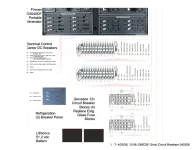
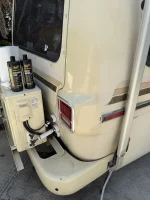
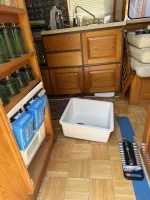
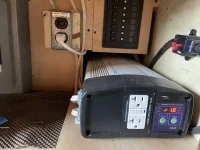
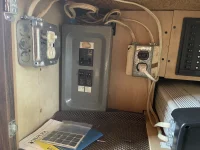
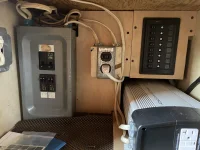
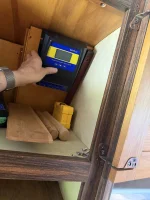
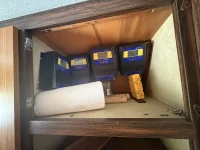
When I bought the coach there were only two ways to charge the batteries, the 12v 60 or 80 amp engine driven alternator with the dumb internal regulator or shore power with this
View attachment 186362000W/16.5A charger. These are woefully inadequate to charge the new battery banks. They were also very stupid.
The new battery bank are:
Diehard 800CCA 12v 100ah 1,200 wHr
(10) BattleBorn GC2 12v 100ah 12,000 wHr
(2) Lithionics 51.2v 150ah 15,360 wHr Total 28,560 wHr
future
(3) Lithionics 51.2v 150ah 23,040 wHr Total 36,240 wHr
THIS IS A LOT OF BATTERY STORAGE.
A Tesla Powerwall3 is: 13,500 wHr
We are adding solar to the shore power and alternator charging sources and introducing a 51.2v system to the coach.
The most difficult is to engineer the 12v system due to the required larger currents required than the 51.2v system.
Charging Sources:
Solar: 1.470 watts 122.5 amps
Balmar 12v 160 amp alternator 1,920 watts 160 amps
Balmar 12v 160 amp alternator (reduced to 75%) 1,920 watts 120 amps
Victron MultiPlus II 120 amps
So all of the wiring, breakers, fuses and other components on the charging side of the charging side had to be upgrade to a minumum of 120 amps . I set a criteria of 150 amps.
The other issue is how to determine which source of charging that should be use and when. Once the sequence is determined, how would which charging source be selected?
I certainly did not want to be the one making the selection, so what to do.
The answer is multiple automated transfer switches (ATS) but not of the normal variety.
The normal ATS is usually the switch between grid power and back up generator. Shen grid power fails, the switch turns on the generator and when the current from the generator is stable the ATS switches to it. That is how our Onan works.
I need a different type of ATS and such a device has been designed and manufactured. I think that this is the result of off grid systems often with back up battery banks. Such systems need to be protecting the battery banks.
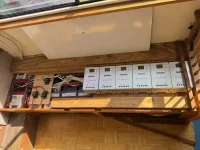
View attachment 18637
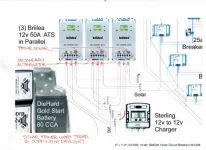
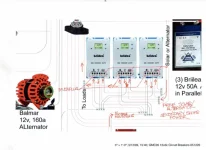
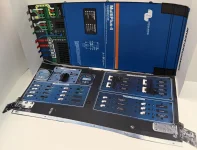
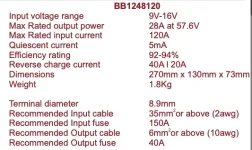
There are (2) sets of (3) 50 amp ac/dc smart ats wired in parallel to provide the 150 amp capacity.
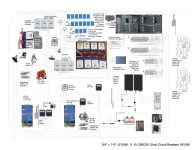
View attachment 18638
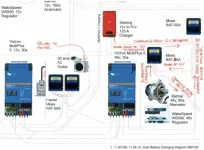
In the upper left corner of the overall electrical you can see the (2) sets of white 12v 50amp smart ATS.
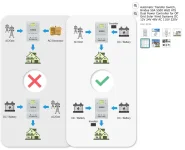
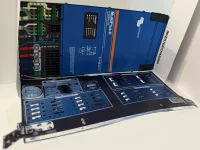
View attachment 18639
As you can see, this ATS can function an AC/AC or DC/Dc transfer switch but not an AC/DC transfer switch.
It can determine whether the source is ac or dc and can also determine the voltage. The units are limited to a maximum of 50 amps and therefore require 3 in parallel to provide 150 amp capacity.
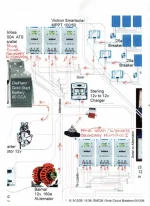
View attachment 18640
The initial automatic selection is between solar and alternator sources.
View attachment 18641
If the sun is out, there will be current from the solar panels and the current will be variable based upon the time of day, the day of the year and the latitude of the coach's position. The current will also vary based upon the cloud cover.
Is there a point when the solar radiation current is too small?
Are you driving and the 455 is running?
Well this ATS provides the capacity to make the decision. Instead of just working o the presence of power, this ATS works based upon upper and lower levels of current that can be be set. Therefore one can program when to switch when the current from the alternator is much stronger than the current from the solar panels.
Therefore, when the engine is running and the sun is down, the charging comes from the alternator. At dusk and dawn, the solar radiation may be too weak to provide sufficient current and the alternator is still providing the battery charging.
At some point the current from the solar panels will reach a level when the current from the alternator is no longer needed and the ATS switches to solar charging.
Also, when the sun is up, the driving lights are no longer needed and when the sun gets high, the dashboard 12v air conditioning load increases. At least the solar panels will be converting about 23% of the roof solar radiation to electrical power, simultaneously providing air conditioning power and lower solar radiation load to the coach's interior.
But what is the engine is not running and the coach is near "shore power"?
View attachment 18642
Now is the tile when the system has to choose between "shore power" and solar power.
Again, we might want to have the system favor solar power over shore power during the sunlight hours. Again we can set this with the 2nd set of ATS switches. Lets use the solar power as much as possible when connected to 'shore power".
What do we do if we are camped and there is no shore power?
Now we are entirely dependent on solar power and the capacity of the battery banks.
For the actually electrical use, all light is LED and the most efficient refrigerator, freezer and hvac system are installed. Indel says that the Combi refrigerator/freezer normally uses only 680 watts in a 24 hour period and even about 30% less when their compressor regulating system is installed.
The YMGI mini-split heat pumps have a SEER of 33 when powered by solar.
So what happens when we are boondoggling without shore power?
We could always run the engine in a pinch, if solar collection is not sufficient. After all, the Onan is using the same gasoline that fuels the 455.
But what is we can increase the solar collection?
View attachment 18643
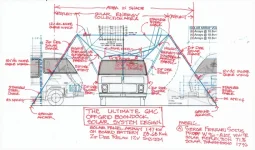
What is the awnings can be modified to slope upwards.
With this configuration, the awnings provide greater shade area. the awnings are further stabilized with ground anchors.
The cable winches adjust the angle of the awnings with 12v cable winches to maximize solar collection.
With the ground anchos, the awning can tolerate greater wind pressure and can be left out longer to collect rain water.
In the end, all of these design decisions will still remain theoretical until the system is fully install and tested over a long period of time. I am certain that there may be problems, failures and/or underperformance.
This discussion is primarily revolving around battery charging.
i am really anxious to see how this all works!
An added feature is that the total design with a 3rd Lithionics battery is nearly equal to the capacity of (3) Tesla PowerWalls.
Since the (2) Victron MultiPlus II units are also inverters, they could supply 30 amps each to my house. My coach will always be parked by my house when I am not using it, so maybe when we are not on the move, the coach may be able to provide all of the power necessary for my house. After all, it may have more capacity than the emergency generator that are already installed.
In another post, I will go through the 51.2 volt charging system.