Sailor Man's Coach: Then & Now

HVAC guy came yesterday and verified that there is refrigerant in the system. However, the system did not start up. We are getting Code 6 & 7 errors which seem the be related to communication issues not power. Working on it.. Me HVAC said that it should start up if we get the communications right.
Found out that the 3 wire communications cable was never installed and that harness is missing. We had to wire the units ourselves and the two heat pumps started up and ran great.
It was around 74° today, so we had to set the temperature down to 68°. They ran strong, cold and quietly.
The only fly in the ointment was that one of the outside compressor units had a label that said that is was 24 volts not the 48 volts we are providing. We took the units enclosure off and verified that all of the components are 48 volt.
Can you believe that someone put the wrong label on!
Calling up the hvac guy to top off the refrigerant and fine tune the system.
I can't believe how cold the air is and how quiet.
It is a dream fulfilled.
 
View attachment 18349
I am color coding each breaker and will be using harness with Anderson connectors. Each breaker capacity is identified. These are not switches. If a breaker overloads and breaks the circuit, just push down on the white dot and the breaker will reset.
I forgot to mention that those black rectangles above the white breaker buttons are actually white letter on black labels, so that each circuit can be identified. No looking up for a list somewhere.
 
Calling up the hvac guy to top off the refrigerant and fine tune the system.
I can't believe how cold the air is and how quiet.
It is a dream fulfilled.
You've anticipated this day for many years, the completion of your mini-split house + cockpit A/C system that's all DC-powered. Congrats!
 
I forgot to mention that those black rectangles above the white breaker buttons are actually white letter on black labels, so that each circuit can be identified. No looking up for a list somewhere.
1777128194992.webp
I am in the process of assigning the destination and breaker capacities all of the new 12vdc breakers in my coach.
 
I have been thinking about how to make the exterior of my coach look better.

In the 50's & 50's, the vehicle paint was much different and we were so much younger then.

We would wash our cars at least once a week and maybe use a combination compound + wax every 6 weeks or so. If we were really serious, we would first wash our car, then apply compound, wipe it off and then apply wax. If your car was looking somewhat dirty, no girl would look at you.

There was no metallic paint or clear coat. It was just elbow grease. Were there electric buffing machine then?

What makes us think that type of paint that is on our GMC Motorhomes was any different?

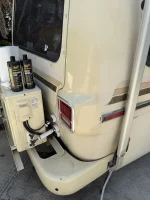
What wo=uld happen if I did a little test by using a very aggressive compound and then wax a small area as a test. What if the compound will remove the oxidized surface of the paint and expose the real original paint?

IMG_0493.webp
Wow!

I have done that to a small area around the tail light. This was done entirely by hand using paper towels. Certainly not the best way to go about things.

The mini-split was newly paint to match the coach about 3 years ago and has never been washed.

Same deal for the bumper cover, the new Mini split enclosures and the new supporting frame

.I am thinking that if I just inspect the coach and repaint just the areas with defects and then compound and wax the coach. This would certainly be much more coat effective.

what if I just compound the coach and get a clear wrap. My neighbor is now a commercial fisherman but for years had a business tinting. I ask him how much it would cost and how long it would last.

He said $7,000 to $8,000 and should last at least 10 years.

Something to think about.
 
  • Like
Reactions: Kendra
I have been thinking about how to make the exterior of my coach look better.

In the 50's & 50's, the vehicle paint was much different and we were so much younger then.

We would wash our cars at least once a week and maybe use a combination compound + wax every 6 weeks or so. If we were really serious, we would first wash our car, then apply compound, wipe it off and then apply wax. If your car was looking somewhat dirty, no girl would look at you.

There was no metallic paint or clear coat. It was just elbow grease. Were there electric buffing machine then?

What makes us think that type of paint that is on our GMC Motorhomes was any different?

What wo=uld happen if I did a little test by using a very aggressive compound and then wax a small area as a test. What if the compound will remove the oxidized surface of the paint and expose the real original paint?

View attachment 18399
Wow!

I have done that to a small area around the tail light. This was done entirely by hand using paper towels. Certainly not the best way to go about things.

The mini-split was newly paint to match the coach about 3 years ago and has never been washed.

Same deal for the bumper cover, the new Mini split enclosures and the new supporting frame

.I am thinking that if I just inspect the coach and repaint just the areas with defects and then compound and wax the coach. This would certainly be much more coat effective.

what if I just compound the coach and get a clear wrap. My neighbor is now a commercial fisherman but for years had a business tinting. I ask him how much it would cost and how long it would last.

He said $7,000 to $8,000 and should last at least 10 years.

Something to think about.
I've seen GMCs with the original Imron paint that had been buffed out and looked like a brand new paint job. The original Imron formulation was as good as paint gets, pretty much bulletproof.

As instructions always caution, start in a concealed spot. 😉
 
View attachment 18106
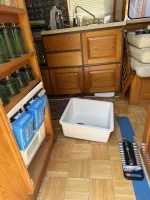
This is the latest version of the kitchen area. The photo illustrates how the counter extension should work.

The counter extension does not quite reach the table, so there is no instruction. I just need to make certain that it clears the cypress seat back as it swings up.

I am using a smaller sink as well.
IMG_0537.webp
The DuPont Corian cameo white sink just arrived along with the full length 1/2" matching corona counter and counter leaf extender.

The only problem was that to get one of these was that I had to order 3 of them. They would not sell them retail. They wanted to sell them only to contractors and custom kitchen people.

When this one is bonded to the corona countertop there will be no joints and cleaning will be very easy.

The other 2 sinks are still in their boxes. Is there anyone interested in them?
 
  • Like
Reactions: Kendra
When I bought the coach there were only two ways to charge the batteries, the 12v 60 or 80 amp engine driven alternator with the dumb internal regulator or shore power with thisIMG_1475.webp2000W/16.5A charger. These are woefully inadequate to charge the new battery banks. They were also very stupid.

The new battery bank are:

Diehard 800CCA 12v 100ah 1,200 wHr
(10) BattleBorn GC2 12v 100ah 12,000 wHr
(2) Lithionics 51.2v 150ah 15,360 wHr Total 28,560 wHr
future
(3) Lithionics 51.2v 150ah 23,040 wHr Total 36,240 wHr

THIS IS A LOT OF BATTERY STORAGE.

A Tesla Powerwall3 is: 13,500 wHr

We are adding solar to the shore power and alternator charging sources and introducing a 51.2v system to the coach.

The most difficult is to engineer the 12v system due to the required larger currents required than the 51.2v system.

Charging Sources:

Solar: 1.470 watts 122.5 amps

Balmar 12v 160 amp alternator 1,920 watts 160 amps
Balmar 12v 160 amp alternator (reduced to 75%) 1,920 watts 120 amps

Victron MultiPlus II 120 amps

So all of the wiring, breakers, fuses and other components on the charging side of the charging side had to be upgrade to a minumum of 120 amps . I set a criteria of 150 amps.

The other issue is how to determine which source of charging that should be use and when. Once the sequence is determined, how would which charging source be selected?

I certainly did not want to be the one making the selection, so what to do.

The answer is multiple automated transfer switches (ATS) but not of the normal variety.

The normal ATS is usually the switch between grid power and back up generator. Shen grid power fails, the switch turns on the generator and when the current from the generator is stable the ATS switches to it. That is how our Onan works.

I need a different type of ATS and such a device has been designed and manufactured. I think that this is the result of off grid systems often with back up battery banks. Such systems need to be protecting the battery banks.

IMG_0533.webp
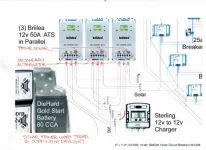
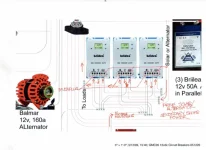
There are (2) sets of (3) 50 amp ac/dc smart ats wired in parallel to provide the 150 amp capacity. 1780485626704.webp
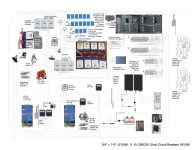
In the upper left corner of the overall electrical you can see the (2) sets of white 12v 50amp smart ATS.
1780486012023.webp
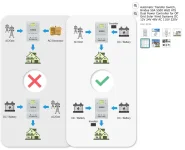
As you can see, this ATS can function an AC/AC or DC/Dc transfer switch but not an AC/DC transfer switch.

It can determine whether the source is ac or dc and can also determine the voltage. The units are limited to a maximum of 50 amps and therefore require 3 in parallel to provide 150 amp capacity.
1780486293300.webp
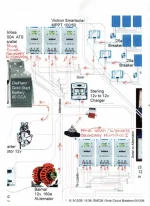
The initial automatic selection is between solar and alternator sources.
1780486373209.webp
If the sun is out, there will be current from the solar panels and the current will be variable based upon the time of day, the day of the year and the latitude of the coach's position. The current will also vary based upon the cloud cover.
Is there a point when the solar radiation current is too small?
Are you driving and the 455 is running?

Well this ATS provides the capacity to make the decision. Instead of just working o the presence of power, this ATS works based upon upper and lower levels of current that can be be set. Therefore one can program when to switch when the current from the alternator is much stronger than the current from the solar panels.

Therefore, when the engine is running and the sun is down, the charging comes from the alternator. At dusk and dawn, the solar radiation may be too weak to provide sufficient current and the alternator is still providing the battery charging.

At some point the current from the solar panels will reach a level when the current from the alternator is no longer needed and the ATS switches to solar charging.

Also, when the sun is up, the driving lights are no longer needed and when the sun gets high, the dashboard 12v air conditioning load increases. At least the solar panels will be converting about 23% of the roof solar radiation to electrical power, simultaneously providing air conditioning power and lower solar radiation load to the coach's interior.

But what is the engine is not running and the coach is near "shore power"?
1780487321354.webp
Now is the tile when the system has to choose between "shore power" and solar power.

Again, we might want to have the system favor solar power over shore power during the sunlight hours. Again we can set this with the 2nd set of ATS switches. Lets use the solar power as much as possible when connected to 'shore power".

What do we do if we are camped and there is no shore power?

Now we are entirely dependent on solar power and the capacity of the battery banks.

For the actually electrical use, all light is LED and the most efficient refrigerator, freezer and hvac system are installed. Indel says that the Combi refrigerator/freezer normally uses only 680 watts in a 24 hour period and even about 30% less when their compressor regulating system is installed.

The YMGI mini-split heat pumps have a SEER of 33 when powered by solar.

So what happens when we are boondoggling without shore power?

We could always run the engine in a pinch, if solar collection is not sufficient. After all, the Onan is using the same gasoline that fuels the 455.

But what is we can increase the solar collection?
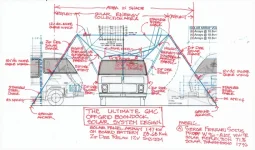
1780488176416.webp
What is the awnings can be modified to slope upwards.

With this configuration, the awnings provide greater shade area. the awnings are further stabilized with ground anchors.

The cable winches adjust the angle of the awnings with 12v cable winches to maximize solar collection.

With the ground anchos, the awning can tolerate greater wind pressure and can be left out longer to collect rain water.

In the end, all of these design decisions will still remain theoretical until the system is fully install and tested over a long period of time. I am certain that there may be problems, failures and/or underperformance.

This discussion is primarily revolving around battery charging.

i am really anxious to see how this all works!

An added feature is that the total design with a 3rd Lithionics battery is nearly equal to the capacity of (3) Tesla PowerWalls.

Since the (2) Victron MultiPlus II units are also inverters, they could supply 30 amps each to my house. My coach will always be parked by my house when I am not using it, so maybe when we are not on the move, the coach may be able to provide all of the power necessary for my house. After all, it may have more capacity than the emergency generator that are already installed.

In another post, I will go through the 51.2 volt charging system.
 
Last edited:
  • Love
Reactions: tmsnyder
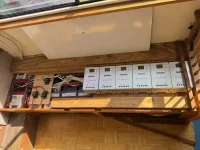
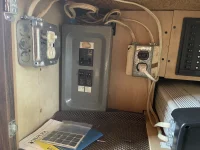
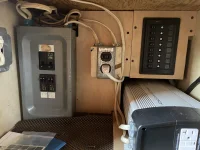
This is what the eledctrcal control center was like when I bought the coach.
IMG_1473.webp
Actually, I had already replaced the fuse block with an 8 circuit breaker panel.
IMG_1474.webp
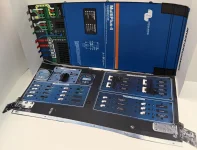
This is a mock up of the new electrical control center.
IMG_0575.webp
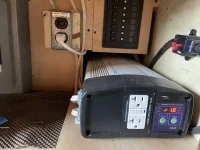
The Victron MultiPlus II is a much more powerful and intelligent inverter charger than the original unit.

Now all of the ac and dc circuits have circuit breakers instead of fuses.

There is a remote 48v MultiPlus II inverter/charger for the 51.2v system.
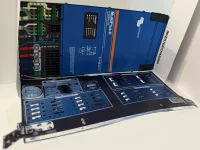
IMG_0577.webp
This is a mock up of the new electrical control center.

I apologize that I had to resort to this paper mock up after I failed to put the MultiPlus II into place. I dropped it on my fingers causing severe lacerations resulting in 14 stitches om nothing middle fingers.

Since this is in the lower cabinet just above the air pump, the location of the panels is better suited to looking down on it. I tis also hinged to rotate 180° forward to access the wiring and components at the rear of the panel.

In other posts, I have already detailed how this electrical center is supposed to work but I wanted to give you a view of how it will be when the installation is complete and functional.

There has been a lot of trips up blind canyons before we got to this point.
 
  • Like
Reactions: Kendra
It's also hinged to rotate 180° forward to access the wiring and components at the rear of the panel.
Why that's not a standard feature I'll never know. The "well, you shouldn't have to get to it" mentality is short sighted to put It charitably. I'm glad you're thinking of your and future owner's access. 🫡

The Birchaven has the breaker box and converter charger in the cabinet under the refrigerator. You have to lie down on your side to see the fuses and work on it. The refrigerator is above the wheel well so the cabinet is also very shallow.

The dash is another electrical access pain in the ass. One guy in Connecticut had reworked all of the passenger side front hatch, glove compartment and dash electrical to move it inside under a new passenger side dash. Remove the top horizontal panel (made a dandy little desk) and all of the electrical stuff was right there. You could sit in the passenger seat and do whatever you needed in comfort and out of the weather.
 
When I bought the coach there were only two ways to charge the batteries, the 12v 60 or 80 amp engine driven alternator with the dumb internal regulator or shore power with thisView attachment 186362000W/16.5A charger. These are woefully inadequate to charge the new battery banks. They were also very stupid.

The new battery bank are:

Diehard 800CCA 12v 100ah 1,200 wHr
(10) BattleBorn GC2 12v 100ah 12,000 wHr
(2) Lithionics 51.2v 150ah 15,360 wHr Total 28,560 wHr
future
(3) Lithionics 51.2v 150ah 23,040 wHr Total 36,240 wHr

THIS IS A LOT OF BATTERY STORAGE.

A Tesla Powerwall3 is: 13,500 wHr

We are adding solar to the shore power and alternator charging sources and introducing a 51.2v system to the coach.

The most difficult is to engineer the 12v system due to the required larger currents required than the 51.2v system.

Charging Sources:

Solar: 1.470 watts 122.5 amps

Balmar 12v 160 amp alternator 1,920 watts 160 amps
Balmar 12v 160 amp alternator (reduced to 75%) 1,920 watts 120 amps

Victron MultiPlus II 120 amps

So all of the wiring, breakers, fuses and other components on the charging side of the charging side had to be upgrade to a minumum of 120 amps . I set a criteria of 150 amps.

The other issue is how to determine which source of charging that should be use and when. Once the sequence is determined, how would which charging source be selected?

I certainly did not want to be the one making the selection, so what to do.

The answer is multiple automated transfer switches (ATS) but not of the normal variety.

The normal ATS is usually the switch between grid power and back up generator. Shen grid power fails, the switch turns on the generator and when the current from the generator is stable the ATS switches to it. That is how our Onan works.

I need a different type of ATS and such a device has been designed and manufactured. I think that this is the result of off grid systems often with back up battery banks. Such systems need to be protecting the battery banks.

View attachment 18637
There are (2) sets of (3) 50 amp ac/dc smart ats wired in parallel to provide the 150 amp capacity. View attachment 18638
In the upper left corner of the overall electrical you can see the (2) sets of white 12v 50amp smart ATS.
View attachment 18639
As you can see, this ATS can function an AC/AC or DC/Dc transfer switch but not an AC/DC transfer switch.

It can determine whether the source is ac or dc and can also determine the voltage. The units are limited to a maximum of 50 amps and therefore require 3 in parallel to provide 150 amp capacity.
View attachment 18640
The initial automatic selection is between solar and alternator sources.
View attachment 18641
If the sun is out, there will be current from the solar panels and the current will be variable based upon the time of day, the day of the year and the latitude of the coach's position. The current will also vary based upon the cloud cover.
Is there a point when the solar radiation current is too small?
Are you driving and the 455 is running?

Well this ATS provides the capacity to make the decision. Instead of just working o the presence of power, this ATS works based upon upper and lower levels of current that can be be set. Therefore one can program when to switch when the current from the alternator is much stronger than the current from the solar panels.

Therefore, when the engine is running and the sun is down, the charging comes from the alternator. At dusk and dawn, the solar radiation may be too weak to provide sufficient current and the alternator is still providing the battery charging.

At some point the current from the solar panels will reach a level when the current from the alternator is no longer needed and the ATS switches to solar charging.

Also, when the sun is up, the driving lights are no longer needed and when the sun gets high, the dashboard 12v air conditioning load increases. At least the solar panels will be converting about 23% of the roof solar radiation to electrical power, simultaneously providing air conditioning power and lower solar radiation load to the coach's interior.

But what is the engine is not running and the coach is near "shore power"?
View attachment 18642
Now is the tile when the system has to choose between "shore power" and solar power.

Again, we might want to have the system favor solar power over shore power during the sunlight hours. Again we can set this with the 2nd set of ATS switches. Lets use the solar power as much as possible when connected to 'shore power".

What do we do if we are camped and there is no shore power?

Now we are entirely dependent on solar power and the capacity of the battery banks.

For the actually electrical use, all light is LED and the most efficient refrigerator, freezer and hvac system are installed. Indel says that the Combi refrigerator/freezer normally uses only 680 watts in a 24 hour period and even about 30% less when their compressor regulating system is installed.

The YMGI mini-split heat pumps have a SEER of 33 when powered by solar.

So what happens when we are boondoggling without shore power?

We could always run the engine in a pinch, if solar collection is not sufficient. After all, the Onan is using the same gasoline that fuels the 455.

But what is we can increase the solar collection?
View attachment 18643
What is the awnings can be modified to slope upwards.

With this configuration, the awnings provide greater shade area. the awnings are further stabilized with ground anchors.

The cable winches adjust the angle of the awnings with 12v cable winches to maximize solar collection.

With the ground anchos, the awning can tolerate greater wind pressure and can be left out longer to collect rain water.

In the end, all of these design decisions will still remain theoretical until the system is fully install and tested over a long period of time. I am certain that there may be problems, failures and/or underperformance.

This discussion is primarily revolving around battery charging.

i am really anxious to see how this all works!

An added feature is that the total design with a 3rd Lithionics battery is nearly equal to the capacity of (3) Tesla PowerWalls.

Since the (2) Victron MultiPlus II units are also inverters, they could supply 30 amps each to my house. My coach will always be parked by my house when I am not using it, so maybe when we are not on the move, the coach may be able to provide all of the power necessary for my house. After all, it may have more capacity than the emergency generator that are already installed.

In another post, I will go through the 51.2 volt charging system.
We can now talk about the ATS system for charging the 51.2vdc battery bank.
IMG_0418.webp
This is a Moes 50 amp smart ATS to control the charging of the Lithionics batteries.
IMG_0420.webp
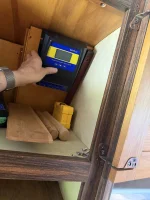
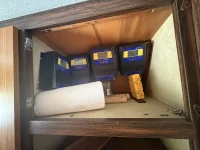
4 of them can fit in the top compartment over the electrical control center.

Since these can handle switching of both ac and dc currents, having direct access to them is essential. They all need to be programed and I will probably have to play with the programming after the system is fired up.

The 51.2v battery bank has 3 sources of charging power:
Balmar 48v 60 amp throttled back 25% 45 amps
MultiPlus II 30 amps
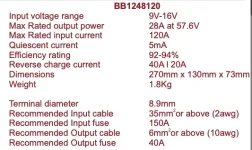
Sterling BB1248120 (fr BattleBorn 12v bank) 28 amps

1780848088025.webp
Therefore all of the wiring and fusing is using 50 amps of current from all of the charging sources.

This means much smaller wiring sizes than we are used to seeing and working with. This is one of the obvious benefits of using higher voltages.

Only (2) of the Moes ATS are used for charging the Lithionics batteries. The other two are bi=eing used for choosing whether the 12v BattleBorn Battery Bank or the 51.2v Littionics battery bank will be used to power my house.

THE FLY IN THE OINTMENT:
The Sterling BB1248120 is bidirectional which means that:
The BattleBorn 12v 1000aH Battery Bank may charge the Lithionics 51.2v Battery Bank
or
The Lithionics 51.2v Battery Bank nay charge the BattleBorn 12v 1000aH Battery Bank

Haven't work that one out yet!

1780848876185.webp
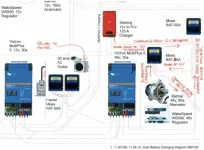
The circuiting is design to have the batteries charged by the Balmar if the 455 is running.

If the 455 is not running the shore power will be charged by shore power via the MultiPlus II charger if shore power is connected.

If the engine is not running and shore power is not connected, the only source of chat=rging power is the 1000 aH BattleBorn batteries and could be the solar panels during the day if the BattleBorn Battery Bank is 100% charged,

Another possibility is the the Litionics 51.2v battery bank amy back up the 12v BattleBorn Battery Bank for 12v loads without a 51,2v to 12v converter.

Much of this will have to be worked out after the systems are fully operational.

Things will change from day to day.

During six months of the year, neither cooling or heating will be necessary for the coach. That happens during the transition from summer air conditioning to winter heating. Since the Lithionics 51.2v Battery Bank is only driving the YMGI mini-splits, where does the Lithionics Battery power go?

It will be very interesting to see how this all works out over a years operation.

Can my house go permanently off-grid?

FPL charges a minimum of $75/mo just to be connected to the grid and you work it off by using $75 of power first. FPL does not allow you to sell unused solar power back to it in excess of your bill and the meter goes back to zero every January 1st.