Drinking the Koolaide... 😊

  • Please note, the forum recently had a problem with outbound emails for notifications, registrations, etc. A new email provider has been set up which should resolve all email issues. If you have any further trouble, please DM Christo or reach out via the Contact Us link in the website footer.
Now I'm torn; I was going to install my transfer switch into the shore-power/water cubby on the backside of the breaker box, with a short run of 6/4 into that box and 6/3 from the 4KW inverter (wired like the Onan outlet). But if I move things around like Paul (pvfjr) did, I might have enough room to put the switch in the cabinet, simplifying routing the 6/3 from the inverter (currently living under the rear bed with the batteries). I may have to purchase the upgrade breaker box/12v fuse panel (same as used by Kendra) to test fitment with the transfer switch.
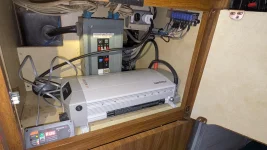
1764608576124.webp
(picture "borrowed" from Paul's post for reference)

Or, give up on the Onan, remove it, move batteries and inverter to that location, and leave the electrical panel as is for now; no transfer switch.....

I'm torn..... :ROFLMAO:
 
My solution was a lot of work, but I'd do this again if I needed to.

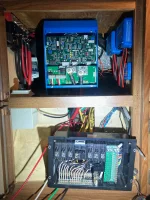
Victron with WFCO fuse panel.webp

Drawer track above needs to be temporarily removed to install a Victron MultiPlus 24/3000/70 (smaller inverter is obviously easier). Wood panel above flexes just enough to tilt the Victron into the cabinet, then it clears with a slight gap above. Access to some components isn't ideal but it all fits.

If anyone else goes this route, remember to attach the Victron enclosure's chassis ground when it's easier to reach.

I added a trim panel around the WFCO breaker/fuse panel.
 
Last edited:
  • Like
Reactions: dsmithy
Hoping to finish wiring the 110VAC systems this weekend. The plan is to put the heat-pump and induction cooker on one leg of the 50A wiring and the combo microwave/convection/air-fryer on the other to balance everything. The house 110VAC outlets won't get used much nor have large loads, so I will probably keep those on the microwave side of the breaker box.

I'm going with the fast and simple installation; 6/3 Romex from inverter, through a hole in the services cubby, then into a "free-floating" NEMA1450 outlet box. Jumper L1/L2 with a 6ga wire in the outlet. Then just plug the shore-power plug into the new outlet.

UPDATE:
Success! While the heat-pump was working last summer via a direct wired connection (bypassing the breaker box) for testing, the inverter is now properly wired directly to the breaker box and the wires are hidden. Now to connect the 80A lithium charger and plug-in somewhere to get some power back into my batteries (PNW late fall and winter doesn't provide much energy...).
 
Last edited:
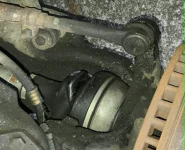
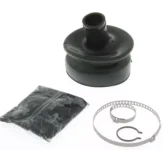
That looks like the outer CV boots you're needing. I don't know where to source an inner, but I've used these Dorman ones for the outer boots:
 
That looks like the outer CV boots you're needing. I don't know where to source an inner, but I've used these Dorman ones for the outer boots:
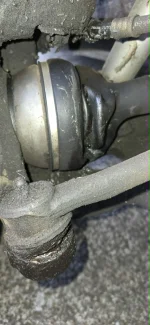
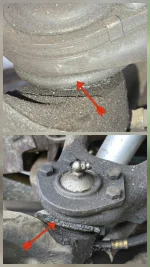
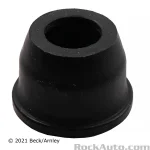
I updated the original post with the items suggested by Kelvin; NAPA CV boot and Rock Auto rubber ball joint boot.
 
Jim K. has the inner boots.
I haven't seen an inner boot that has rip open but, never say never.

Try to find the outer boot with more than one rib, they seem to outlast the one rib design.
Don't clamp the inner diameter of the boot to the axle so the boot can rotate and not twist up as they sometimes do.
 
  • Like
Reactions: pvfjr
Try to find the outer boot with more than one rib, they seem to outlast the one rib design.
X2 on that one. IMHO the Dorman 614-003 one seems less problematic than the Napa one for the outers. You'll notice it's the "newer style". I think there's a reason all boots look like that these days. Those single rib ones seem to get themselves in a bunch too easily. Those were kinda the early days of CV boots.

Something about the inners does tend to make them last forever though. Maybe it's just the limited range of motion combined with good materials.
 
Something about the inners does tend to make them last forever though. Maybe it's just the limited range of motion combined with good materials.

Speaking with a guy at the last international in Traverse City, he replaced his inner boot with one from a more modern 3/4 or 1 ton chevy truck front axle and showed me pictures, it looked great!
 
  • Like
Reactions: pvfjr
Speaking with a guy at the last international in Traverse City, he replaced his inner boot with one from a more modern 3/4 or 1 ton chevy truck front axle and showed me pictures, it looked great!
That's good to know. I'll have to see if I can find a part number somewhere. My '68 Toronado has both inner boots torn, as the PO pulled the engine, let the trans/final drive sag, and dragged the thing around the yard while the boots were grinding on crossmembers and such. :(
 
That's good to know. I'll have to see if I can find a part number somewhere. My '68 Toronado has both inner boots torn, as the PO pulled the engine, let the trans/final drive sag, and dragged the thing around the yard while the boots were grinding on crossmembers and such. :(

I wish I'd taken better notes, year, model etc.
 
Hopefully, I don't jinx this....

Wonder of wonders, my parking pawl started to work! For some unknown reason, my coach now holds position when I engage "Park". I still use the parking brake as I don't trust the pawl yet, but places I usually roll are now stable....
 
  • Like
Reactions: pvfjr
Hopefully, I don't jinx this....

Wonder of wonders, my parking pawl started to work! For some unknown reason, my coach now holds position when I engage "Park". I still use the parking brake as I don't trust the pawl yet, but places I usually roll are now stable....
Definitely trust with caution. My Glenbrook parking pawl has always been 100% reliable. On my Palm beach, sometimes it works and sometimes it doesn't. This has been with two different transmissions, and has been similarly unreliable. I don't think it is the transmissions, but rather, related to something in the linkages/column.

If I calibrate my linkages to the neutral position as described in the service manual, I won't have park. If I disconnect linkages and manually put the transmission lever in park, it works fine. It seems as though the column isn't providing enough travel to get from the calibrated neutral point all the way to park. Something is off. It was in a front end collision, so maybe that's related. I may have to measure a bunch of things and see if something is awry geometrically speaking.

For your transmission, have you run through the adjustment procedure in the manual?
 
Definitely trust with caution. My Glenbrook parking pawl has always been 100% reliable. On my Palm beach, sometimes it works and sometimes it doesn't. This has been with two different transmissions, and has been similarly unreliable. I don't think it is the transmissions, but rather, related to something in the linkages/column.

If I calibrate my linkages to the neutral position as described in the service manual, I won't have park. If I disconnect linkages and manually put the transmission lever in park, it works fine. It seems as though the column isn't providing enough travel to get from the calibrated neutral point all the way to park. Something is off. It was in a front end collision, so maybe that's related. I may have to measure a bunch of things and see if something is awry geometrically speaking.

For your transmission, have you run through the adjustment procedure in the manual?
Last year or 2023, I forget. The local transmission shop adjusted it. I went from no pawl to hearing a click when rolling in Park (so I stopped trying). Now, many months later, I suddenly have a parking pawl. Just happened this weekend.
 
  • Like
Reactions: pvfjr
Last year or 2023, I forget. The local transmission shop adjusted it. I went from no pawl to hearing a click when rolling in Park (so I stopped trying). Now, many months later, I suddenly have a parking pawl. Just happened this weekend.
Interesting, it sounds like we're in the same boat! I'll let you know if I get to the bottom of my issue. Perhaps there is a worn part causing us to lose some of our throw. I'll take some measurements off the Glenbrook while I still have it, since it has always worked perfectly. I almost wonder if there aren't some lever-length disparities or something weird going on.
 
Going back to an earlier "upgrade" that needs revisiting....

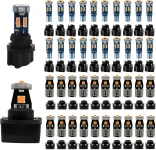
I replaced the instrument lights with LEDs. They don't dim. I was looking at a PWM dimmer via voltage control (the stock dimmer on the headlight switch provides a 3v range), but noticed there are bulbs listed as "dimmable". Anyone using dimmable LEDs in their coach? If so, what did you purchase? I'm looking at these on Amazon
1765901734850.webp

UPDATE:
They work! Now my instruments are the same color as the original bulbs and dim properly. Amber lights are easier on the eyes at night than the white LEDs I had originally installed.
 
Last edited:
I've never found instrument panel LEDs with full-range dimming. It's possible newer versions can do this, but I tried several types of LEDs in dashboards in the past (not on an GMC) and was disappointed, went back to incandescent.

SuperBrightLEDs.com sells quality products with excellent service, although prices are higher than you'll find on Amazon. Their instrument panel LEDs don't claim to be dimmable - probably because they are honest about performance.
 
I've never found instrument panel LEDs with full-range dimming. It's possible newer versions can do this, but I tried several types of LEDs in dashboards in the past (not on an GMC) and was disappointed, went back to incandescent.

SuperBrightLEDs.com sells quality products with excellent service, although prices are higher than you'll find on Amazon. Their instrument panel LEDs don't claim to be dimmable - probably because they are honest about performance.
I guess I'll buy them and report back.... 😁
 
The dimmer control in the headlight switch is just a plain old variable resistor. The value of this variable resistor was chosen base on the total current requirements of all the incandescent lamps that it is powering in the dash. Since LEDs take about 1/10th of the current, the voltage drop across the dimmer resistor is going to be very low, hence the LEDs will dim very little.

You could put a power resistor across the feed to the LEDs to increase the load back to near what it was with incandescent bulbs, but that would defeat the purpose of going to LEDs. A PWM controller would be a good fix.
 
The dimmer control in the headlight switch is just a plain old variable resistor. The value of this variable resistor was chosen base on the total current requirements of all the incandescent lamps that it is powering in the dash. Since LEDs take about 1/10th of the current, the voltage drop across the dimmer resistor is going to be very low, hence the LEDs will dim very little.

You could put a power resistor across the feed to the LEDs to increase the load back to near what it was with incandescent bulbs, but that would defeat the purpose of going to LEDs. A PWM controller would be a good fix.
Yup. I may try a voltage controlled PWM if these aren't actually dimmable (I mean, they might have a tiny PWM-on-a-chip on each bulb; they cost enough).