Drinking the Koolaide... 😊

  • Please note, the forum recently had a problem with outbound emails for notifications, registrations, etc. A new email provider has been set up which should resolve all email issues. If you have any further trouble, please DM Christo or reach out via the Contact Us link in the website footer.
When sizing an inverter, remember the bigger the inverter, the higher the standby power consumption is. If you are running something like a heat pump and need the power for that, you may want to consider a much smaller one for the TV, charging cell phones, CPAC etc. to save power when the heat pump is not being used.
 
When sizing an inverter, remember the bigger the inverter, the higher the standby power consumption is. If you are running something like a heat pump and need the power for that, you may want to consider a much smaller one for the TV, charging cell phones, CPAC etc. to save power when the heat pump is not being used.
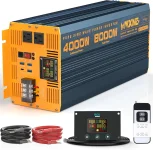
Indeed. The purpose of this inverter will be to run the heat pump, microwave, and perhaps an induction cooktop. That is the reason for remote on/off capability. Most everything else runs from DC. Small draws probably won't even activate the inverter. :LOL:

Once I have a large enough draw on my battery, I can get a better handle on my recharge time (I'm currently so over-provisioned that I am fully recharged early in the morning; I haven't seen my maximum power production capability). My first "hot" camping experience with the new setup happens mid-July. Then I will see how long the battery can last and how many more I will need.
 
Last edited:
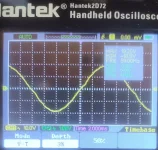
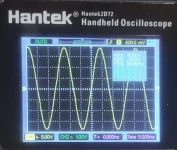
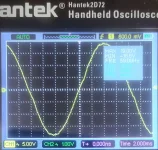
Waveforms...
1000005069.webp1000005067.webp1000005068.webp
Looks Good! Draws 33W parasitic in standby, but the remote panel shut-off takes it down below measurable values (even on one battery that parasitic load would take 100 hours to drain the battery, and that's not considering solar input). Boiled water in an electric kettle (1095W) and ran the microwave (1800W) for 3 minutes; fan never came on.

No change in the waveform in standby or under load.
 
Last edited:
  • Like
Reactions: pvfjr
Unless you just want a "don't do as I do" story, you can ignore this post....

Minor setback (major headache)...

I know just enough to be dangerous... 🤣

My solar setup took out my fridge, freezer, and inverter. My fault. I took the word of the battery manufacturer (both in the manual and over the phone) for how to program the charge controller. I set the charge voltage too high (14.5v) and caused the BMS in the battery to disconnect the battery from the charger (the cells were out of balance; one cell went over 3.7v, the upper limit for these cells). This resulted in the charger dumping the full array voltage onto the DC bus, over-volting (80V approx.) the equipment connected to it.

The good news; the designers of the fridge and freezer built a zener diode into the control boards. Its failure-mode in a voltage-spike situation is a short-circuit. As it was wired between the positive and negative battery connections, it shorted them out, blowing their fuses. Replacing those diodes and fuses got the units functional again.

The bad news, the inverter went up in a puff of soot. But, that appears to be handled as well.

So far, my out-of-pocket expenses for this learning experience are only $11 (for diodes and shipping; I bought a few spares just in case).

I have now programmed the MPPT charge controller to a more conservative setting (13.6v charging, 13.4v "float"). The cells will still get fully charged (OK, probably 99%) and the BMS should never have to disconnect the battery again.šŸ¤ž

What a week....

Update!
Ordering a Victron 150/70 MPPT controller. My inexpensive (under $200) BougeRV/HQST controller just cooked a test 100Ah battery. On a positive note, it's true that LiFePo4 batteries don't explode; but they DO create a lot of heat... Now to clean every surface in the coach of a greasy residue left from the smoke. And lots of laundry....

Apparently, the lower-priced solar charge controllers exhibit the functions I indicated and all will fail the same way if disconnected from the battery by the BMS. More expensive controllers pull their operating power from the solar array once they establish they have a battery connected. So, while they will lose power when the panels are no longer producing, there is also no power to damage equipment once the panels are no longer producing....šŸ˜ŽšŸŒž
 
Last edited:
  • Like
Reactions: pvfjr and dsmithy
Yeeeouch. I'm glad I converted shore power to solar as well, but this involves a surprising number of things to piece together and adjust.
 
Yeeeouch. I'm glad I converted shore power to solar as well, but this involves a surprising number of things to piece together and adjust.
I seem to be of the school that thinks; "sure, I can throw money at it and get the best solution with the least headaches, but I want to see what I can get working on the low-end with much brain-cell burning..." I LIKE projects. I LIKE to customize... I own a GMC Motorhome... 🤣

Plus, you've got to SHOW me why I should pay more for the "same" components from name-brand manufacturers. I hear Victron doesn't dump the array voltage onto the bus if the battery disconnects (most controllers do), but I haven't seen that documented....

Update:
I bought the Victron... Live and learn...
 
Last edited:
Tested the 15K BTU roof-top heat-pump using the 4KW inverter and 280Ah (3584Wh) battery. It starts and runs! In "Turbo" mode (fan and compressor both at "high") I should get around 3.5 hours running non-stop. Hopefully, the compressor will cycle and I will also use a lower setting to increase my duration.

The inverter was drawing 950-1125W from the battery in Turbo (around 260W at lower settings and only 65W with just the fan). With 900W of solar on the roof (effectively 750W real-world), at the hottest part of the day most of the power requirements can be met from the panels, increasing the time the system can run. Plus, I will have a second battery on Monday, doubling everything.

I will completely test the system in the real world the weekend of the 11th.
 
Last edited:
Second battery arrived as well as the new solar charge controller. Installed the fridge and freezer after repair. Ran the AC for multiple hours from battery. I will most likely have to utilize my ground-deployed solar "blankets" in addition to my rooftop panels to help extend the batteries, although I still had 61% charge when I parked the coach in storage at 8PM last night. Everything is unplugged/unhooked to avoid a repeat of my latest debacle, although the new Victron solar controller (SmartSolar 150|70) should remedy the issue. I'll verify this weekend (clean-up before camping the following weekend).

I wasn't confident enough in the success of my plan to go all-in from the start. If I was starting over, I'd use the new miniature 280ah/300ah batteries that have come onto the market instead of the large batteries I have. I would also go 24v or 48v instead of 12v (since the fridge and freezer will operate at 24v, 24v probably makes more sense than 48v) and use a buck converter for the circuits that require 12v. That lets you use a less expensive charge controller (150|35) and smaller gauge wiring. That's the difference between building in stages vs. investing in a complete system at the start.... 🤣 šŸ˜–

Now to build a battery box and install various circuit breakers for protection.
 
Last edited:
I've been watching and admiring your progress. My 2022 solar installation was a mixture of good and bad decisions, mostly successful but I picked 12v and wish I'd hit the 24v buy button. I now consider 24v the minimum for this grade of solar but still glad I have what I have. You'll enjoy silent boondock power.
 
Moved some of the solar components around now that I'm integrating that system into the house electrical system. Finalized my solar entry wiring (no more wires passing through at the top of the entry door):

Replaced the vent cap over the kitchen plumbing vent. Pushed through the sealing caulk around the PVC pipe and dropped two 10ga "solar" wires through. Protected the wires by installing a flexible plastic grommet over the aluminum cutout edge. Drilled two 1/4" holes in the side of the vent cap for those wires.​

Ran the AC from batteries from 11AM to 6PM (when the coach went back into storage).

Batteries started at 60% (disconnected since the last test) and finished at 30%. I realized approx. 750W from a theoretical maximum of 900W of panels, plus added my ground deployed panels (theoretical 600W max; probably 350W in reality) to assist. At current usage I could have potentially achieved another 5-6 hours of operation before depleting the batteries completely (probably less as the solar offset would decease in the evening), but the air outside was cooling off and becoming pleasant anyway.

The batteries will live under the rear bed near the generator. The solar charge controller will be mounted low in the closet on the wall in front of the generator. The inverter will be mounted near the batteries under the bed, close to the existing house electrical panel. For now I will disconnect all external sources (a transfer switch will be installed at a later date, but I primarily boondock) and wire the inverter into the breaker panel at the main input. I will have to convert from 50A to 30A service. Or, I might simply swap the connections at the 6K generator outlet and keep the 50A box until I'm ready to re-wire.

UPDATE:
Changed from 30 amp transfer switch to 50 amp transfer switch. Turns out my inverter can output 45 amps. So, I don't have to change anything in the breaker panel for the time being; just add the transfer switch at some point.
 
Last edited:
  • Like
Reactions: Kendra
Time to complete the solar integration.
  • 50 amp automatic transfer switch purchased.
  • 10/3 stranded "romex" purchased.
  • Battery tie-down straps ordered.
  • Various circuit-breakers for the solar system obtained (installing tomorrow).
In about a week I should have the inverter connected to the house breaker panel via the transfer switch. Then I should be able to forget about the solar systems entirely and get back to fabricating ceiling and wall panels. At some point I will replace the old breaker panel and DC fuse block with a combination panel.
1752078894694.webp
 
Last edited:
  • Like
Reactions: Kendra
Time to complete the solar integration.
  • 30 amp automatic transfer switch purchased.
  • 10/3 stranded "romex" purchased.
  • Battery tie-down straps ordered.
  • Various circuit-breakers for the solar system obtained (installing tomorrow).
In about a week I should have the inverter connected to the house breaker panel via the transfer switch. Then I should be able to forget about the solar systems entirely and get back to fabricating ceiling and wall panels. At some point I will replace the old breaker panel and DC fuse block with a combination panel.
View attachment 15552
Let me know what you think about your transfer switch once you get it in. I always thought the buzz-box in my Glenbrook was the old power converter. But once I installed my Xantrex converter/inverter, the buzzing didn't go away. It turned out to be the transfer switch all along! Just a constant hum--mildly annoying. I'm still using the generator outlet/plug combo on my Palm Beach, until I can figure out something better that doesn't break the bank.
 
  • Like
Reactions: Tybalt39
View attachment 14732
This is the solar array on my 26 foot coach. I also have the base drawing.
My rig with the toad.
This is a (15) panel SunPower semi flexible solar system applied directly to the roof with zero framing. Check out how to install this on https://www.gmcmotorhome.org/thread...-batteries-and-sailor-mans-lifepo4-build.982/
I have the drawings on my cadd system, including elevations, floor plans, sections, elevations, etc. You can copy any of my drawings on the thread.
image-webp.14733
Maybe I can get started on the solar installation next month if the hurricanes stay away. I have just completed the 70 gal alum gas tank, fuel delivery system and FiTech installation on my coach. I detailed it on So what did you do to your GMC today?
The engine is running great and I hope to get it back on the road soon.
 
  • Like
Reactions: tmsnyder
Let me know what you think about your transfer switch once you get it in. I always thought the buzz-box in my Glenbrook was the old power converter. But once I installed my Xantrex converter/inverter, the buzzing didn't go away. It turned out to be the transfer switch all along! Just a constant hum--mildly annoying. I'm still using the generator outlet/plug combo on my Palm Beach, until I can figure out something better that doesn't break the bank.
Will do! Just waiting on the return of the 30A to complete before ordering the 50A (too many returns bouncing back and forth; letting everything catch-up).
 
Success!

The 360° bird's eye view camera system is functional!

Rear view (no big deal by itself), front view, and both sides. Integrated into an overview and virtual 3D view. Also allows for showing just the combined left and right views (split-screen) going down the road to keep the vehicle between the lines. Of course, the representational vehicle isn't a GMC motorhome (there isn't even a van to choose). Someday I may have to try to find a community to customize this system (XDA Developers Forums perhaps?) to allow for custom graphics and measurements; the inexpensive system I picked as a test isn't intended for vehicles 26' long. There is still some tweaking to do (too much of the side of the coach is visible in the side cameras, one of the side cameras is reversed, etc.), but the firmware has provisions to customize the camera views. This was simply a proof of concept. The cameras were taped to the body. Once the weather warms-up, I will drill holes and affix them permanently, then spend time fine-tuning the views.

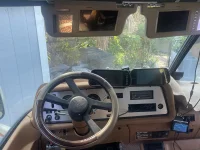
The basic "kit" was $135, plus $100 ($50 each) for two wider-angle cameras with more flexible mounting options than the cameras that came with the kit, and $30 for the calibration mats (I'll loan those to anyone in the nearby area who wants to install a system). Added cost would be for your choice of monitor ($25-$50 for a 4" or 5" display; more for larger). I plan to use the rear camera input of my dash-top Android Auto system (shown below). If you already have an input on an existing camera system or dedicated GPS device, then you have a monitor. This system supports standard NTSC/VBS/composite video, AHD (720p/1080p), VGA, HDMI, etc. The cameras are AHD 1080p/25hz.

If you wish to avoid some of the headaches I experienced configuring a system intended for a car onto a motorhome, there are more expensive systems that are turn-key for larger vehicles. Much more expensive!

View attachment 12687View attachment 12688
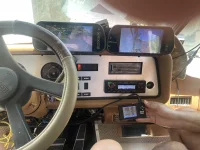
I have bought a system from Tadi Brothers, but I am not ready to do the installation.
I currently have these two monitors, which can be split into 2 or 4 views each.
IMG_2960.webp
These are currently set for driver and passenger side mirror views.
Peeking out above the two monitors are indicators lights for blind side alarm.
IMG_2937.webp
The two visor monitors each have (2) views without switching.
 
Added three 55W small panels in the empty spaces around the vents on the roof.
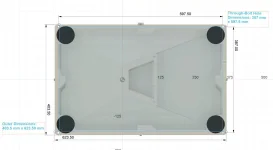
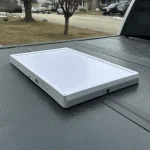
Test-fit a StarLink standard Gen 3 antenna in the remaining space in front of the rear 14" ventilation fan. It will have to mount east/west to fit, so a flat mounting kit is required.1757975560471.webp
1757975409052.webp1757975298990.webp
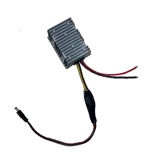
I'm considering a DC converter to replace the included power supply to simplify wiring and make it more efficient. It's from the same source as the mount.
 
Last edited:
  • Like
Reactions: Kendra
I discovered why my coach always seemed to start weakly.

Every time I turned the ignition key, the starter barely turned over. I had to enable Battery Boost each time. Both the starter and front house battery were new (I purchased them when I test drove the coach in 2023). The alternator never seemed to get enough charge to the starter battery; it was always low/weak.

Turns out a PO wired more house batteries in at the Onan. I knew this. What I didn't know was that he wired them to the starter side of the boost solenoid not the house side, and that they were dead, so they were constantly trying to charge from the starter battery. Also, any time I ran my roof vents or any other house systems, they were pulling power from the starter battery. The second front battery on the house side of the boost switch was just sitting there, unused except when called upon to help start the engine in boost mode.

I discovered all of this when I forgot to turn off the boost when I parked the coach after camping in July. A month later, every battery was dead and unrecoverable. Before installing the new starter battery, I checked the connection to the rear batteries; it was on the starter terminal of the boost solenoid. I pulled the inline fuse at the rear to disconnect those batteries. I installed a battery cutoff switch on the new starter battery.

Now, the coach starts just fine and the starter spins up briskly! But... The fuse in the rear disconnected the batteries, but the house is still wired to the starter battery (the vent fans and interior lights came on when the cutoff switch was closed). There is a terminal block (PO installed) in the electrical cabinet with a connection to the house fuse block. The wire from the starter battery to the rear must go through that block before getting to the rear batteries. So much to uninstall.... 🤣

Why didn't I just remove the wire from the solenoid? There is a PO installed security motion sensor right next to the solenoid; no room to get a tool in. I have to remove much aftermarket "stuff" to make room to correct things. It will happen in the next few weeks. At least I can start the coach without "hesitation" and know that I will have a fully charged battery when needed.
 
  • Like
Reactions: Kendra