Drinking the Koolaide... 😊

  • Please note, the forum recently had a problem with outbound emails for notifications, registrations, etc. A new email provider has been set up which should resolve all email issues. If you have any further trouble, please DM Christo or reach out via the Contact Us link in the website footer.
Yes, I see that on the original from Kelvin. But what is its function? There isn't one on my Onan now.
The K relay mounted on the starter motor has a plunger that pulls the starter gear out to engage with the engine flywheel ring gear. It then provides the high current required by the starter motor itself. The K relay has 2 internal coils. The first one is a higher current coil to provide the force needed to throw the starter gear out to the ring gear. Then the contacts close and that high current coil is de-energized and a lower current Holding coil keeps the starter going. The high current coil likely consumes 15-25 Amps, hence K1 provides this high current.
 
The K relay mounted on the starter motor has a plunger that pulls the starter gear out to engage with the engine flywheel ring gear. It then provides the high current required by the starter motor itself. The K relay has 2 internal coils. The first one is a higher current coil to provide the force needed to throw the starter gear out to the ring gear. Then the contacts close and that high current coil is de-energized and a lower current Holding coil keeps the starter going. The high current coil likely consumes 15-25 Amps, hence K1 provides this high current.
My mistake; I conflated the pump issue with the starting issue. I was matching "K" to the pump.... Ignore all statements from me about the K relay. šŸ˜–

But, there IS a solenoid on the fuel pump originally. There is not one in my system currently. Anyone know the purpose of that solenoid?
 
My mistake; I conflated the pump issue with the starting issue. I was matching "K" to the pump.... Ignore all statements from me about the K relay. šŸ˜–

But, there IS a solenoid on the fuel pump originally. There is not one in my system currently. Anyone know the purpose of that solenoid?
It's a fuel shut-off. It needs to be open (powered) for the fuel pump to draw fuel.
 
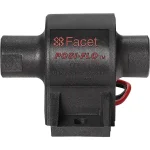
How about this pump for the Onan? $55 Get rid of the regulator. It might even bolt to the original location.
PN
OEM PN
Description
Volts
PSI Max-Min
GPH
Fitting Size
Lift Min. Dry
Check Valve
Position Shut Off Valve
05-10882​
60304​
Facet Posi-Flo Fuel Pump​
12​
2.0-1.0​
15​
1/8 - 27 INT​
24"​
Y​
N​
1733526375747.webp
 
  • Like
Reactions: Don Jaksa
Most fuel solenoids have been removed over the years.
Thinking about this, is it possible the original purpose of the solenoid was not to simply stop fuel flow when the generator was not active, but to act as a check-valve to maintain "vacuum" to keep fuel in the line for faster starts with little priming? Could that be the reason it can safely be removed; many pumps now include a check-valve?

I'm no expert in engines, so I could be completely off-base. Just wondering "out loud"...
 
Thinking about this, is it possible the original purpose of the solenoid was not to simply stop fuel flow when the generator was not active, but to act as a check-valve to maintain "vacuum" to keep fuel in the line for faster starts with little priming? Could that be the reason it can safely be removed; many pumps now include a check-valve?

I'm no expert in engines, so I could be completely off-base. Just wondering "out loud"...


One thing to just note. Our generators sit significantly higher then the has tank it draws fuel from.

Most other generators get fuel from the same level or even gravity fed. I think the solenoid is left overThought from a possible gravity fed situation.
 
Thinking about this, is it possible the original purpose of the solenoid was not to simply stop fuel flow when the generator was not active, but to act as a check-valve to maintain "vacuum" to keep fuel in the line for faster starts with little priming? Could that be the reason it can safely be removed; many pumps now include a check-valve?

I'm no expert in engines, so I could be completely off-base. Just wondering "out loud"...
The Onan engine was used in many applications including lawn tractors. The fuel tank may have been above the engine in some applications and the solenoid cut off the fuel from the car when not running.

Just my 2 cents
 
Is 2 psi enough?
From another thread:

"You want the 1-4 psi. Higher pressure pumps will push the needle off the seat and make it run rich. The GPM rating is meaningless."

My current pump is 5 psi and I have a regulator adjusted for "1" to get it lean enough to run smooth. Following the link in the previous post will list other versions at different pressures. I await input from the experts.
 
From another thread:

"You want the 1-4 psi. Higher pressure pumps will push the needle off the seat and make it run rich. The GPM rating is meaningless."

My current pump is 5 psi and I have a regulator adjusted for "1" to get it lean enough to run smooth. Following the link in the previous post will list other versions at different pressures. I await input from the experts.
I wouldn't trust the "1" on the regulator without verifying with an independent low-pressure gauge teed in.

In any case, these generators don't really need fuel pressure "dialed in" to run properly. What they need is a fuel bowl with proper level under varying conditions. Of course if there are some restrictions, that level can vary depending on pressure and load. For instance, if there is a blockage and you're running at 1 psi, you might get enough fuel to run under a no-load situation, but under a heavy load that demands more fuel, you might start starving out if 1 psi can't force enough flow through the restriction to keep up with demand.

On the flip side, if your needle/seat/float is compromised, you might flood out with inadequate demand. The float/needle/seat should be able to hold back 4 psi--full stop. If they can't hold back 4 psi, and there's a leakage rate getting past the needle and seat, that leakage rate will be worse at 4 psi than it is a 1 psi. So 1 psi might seem to work better under light loads when the demand can seem to keep up with the current leakage rate.

Even worse, you could have both issues. You could have a restriction the slows the flow during high loads, and a leak that allows too much flow during light loads. In that case, you'll never get the fuel pressure dialed in just right (which is a band-aid anyway).

If I were in your shoes, I'd want to know for dead-certain that the needle and seat can perform their job at 4+ psi. I think I'd hook up a clear fuel line running uphill from the carb, fill it with fuel so I could see the level. See if gravity is enough, watch to see if the fuel level drops on its own. If not, hook up an air source and see if 4 or 5 psi pushes the fuel down the clear line and into the carb (doing all this with the generator off of course). If the carb allows the excess fuel in while the generator isn't running, then the float/needle/seat need revisited again.
 
  • Like
Reactions: Tybalt39
I wouldn't trust the "1" on the regulator without verifying with an independent low-pressure gauge teed in.

In any case, these generators don't really need fuel pressure "dialed in" to run properly. What they need is a fuel bowl with proper level under varying conditions. Of course if there are some restrictions, that level can vary depending on pressure and load. For instance, if there is a blockage and you're running at 1 psi, you might get enough fuel to run under a no-load situation, but under a heavy load that demands more fuel, you might start starving out if 1 psi can't force enough flow through the restriction to keep up with demand.

On the flip side, if your needle/seat/float is compromised, you might flood out with inadequate demand. The float/needle/seat should be able to hold back 4 psi--full stop. If they can't hold back 4 psi, and there's a leakage rate getting past the needle and seat, that leakage rate will be worse at 4 psi than it is a 1 psi. So 1 psi might seem to work better under light loads when the demand can seem to keep up with the current leakage rate.

Even worse, you could have both issues. You could have a restriction the slows the flow during high loads, and a leak that allows too much flow during light loads. In that case, you'll never get the fuel pressure dialed in just right (which is a band-aid anyway).

If I were in your shoes, I'd want to know for dead-certain that the needle and seat can perform their job at 4+ psi. I think I'd hook up a clear fuel line running uphill from the carb, fill it with fuel so I could see the level. See if gravity is enough, watch to see if the fuel level drops on its own. If not, hook up an air source and see if 4 or 5 psi pushes the fuel down the clear line and into the carb (doing all this with the generator off of course). If the carb allows the excess fuel in while the generator isn't running, then the float/needle/seat need revisited again.
Thank you! I had no idea that was how the system operated (not an engine guy, I think I mentioned🤣). I wasn't aware the needle/seat vs. demand regulated the pressure of the fuel system; I was wondering how there could be a range of pressures instead of a fixed pressure. Now I understand why it's been mentioned "1-4" instead of a fixed value or a lower value. While it may not be needed at the moment (or at 50 years might be), it sounds like a full servicing of the carb, plus returning the pump to original pressure-range (and eliminate the regulator) would be a good place to start.


This is the kind of input I find really useful and why I prefer forums over social media quick-posts.
 
Been looking at those - lower efficiency traded for walk-on ruggedness, short and shading management by design, and less degradation over time.
Yup, the shading resistance and flexibility is what sold me on them. The longer daily usage window for thin-film panels should make-up the difference in efficiency. Now that the new heat-pump is in-place, once the weather warms-up I'll use the two long and one short to tetris them onto the roof. I hope to be able to fit 600W-800W on the roof almost invisibly. We shall see...
 
Last edited:
Saturday, I spent a couple of hours on a 2nd attempt at calibrating the 360-degree "bird's-eye view" camera system. Got the front and rear cameras calibrated and giving good images. Just need to find/make the correct targets for calibrating the side cameras (8 points of calibration per camera). I have to do manual calibration as auto-calibration fails every time; the system is designed for the distances between cameras on a car, not a "bus". Yes, I know there are systems available designed for buses and trucks, they just cost three/four/more times as much as an inexpensive system for a car. If this can be made to work, it will provide a simple and inexpensive alternative (and I didn't want to invest heavily in case the idea didn't work as hoped).

Update Jan 27th:
Success!
Update below.
 
Last edited:
Saturday, I spent a couple of hours on a 2nd attempt at calibrating the 360-degree "bird's-eye view" camera system. Got the front and rear cameras calibrated and giving good images. Just need to find/make the correct targets for calibrating the side cameras (8 points of calibration per camera). I have to do manual calibration as auto-calibration fails every time; the system is designed for the distances between cameras on a car, not a "bus". Yes, I know there are systems available designed for buses and trucks, they just cost three/four/more times as much as an inexpensive system for a car. If this can be made to work, it will provide a simple and inexpensive alternative (and I didn't want to invest heavily in case the idea didn't work as hoped).
Keep us posted!
 
Success!

The 360° bird's eye view camera system is functional!

Rear view (no big deal by itself), front view, and both sides. Integrated into an overview and virtual 3D view. Also allows for showing just the combined left and right views (split-screen) going down the road to keep the vehicle between the lines. Of course, the representational vehicle isn't a GMC motorhome (there isn't even a van to choose). Someday I may have to try to find a community to customize this system (XDA Developers Forums perhaps?) to allow for custom graphics and measurements; the inexpensive system I picked as a test isn't intended for vehicles 26' long. There is still some tweaking to do (too much of the side of the coach is visible in the side cameras, one of the side cameras is reversed, etc.), but the firmware has provisions to customize the camera views. This was simply a proof of concept. The cameras were taped to the body. Once the weather warms-up, I will drill holes and affix them permanently, then spend time fine-tuning the views.

The basic "kit" was $135, plus $100 ($50 each) for two wider-angle cameras with more flexible mounting options than the cameras that came with the kit, and $30 for the calibration mats (I'll loan those to anyone in the nearby area who wants to install a system). Added cost would be for your choice of monitor ($25-$50 for a 4" or 5" display; more for larger). I plan to use the rear camera input of my dash-top Android Auto system (shown below). If you already have an input on an existing camera system or dedicated GPS device, then you have a monitor. This system supports standard NTSC/VBS/composite video, AHD (720p/1080p), VGA, HDMI, etc. The cameras are AHD 1080p/25hz.

If you wish to avoid some of the headaches I experienced configuring a system intended for a car onto a motorhome, there are more expensive systems that are turn-key for larger vehicles. Much more expensive!

IMG_20250126_165832578.jpgIMG_20250126_165707519-1.jpg
 
Last edited:
  • Like
Reactions: Kendra and ScottC