Drinking the Koolaide... 😊

  • Please note, the forum recently had a problem with outbound emails for notifications, registrations, etc. A new email provider has been set up which should resolve all email issues. If you have any further trouble, please DM Christo or reach out via the Contact Us link in the website footer.
I understand that the Lenzi mid-brake disc kit will help prevent the rears from lifting; is that the case?
I have Lenzi's super duty disk bakes. I also have quad bags. I believe that unless you have a quad bag system, Lenzi's kit won't prevent the rears from lifting. Besides, his disk brakes, I have over size front calipers (80mm), his sensitized brake booster and oversized slave cylinders in the rear. My coach stops, it seems to me, as well as my SUV. I am very pleased with my brakes now after years worrying if I could stop.
 
I have Lenzi's super duty disk bakes. I also have quad bags. I believe that unless you have a quad bag system, Lenzi's kit won't prevent the rears from lifting. Besides, his disk brakes, I have over size front calipers (80mm), his sensitized brake booster and oversized slave cylinders in the rear. My coach stops, it seems to me, as well as my SUV. I am very pleased with my brakes now after years worrying if I could stop.
Interesting. So if I'm interpreting this correctly...

When changing to rear discs, if I change to the quad-bag air-ride system I could use electronic parking brake while still having the benefit of all six wheels on the ground during sudden braking without using the reaction arm. Is this correct? Does having a quad-bag system negate the need for the reaction-arm system (keeps all wheels on the ground, improving traction/friction for sudden braking)?

Are there any other brake system upgrades at which I should be looking?
 
Last edited:
Luther,
The quad and 4bag systems, by design, have a solid mounting plate between the bags. The nature of this setup allows both bags to be inflated equally to...say... 110psi. When under hard braking, while the single bag systems may unload the rear tire (sometimes called "pole vaulting") leading to that tire loosing traction (skidding), the quad/4bag systems have a single bag for each arm and keep a full 110PSI of down force on both bogie arms, with no pole vaulting effect and little or no transfer of weight to the front arm, thus significantly reducing rear wheel loss of traction. This becomes significant when going to the heavy duty disc systems that can be installed on the front axle (of the rear).

It could be said that the solid plate between the two bags does not allow for a smooth ride over bumps like speed bumps. I have noticed no difference in coach handling between the original or Sully systems as compared to the 4bag over speed bumps. Felt the same to me, and I've tested this on speed bumps at speeds exceeding 30mph. A smooth ride back there.

So, yes, a 4bag/Quad system keeps all wheels on the ground, improving traction/friction for sudden braking.
 
Luther,
The quad and 4bag systems, by design, have a solid mounting plate between the bags. The nature of this setup allows both bags to be inflated equally to...say... 110psi. When under hard braking, while the single bag systems may unload the rear tire (sometimes called "pole vaulting") leading to that tire loosing traction (skidding), the quad/4bag systems have a single bag for each arm and keep a full 110PSI of down force on both bogie arms, with no pole vaulting effect and little or no transfer of weight to the front arm, thus significantly reducing rear wheel loss of traction. This becomes significant when going to the heavy duty disc systems that can be installed on the front axle (of the rear).

It could be said that the solid plate between the two bags does not allow for a smooth ride over bumps like speed bumps. I have noticed no difference in coach handling between the original or Sully systems as compared to the 4bag over speed bumps. Felt the same to me, and I've tested this on speed bumps at speeds exceeding 30mph. A smooth ride back there.

So, yes, a 4bag/Quad system keeps all wheels on the ground, improving traction/friction for sudden braking.
Thank you. I had also heard the quad system rode a bit "rougher" than the single-bag. I have been following this style of coach for a few years and have been watching the CO-OP videos as well as others. I had originally thought of changing to the quad for the redundancy (bags and wheels) in the case of a rubber failure, but the ride issue had caused me to rethink. Glad to hear you have not experienced this.
 
On paper the single bag should be a better ride.
Thats why I opted to retain the original system, even with it's flaws. Well, that and the fact that is is still working.

Mine is single and does ride nice, but I have no experience with the quad bag setup.
 
  • Like
Reactions: Tybalt39
Luther,
The quad and 4bag systems, by design, have a solid mounting plate between the bags. The nature of this setup allows both bags to be inflated equally to...say... 110psi. When under hard braking, while the single bag systems may unload the rear tire (sometimes called "pole vaulting") leading to that tire loosing traction (skidding), the quad/4bag systems have a single bag for each arm and keep a full 110PSI of down force on both bogie arms, with no pole vaulting effect and little or no transfer of weight to the front arm, thus significantly reducing rear wheel loss of traction. This becomes significant when going to the heavy duty disc systems that can be installed on the front axle (of the rear).

It could be said that the solid plate between the two bags does not allow for a smooth ride over bumps like speed bumps. I have noticed no difference in coach handling between the original or Sully systems as compared to the 4bag over speed bumps. Felt the same to me, and I've tested this on speed bumps at speeds exceeding 30mph. A smooth ride back there.

So, yes, a 4bag/Quad system keeps all wheels on the ground, improving traction/friction for sudden braking.
It is the brake caliper torque applied to the bogie arm that causes the bogie arms to rotate in the same direction as the wheels when the brakes are applied. This causes the mid axle bogie to lift the frame and the rear-rear to lift the wheels. The 4 bag systems may keep more down pressure on the rear-rear wheels, but this torque rotation of the bogie arms still applies.

The only way to fix this is to remove the caliper torque from the bogie and transfer this force to the frame. This is what the reaction arms do. The bogie arms no longer rotate with application of the brakes.

The 4 bag systems do transfer the road shock (bumps and jolts) directly to the frame rather than to the opposite wheel as in the single bag OEM design. I believe this is what 4 bag owners describe as a "firmer ride"
 
  • Like
Reactions: kbeefy
It is the brake caliper torque applied to the bogie arm that causes the bogie arms to rotate in the same direction as the wheels when the brakes are applied. This causes the mid axle bogie to lift the frame and the rear-rear to lift the wheels. The 4 bag systems may keep more down pressure on the rear-rear wheels, but this torque rotation of the bogie arms still applies.

The only way to fix this is to remove the caliper torque from the bogie and transfer this force to the frame. This is what the reaction arms do. The bogie arms no longer rotate with application of the brakes.

The 4 bag systems do transfer the road shock (bumps and jolts) directly to the frame rather than to the opposite wheel as in the single bag OEM design. I believe this is what 4 bag owners describe as a "firmer ride"
Rats..... Can't get there from here.... šŸ˜“šŸ˜®ā€šŸ’Ø
 
It is the brake caliper torque applied to the bogie arm that causes the bogie arms to rotate in the same direction as the wheels when the brakes are applied. This causes the mid axle bogie to lift the frame and the rear-rear to lift the wheels. The 4 bag systems may keep more down pressure on the rear-rear wheels, but this torque rotation of the bogie arms still applies.
Thats as I understand it. Brake caliper torque causes 'lift', or 'pole vaulting'...
Simple physics, not related to air bag or tire pressure.
The 4 bag systems do transfer the road shock (bumps and jolts) directly to the frame rather than to the opposite wheel as in the single bag OEM design. I believe this is what 4 bag owners describe as a "firmer ride"
Also as I understand it. Mono bag shares the shock and 1/2 (or less) of the load is transferred to the coach.
That equaes to a smoother ride, as designed.

I call it 'bridging'. When one tire takes the load leaving the other tires to follow the road. It is much more obvious with triple axles, but it still happens with dual axles.
 
Bruce,
You're welcome to drive my quad-bag coach anytime and convince me it has a "firmer ride." I spent two days and over two grand and really wanted to feel a difference when I went from OEM to quad-bag, but I couldn't tell the difference. My coach is a pleasure to drive and stops like a champ. No regrets.
 
  • Like
Reactions: kbeefy
Turn signal switch question...

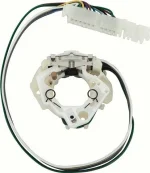
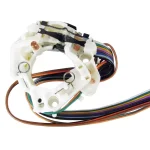
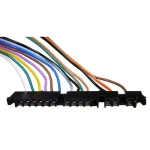
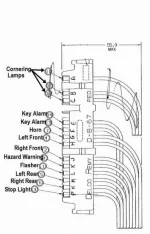
The switch listed at Applied uses 8 wires. There are 10 and 13-wire switches available that use the same connector and (apparently) the same switch body; just more contacts at various points on the switch body. Is there any reason not to use those other switches? Do those additional contacts provide connection for additional functions?

UPDATE:
The 8-wire switch contains all the required lighting connections. The 10-wire switch adds the "key alarm" to remind you to remove the ignition key. The 13-wire version is used if you have "cornering lights". Depending on what functions you really need, any of them can work to replace the others.

8 wire switch.jpg10 wire switch.JPGScreenshot 2023-04-26 at 10-05-54 Duralast Switch SW326.pngScreenshot 2023-04-26 at 10-07-03 Duralast Switch SW326.png
1684172556422.png

Latest update...

There is a rebuild kit for the switch that doesn't require the removal of the existing switch. Just the top plastic part that usually breaks at the metal "arm". $12 at AutoZone. If only I had known in advance... What a labor saver that would have been! :ROFLMAO:
 
Last edited:
Getting there...

The coach has the makings of something good.

Electric wiper conversion already done, but...
A weld broke so the motor turns but the wipers don't move.
Fixable! FIXED!

It has the "Red" steering box, but...
The intermediate short shaft was improperly installed.
Fixable! FIXED!
:ROFLMAO:

It WILL get there!! GETTING THERE!
 
Last edited:
  • Like
Reactions: kbeefy and tmsnyder
Turn signal switch question...

The switch listed at Applied uses 8 wires. There are 10 and 13-wire switches available that use the same connector and (apparently) the same switch body; just more contacts at various points on the switch body. Is there any reason not to use those other switches? Do those additional contacts provide connection for additional cruise control functions (resume, etc.), headlight dimmer (moving from floor), or wiper/washer controls? I'm going to perform all of those modifications anyway....

UPDATE:
Apparently, the 13-wire version is used if you have "cornering lights". Again, any reason not to use it anyway?

View attachment 8376View attachment 8377View attachment 8382View attachment 8381
You can use the "cornering lights" version, just ignore the extra wires. I found the cornering lights version was cheaper so that is what I used. No issues.
 
  • Like
Reactions: kbeefy
Plumbing....

I'm not a fan of having water lines in the ceiling. Too much could go wrong if anything leaks.

Has anyone looked into using "armored" water lines routed under the coach to the galley? Use red and blue foam tubing to insulate them?

This type of thing...
1682984248667.webp
 
Plumbing....

I'm not a fan of having water lines in the ceiling. Too much could go wrong if anything leaks.

Has anyone looked into using "armored" water lines routed under the coach to the galley? Use red and blue foam tubing to insulate them?

This type of thing...
View attachment 8416
One important benefit of running the water lines up over the ceiling is that they will easily drain when winter-proofing the coach. Water is liable to get trapped in lines running under the floor.