Drinking the Koolaide... 😊

  • Please note, the forum recently had a problem with outbound emails for notifications, registrations, etc. A new email provider has been set up which should resolve all email issues. If you have any further trouble, please DM Christo or reach out via the Contact Us link in the website footer.
Any suggestions where to optain the felt "gaskets" that go in-between the sliding window panes? I'd buy the complete kit from Applied, but I'm told their channel is not the best fit for a 1973; too thick along the bottom. It makes the window bind.
 
I just performed a search and didn't find anything useful...

For the first time, my coach isn't shifting from 1st into 2nd until I hit 40mph. It shifts back to 1st below 30mph. Even at 55mph I didn't get to 3rd (I quickly left the highway and continued on city streets until I reached my destination). I checked the transmission fluid while the engine was hot and idling; after wiping and re-inserting, it was above the two "dimples"(?) and in the area listed as Hot while running. It was also relatively "clean" fluid.

I have no idea if the higher ambient temperatures this week contributed to the situation. I've got a call into a transmission shop that seems to be knowledgeable on the TH425 (Kelvin D. is using the same shop).

So, for the time being, the coach is sidelined near my home while I address various small electrical issues and general clean-up.

Any suggestions for a starting-point either for myself or the technician that will be looking at it? It was going in for a transmission service in the next couple of months to address a slow fluid leak anyway.
 
Yep, definitely check out the modulator. I have a mityvac I use for troubleshooting vacuum devices. You can see if they hold vacuum without leaking, you can see if they actuate properly, etc. When ruptured, the modulator will also dump ATF into your intake.

Could this potentially be a governor issue as well? I know the plastic gears are known to be a weak point. When you were checking speed, was it on the factory speedometer or another source? If the factory speedometer was still working, that tells us something.
 
  • Like
Reactions: tmsnyder
Yep, definitely check out the modulator. I have a mityvac I use for troubleshooting vacuum devices. You can see if they hold vacuum without leaking, you can see if they actuate properly, etc. When ruptured, the modulator will also dump ATF into your intake.

Could this potentially be a governor issue as well? I know the plastic gears are known to be a weak point. When you were checking speed, was it on the factory speedometer or another source? If the factory speedometer was still working, that tells us something.
It was using the OEM/factory speedo. No changes to the gauges yet.

The transmission shop called. They also suggested testing vacuum at the modulator. Feel the hose for wear, test for any vacuum, then pull it and see if the engine runs faster or rougher.

As this happened after the ambient temperature exceeded 90 degrees in the last few days, there is a good chance the rubber vacuum hose finally died....

An electric "kick-down" was also mentioned. The last choice was the regulator. I'm hoping it's vacuum. If not, I'll limp/park it until they can see me for service at the end of July!
 
Last edited:
So my transmission had the same issue, would not shift from first, but I could pull the shifter into 2nd and it would shift, then back to Drive and it would shift normally to 3rd. It would only do this a couple times a year, usually on the first time out for the season. The guy who rebuilt it said the modulator valve was sticking and cleaned it up and refilled with Amsoil AFT. That worked for several years, but then it came back... but only a couple of times in a season.

One year it was doing it almost constantly after having a detour in Toronto on city level streets, stop and go. I found the rubber tube that connects the modulator to the metal vacuum tube was loose on the tube. Seems the new modulators have a larger tube and hose than OEM. The tube fits snugly over the stop ring on the metal tube, but over time the hose loosened off and the heat from stop & go traffic allowed a vacuum leak. I found this with my hand vacuum pump and gauge. New hose fixed it for another year.

Then, after about 10 years (2020) I decided it would be a good idea to change the ATF and filter. Shortly after that it would not shift automatically most of the time. I finally took it to Borrmann's. They measured the line pressure and found it was low and dropped before shifting (if I recall). They pulled it and sent it to their rebuilder who found a land where a seal rides to be badly worn. They replaced that part and rebuilt it. Borrmann's re-installed it and it did the same thing, no shift and the line pressure was not right. So they pulled it again and sent it back to the rebuilder who could not find a reason.

Borrmann's had a core transmission, so they pulled the reusable new parts from mine and rebuilt the core. Installed the rebuilt core and its been working fine ever since and line pressures were good.

So I'm thinking there was an issue with the tranny case, pump regulator or valve body on the old transmission. It was sitting just on the edge of working and any little thing would cause the shift to fail.

So I hope your transmission is an easy fix. When it doesn't shift to 2nd, try manually shifting to second, then back to Drive.
 
Interesting...

At the time, I did try manually shifting through the "gears" with no change.

On a tangent, did anyone ever have the Ford "semi-automatic" transmission? Not kidding; it was in the user manual and was printed on the dash gear indicator! There was no clutch, but you had to manually shift through the gears on the column. 1970 Ford Maverick. It was my first car in high-school (1977).
 
Last edited:
On a tangent, did anyone ever have the Ford "semi-automatic" transmission? Not kidding; it was in the user manual and was printed on the dash gear indicator! There was no clutch, but you had to manually shift through the gears on the column. 1970 Ford Maverick. It was my first car in high-school (1977).

I didn't have the ford one, but I have been around a couple 'Auto-stick' transmissions.
The ones I recall in particular were air cooled volkswagons, they used a vacuum switch in the shifter assembly to actuate a vacuum diaphragm on the clutch.

I also had a couple column shift manual transmission trucks. People that didn't know asked why I was shifting (what they assumed was an automatic) so much... then I would point out the clutch pedal.
 
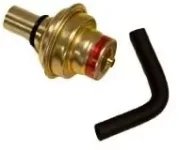
So, it was the vacuum modulator. The symptoms so perfectly matched the component function and expected failure profile that I did minimal testing; just blew air through the vacuum line and replaced the component ($10 from Amazon; cheap insurance) and rubber hose at each end. All is good now.

Except, now coolant is coming from the top of the radiator and pooling under the coach. Unless the cap/weld has an issue, it's probably the top hose. A simple fix, but it would be nice to start working on the interior and upgrades rather than playing whack-a-mole on small problems.... :ROFLMAO:

The repair took about 10 minutes and involved the loss of about a quart of fluid (have a pan under that if you have to remove the component). Make certain to put your finger in the hole to find the o-ring if it didn't come out with the old component; the new component won't fit all the way inside if the old o-ring is still there. 😁

vacuum.jpg
 
Last edited:
A question....

Is there any reason to force the smaller barrels of the carburetor to be open at all times? It was noticed that the engine runs rough at first start. Upon inspection, it was found the smaller "butterfly" on the carburetor is "frozen" wide-open. We assumed failure, but as EFI is in my future, we didn't worry about it as the engine runs just fine once it warms-up.

Fast forward to yesterday. While I had the air-cleaner off to check vacuum lines, I more closely inspected the carburetor. After playing with the linkages at that front valve, I noticed there was a wire holding the components in place wide-open. the wire was wrapped and twisted to keep it tight. Is this a kludge/fix for a broken linkage in the carburetor, or perhaps a "remedy" for a specific known issue?
 
Thats the choke plate. It's probably wired open because the choke is defective or someone didn't know how to adjust it.

With those wired open all the time the engine is running way to lean at cold start, likely your rough running issue.
You probably have to feather or pump the gas to keep it running until it's warm enough to not need the choke.
 
  • Like
Reactions: Tybalt39 and pvfjr
That's the choke plate. It's probably wired open because the choke is defective or someone didn't know how to adjust it.

With those wired open all the time the engine is running way to lean at cold start, likely your rough running issue.
You probably have to feather or pump the gas to keep it running until it's warm enough to not need the choke.
Yup, that's what I have been doing. I really need to learn the proper terms....

What is the downside to releasing that wire to see what happens? Will the engine not start if the choke-plate is fully closed at startup?

I'll probably just leave it alone unless it takes longer than planned to upgrade to EFI.
 
Last edited:
Yup, that's what I have been doing. I really need to learn the proper terms....

What is the downside to releasing that wire to see what happens? Will the engine not start if the choke-plate is fully closed at startup?

The choke plate is supposed to be fully closed at (cold) startup, and then gradually open as it warms up.
You should have better cold starts and idle with the plate closed, but restricted power when you give it fuel.

It would be helpful to see a picture of the choke linkage, it might just need an adjustment or part replaced.
 
Yup, that's what I have been doing. I really need to learn the proper terms....

What is the downside to releasing that wire to see what happens? Will the engine not start if the choke-plate is fully closed at startup?

I'll probably just leave it alone unless it takes longer than planned to upgrade to EFI.
It'll start cold (that is what the choke plate helps with), but it might begin running too rich as it warms up if the choke isn't "pulling off" correctly.

Do you still have the original hot-air choke, or has it been modded to electric? A picture here would tell us if you're uncertain. There's really nothing to lose. One must simply ensure the choke and its coil work, then adjust it properly. They're fairly simple over all.
 
It's still run by heat; no electric. There are very few modifications to the stock systems, other than the electric wipers. There is a random fuel filter over the engine, and what appears to be a pressure regulator in the fuel line. These will probably go away at some point. An electric fuel pump is on my list of mods, along with HEI and EFI.
 
Last edited:
It's still run by heat; no electric. There are very few modifications to the stock systems, other than the electric wipers. There is a random fuel filter over the engine, and what appears to be a pressure regulator in the fuel line. These will probably go away at some point. An electric fuel pump is on my list of mods, along with HEI and EFI.
Ah, well if it's still run by heat, the little tube coming out of the intake can get clogged up. That could prevent the choke from ever getting adjusted just right, and lead someone to disable it entirely. There's a coil in the choke housing either way, and those can go bad too.

One important note, the original chokes used the heat from the exhaust crossover. The exhaust crossover ports in the intake manifold are known to cause issues--cracked manifolds, hidden vacuum leaks, boiling your fuel bowls, etc. It's a VERY common fix to block these exhaust crossover ports. Someone may have done this to your coach. This does affect the coach though, so a person ought to switch over to an electric choke at the same time.
 
Ah, well if it's still run by heat, the little tube coming out of the intake can get clogged up. That could prevent the choke from ever getting adjusted just right, and lead someone to disable it entirely. There's a coil in the choke housing either way, and those can go bad too.

One important note, the original chokes used the heat from the exhaust crossover. The exhaust crossover ports in the intake manifold are known to cause issues--cracked manifolds, hidden vacuum leaks, boiling your fuel bowls, etc. It's a VERY common fix to block these exhaust crossover ports. Someone may have done this to your coach. This does affect the coach though, so a person ought to switch over to an electric choke at the same time.

Makes sense, thank you! While it is claimed to have had an engine rebuild/replacement less than 10 years ago, I'm told by Kelvin D. that he doubts the blocks were installed; the paint on the intake manifold is rippled and peeling, but not on the valve covers. At some point I will have to investigate this, but it's currently low on my priorities list. When I put new gaskets on the valve covers (first step in stopping minor oil leakage), that may be the time to look at the intake manifold.
 
  • Like
Reactions: pvfjr
I think there is a very good chance some PO installed the wrong radiator cap. As I think about what I saw when the rad was boilling over, there was fluid coming out around the cap. That would seem to indicate the pressure had increased enough to push coolant out of the system, but it wasn't going into the overflow container. So, either a clogged hose to the overflow, or the cap didn't route the coolant to the overflow; hence thinking it's the wrong cap. I'll take a look at it when I get home tonight. Probably time for a radiator flush anyway....

Update:

To close the loop, the rad cap had no slots to allow coolant to flow to the overflow tank. I replaced the cap with one that had the slots. No boil-overs since.
A minor issue; the "original" cap was rated at 9psi. From what I could find, it should have been a 7psi cap. The new cap is 7psi.
 
Last edited: