Converting to LiFePO4 batteries and Sailor Man's LiFePO4 Build

As my log books record, I have fueled in excess of 48 gallons multiple times but only a few in excess of 50.
Do you plan to install a second tank for the generator? Or is that going to be propane?
Matt_C
The Firman 3042 is a dual fuel inverter generator with its own internal 1.8 gal gasoline tank. I only intend to use gasoline as a backup. It is permanently connected to the lpg tank that not longer provides fuel to a furnace, refrigerator or oven. In this design the propane only fuels a tankless hot water heater, a cooktop and generator. The inverter lpg generator is very efficient, providing a 30 amp ac power source.
After I get some road time on the coach, I can determine is a generator is needed at all. Lithionics is advertising that its batteries are a replacement for a generator in RVs.
 
Good to see that you have worked out some of the inherent problems with a large shallow flat bottom fuel tank. It will be interesting to see how that tank works out. Just a suggestion regarding the sumps you have in the corners of the tank. I'm looking at a flat surface on the forward facing sump surface. Just an added precaution, maybe that should be angled so as deflect road debris rather than catching it?

Thanks for keeping us updated on your progress. Maybe you'd be interested in doing a session at one of the GMCMI conventions? I'm sure a lot of people would be interested in your innovations.
Jason told me that he is now not in favor of sumps because they tend to collect debris over time and cause multiple time that the gasoline filters clog. I am sure that it is better than the original tanks, because there is no long term rusting issue.
I also have my own issues with ethanol when there are long periods of time between coach trips. In my sailboat we would only had to get get more diesel every 2-4 years, so every 6 months, stabilizer had to be added.
Since the tank is sitting between the chassis side rails and crossmembers, I don’t think that the tank is particularly vulnerable to road debris.
I would love to to doing a session at a GMCMI Convention. I don’t know when I will be ready for that.
We you keep pushing the envelope and think you have cleared all the hurtles, somehow another dozen pop up. It sure is exhausting. This latest “Blind Side” has been particularly difficult, but I am working though it. However, it is going to cost considerable additional money and time. It is requiring removing a lot of stuff in addition to massive redesign.
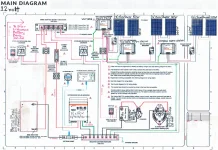
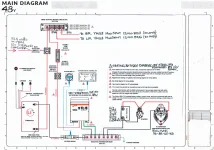
GMC 12v System 022123.webpHere is the preliminary redesigned 12v and 40v (actually 51.2v) wiring diagrams. They are not final.
GMC 48v System 022123.webp
 
I have been looking for a solution to get rid of the engine driven radiator fan for a long time. It is the one remaining parasitic load on the 455 that I wanted to eliminate.
This is Florida and the thought of being stuck on Interstate 75 mid June parked in traffic and the water temperature rising, just terrifies me. I have not been able to put together an electric fan/radiator upgrade until now. As a Ranch Head, I have been following Jim and Jason. There is Jason showing a new dual electric fan shroud to be combined with a new aluminum Yokon radiator. Eureka!
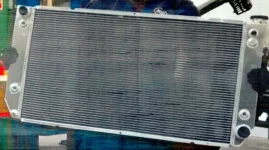
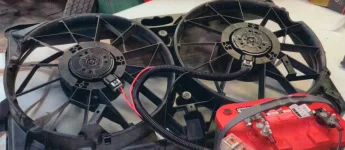
The new radiator has sections for oil, transmission and engine cooling. There is also a dual fan controller with many options. The fan controller is electrIcally connected to the FiTech fuel injection system.
I can’t wait to move ahead with this project.
GMC Alum Radiator 022123.webp
GMC Elc Radiator Fan Shroud 022123.webp
 
Glad you won it.
It was a pleasure meeting both you and Kendra.
Was fun sitting around talking about all the "what if" situations and powertrains.
There were so many new people there and stuff to see and buy. I am generally very bad at remembering name, so I can't place you. Can you send a photo, so I can remember you and what did we talk about?
 
There were so many new people there and stuff to see and buy. I am generally very bad at remembering name, so I can't place you. Can you send a photo, so I can remember you and what did we talk about?
We talked about your idea on a Ford powertrain swap. Was way above my head.
 

Attachments

  • IMAG0136_1.webp
    IMAG0136_1.webp
    35 KB · Views: 3
Great stuff Sailorman! This documentation and commentary is invaluable to those of us that follow. I don't think I'll get to the level you're headed but it's appreciated.
Thank you.
I am trying to provide assistance to people who are looking for stuff or projects they have not though of. That is why I am identifying who the manufacturers are and precisely which products I am using by giving the product numbers.
As an architect, I have over 60 years of specifying various products and comparing them with many other similar products. My specifications need to have the phase "or equal" to a product I have selected. Most contractors will submit another product that they contend is an equal to the products I have specified. They submit mostly because it is less expensive and they can make more profit. It is up to me to judge whether their submission is actually equal or better than the product I specified. Sometimes, it is actually acceptable and I learn from that, but most often, it is not.
Architects produce the "contract documents", which are the plans and specifications. The architect is the sole interceptor of the contract documents, so we are in a quasi-judicial position. The only way to challenge my interpretation is to file a lawsuit. It has happened many times and occasionally, I have lost, but most of the time, I have prevailed.
I am trying to apply my skills to help everyone who is trying to extend the lifespan of the GMC Motorhome, no matter what pathway they select.
 
We talked about your idea on a Ford powertrainwaswap. Was way above my head.
All of the repower ideas were to replace the engine with a Caddy or Buick motor. The most common was a diesel swap.
My notion was to replace the motor, tranny, front system, steering system, etc.
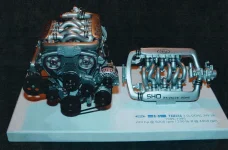
This is what the Yamaha engine looks like.
Ford SHO Yamaha Demo Exhibit 082922.webp

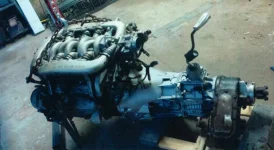
The is what the Yamaha ending looks like with the custom designed 5 speed manual Ford transaxle.
Ford SHO Yamaha DriveTrain  082922.webp
All that would be needed is to extend the axle on the passenger side to match the Motorhome's track.
You can see how much smaller this very torquey high rev system is. I bought a 1989 Ford Taurus SHO new and put 210,000 miles on it wavering 26 mpg. The Olds Tornado averaged 14 mph.
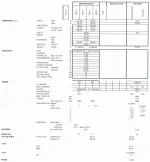
I have analyzed the GMC Motorhome, Workhorse LF72 and 1989 Ford Taurus SHO and put together this spreadsheet.
The WorkHorse was the the base for Jim Bound's diesel on off project of putting a GMC 13 baby on a WorkHorse chassis and drivetrain. The WorHorse was from a bus and had a 6 speed automatic transaxle.
I tried to buy that one off before I bought my coach.

Olds 455 vs Yamaha Analysis 022323.webp


Is there anyone who wants to try this repower Yamaha/Ford engine/transaxle? I'd love to help you do it!
By the way, when I switch the in the Koba Motor with fuel injection, I will have a fully well functioning 455 with carb for sale.
 
Thank you.
I am trying to provide assistance to people who are looking for stuff or projects they have not though of. That is why I am identifying who the manufacturers are and precisely which products I am using by giving the product numbers.
As an architect, I have over 60 years of specifying various products and comparing them with many other similar products. My specifications need to have the phase "or equal" to a product I have selected. Most contractors will submit another product that they contend is an equal to the products I have specified. They submit mostly because it is less expensive and they can make more profit. It is up to me to judge whether their submission is actually equal or better than the product I specified. Sometimes, it is actually acceptable and I learn from that, but most often, it is not.
Architects produce the "contract documents", which are the plans and specifications. The architect is the sole interceptor of the contract documents, so we are in a quasi-judicial position. The only way to challenge my interpretation is to file a lawsuit. It has happened many times and occasionally, I have lost, but most of the time, I have prevailed.
I am trying to apply my skills to help everyone who is trying to extend the lifespan of the GMC Motorhome, no matter what pathway they select.
Interesting info SailorMan,
In my business (radio communications like Police & Fire Dept use) a Consulting Engineer is brought in to determine the wants and needs of the Customer. Then the Consulting Engineer comes up with a system design and specifications that will meet the customer's needs and sends out a Request for Proposal to Vendors. The Vendors then put together a bid with an equipment list that meets the specifications. Any exceptions to the specifications are noted.

If the Consulting Engineer specified actual products, then he would no longer be a "Consultant" but rather a sales Engineer for the Manufacturer of his specified product. There would be no competitive bids since no one else could meet his specs. Many times the RFP favors one manufacturer which raises complaints.

Sometimes the Consultant has been living in a cave and has not kept up with technology or does not understand the operation of the new technology (what you read in the marketing literature does not always match real world operation).

In any case, the Customer usually does not care what name is on the equipment, they just want it to do the job and work reliably to their satisfaction. Oh, and also has to fit their budget!
 
All of the repower ideas were to replace the engine with a Caddy or Buick motor. The most common was a diesel swap.
My notion was to replace the motor, tranny, front system, steering system, etc.
This is what the Yamaha engine looks like.
View attachment 7734

The is what the Yamaha ending looks like with the custom designed 5 speed manual Ford transaxle.
View attachment 7735
All that would be needed is to extend the axle on the passenger side to match the Motorhome's track.
You can see how much smaller this very torquey high rev system is. I bought a 1989 Ford Taurus SHO new and put 210,000 miles on it wavering 26 mpg. The Olds Tornado averaged 14 mph.
I have analyzed the GMC Motorhome, Workhorse LF72 and 1989 Ford Taurus SHO and put together this spreadsheet.
The WorkHorse was the the base for Jim Bound's diesel on off project of putting a GMC 13 baby on a WorkHorse chassis and drivetrain. The WorHorse was from a bus and had a 6 speed automatic transaxle.
I tried to buy that one off before I bought my coach.

View attachment 7736


Is there anyone who wants to try this repower Yamaha/Ford engine/transaxle? I'd love to help you do it!
By the way, when I switch the in the Koba Motor with fuel injection, I will have a fully well functioning 455 with carb for sale.
Why is the Workhorse LF72 in this Table? Well. before I bought my coach, I was searching around for which GMC Motorhome to buy. In my search I came across this on the GMC COOP website:

http://www.gmccoop.com/restorations/gallery/gmc-motorcoach-projects/23d/

I don’t know if you are aware of this. Since Jim mentioned that he had lost track of it and it was for sale, I started searching for it.Jim Bound's 23D Motorhome Photo 022423.webp
Jim said that he had found it and it was for sale, so I started looking for it. It seemed like it was a steal at $45,000!
Jim Bound's 23D For Sale Ad 022423.webp
This was a 2019 advertisement.
My notes at the time:
"NOW FOR SALE @ $52,000
18 mpg w/5 speed (can be upgraded to 6 speed) $2,078 parts & install
50 gal diesel tank: @ 18mpg - 900 mile range
Diesel generator (8 hrs) - can be upgraded to Diesel Inverter Generator
10K mi on diesel since purchase"

I was not able to find Martin Carew, so I started to think, "What would it take to make a 26ft version of this with 6 wheels. Well, how would it get Workhouse chassis to mate with a survivor motorhome?

Workhorse 2019 Auction 022423.webp
This is a 2007 Startrans bus with 39,012 miles. It was pulled out of service on 7/1/18. It was in good condition and running well. It sounded like a good start.
I certainly good locate a good used GMC motorhome survivor for a body and this bus already had an air suspension. The 4 wheels was a negative. How to deal with that?
Maybe I should get the 23ft Workhorse and splice in another 3 feet of chassis at the rear wheel to install a second pair of wheel and a quad bag.
The bus didn't have a fresh water or black tank, so the extension would provide plenty of room for additional tankage.
I have a photo drawing showing the LF-72 4 wheel chassis and an extended LF-72 with 6 wheels, but I can't get my hands on it right now. I will add it when I locate it.
Is there anybody interested in doing this?
 
I have been looking for a solution to get rid of the engine driven radiator fan for a long time. It is the one remaining parasitic load on the 455 that I wanted to eliminate.
This is Florida and the thought of being stuck on Interstate 75 mid June parked in traffic and the water temperature rising, just terrifies me. I have not been able to put together an electric fan/radiator upgrade until now. As a Ranch Head, I have been following Jim and Jason. There is Jason showing a new dual electric fan shroud to be combined with a new aluminum Yokon radiator. Eureka!
The new radiator has sections for oil, transmission and engine cooling. There is also a dual fan controller with many options. The fan controller is electrIcally connected to the FiTech fuel injection system.
I can’t wait to move ahead with this project.
View attachment 7716
View attachment 7717
Relative to the aluminum radiator. Inspect closely the manner in which the core itself is attached to the two tanks. Welded? These radiators, mounted where they are, over the long haul, take quite a beating. A number of us have had issues with the core actually cracking at the tank and then leaking. Since they are aluminum, they cannot be just soldered by the local radiator shops. Most that have the aluminum radiators are not long haul drivers like me. We put on 10-14K miles per year often in some pretty rough conditions. Ya know, like Interstate 10 west of Florida. While many of my GMC friends may only put on 3-4K/yr in gentle drives to local rallys, it may take many years to experience these leaks. I have replaced 3 aluminum radiators, all of which have separated and leaked at the tank. (yes they were properly grounded) I finally went to a upgraded copper radiator. Now, IF it leaks, at least I can have it soldered and get on with life. JFWIW
 
Blindsided by BattleBorn/Dragonfly !!!

It has been very difficult to solve the issue that the WakeSpeed WS500 remote alternator regulator was not getting my 12v Balmar alternator to function. It was almost impossible to get tech support from Dragonfly who had bought WakeSpeed about 8 months ago.
I surprisingly, finally broke through last Monday and my life and project became topsy turvy since then. All final work and test has ceased on the new electrical center. When talking with Matthew from Dragonfly about the 12v WakeSpeed he mentioned that we could not use the WakeSpeed to regulate the 48v Balmar alternator, but he did not know why. All of the BattleBorn technical information had said that we could connect (4) 12v batteries in series to produce a 48v battery bank. We did have to charge each battery separately to 14.4v to 14.6v before wiring them together. So I proceeded to do that.
I bought the (2) WakeSpeed WS500’s from Offgrid Software Solutions and I have been monitoring their message board. I asked them why I could not use the WS500 to regulate the Balamr 48v alternator to charge BattleBorn batteries in series. In a couple of days, I got this detailed reply from “Al”.

Hello! A couple of notes. First, the Ws500 works with 48v alternators. We have been involved in 1,000's and 1,000's of such installs, mostly in the RV world -- and they work very well, and have done so from the very beginning (The first usages of the Ws500 was 48v installs in Sprinter vans).
What we do not support is 48v battery systems with no commutations between the BMS and the WS500. (such as the Battle Born drop-ins you noted) 12v, 24v fine (Approved batteries only, see website and app). But for 48v, need some comms. Lithionics, MG Energy, Victron Lynx are a few examples. All good solutions, and all have been deployed in 48v installs. REC should be OK as well, though I am not aware of any in the field.
So, I think your first issue is using the Battle Born drop-ins with a 48v alternator; that is dangerous and a model we do not support. 12v, 24v fine. 48v, no. (BTW, the recent announcement of Dragonfly IntelLigence address this). You should be fine with the DCDC converter approach, but I would recommend you either change the 48v battery subsystem to a supported one with communications, or remove the 48v alternator.
You have not describes what issues you are having with the 12v alternator. I would think it would be rather straight forward; make sure all the required wires are connected; using the app can ease in creating a config file. As a initial troubleshooting approach, you might try removing the Blue Field wire from the alternator (Please be safe here), make sure the batteries are around 60-70% SOC or less, and then while the engine is running BRIEFLY touch the Field terminal on the alternator to +12v. You should be able to hear the engine loading and notice amps being delivered. If not, something is up with the alt. Just do it for a second or so, no longer and should be OK. Balmar alts are good units, and I do not hear too many issues with them, but at items there are issues - and a couple of customers went around for days trying to sort things out just to fine out some quality issue in the alt. The quick full-field test is a way to quickly bring that to closure.
As to the regulator, the most common issue we find is not connecting up all the wires (esp the twored and two blacks!), not installing the 15A alt+ fuse (though the Ws500 issue a FLT code for that), and also over-engineering the config -- typically turning on Expert Mode in the app and adjusting the rose background values. Assuming the alt is good (and they most often are), dbl check the wiring against the our User's guide (there is also a BattleBorn specifc .pdf on the Wakespeed website), create a fresh config w/o adjustments via Expert Mode, and get to a point of working. Then you can fine tune things down the road as appropriate
If you have any specific question on your 12v install, please let us know here and I am sure help will be on the way!
Hope this helps!

-al-"

Wow!! What a shock! I then investigated the batteries mentioned and whether I could use any of the components I have bought. After much research, I determined that Lithionics a=was the only appropriate solution. I would need to purchase (2) Lithionics GT51/150-F24-UL-MOD batteries and connect them in parallel with a remote Lithionics BMS, custom cables and connectors. This would increase the capacity of the 48v battery bank to 51.6v of 300ah.
What I going to do with the (4) BattleBorn GC3 batteries, already charged, mounted in place, waiting to be connected.
At least Dragonfly stood up tall. They said that they would ship a pallets, complete with cardboard boxes and packing materials to me and give me a refund for the entire purchase. In addition, they will pay for the shipping. I would be getting a refund of about $9,500.
However, it would cost me much more to switch to Lithionics and I had to find one of the local distributers. I found one in Sarasota, FL and with some discussion found that I could eliminate packing and shipping of the batteries and components by picking the stuff up at their factory in Clearwater, FL. I have done that before myself.
I do not know how long it would take to get the order. Based on my previous experience with Lithionics, it could take 30 to 90 days. The batteries are built to order and they are not stocked. When I pay 50% at the time of order, they will check their production schedule and give me a delivery date.
I am estimating that this order will be in the range of $18,000 to $19,000. That is double the cost and I get maybe 15% more capacity. If I wire the money, I get a 2% discount. However, the 30% federal tax credit helps some. 30% o $9,500 is $2,850, so I am only out $6.650 with a possible delay of up to 3 months.
When pushing the envelope and exploring new frontiers, sometimes there are very uncomfortable consequences.
I am really stunned and hurting.

This is the preliminary wiring diagram of the new arrangement. At least I can use all of the other components I already have.

View attachment 7701
This is what the installation would look like, I will probably use a 4-position combiner box to allow for up to (2) more batteries if I determine that a generator is really not necessary.
View attachment 7702
There is a Dilemma!

There is good new that I may be able to pick up the Lithionics batteries and accessories in the 3rd or 4th week of March. I was dreading how long it would take. I was afraid that it could take as long as 4 months. Phew!!
The only hang up is in establishing the length of the cables, which I must provide. I have to determine the exact length of the cables and being even an inch too short would be a disaster. This is one of the complications in purchasing a plug and play system when there are physical constraints.
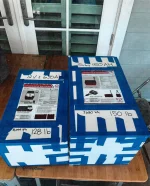
Lithionics Mockups 021623.webp
One of the problems is whether one can actually get a battery or any component into place. We often figure out that something fit and we purchase it and then realize that we can't get it into position with taking half of the vehicle apart. It happens more often on a yacht. As a result, I make a cardboard mock up and try to maneuver it into position before I purchase it. These were made for my coach. The one 12v 630a battery on the left was theoretically able to be mounted in the engine compartment. However, there was no way to get in into place without taking apart almost everything on the passenger side.
The mock up on the right it the battery that I am now actually going to purchase (2 or 3). I actually maneuvered into both positions in the generator compartment and under the bed. So good, so far.
What about the attached cables!
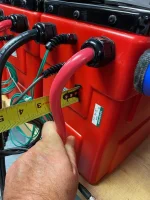
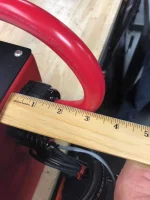
So I asked Lithionics about the options. Could the cables come out the top of the case? How far do they stick out and dimensionally, where were they located? Which size cable did we need? The 51.6v means far less current and smaller cables. What is the minimum turning radius of a 90° and 180° bend?
They immediately respond with these photos!
thumbnail_2 OT Cable Radius.webp

thumbnail_4-0 Marine Cable Bend Radius.webp
Kudos to them!
The top image is 2.0 and the bottom 4.0. The cables are Ancor tinned threaded cables. The smaller 2.0 is more than capable of handing the current and has a smaller turning radius, so I am specifying them.
Next comes the dilemma! Since I was told that they still had a small quantity of these battery cases in stock, they could make me more now. I asked them if I could buy an empty case case so I could store it myself if I ever decided to eliminate the generator and add a third battery in parallel. They said that they could not do that, but they could sell me the third battery now.
Hmm! I wanted to get some real operational data to see if I could really eliminate the generator. It was an option for the future to see how effective all of the energy conservation implementations turned out to be. Do I bite the bullet and buy it now. I am already purchasing a (3) port combiner box to prepare for the future battery. Do I spend the money now? Should I get the additional storage capacity, particularly if I can go off grid and use the coach and solar panels to power my house? I am already thing of adding fold up solar panels to augment the 15 SunPower panels on the roof.
What do you guys think? I plan to place the order next week.
 
This may be a way for you to get to where you need to be. Much of the Chandler's work was making "Performance Cruisers" from retired racing sloops. House electrics was always a big deal. I don't need to tell you about storage volume being precious.
Well, the only way to get the hotel power that one owner wanted was to get huge AGMs in there.
Problem: The standard configuration would have required boosting the one side bunk/dinette by 1-1/2 inch and in our mock up, this looked really bad. In the digging around (that is all billed to the client), I discovered that the right sized jars (this was prior to LiFePo4) could be ordered with flat tapped posts. Even with these and normal cable, things still would not fit.
But, if instead of cable and fittings, I used flat copper bar to run out of the battery box and to a place where I could change to good cable I could (and did) make it all fit.
Matt_C
 
>
Hmm! I wanted to get some real operational data to see if I could really eliminate the generator. It was an option for the future to see how effective all of the energy conservation implementations turned out to be. Do I bite the bullet and buy it now. I am already purchasing a (3) port combiner box to prepare for the future battery. Do I spend the money now? Should I get the additional storage capacity, particularly if I can go off grid and use the coach and solar panels to power my house? I am already thing of adding fold up solar panels to augment the 15 SunPower panels on the roof.
What do you guys think? I plan to place the order next week.

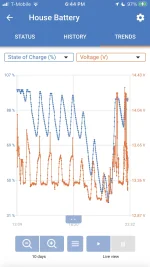
I eliminated my generator last August, boondocked 10 days on 300A lithium without shore power in summer heat. Majority of my driving/camping is western US, areas with less humidity. I've kept the rooftop 110v A/C power hog for now, tempted by your rear bumper split A/C but holding out for the price of DC-powered rooftop A/C to come down in the future.

I need to fully document my electrical system - it's considerably less capable and less elaborate but has a few things in common with yours. I'll write a detailed post after cleaning up a few loose ends this spring.

In a region without high humidity I don't miss the generator at all. I'm enjoying the additional storage space, weight savings and have one less thing to maintain.
 
Kendra - was that 10 days parked up or did you drive in the interim?
10 days parked in Nevada sunshine. Didn't start the engine until I left.

300A Battery.png
97 miles from a gas station, nice not having to worry about a generator eating too far into the main fuel supply.
 
Last edited:
  • Like
Reactions: boybach
Kendra, How much solar are you running? I'm guessing you were not using the rooftop AC unit(s).
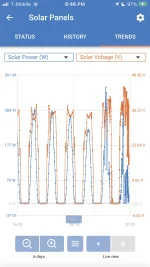
No rooftop A/C while boondocking in my configuration. Solar is six flexible Renogy panels adding up to 750w. Actual wattage peaks around 300 which has been good enough without rooftop A/C. Flexible panels are less efficient and some parts of the roof always curve away from the sun, but I didn't want anything that changed the looks of the GMC. I need to do a full write-up.

750W Solar.png
 
Impressive! What were the main power consumption devices you used? I'm guessing furnace/water heater?
No water heater boondocking and I haven't tried the furnace this way (I will this year).
- 3 roof vent fans running 24/7
- Propane fridge 24/7 (also consumes DC power)
- 3 additional USB fans running all night
- Lighting as needed, and charged phones & iPad
- Swamp cooler 4 to 6 hours per day.
Swamp cooler fits over the engine cover and draws shaded air from underneath while parked, uses an electric car radiator fan plus a 12v pump to mist water (helps in Nevada but not Florida).

I'm about to switch from propane fridge to a dedicated 12v DC fridge. I'll do a full write-up this spring along with amperages.

Apologies to Sailor Man, I don't want to hijack your build thread. Hoping this information helps with decisions.
 
  • Like
Reactions: boybach