Converting to LiFePO4 batteries and Sailor Man's LiFePO4 Build

> Should I change the final drive ratio. since I plan to tow about 5,000#, the current option is either the 3.70 or 4.10 limited slip. The jury is out.

> As long as the coach will be on Cliff Golby’s lift for a while, I am talking to Jason Stryker about replacing the two original steel gasoline tanks with his 70 gal custom aluminum tank.

> Jason told me that they had a place to take all the unsold motorhomes stuffed full of all of the stuff they didn’t sell.

I'm happy with my 3.55 ratio behind a 455 with similar power. I have not trailered (might tow a light 2k pound in the future) but mine has run up steep 2-lane mountain passes in AZ/ID/UT/WA without any problems.

Aluminum 70 gallon single tank is tempting but I have concerns about torsional stress of an internal frame member passing through center of a rigid enclosure holding 400 pounds of flammable. That won't all bend at the same rate and I don't think anyone with formal mechanical engineering background was involved with the tank's design (correct me if I'm wrong). I'll decide after a few have been run quite a few miles on twisty roads.

Very glad to hear the coaches I saw in the CoOp's field are not all being abandoned or crushed.
 
I have spoken to Jim Kanomata, Jim Bounds and Jason Stryker about the proper final drive ratio, since I will have to buy the parts from him. Jim K want to have the coach driven with the existing motor to record the engine rpm and the corresponding coach’s speed. He wants to confirm what the actual gearing is in the tranny. Cliff Golby was have a conversation with Jim K and will perform the test. I think that Jim K is correct. Who know what the tranny actually is like and it is prudent to know exactly what we are dealing with.
I don’t expect to limit myself to limiting the speed to 65mph, not with this new engine and the elimination of so much parasitic loads.
I have also asked Jim K to factor in the probability of 5,000# tow loads.
I don’t know exactly when the engine was last run. I will ask Jason Stryker about that.
 
I'm happy with my 3.55 ratio behind a 455 with similar power. I have not trailered (might tow a light 2k pound in the future) but mine has run up steep 2-lane mountain passes in AZ/ID/UT/WA without any problems.

Aluminum 70 gallon single tank is tempting but I have concerns about torsional stress of an internal frame member passing through center of a rigid enclosure holding 400 pounds of flammable. That won't all bend at the same rate and I don't think anyone with formal mechanical engineering background was involved with the tank's design (correct me if I'm wrong). I'll decide after a few have been run quite a few miles on twisty roads.

Very glad to hear the coaches I saw in the CoOp's field are not all being abandoned or crushed.
Jason showed me the 70 gal aluminum tank that was installed on the coach sitting on an outside lift next to the paint section. He informed me that there is no chassis frame member that is actually structural in the way. He said that there is an internal aluminum frame member and baffles that are structural. I think that it would be prudent to ask Jason for drawings of the tank, so I could run some numbers. I am a retired architect, after all, and my license empowered me to perform any engineering service without the assistance of another engineer.
I am also thinking that a 70 gal tank along with your experience of averaging about 10mpg means that the coach could have a range of at least 700 miles, especially since all of the petrol can be used unlike the present situation.
 
There’s no way I’d put one of those things in my coach. I prefer things that are designed by engineers and thoroughly tested before I trust them with my life. I’ve watched the videos and that thing screams danger.
 
IMHO, the 50gal capacity of our coaches is all that most of us would really need. It gives us a 300-350 mi range (If you run it down to fumes.) Can't speak for everyone else, but for me, I have to stop every 200--250 miles just to pee. Might as well make extra use of the stop, fill up and stretch the legs. 700mi nonstop is a bit much. Also, at the current rate of $3.59/gal for 65 gal is $230 for a fill-up. Don't know how I'd handle that when $100 fill up is a head shaker. JWIT
 
Larry
You are saying that with a 300-350 mile range, you are getting 6-7 mpg. Kendra is saying she is getting 10 mpg.
The reason why I am focusing on maximum range is because I live in Florida on the south bank of Tampa Bay. I live on a canal in a mandatory evacuation zone. One of the most critical uses planned for my coach is for it to function as a lifeboat.
On U-75, at 75mph, it takes 4 hours to travel the 256 miles to the Georgia border. In the evacuation, we probably averaged about 30mph. We are now talking 9-10 hours.
We had to run from Irma because we had not yet replaced all the windows and French doors with Miami-Dade units that will handle around 200mph given their smaller size. The escape was a horror.
There had been so many cars at all of the gas stations, few stations had any fuel left. There were lines to the stations around a mile long and some had run out of fuel on line. They had no way to know that there might be no fuel available.
The gas stations had trouble because they had a very hard time delivering fuel and it became very difficult for the trucks to return to fill up for another trip back to the station. Some of the stations had gas but they could not put fuel in cars and rv’s because the electrical service had failed and they did not have emergency batteries. Few of them do. More stations were losing power every minute.
Most of the vehicles on line were running the engines at least part of time, just to get relief from the heat and humidity. The RV’s were probably running their generators, stealing gasoline from the gas tanks.
The sun was out and strong because the edges of the storm had no yet arrived. Caught in sun a situation, you probably would be getting 3-4mpg, so your range would be reduced to 150-175 miles.
We made it to Georgia without a stop in our 2017 Chevy Volt plug-in hybrid that had a 55 mile EV range. When we were stopped in traffic the engine would shut down and the car functioned under electrical power, including the ac.
In addition, it was almost impossible to find a place to eat or sleep. The one motel that we did find had not been cleaned in days and was going to be evacuated when we woke up.
If I put in the 70 gal tank and at least 10mpg, I will have a range of 700 miles. If I get 15mpg, the range is 1,050 miles.
At least with the massive battery capacity, all of the air condition will run from the power in the batteries. With the composting toilet, I never have to pump out. I can go almost anywhere and stay away from the storm and all of its after effects.

Have I made my case for the larger tank and expanded range?
 
OK, that motor has been sitting on the shelf for 3 years? Please read this Before you attempt to start it. JWID


As for the FD, personally, I would NOT go any steeper than the 3.70 unless you would be doing a lot of moutain driving and keeping your speed to 65mph or less. JWIT
Jim Bounds has the Mercedes test vehicle which has both the Mercedes engine up front and the rear body removed to allow a 403 or 455 to be mounted. They have the option to connect the rear axle to either the Mercedes in front or the mounted Olds engines in the rear. That way they an either deliver the vehicle using either engine to get to the final destination and use the Mercedes motor to get back.
Jason Stryker told me that they have mounted my engine on the test vehicle, prepared it and run it in again.
Man, what a relief and who is better equipped to do it!
 
I get 8.8mpg after correcting the odometer, here's almost 10,000 miles of data.


If you need to leave the area for a hurricane, hopefully you won't be dealing with trying to get gas until you drive about 300-400 miles. Keep it full when parked. You should be able to get up to almost Atlanta GA before needing fuel.
 
Iwonthe

Well, I won the auction! I couldn’t believe that this Koba motor has been sitting on the shelf at COOP for three years, ready to be installed.

View attachment 7559
Usually, one had to find and purchase a “crate” 455 and ship it to the COOP. It then had be worked on by Koba, then painted and run it. I think that a process like this could take about 6 months, but here is it ready to be installed. With the COOP gone, maybe another one will never be made, so I just made a leap of faith and jumped in.

Kendra has one in her coach and has 45,000 miles on it. It has the standard carburetor and she says she gets about 10 mpg. It doesn’t know how to burn oil.
I have to drop the current 455, which runs very well, by the way. It had a lot of work on it itself about 15 years ago, mostly related to the heads, etc. I guess it will be available to purchase, if anyone is interested.
The unexpected has happened and I am scrabbling about what other things can be addressed at the same time. I had originally thought that this new motor would be a sencond stage project a couple of years from now, but my hand has been forced.
Should I change the final drive ratio. since I plan to tow about 5,000#, the current option is either the 3.70 or 4.10 limited slip. The jury is out.
I have to move all the belts, pulleys, atlernators, etc. and install them on this new motor.
As long as the coach will be on Cliff Golby’s lift for a while, I am talking to Jason Stryker about replacing the two original steel gasoline tanks with his 70 gal custom aluminum tank.
I will keep you up to date as this huge change of direction works out.
Jason told me that they had a place to take all the unsold motorhomes stuffed full of all of the stuff they didn’t sell.
Glad you won it.
It was a pleasure meeting both you and Kendra.
Was fun sitting around talking about all the "what if" situations and powertrains.
 
We find that the 50 gallon capacity is just fine. But, I do like the plan someone out there added an extra 50 gallon tank forward of the original set. The thing we love to do is manage the fuel inventory so we have some in the main tank to run the APU at where ever End of Day happens to be.
If the level indicators work right and you have a good idea what your actual fuel rate is, there is nothing that more tank would add except the extra 6.8#/gallon.
Our 73-23 does a very predictable 9.2. We have never been in evacuation traffic or anyplace as flat as Florida.
If you have an Onan running a roof unit, it will burn a shade less than 0.5g/hr (result of a real test I did years back).
The only people I know that actually do ~10 have 402s and TBI.
Matt
 
My 10mpg might be inaccurate. I'm a relatively new owner and we all know how difficult it is to consistently fill these dual tanks (gurgle gurgle wait, gurgle wait). First long drive (AZ>WA) I didn't check MPG every tank. Second long drive (WA>NV>WA) was in record setting heat so I didn't push the speed. 65mph at times but 55-60mph mid day on 2 lane roads in the desert. I wouldn't compare my number to those who have measured and logged every fill-up for years.
 
View attachment 6652
I am installing (4) GC3 12dc 275ah batteries wired in series to provide a 48vdc 275ah battery bank to power the (2) YMGI 12,000 btuh mini split heat pumps mounted above the rear bumper. (2) of the batteries fir in the revised generator compartment next to the Firman 3042df generator on a custom slide out. Another (2) of these batteries willl be located under the bed in the rear.

Each battery weighs only 80.8lbs, so they can still be handled with reasonable effort unlike the normal lead acid battery it replaces. The total weight of the 48vdc battery bank is 323.2 lb.

The total weight of the battery banks, 708lbs is less than the normal 12vdc,m 200ah lead acid batteries and the Onan. 200ah original vs the 2,400 ah of this design. In addition, all 2,400ah can be used vs. the available 100ah of the lead acid battery installation. That is 24 times the original capacity with less weight. It is also about the capacity of (2) Tesla PowerWalls, which can now only be bought in conjunction with Tesla solar panels.

Since there are only (2) very efficient heat pumps attached to this massive battery bank, It also backs up
the 12vdc house & starting battery bank through MasterVolt 48v to 12v dc to dc converter.

The 48v battery bank can be charged via shore power or generator through a Victron MultiPlus II. charger/inverter. It can also be charged from the 12vdc battery bank through a 12vdc to 48vdc battery to battery charger.

Ince the solar array is charging the 12vdc battery bank, the 48vdc bank can be also indirectly charged by the solar array.
Blindsided by BattleBorn/Dragonfly !!!

It has been very difficult to solve the issue that the WakeSpeed WS500 remote alternator regulator was not getting my 12v Balmar alternator to function. It was almost impossible to get tech support from Dragonfly who had bought WakeSpeed about 8 months ago.
I surprisingly, finally broke through last Monday and my life and project became topsy turvy since then. All final work and test has ceased on the new electrical center. When talking with Matthew from Dragonfly about the 12v WakeSpeed he mentioned that we could not use the WakeSpeed to regulate the 48v Balmar alternator, but he did not know why. All of the BattleBorn technical information had said that we could connect (4) 12v batteries in series to produce a 48v battery bank. We did have to charge each battery separately to 14.4v to 14.6v before wiring them together. So I proceeded to do that.
I bought the (2) WakeSpeed WS500’s from Offgrid Software Solutions and I have been monitoring their message board. I asked them why I could not use the WS500 to regulate the Balamr 48v alternator to charge BattleBorn batteries in series. In a couple of days, I got this detailed reply from “Al”.

Hello! A couple of notes. First, the Ws500 works with 48v alternators. We have been involved in 1,000's and 1,000's of such installs, mostly in the RV world -- and they work very well, and have done so from the very beginning (The first usages of the Ws500 was 48v installs in Sprinter vans).
What we do not support is 48v battery systems with no commutations between the BMS and the WS500. (such as the Battle Born drop-ins you noted) 12v, 24v fine (Approved batteries only, see website and app). But for 48v, need some comms. Lithionics, MG Energy, Victron Lynx are a few examples. All good solutions, and all have been deployed in 48v installs. REC should be OK as well, though I am not aware of any in the field.
So, I think your first issue is using the Battle Born drop-ins with a 48v alternator; that is dangerous and a model we do not support. 12v, 24v fine. 48v, no. (BTW, the recent announcement of Dragonfly IntelLigence address this). You should be fine with the DCDC converter approach, but I would recommend you either change the 48v battery subsystem to a supported one with communications, or remove the 48v alternator.
You have not describes what issues you are having with the 12v alternator. I would think it would be rather straight forward; make sure all the required wires are connected; using the app can ease in creating a config file. As a initial troubleshooting approach, you might try removing the Blue Field wire from the alternator (Please be safe here), make sure the batteries are around 60-70% SOC or less, and then while the engine is running BRIEFLY touch the Field terminal on the alternator to +12v. You should be able to hear the engine loading and notice amps being delivered. If not, something is up with the alt. Just do it for a second or so, no longer and should be OK. Balmar alts are good units, and I do not hear too many issues with them, but at items there are issues - and a couple of customers went around for days trying to sort things out just to fine out some quality issue in the alt. The quick full-field test is a way to quickly bring that to closure.
As to the regulator, the most common issue we find is not connecting up all the wires (esp the twored and two blacks!), not installing the 15A alt+ fuse (though the Ws500 issue a FLT code for that), and also over-engineering the config -- typically turning on Expert Mode in the app and adjusting the rose background values. Assuming the alt is good (and they most often are), dbl check the wiring against the our User's guide (there is also a BattleBorn specifc .pdf on the Wakespeed website), create a fresh config w/o adjustments via Expert Mode, and get to a point of working. Then you can fine tune things down the road as appropriate
If you have any specific question on your 12v install, please let us know here and I am sure help will be on the way!
Hope this helps!

-al-"

Wow!! What a shock! I then investigated the batteries mentioned and whether I could use any of the components I have bought. After much research, I determined that Lithionics a=was the only appropriate solution. I would need to purchase (2) Lithionics GT51/150-F24-UL-MOD batteries and connect them in parallel with a remote Lithionics BMS, custom cables and connectors. This would increase the capacity of the 48v battery bank to 51.6v of 300ah.
What I going to do with the (4) BattleBorn GC3 batteries, already charged, mounted in place, waiting to be connected.
At least Dragonfly stood up tall. They said that they would ship a pallets, complete with cardboard boxes and packing materials to me and give me a refund for the entire purchase. In addition, they will pay for the shipping. I would be getting a refund of about $9,500.
However, it would cost me much more to switch to Lithionics and I had to find one of the local distributers. I found one in Sarasota, FL and with some discussion found that I could eliminate packing and shipping of the batteries and components by picking the stuff up at their factory in Clearwater, FL. I have done that before myself.
I do not know how long it would take to get the order. Based on my previous experience with Lithionics, it could take 30 to 90 days. The batteries are built to order and they are not stocked. When I pay 50% at the time of order, they will check their production schedule and give me a delivery date.
I am estimating that this order will be in the range of $18,000 to $19,000. That is double the cost and I get maybe 15% more capacity. If I wire the money, I get a 2% discount. However, the 30% federal tax credit helps some. 30% o $9,500 is $2,850, so I am only out $6.650 with a possible delay of up to 3 months.
When pushing the envelope and exploring new frontiers, sometimes there are very uncomfortable consequences.
I am really stunned and hurting.

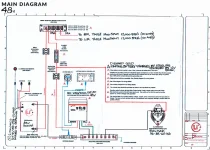
This is the preliminary wiring diagram of the new arrangement. At least I can use all of the other components I already have.

Lithionics 48v Wire Diagram 021823.jpg
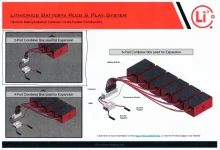
This is what the installation would look like, I will probably use a 4-position combiner box to allow for up to (2) more batteries if I determine that a generator is really not necessary.
Lithionics 51.6v System 021923.jpg
 
I like the idea of the 70gal single tank. When it comes to the frame, remember this is a ladder frame, the structural part is the long side rails. The cross members are mainly there to hold the frame in place. If the cross members were critically structural, they wouldn't have so many holes in them.
I've been considering the options of building my own ~70 gal tank including the installation of fuel cell foam blocks
 
GlenC, As a mechanical and marine engineer, I can tell you that those holes make little difference in the strength of the crossbeams (thwart-ships members). They also have some other functions depending on the actual locations.
After running Chaumière for 17 years and over 80Kmiles, addition fuel tank capacity is not something I would spend money and time on ever.
Matt
 
  • Like
Reactions: Carl Stouffer
Installed 70gal Tank w angled L 022023.webp
This is a view of an installed 70 gal aluminum tank. One existing chassis crossmember has been removed and replaced with a new steel angle has been installed beneath the tank, spanning from one side of the chassis to the other. This installation also shows a sun for fuel collection on the rear drivers side.
I have sketched in a second sump in the forward passenger corner. This revised arrangement should eliminate fuel starvation when accellerating, braking, cornering and going up and down hills. I have also sketched in two diagonal angles to resist torsional loads on the chassis.
According to Jason, he installs a surge tank forward by the motor that should deal with fuel starvation. He is placing orders for 10 tanks with a fabricator. The most recent order has the most advanced version of the tank that he is continuously upgrade. Some of the issues that arose on the earlier designs have been dealt with and no long crop up.
We all know that with the two 25 gal tanks, only 44-46 gal can be supplied to the 455. This is added to the pain of having to switch over to the second tank as the first tank is nearly empty.
 
Good to see that you have worked out some of the inherent problems with a large shallow flat bottom fuel tank. It will be interesting to see how that tank works out. Just a suggestion regarding the sumps you have in the corners of the tank. I'm looking at a flat surface on the forward facing sump surface. Just an added precaution, maybe that should be angled so as deflect road debris rather than catching it?

Thanks for keeping us updated on your progress. Maybe you'd be interested in doing a session at one of the GMCMI conventions? I'm sure a lot of people would be interested in your innovations.
 
  • Like
Reactions: Kendra