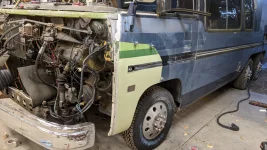
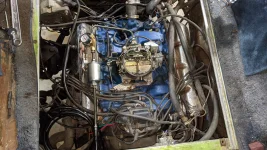
1975 GMC Glenbrook

  • Please note, the forum recently had a problem with outbound emails for notifications, registrations, etc. A new email provider has been set up which should resolve all email issues. If you have any further trouble, please DM Christo or reach out via the Contact Us link in the website footer.
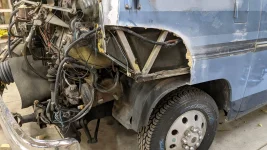
I dug out my patch panel and started sketching out the outline. I'll be cutting the original panel back a ways to get rid of all the fine cracks.PXL_20210509_061605072.webp
 
Paul,
When you finally work out the Heater core thing, post final pics part #'s and core application to this and the other GMC forum. Also maybe to the GMCMI parts exchange. Thats a GREAT find!! A number of years ago I replaced my radiator with an aluminum, and also replaced the 7lb cap with the 16lb recommended for the aluminum. That turned out to be a mistake as it was shortly after that the heater core sprung a leak an had to be replaced. IMO, it might be a good idea to run with a lower pressure cap or cap recommended for the Econoline core that you are using. Just what I think. Looks like you are doing good work. Nice to watch the progress.
 
Paul,
When you finally work out the Heater core thing, post final pics part #'s and core application to this and the other GMC forum. Also maybe to the GMCMI parts exchange. Thats a GREAT find!! A number of years ago I replaced my radiator with an aluminum, and also replaced the 7lb cap with the 16lb recommended for the aluminum. That turned out to be a mistake as it was shortly after that the heater core sprung a leak an had to be replaced. IMO, it might be a good idea to run with a lower pressure cap or cap recommended for the Econoline core that you are using. Just what I think. Looks like you are doing good work. Nice to watch the progress.

Larry, what radiator did you use?
 
Paul,
When you finally work out the Heater core thing, post final pics part #'s and core application to this and the other GMC forum. Also maybe to the GMCMI parts exchange. Thats a GREAT find!! A number of years ago I replaced my radiator with an aluminum, and also replaced the 7lb cap with the 16lb recommended for the aluminum. That turned out to be a mistake as it was shortly after that the heater core sprung a leak an had to be replaced. IMO, it might be a good idea to run with a lower pressure cap or cap recommended for the Econoline core that you are using. Just what I think. Looks like you are doing good work. Nice to watch the progress.
Thanks, Larry. The Spectra part number I'm using is 94584, and was available from Oreilly's as a Murray #94584 as well. Pulled it out of the box, and it had the Spectra sticker on it anyway (should be shown in the pics in previous post).

Thanks for the words of wisdom about the radiator cap. I'll have to double check mine, and make sure it's up to the correct specs. I don't trust anything based on some of the PO mods I've seen so far. Someone at some point spent tons of money on this thing and bought all the best, most expensive kits available. Someone else followed it up with hack job after hack job. It's been an interesting mix.
 
PXL_20210512_014519365.jpg

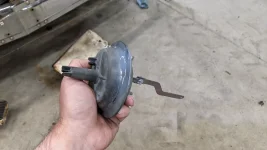
I fixed up the old dual diaphragm actuator. My 4 y/o son helped pick out the new o-ring for the inside, and was elated when he landed on the right one. This thing feels so much smoother than the new junk Old Air sent me. Sealed it up with epoxy, disassembled and reassembled the heater box once more, and we're in business. It actuates fully without jamming. Hopefully I can get my $80 back.

PXL_20210511_003732175.jpg

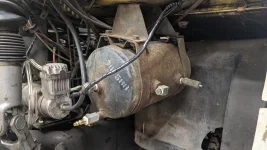
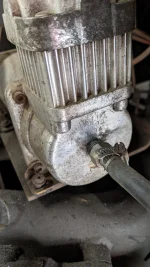
The Airlift compressor turns out to be a rebadged Viair 325C, so that made finding new rubber feet on eBay pretty easy. They don't get much worse than this, no hint of rubber anywhere.


PXL_20210512_025514569.jpg

I carved out the cracks in the side panel and cut it to fit my patch. I may try to repair that battery cable while it's accessible. I'm considering a Ragusa triple tray up front with a 12V engine battery and two 6V house batteries. That might make the old cable excessive for starting the generator or running the house, so I haven't completely decided how I'll handle it.


PXL_20210512_033416732.jpg

I've mocked up the patch panel with butt weld clamps. This whole project is starting to seem feasible.
 
  • Like
Reactions: tmsnyder
Paul,
If you put the big battery tray there, use it for other storage. Keep the house bank in the rear and get the full pull tray for the batteries back there. You can save the weight on the front.
Matt
The front has had quite a bit of weight already removed for other reasons, and I'm pretty set on utilizing the triple tray for its intended purpose. The space in the back hatch will house a similar weight in tools, something I'll need more regular access to. I don't intend on swapping the batteries very often, so I'll use the less convenient storage area in the front for those.
 
Question:
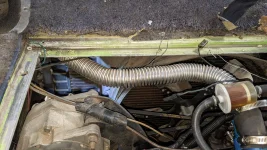
Can you still call them "tranny cooler lines" if they're touching the headers? :cautious: Time to order a whole roll of tubing I suppose.
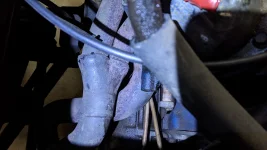
PXL_20210513_035528597.webp


I also noticed the fan shroud doesn't cover the whole radiator. Great, another hack job I get to redo.


PXL_20210513_040214954.webp
 
Last edited:
Question:
Can you still call them "tranny cooler lines" if they're touching the headers? :cautious: Time to order a whole roll of tubing I suppose.

View attachment 4414


I also noticed the fan shroud doesn't cover the whole radiator. Great, another hack job I get to redo.


View attachment 4415
Unfortunately that fan shroud not covering entire radiator is a factory gm oem thing.
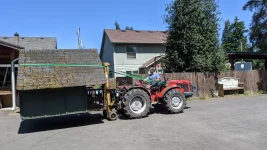
 
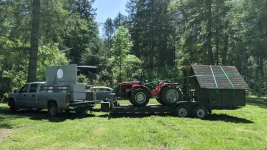
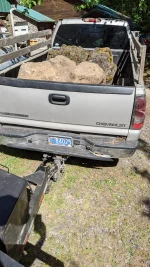
I didn't get to the fiberglass this weekend as I planned. It was a busy weekend for the truck and tractor instead. Transported a playhouse that was passed down to us, then took possession of some boulders another friend wanted to get rid of.

PXL_20210515_194632031.MP.webp

PXL_20210515_214036655.webp

PXL_20210516_230955282.webp

I really put the 496 and Allison to work coming up the hills! Combined weight was around 20k, and it did pretty good. I couldn't help but think the 496 would make a great transplant into the GMC.
 
I did get just a little time with the GMC. I fixed the wiring for the under hood light and got it working. I also installed a universal washer fluid tank/pump/switch with the original wiring. Worked great, and I was able to spray an unsuspecting three-foot looky-loo with some refreshing water on this hot day.

I also undid the POs fuel pump wiring. It was wired to the taillight fuse with a switch. I'll have to figure how I want to wire it.
 
Is that a 454 you stroked? What year truck?
It's a 2004, factory engine with 306k on it. It is effectively a stroked out 454 block, but with more LS type tech grafted onto it. Cathedral style heads, coil packs, etc. Average mileage with the crew cab long bed with mud terrains is 8.5 though. That's a lot of barrels if you add it up over the course of 306k miles.
 
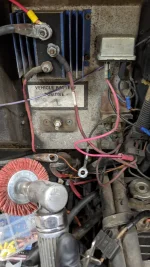
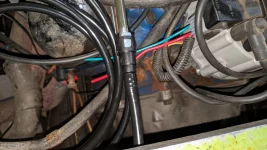
I've been working on tidying up all the ring terminal connections. I didn't expect that even the horn relay was used as a terminal block. Interesting. Both sides of every ring got cleaned up with the nylon wheel. Everything got a light coating of dielectric grease upon reassembly as well. Hopefully it will all age more slowly this time. The good news is the alternator actually puts out 13ish instead of 17ish now. It seems the fusible link didn't supply the terminal block on the horn relay very well, which seems to be where the alternator gets its feedback.
PXL_20210522_173927086.jpg

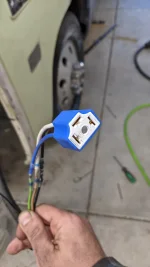
The headlight connectors weren't worth saving, so I've got some new ceramic H4 connectors now.
PXL_20210523_031552723.jpg

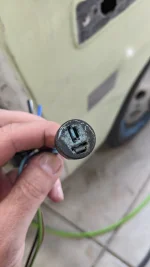
I haven't really decided what I want to do with the turn signal connectors yet. They're bad on both sides of each connection. I don't want to replace four connectors with the stock setup that isn't watertight. I might switch to another connector style, or I might just solder everything together.
PXL_20210522_012914187.jpg

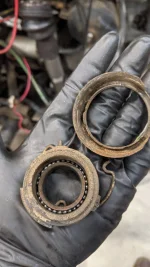
The lower steering column bearing was a little dry, crusty and loose. The new one went in pretty easy. This was probably the smoothest task I've ever completed on this motorhome. The new bearing was dry as well, so it got thoroughly packed before assembly.
PXL_20210522_192408418.jpg

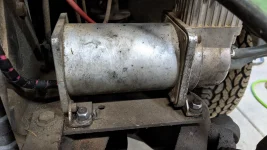
I got the rubber isolators replaced on the Viair too. This was more of a pain than it should've been, due to poor planning by whoever mounted it. I didn't feel like relocating it however.
PXL_20210523_031628217.jpg

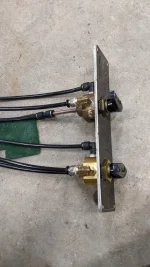
I also got the air suspension valves patched up and ready to go.
PXL_20210523_041411005.jpg

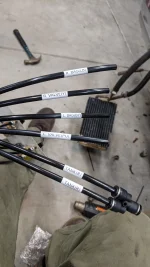
The air lines lacked a service loop and have probably already had some slack trimmed away over the years. The tubing in the firewall area was a bit scarred up too. I cut about 18" off the end of each line, then attached about 24" of fresh line onto each port of the control valves. I also decided to have a little fun with my new label maker to allow for easy installation later on.
PXL_20210523_041352174.jpg
 
Last edited:
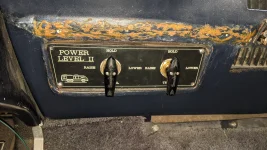
I finally got the valves fitted back where they go, and wound up losing a couple of screws. Ugh. I'm happy to report all is well, in all valve positions! No leaks, and the travel position seems to work great now. I'll have to see if it needs calibrated once it's on flatter ground.
PXL_20210528_023513146.webp

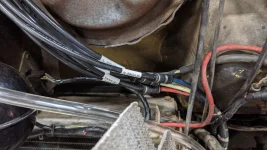
Everything is nicely labeled and spliced in an easy-access area this time. I've been doing a lot of tidying up with spiral loom as well.
PXL_20210528_023615835.webp

One of the pressure switches was oddly mounted way up on the firewall with a whole bunch of leaky tubing connecting it up. With a 1/4 x 1/8 bushing, I moved it down to the tank and eliminated that nonsense. The drain valve also discharged through a 1/4 FPT fitting, so I added a compressed air plug for easy filling. That sure made it easy to experiment with the air suspension using shop air, since the coach was presently without its battery.
PXL_20210528_023732357.webp

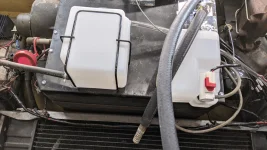
New coolant expansion tank to replace the old cracked one, and a bit more tidying.
PXL_20210528_023641932.MP.webp

Tonight I think I'll work on some fuel plumbing. I've been collecting parts and new tools...
 
PXL_20210529_041309974.jpg
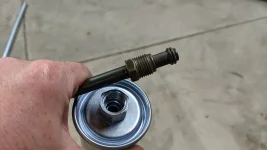
I've been having some fun using all the different parts of my Mastercool hydraulic flaring set. I did some o-ring flares for the 80s and 90s 3/8" metric fuel filters. It was difficult to source the standard/metric tubing nuts locally, but I like having a 3481 filter that's ubiquitous and cheap. It also installs with way less torque than inverted flare fittings. I could swap one easily with my leatherman.


pxl_20210529_053246832-jpg.4561

I've made a goal to eliminate 100% of pressurized rubber fuel line. I had to get a shorter-bodied fuel inlet for the carburetor since the waterneck is so darn close. I can only bend so close to the fitting with my bender. I can't complain about the results of the 90s I was able to bend. Not bad for a cheap bender.

I didn't want to run 100% hard line from engine to frame due to movement and fatigue. So, I decided to form a custom nylon line with quick-connect fittings. They're pleasant to use as well--when they're new at least.


PXL_20210529_043947796.jpg
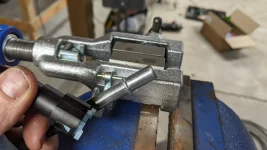
The first flare was a success, though I didn't polish off the PVF coating at first, and it got REALLY stuck in the forming die. The second one was better, I ran the tubing on the wire wheel on the bench grinder, and oiled it before I flared it. It still got a little stuck, but didn't take any great efforts to remove.


PXL_20210529_053255348.jpg
The flexible line went on with a very satisfying click. Getting the nylon onto the barb seemed like it had potential to be challenging, but I was able to rig it up OK by misusing my Mastercool kit again.


PXL_20210530_013652117.jpg
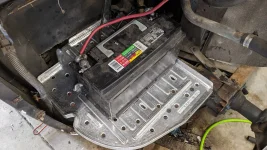
I finally installed my Ragusa tray. I'm glad I didn't have to fabricate anything from scratch as that would've just taken more time, but I am a little disappointed with it. There are no provisions for battery hold-downs, and the bolt holes didn't even come close to lining up. Who can say why. I also find it curious that they provide no instructions. Not that I need any personally, I just find it odd. I think this big battery will be destined for the dump truck. It's probably been overcharged a few times, and doesn't fit in the slot they reserve for the engine battery. It's now sitting where a pair of 6V batteries will eventually go.

PXL_20210528_050301016.jpg
This is my original bracket arrangement. Since none of the bolt holes lined up with the tray, I decided to swap the brackets with each other front to back. This spread out my bolt pattern by several inches, which I felt better about. I also counter-sunk some flat-head socket cap screws into the tray (previous photo) so I wouldn't be annoyed by protruding bolt heads. I really feel like this should be the design from the factory, but alas, it is not.


PXL_20210529_225544914.jpg
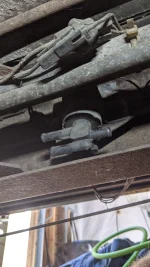
Moving toward the rear with the fuel plumbing, I discovered some more PO sins. The selector valve had been abandoned, and all three lines were hooked to A TEE! It seems like as soon as one of the tanks was empty, you'd be hard pressed to draw any fuel from the other tank. So hills could've been bad news! A little work with the wiring and selector switch saw the valve working again. I checked it with air and it seemed to switch over just fine. It's all hooked back up again now. I also remounted my Holley pump with something other than zip ties since I'm not stranded on the freeway at 2 AM this time around.
 

Attachments

  • PXL_20210529_053246832.webp
    PXL_20210529_053246832.webp
    1.2 MB · Views: 90
Last edited: