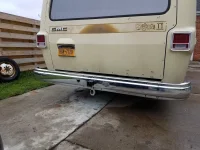
1976 Eleganza II

  • Please note, the forum recently had a problem with outbound emails for notifications, registrations, etc. A new email provider has been set up which should resolve all email issues. If you have any further trouble, please DM Christo or reach out via the Contact Us link in the website footer.
Todd,
Why would you need timing on other cylinders? The only time I have cared about that was to adjust valve lash.
Matt

I'm talking about setting the engine timing using cylinder #5 instead of #1.

The timing mark used to set timing on #1 cylinder is impossible to see on the front / top of the engine. I've looked a few times and I just can't see how anyone could shine a timing light on that. In fact, I don't even see a tab. All I see is a small cylinder on the block, pointing at the centerline of the crank, at the harmonic balancer. Maybe this is for some sort of factory pickup. Idk. It's useless to me anyway.

The problem is not unique to GMCs. To account for the difficulty in timing down through a doghouse in a motorhome, the Chevy P30 chassis for motorhomes are timed on cylinder #5 instead of #1. That puts the timing tab 90 degrees clockwise from the location of #1 tdc on the balancer, down at around 4 oclock where there's easy access the balancer from underneath the coach. They mount tab there for timing on #5.

I thought it was sort of a pain when I owned one (Holiday Rambler Class A) but now that I have a GMC I actually miss being able to set the timing from underneath. Or at least check it to see where I ended up.

The thing in the picture bolts near the harmonic balancer. It's just a big timing tab. All it is, is a curved steel strip mounted 1/4 off the balancer. I've painted it white since the picture. I'll have to pull all the spark plugs and use a piston stop to find TDC from both directions on #5. That'll give me 0 degrees and I can use math to mark off the timing marks.

You mentioned a way to measure it from above, that would be handy, but I don't really want to take a hole saw to my tranny bell housing.
 
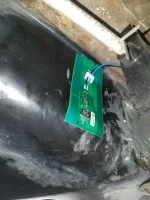
This is the only timing tab I have on my engine. That blue cylinder is pointing at the balancer, maybe it takes some sort of electronic pick-up that I don't own.

20210501_115556[1].webp

Here is the timing tab I made, hoping it will be in a good spot for timing on Cylinder #5 but looking at it in the photo it might end up being better for #7. Maybe I'll even have to modify it to cover a different portion of the rotation:

20210501_115459[1].webp
 
This is the only timing tab I have on my engine. That blue cylinder is pointing at the balancer, maybe it takes some sort of electronic pick-up that I don't own.

View attachment 4333

Here is the timing tab I made, hoping it will be in a good spot for timing on Cylinder #5 but looking at it in the photo it might end up being better for #7. Maybe I'll even have to modify it to cover a different portion of the rotation:

View attachment 4335
The cylinder is a red herring. Look beyond it, and I think I see the curved scale with the teeth on the edge for reading your timing. You're not wrong, it's terribly located. I like your homemade version much better. Since it lacks a scale, I assume you're using the timing gun with an adjustable timing offset?

You may already be familiar with the process, but for posterity:
If you make a new mark on your crank pulley, you can time off whichever cylinder you desire. You could even stick with #1 for simplicity. Insert a piston stop in your #1 spark plug hole, turn the motor till it stops, make reference marks between the pulley and your new timing tab, then turn the motor the opposite direction until it stops again, and make a new mark on the scale that lines up with the previous mark on the pulley. Between these two marks is your true TDC for #1. The piston stop can be fine tuned to get the marks as close to each other as possible to reduce error in the averaging of the two marks.
 
Last edited:
  • Like
Reactions: tmsnyder
Todd,
I just sent you the copy of an article that I am working on that very much pertains to your situation. When you see what this can do, you may change your mind about the hole. It makes a very comfortable situation.
Matt
Do you have another copy you could send my way, Matt? I could blunder my way through the process, but why reinvent the wheel when someone else has paved the way of drilling a hole in the bell housing? Even just a picture would probably aid me significantly. I've had visions of timing our finicky beast with great ease, and by myself.
 
The cylinder is a red herring. Look beyond it, and I think I see the curved scale with the teeth on the edge for reading your timing. You're not wrong, it's terribly located. I like your homemade version much better. Since it lacks a scale, I assume you're using the timing gun with an adjustable timing offset?

You may already be familiar with the process, but for posterity:
If you make a new mark on your crank pulley, you can time off whichever cylinder you desire. You could even stick with #1 for simplicity. Insert a piston stop in your #1 spark plug hole, turn the motor till it stops, make reference marks between the pulley and your new timing tab, then turn the motor the opposite direction until it stops again, and make a new mark on the scale that lines up with the previous mark on the pulley. Between these two marks is your true TDC for #1. The piston stop can be fine tuned to get the marks as close to each other as possible to reduce error in the averaging of the two marks.

That shot was from a cell phone camera pushed up past the fan shroud, I wouldn't put that camera there if the motor was running let alone my eye! So if the timing tab didn't show up clearly in that photo, it is totally useless for timing with a light.

You noticed that the tab I'm making currently lacks a scale. That's because I'm in the middle of the process of building it. Once I find TDC I'll indicate where the mark on the dampener lands for that cylinder. (You can use any cylinder to set the timing) From TDC I'll use math to make marks for the degrees BTDC.

I don't trust dial back timing lights. I've heard of people fighting with timing problems only to finally figure out it was the timing light.

Yes that's how you use a piston stop as you described. Except I would remove all the spark plugs to make the engine easier to turn over. So as to have a better feel for when the piston is coming up and kissing the stop. The piston is at the end of its swing on the crank at that location, there's a tremendous amount of mechanical advantage at that point. I wouldn't want to damage the piston by bringing it around too forcefully.

Right now I've been sidetracked cleaning up the rear bumper frame and building a Merrill-style hitch.

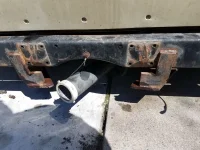
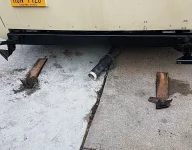
First had to cut off the remnants of a PO's hitch. Their hitch was one way to do it I guess. They basically ran 3/4" thick steel flat bar stock diagonally forward to pick up the cross brace frame members. The point of the V must have protruded from under the bumper ending with a hole for the ball. Pretty crude welding job, what a pita to get most of it off the coach. There's two small-ish hunks of steel welded onto the frame braces which I left in place.

At some point someone cut the hitch off at the rear frame without removing the rest of the hitch which was welded to the frame.

Here's before:
20210501_145359.jpg


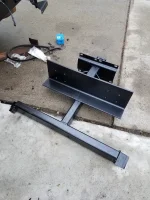
Here's after, with the steel on the ground:
20210501_175222.jpg
 
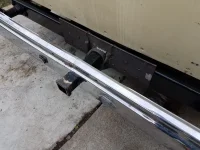
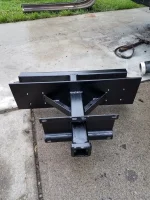
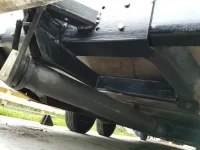
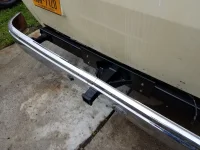
So the last few evenings I got the hitch built. Using all steel I had on hand except the $40 receiver tube. I painted it with Chassis Saver which was $60 for a quart, but I only used less then 1/4 of it; $15 worth. So all in I'm at about $55. (Not counting about 12 hours of time and a couple thousand in equipment, welding wire, gas etc etc it was almost FREE!! LOL)

20210505_074937.webp20210505_074946.webp20210505_082249.webp20210505_082216.webp20210505_082359.webp

I still need to bolt on the spare tire carrier so it's only half bolted. It needs a coat of paint first.

Once that's on there and all the bolts are installed, it'll be time to try the little Honda bike on there!
 
  • Like
Reactions: ScottC and rodknu
So the last few evenings I got the hitch built. Using all steel I had on hand except the $40 receiver tube. I painted it with Chassis Saver which was $60 for a quart, but I only used less then 1/4 of it; $15 worth. So all in I'm at about $55. (Not counting about 12 hours of time and a couple thousand in equipment, welding wire, gas etc etc it was almost FREE!! LOL)

View attachment 4348View attachment 4349View attachment 4350View attachment 4351View attachment 4352

I still need to bolt on the spare tire carrier so it's only half bolted. It needs a coat of paint first.

Once that's on there and all the bolts are installed, it'll be time to try the little Honda bike on there!
Nice job, that looks great!
 
The refrigerator dumped all its ammonia just as we were heading off for a weekend camping, had to use coolers, which really made us appreciate the refrigerator.

We got a Norcold NA7LXR from our local family owned RV store (Mantelli Trailer Sales in Lockport, NY) They were able to price match what I was seeing online and it was very appreciated, they are a great asset to have locally.

It's a 7 cf refrigerator. I got it based on my brother's GMC which has a Norcold 641.3 in it, this is supposed to be a direct replacement so it _should_ fit.

Well, "should fit" turned out to be "fits with modifications" .

In retrospect I wish I'd pulled the old fridge first and taken a really hard look at the interior dimensions of the cabinet, and given some thought to the drafting of the air at the back of the cabinet and up out the roof vent. This seems to work, but I probably should have gone with a smaller fridge, maybe one without a freezer door.

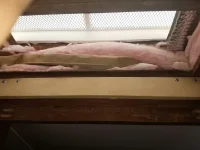
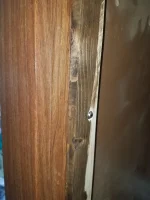
This first picture is the upper right corner above the fridge opening. I've popped off the top trim board b/c the refrigerator opening actually needs to be where the arrow is. I hit the screws with the multitool which seemed to loosen them up and then tapped them down flush with a hammer.
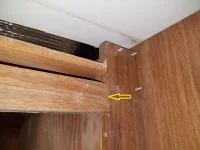
20210512_160428.jpg

The sucky thing is, that horizontal header board is a half lap board built into the cabinet. It's definitely a structural part of the cabinet. The plywood above it is also structural, so it will have to do the job itself. I used an oscillating multi-tool to cut the header board cleanly from the backside, and then used Kreg pocket screws to mount it so the bottom of the header was at the arrow, giving the opening needed for the refrigerator height.

I ripped the face mounted trim board to 3" and mounted it with two black drywall screws. (Ignore the fridge, the photo was taken later in the process)
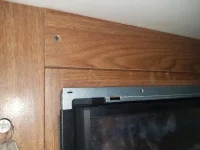
20210514_105830.jpg

The width needed to be brought in so I ripped a slice of 2x4 and grooved one edge about 3/16 so it would be flush with the face of the cabinet and also tight against the inside of the cabinet interior. Iirc, the remaining thickness needed to be 5/8, so I ripped the 2x4 13/16 or so. And stained with dark walnut so it's ~"close" Not perfect but hey, we're camping, not building a show car.
20210514_105353.jpg

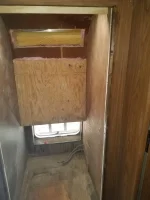
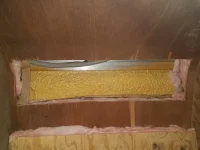
When I say this fridge doesn't really fit, this is the biggest problem; it hits the back curved interior wall of the cabinet. I had to cut out a rectangle so the coils would clear. This means that now that area is part of the venting. Hot air from the flame and heat from the coils needs to set up a draft and keep air moving over all the coils on the rear of the fridge in order for it to work properly. Similar to a chimney on a fireplace needs to draft properly in order to carry the smoke up the chimney and out of the house. Otherwise it won't work well. To keep the draft functioning (I hope), I sealed off the other spaces with fiberglass insulation including around the roof vent hole. So the space between the cabinet plywood and the foamed aluminum exterior is now included in the draft, and that area is sealed off with strips of fiberglass. I also added a baffle at the roof vent, down from the top of the cabinet to the top of the refrigerator. You can just see it at the top of the photo, it's the lighter colored wood. And added a large baffle at the rear of the cabinet, vertically, within an inch of where the coils will be.
20210514_105241.jpg

20210514_105251.webp

20210514_105259.webp

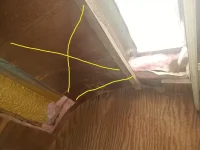
This part of the thin plywood top of the cabinet probably could have been cut out and tossed. The air is going to vent through the rectangular cutout and up through that air gap above it and then up and out the roof vent. The wood shouldn't impede the air flow much, but it is adding some strength to the cabinet so I left it in place.
20210514_105312.webp

I used a set of casters with one of my brew kettles mounted to it, as a support to roll the fridge in front of the opening so it could slide into the opening. Definitely worth the effort, b/c it was a pita to wrestle this thing into the hole without it.
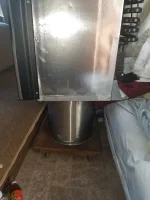
20210514_105327.jpg

After getting the fridge in the hole and installing the plastic upper and lower trim pieces, the lower piece interferes with the bottom cabinet hinge GODDAMMMIT!
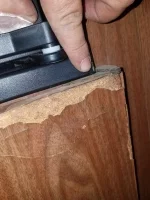
20210514_145939.jpg

So I found some white board which is about 1/8 thick, and ended up cutting the door fronts from it, and using the scraps for two shim boards for the front and rear of the fridge, to raise it 1/8 inch. In retrospect, I wish I'd raised it 1/4 inch b/c the hinge still rubs. It works with the 1/8" shim, but 1/4 would have been better.
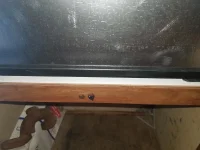
20210514_145317.jpg

The left edge pulls off the fridge doors in order to slip in the door covers. All the photos online show the door covers installed, I was not expecting it to show up without covers. They are $80 for a set! We'll use this whiteboard for a while, the kids like to use them as dry erase boards anyway. If I get sick of the white, I'll spray them black. The bottom door is pretty good, the freezer door panel is all beat up but good enough for now. It's just what I had kicking around. Should be better after I clean them.
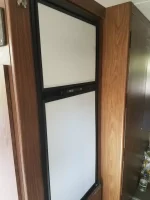
20210517_082953.jpg

On the backside, I had to make a short extension to the LPG line, and also soldered on extensions to the 12V wires, and soldered on 1/4 female spade connectors.
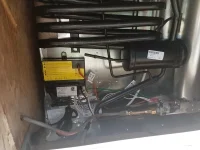
20210514_140001.jpg

It seems to be working fine, time will tell. Hope this helps if someone has to do something similar.
 
Last edited:
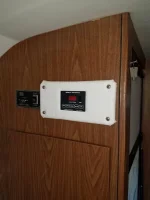
SeeLevel II installation

$200 for the kit if I got the one with the pump switch that won't be used.

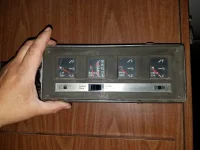
Old level sensors were shot, price of replacement senders is too high, this system uses sensors which stick to the side of the plastic tank. No holes to drill in your tank. Readout is 0-100 in 1% increments. One wire communications with the display! All the sensor wires are soldered together into the single blue wire.

Removed old panel:

20210514_212352.jpg

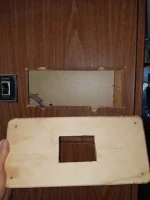
Cut a scrap piece of plywood, radius corners, and edges with router:

20210515_101146.jpg

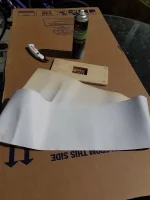
Wrap with the headliner material:

20210515_101607.jpg

Well, that's pretty terrible, time to start starting over:

20210515_104054.jpg

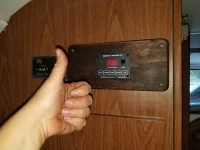
I'll just go with dark walnut stain on another piece of plywood:

20210515_130702.jpg

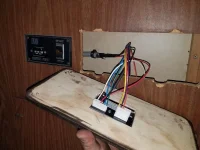
Good enough. Time to wire up the panel. Pulled the #3 12v fuse to cut the power. Cut off the old connector and soldered the purple power wire to the red SeeLevel wire. Black to black. White to the green for LPG. And both wires from the tanks, red and yellow, were soldered to the blue SeeLevel wire for communications to the sensors. Mine came with extra wires for a 3 way pump switch and light that won't be used. And a button for Grey water that won't get used. The panel without the switch was not available or cost 2x as much for some reason.

20210515_130612.jpg

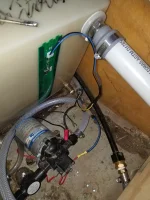
Put the fuse back in #3 and voltage worked right away, and there's a reading for the LPG but it needs calibrating at the next fill-up of the tank. Now for the main reason I got this; the freshwater tank. Sensor is 12 inches full length, tank is 13-14 inches so it's perfect. Soldered and shrinkwrapped the two wires at the tank, yellow to blue and black to black. Cleaned the tank side and stuck it on about 1/2 inch from the bottom:

20210515_133253.jpg

It worked right away! Reads exactly what's left in the tank.

Now for the black water tank. The sensor can be cut off in 1.5 inch intervals, in between pads on the sensor. I cut this one off at 4.5 inches and snipped the ear off to let it know it was going on the BLK tank. That's how they can communicate on one line, you program them by cutting the tab off the sensor. Soldered and shrink wrapped brown to blue (color is red at panel, changes to brown at tank) and black to black. Cleaned off the tank and stuck to left side of valve. (the BLK ear is still intact in this photo, I cut it off with a utility knife shortly after this photo)

20210515_142047.jpg

Tank was empty but reads 22 on the display, ..... hmmmm... Filled it with water from the fresh water tank, watched the fresh water level go down to 0 and started sucking air right at 0, cool! But black water tank still reads 22, then down to 19 ..... hmmmmm.

Checked the diagnostics on that sensor, reads 50% power (normal) and 8 pads long! 8x1.5 is 12 inches, it still thinks it's full length. Something is wrong with it, so I've contacted Garnet for assistance. TBD. Once this is worked out, Garnet recommends painting right over the whole sensor to seal it all up and prevent corrosion on the circuitry.

Hopefully I will get the black water tank sensor working, but even without it the fresh water tank is working great and I can get by with just that one as long as I fill and dump at the same time.

Update: Garnet sent me a new sensor, and instead of the 12" long one, they sent me a shorter one perfect for this shallow tank. I installed it and it works perfect. Painted over it with a rubberized undercoating to protect the circuitry.

Update 8/2022: Found that the ground wire at the tank was under one of the 4 hold-down bolts of the tank, holding the tank down to plywood. After 46 years the plywood is crushed/shrunk under the washer that the bolt isn't tight. After moving the ground wire to the steel base of the tank, the readout seems steady and reasonable. Tank is fairly empty and readout is 7%. It can be calibrated at fillup, so we'll see how that goes!
 
Last edited:
Garnet got right back to me about the SeeLevel II sensor. Their tech guy says the sensor must be bad if it's not reading its length correctly. And after seeing a photo of the installation, he's sending me their shorter 6" sensor which can be cut off at 4 inches and give better resolution than the 12" sensor cut at 4.5" Sweet!

After getting the rear end up in the air to work on the tank sensor, I noticed that one rear wheel had a dragging brake. It wasn't dragging before..... I found that wheel cylinder was leaking. Whoa, time to do rear brakes!

I rebuilt the forward wheels with new shoes and a 1" wheel cylinder off a 1985 Chevy C20 3/4 ton with 11" brakes. The brake line connection is the same size unlike the 1-1/16 and 1-1/8 I was finding. 1" vs 15/16 is 14% more area.

On the wheel that was dragging, I couldn't get the drum back on. The parking brake cable looked as though it were pulling on the lever and I couldn't get it to back off. The cable was stuck, so it got cut off. No parking brake for now, but the drum went on easily and then was adjusted.

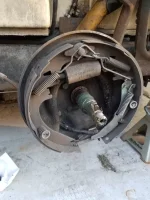
Over to the second forward brake, I found this:

20210518_194154.webp

We seem to be missing some parts, and the parking brake cable isn't even connected! Well, guess I don't feel so bad about cutting that cable on the other side.

Now, on to the rears, just waiting for the shoes to come in.

And start thinking about getting parking brake working.....
 
Todd,

Please be aware that you now have a condition that has some risk....
Without the parking brake, if you take even a minor hit in the driveline, you have no way to hold the coach in location when you shut down.
This can happen if:
- The shift linkage gets misaligned and you can't get to park.
- There is damage to the final drive such that it is not long engaged.
- Any of the four CV joints becomes non-solid.
Unless you have a passenger with a chock at the ready, this can be a serious condition.

All the parts to reassemble the parking brake are available.

Matt
 
  • Like
Reactions: tmsnyder
Thanks Matt, yes it sure would be nice if the P-brake worked. I'll get them working, especially on a slope it would be good to get it held by the p-brake before putting it in park so the pawl doesn't get abused.
 
Todd nice plan , stick to it ! watch out for pit falls . re evaluate and continue. best of luck.. larry 78/455 XPB your Cattaraugus neighbor
 
  • Like
Reactions: tmsnyder