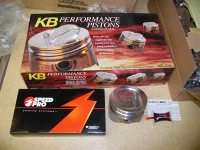
Any help is appreciated.
Based on piston inspection, the compression numbers, and feedback from others familiar with the stock pistons, it appears to have higher compression pistons.
Most likely 9.5:1.
The center dish on the hi-comp pistons measured about .200 taller than the pistons on a 1977 factory GMC 455 motorhome with J heads.
I believe stock configuration for the later model motorhomes is closer to 8.0 or 8.3:1
Typical scenario:
87 octane - 2°
91 octane - 4–5°
91 + octane booster (93) - 7–8°
The engine runs well at around 10°, but detonation begins under load unless base timing is pulled back.
Changing the pistons seems like the obvious solution, but we’d prefer to avoid a rebuild.
It seems likely it will need higher octane fuel regardless, but it appears 93 becomes harder to find when you are traveling west.
Engine / Coach Specs
- Oldsmobile 455
- 1977 GMC Motorhome (Birchaven)
- Quadrajet carburetor
- HEI ignition
- Exhaust Headers
- Cylinder heads recently rebuilt after discovering tuliped intake valves
- #1 intake valve tuliped and leaking
- #8 intake beginning to tulip but not leaking yet
- Compression test results
- 180–190 PSI on 1,2,3,4,6,7,8 cylinders
- #5 slightly lower at 175 PSI
Based on piston inspection, the compression numbers, and feedback from others familiar with the stock pistons, it appears to have higher compression pistons.
Most likely 9.5:1.
The center dish on the hi-comp pistons measured about .200 taller than the pistons on a 1977 factory GMC 455 motorhome with J heads.
I believe stock configuration for the later model motorhomes is closer to 8.0 or 8.3:1
Current Issue
The engine runs strong overall but pings badly under load.Typical scenario:
- Moderate grade
- 2200–2600 RPM
- Not wide open throttle
- Manifold vacuum drops to 5 inHg or less
Fuel / Timing Behavior
Fuel & Base Timing Needed to Avoid Ping87 octane - 2°
91 octane - 4–5°
91 + octane booster (93) - 7–8°
The engine runs well at around 10°, but detonation begins under load unless base timing is pulled back.
What We've Checked
- Carburetor swapped and tuned
- Tested with an alternate known working carburetor
- Rebuilt current carb with the same results.
- Tested with both 50D primary metering rods and 39B, with pinging in both cases.
- Vacuum leaks repaired (17–18 inHg idle vacuum)
- Distributor advance curve logged
- Mechanical advance appears slightly conservative: 11º 1/2 at 2000 RPM, 14° at 2400 RPM.
- Harmonic balancer timing mark verified and has not slipped
- Verified timing light with second light
- Confirmed timing tab on the engine block is in the correct location
- Vacuum advance tested both connected and disconnected, and is about 10°
Observed Pattern
The ping consistently occurs in the 2200–2600 RPM range under heavy loadAdditional Context
I had been running 87 octane before realizing how sensitive the engine is to detonation. It's likely that extended detonation contributed to the tuliped intake valves that led to the recent top end rebuild. When we removed the plugs they were damaged: the ceramic was cracked and the electrodes were completely missing from both #1 and #8.Changing the pistons seems like the obvious solution, but we’d prefer to avoid a rebuild.
It seems likely it will need higher octane fuel regardless, but it appears 93 becomes harder to find when you are traveling west.
Questions
- This does sound like too much compression for a heavy GMC motorhome application?
- What are successful strategies for running 9.5:1 compression pistons in a GMC 455 with the load characteristics of a 12k lb motorhome?
- Would recurving the distributor help reduce this mid-RPM load detonation?
- Are there other tuning strategies worth trying before accepting that this engine simply requires premium fuel all the time
- A couple people have mentioned water/meth injection at load can help cool cylinder temps when needed.
- Are there negative effect to running with octane boosters?