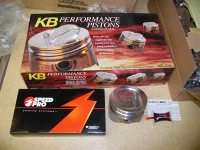
455 with Higher Compression Pistons / Persistent Pinging Under Load

  • Please note, the forum recently had a problem with outbound emails for notifications, registrations, etc. A new email provider has been set up which should resolve all email issues. If you have any further trouble, please DM Christo or reach out via the Contact Us link in the website footer.

mwilkie

New member
Jul 1, 2025
7
4
3
Any help is appreciated.

Engine / Coach Specs

  • Oldsmobile 455
  • 1977 GMC Motorhome (Birchaven)
  • Quadrajet carburetor
  • HEI ignition
  • Exhaust Headers
  • Cylinder heads recently rebuilt after discovering tuliped intake valves
    • #1 intake valve tuliped and leaking
    • #8 intake beginning to tulip but not leaking yet
  • Compression test results
    • 180–190 PSI on 1,2,3,4,6,7,8 cylinders
    • #5 slightly lower at 175 PSI
The engine was rebuilt before I owned the coach and it does not have the stock pistons normally found in a GMC motorhome.

Based on piston inspection, the compression numbers, and feedback from others familiar with the stock pistons, it appears to have higher compression pistons.

Most likely 9.5:1.

The center dish on the hi-comp pistons measured about .200 taller than the pistons on a 1977 factory GMC 455 motorhome with J heads.

I believe stock configuration for the later model motorhomes is closer to 8.0 or 8.3:1

Current Issue

The engine runs strong overall but pings badly under load.

Typical scenario:
  • Moderate grade
  • 2200–2600 RPM
  • Not wide open throttle
  • Manifold vacuum drops to 5 inHg or less
The sound is a sharp metallic rattle/ping that immediately disappears when backing off of the throttle.

Fuel / Timing Behavior

Fuel & Base Timing Needed to Avoid Ping

87
octane - 2°
91 octane - 4–5°
91 + octane booster (93) - 7–8°

The engine runs well at around 10°, but detonation begins under load unless base timing is pulled back.

What We've Checked

  • Carburetor swapped and tuned
    • Tested with an alternate known working carburetor
    • Rebuilt current carb with the same results.
    • Tested with both 50D primary metering rods and 39B, with pinging in both cases.
  • Vacuum leaks repaired (17–18 inHg idle vacuum)
  • Distributor advance curve logged
  • Mechanical advance appears slightly conservative: 11º 1/2 at 2000 RPM, 14° at 2400 RPM.
  • Harmonic balancer timing mark verified and has not slipped
    • Verified timing light with second light
    • Confirmed timing tab on the engine block is in the correct location
  • Vacuum advance tested both connected and disconnected, and is about 10°
Overall the engine appears well tuned, but extremely sensitive to detonation under load.

Observed Pattern

The ping consistently occurs in the 2200–2600 RPM range under heavy load

Additional Context

I had been running 87 octane before realizing how sensitive the engine is to detonation. It's likely that extended detonation contributed to the tuliped intake valves that led to the recent top end rebuild. When we removed the plugs they were damaged: the ceramic was cracked and the electrodes were completely missing from both #1 and #8.

Changing the pistons seems like the obvious solution, but we’d prefer to avoid a rebuild.

It seems likely it will need higher octane fuel regardless, but it appears 93 becomes harder to find when you are traveling west.

Questions

  1. This does sound like too much compression for a heavy GMC motorhome application?
  2. What are successful strategies for running 9.5:1 compression pistons in a GMC 455 with the load characteristics of a 12k lb motorhome?
  3. Would recurving the distributor help reduce this mid-RPM load detonation?
  4. Are there other tuning strategies worth trying before accepting that this engine simply requires premium fuel all the time
  5. A couple people have mentioned water/meth injection at load can help cool cylinder temps when needed.
  6. Are there negative effect to running with octane boosters?
Appreciate any advice from folks who have dealt with similar load/detonation issues like this.
 
Any help is appreciated.

Engine / Coach Specs

  • Oldsmobile 455
  • 1977 GMC Motorhome (Birchaven)
  • Quadrajet carburetor
  • HEI ignition
  • Exhaust Headers
  • Cylinder heads recently rebuilt after discovering tuliped intake valves
    • #1 intake valve tuliped and leaking
    • #8 intake beginning to tulip but not leaking yet
  • Compression test results
    • 180–190 PSI on 1,2,3,4,6,7,8 cylinders
    • #5 slightly lower at 175 PSI
The engine was rebuilt before I owned the coach and it does not have the stock pistons normally found in a GMC motorhome.

Based on piston inspection, the compression numbers, and feedback from others familiar with the stock pistons, it appears to have higher compression pistons.

Most likely 9.5:1.

The center dish on the hi-comp pistons measured about .200 taller than the pistons on a 1977 factory GMC 455 motorhome with J heads.

I believe stock configuration for the later model motorhomes is closer to 8.0 or 8.3:1

Current Issue

The engine runs strong overall but pings badly under load.

Typical scenario:
  • Moderate grade
  • 2200–2600 RPM
  • Not wide open throttle
  • Manifold vacuum drops to 5 inHg or less
The sound is a sharp metallic rattle/ping that immediately disappears when backing off of the throttle.

Fuel / Timing Behavior

Fuel & Base Timing Needed to Avoid Ping

87
octane - 2°
91 octane - 4–5°
91 + octane booster (93) - 7–8°

The engine runs well at around 10°, but detonation begins under load unless base timing is pulled back.

What We've Checked

  • Carburetor swapped and tuned
    • Tested with an alternate known working carburetor
    • Rebuilt current carb with the same results.
    • Tested with both 50D primary metering rods and 39B, with pinging in both cases.
  • Vacuum leaks repaired (17–18 inHg idle vacuum)
  • Distributor advance curve logged
  • Mechanical advance appears slightly conservative: 11º 1/2 at 2000 RPM, 14° at 2400 RPM.
  • Harmonic balancer timing mark verified and has not slipped
    • Verified timing light with second light
    • Confirmed timing tab on the engine block is in the correct location
  • Vacuum advance tested both connected and disconnected, and is about 10°
Overall the engine appears well tuned, but extremely sensitive to detonation under load.

Observed Pattern

The ping consistently occurs in the 2200–2600 RPM range under heavy load

Additional Context

I had been running 87 octane before realizing how sensitive the engine is to detonation. It's likely that extended detonation contributed to the tuliped intake valves that led to the recent top end rebuild. When we removed the plugs they were damaged: the ceramic was cracked and the electrodes were completely missing from both #1 and #8.

Changing the pistons seems like the obvious solution, but we’d prefer to avoid a rebuild.

It seems likely it will need higher octane fuel regardless, but it appears 93 becomes harder to find when you are traveling west.

Questions

  1. This does sound like too much compression for a heavy GMC motorhome application?
  2. What are successful strategies for running 9.5:1 compression pistons in a GMC 455 with the load characteristics of a 12k lb motorhome?
  3. Would recurving the distributor help reduce this mid-RPM load detonation?
  4. Are there other tuning strategies worth trying before accepting that this engine simply requires premium fuel all the time
  5. A couple people have mentioned water/meth injection at load can help cool cylinder temps when needed.
  6. Are there negative effect to running with octane boosters?
Appreciate any advice from folks who have dealt with similar load/detonation issues like this.

Pings under load, unfortunately the motorhome is constantly under load.

In your other thread, I asked about the head gaskets. How thick are they? Standard rebuild gaskets are 0.045". But there are thin ones that are steel shim style. Do you see composite gasket material there? Or steel? Can you get a feeler gauge between the head and block near the distributor?

What is the casting ID on the heads? Maybe they bolted on a smaller chamber head? You may just need a head with larger chamber.

If the builder used thin steel gaskets, you could lower compression just by changing the head gasket.

Also if the cam is installed advanced, you can change that to straight up or retarded to reduce your cranking pressure.

If you want to try to control the ping, applied sells a cool spark controller that detects ping and adjusts timing automatically. Its almost $1000, but will control spark cylinder by cylinder, so if one is pinging and another one isn't, it retards just the one that is pinging. Very cool tech.
 
Last edited:
Any help is appreciated.

Engine / Coach Specs

  • Oldsmobile 455
  • 1977 GMC Motorhome (Birchaven)
  • Quadrajet carburetor
  • HEI ignition
  • Exhaust Headers
  • Cylinder heads recently rebuilt after discovering tuliped intake valves
    • #1 intake valve tuliped and leaking
    • #8 intake beginning to tulip but not leaking yet
  • Compression test results
    • 180–190 PSI on 1,2,3,4,6,7,8 cylinders
    • #5 slightly lower at 175 PSI
The engine was rebuilt before I owned the coach and it does not have the stock pistons normally found in a GMC motorhome.

Based on piston inspection, the compression numbers, and feedback from others familiar with the stock pistons, it appears to have higher compression pistons.

Most likely 9.5:1.

The center dish on the hi-comp pistons measured about .200 taller than the pistons on a 1977 factory GMC 455 motorhome with J heads.

I believe stock configuration for the later model motorhomes is closer to 8.0 or 8.3:1

Current Issue

The engine runs strong overall but pings badly under load.

Typical scenario:
  • Moderate grade
  • 2200–2600 RPM
  • Not wide open throttle
  • Manifold vacuum drops to 5 inHg or less
The sound is a sharp metallic rattle/ping that immediately disappears when backing off of the throttle.

Fuel / Timing Behavior

Fuel & Base Timing Needed to Avoid Ping

87
octane - 2°
91 octane - 4–5°
91 + octane booster (93) - 7–8°

The engine runs well at around 10°, but detonation begins under load unless base timing is pulled back.

What We've Checked

  • Carburetor swapped and tuned
    • Tested with an alternate known working carburetor
    • Rebuilt current carb with the same results.
    • Tested with both 50D primary metering rods and 39B, with pinging in both cases.
  • Vacuum leaks repaired (17–18 inHg idle vacuum)
  • Distributor advance curve logged
  • Mechanical advance appears slightly conservative: 11º 1/2 at 2000 RPM, 14° at 2400 RPM.
  • Harmonic balancer timing mark verified and has not slipped
    • Verified timing light with second light
    • Confirmed timing tab on the engine block is in the correct location
  • Vacuum advance tested both connected and disconnected, and is about 10°
Overall the engine appears well tuned, but extremely sensitive to detonation under load.

Observed Pattern

The ping consistently occurs in the 2200–2600 RPM range under heavy load

Additional Context

I had been running 87 octane before realizing how sensitive the engine is to detonation. It's likely that extended detonation contributed to the tuliped intake valves that led to the recent top end rebuild. When we removed the plugs they were damaged: the ceramic was cracked and the electrodes were completely missing from both #1 and #8.

Changing the pistons seems like the obvious solution, but we’d prefer to avoid a rebuild.

It seems likely it will need higher octane fuel regardless, but it appears 93 becomes harder to find when you are traveling west.

Questions

  1. This does sound like too much compression for a heavy GMC motorhome application?
  2. What are successful strategies for running 9.5:1 compression pistons in a GMC 455 with the load characteristics of a 12k lb motorhome?
  3. Would recurving the distributor help reduce this mid-RPM load detonation?
  4. Are there other tuning strategies worth trying before accepting that this engine simply requires premium fuel all the time
  5. A couple people have mentioned water/meth injection at load can help cool cylinder temps when needed.
  6. Are there negative effect to running with octane boosters?

Appreciate any advice from folks who have dealt with similar load/detonation issues like this.
IMG_2197.webp
Most gas stations in Florida sell Ethanol Free Gasoline. This photo was taken when gasoline prices were much higher than the cost before the Iran war.

If you are adventurous, you could try HHO. This mainly adds additional oxygen to the incoming combustion air but only makes the most sense if you power the HHO generator from solar panels and back up batteries. Chuck Botts increased his mpg to 13.5 with HHO and no solar.

HHO basically increases combustion efficiency, so ping issues may disappear or become minimal.
 
As I mentioned in my other post, I have the same setup as you.
I rebuilt my engine with the high comp pistons. I don't think that was a bad decision - more compression = more power in my book as long as you are within a reasonable window that enables reliability.

Anyway, sounds like your system is all original. I have a FiTech injection unit on mine with the stock HEI distributor. PO died, so no info on previous history but the engine pinged from day 1 for me, despite various attempts to set static timing to correct value. It had been rebuilt (poorly) and I haven't pulled off the heads to inspect after verifying the bad rod bearings that required replacement.

Do you have your vac advance hooked to a ported vacuum (comes on at higher rpms), or directly to manifold vacuum?

My FiTech unit doesn't put out an adequate ported vacuum signal. My expectation is that the vacuum advance will provide advance just off idle, to (in effect) give you a timing advance on accel, particularly off idle. In my experience this is critical (along with the pump shot) to smooth, powerful acceleration.

My only option was to go to full manifold vacuum at idle, a very different scenario as regards timing.
I ended up setting it on the road by ear with the vacuum attached.
Therefore, I'm at full vacuum advance at idle. There are a number of articles on the net about this. Seems like the prevailing opinion is that max vac advance at idle is the best option. I was a tech throughout that period of vehicles. I had to get them vehicles through emission tests while keeping them drivable. It was often a challenge.

My next step is to check my base timing with no vac advance. I'll do that over the next couple of days (we're getting snow today in the PNW) and post it back at you then. Gas is expensive and going up daily, so getting all the power I can out of it is paramount.

There used to be a dial on GM distributors to adjust the timing by small increments. I think they called it an "octane selector". Best gizmo ever! I recall reading about timing in a manual from about then. You were directed to advance the timing until there was a slight ping under hard accel (as in, driving up a hill). I've used that advice to my advantage to get the most advance I can out of whatever I'm using. Should work here but we're all curious about the actual numbers. Is the compression a red herring? Stay tuned...
 
If you are adventurous, you could try HHO. This mainly adds additional oxygen to the incoming combustion air but only makes the most sense if you power the HHO generator from solar panels and back up batteries. Chuck Botts increased his mpg to 13.5 with HHO and no solar.

HHO basically increases combustion efficiency, so ping issues may disappear or become minimal.
I really wish the HHO hype was real, but currently it's not. If HHO generators actually had even half of Chuck Botts claimed 50% mpg increase, and at such a tiny cost, the automotive switchover would've been quicker than the switch to fuel injection. We'd all be driving them. There would be exactly zero manufacturers unable to meet the Corporate Average Fuel Economy (CAFE) standard.


And less gently said and including solar panels:

From a Quora article:
"The process of cracking water takes more energy than you get back. Roughly speaking, only about a third of the electricity pumped from you alternator into an HHO system will come out as useful chemical energy (hydrogen and oxygen that you can burn in the engine.

This hydrogen and oxygen are then burned in the engine with (optimistically) a third of the heat energy from the burning hydrogen and oxygen being converted to mechanical energy by the pistons. The rest goes out the radiator and tail pipe. You’ve now got (at best) 1/9th of the energy your alternator put into the HHO gizmo.

It’s an elaborate way to turn every 100 watts of electricity out of your alternator into (maybe, if the thermodynamics and chemistry fairies like you) 11 watts of extra mechanical power. For comparison, 1 horsepower is 747 watts."

Substitute a GMC roof totally covered
with 1000 watts of solar panels for the alternator, that'd be 110 watts of extra mechanical power.

Sorry, but it's a losing proposition.
 
  • Like
Reactions: Christo
Try adding a bunch of kerosene to the fuel, that will boost the octane rating way better than commercial octane boosters.
 
I really wish the HHO hype was real, but currently it's not. If HHO generators actually had even half of Chuck Botts claimed 50% mpg increase, and at such a tiny cost, the automotive switchover would've been quicker than the switch to fuel injection. We'd all be driving them. There would be exactly zero manufacturers unable to meet the Corporate Average Fuel Economy (CAFE) standard.


And less gently said and including solar panels:

From a Quora article:
"The process of cracking water takes more energy than you get back. Roughly speaking, only about a third of the electricity pumped from you alternator into an HHO system will come out as useful chemical energy (hydrogen and oxygen that you can burn in the engine.

This hydrogen and oxygen are then burned in the engine with (optimistically) a third of the heat energy from the burning hydrogen and oxygen being converted to mechanical energy by the pistons. The rest goes out the radiator and tail pipe. You’ve now got (at best) 1/9th of the energy your alternator put into the HHO gizmo.

It’s an elaborate way to turn every 100 watts of electricity out of your alternator into (maybe, if the thermodynamics and chemistry fairies like you) 11 watts of extra mechanical power. For comparison, 1 horsepower is 747 watts."

Substitute a GMC roof totally covered
with 1000 watts of solar panels for the alternator, that'd be 110 watts of extra mechanical power.

Sorry, but it's a losing proposition.
Did you read Chuck Bott's post on HHO?
 
Back to original topic, our OP is somewhat absent.

I'm suspecting he has the wrong, small chamber heads on the 455 and am interested to learn what heads he has. It's not even necessary to remove the valve covers to see the head ID.
 
As I mentioned in my other post, I have the same setup as you.
I rebuilt my engine with the high comp pistons. I don't think that was a bad decision - more compression = more power in my book as long as you are within a reasonable window that enables reliability.

Anyway, sounds like your system is all original. I have a FiTech injection unit on mine with the stock HEI distributor. PO died, so no info on previous history but the engine pinged from day 1 for me, despite various attempts to set static timing to correct value. It had been rebuilt (poorly) and I haven't pulled off the heads to inspect after verifying the bad rod bearings that required replacement.

Do you have your vac advance hooked to a ported vacuum (comes on at higher rpms), or directly to manifold vacuum?

My FiTech unit doesn't put out an adequate ported vacuum signal. My expectation is that the vacuum advance will provide advance just off idle, to (in effect) give you a timing advance on accel, particularly off idle. In my experience this is critical (along with the pump shot) to smooth, powerful acceleration.

My only option was to go to full manifold vacuum at idle, a very different scenario as regards timing.
I ended up setting it on the road by ear with the vacuum attached.
Therefore, I'm at full vacuum advance at idle. There are a number of articles on the net about this. Seems like the prevailing opinion is that max vac advance at idle is the best option. I was a tech throughout that period of vehicles. I had to get them vehicles through emission tests while keeping them drivable. It was often a challenge.

My next step is to check my base timing with no vac advance. I'll do that over the next couple of days (we're getting snow today in the PNW) and post it back at you then. Gas is expensive and going up daily, so getting all the power I can out of it is paramount.

There used to be a dial on GM distributors to adjust the timing by small increments. I think they called it an "octane selector". Best gizmo ever! I recall reading about timing in a manual from about then. You were directed to advance the timing until there was a slight ping under hard accel (as in, driving up a hill). I've used that advice to my advantage to get the most advance I can out of whatever I'm using. Should work here but we're all curious about the actual numbers. Is the compression a red herring? Stay tuned...


Hi Angus,

Did you ever check your cranking pressure? What was the psi?
 
Nope. Never actually computed the exact compression ratio (utilizing fluid measurements ) either. Just checked to ensure it was in the ball park. I had a good machinist do all the machining. That's critical.
I actually have C heads on my engine. The free J heads I picked up were cracked and that's all I could find at the time. When I was looking at head specs, I saw that all the 455 head chambers are the same EXCEPT one. I don't remember which but it seemed to me they would be quite rare. Mine has the same chamber size as the E heads. They are more desirable for the performance builds but not sure why. I guess no emission mods for starters.

Anyway, the compression numbers aren't generally that much help beyond seeing a large discrepancy or extremely high reading (carbon probably). The tool that really helps in diagnosis is a leakdown tester. I found it invaluable. I would suspect my compression readings are similar to the OP's. Another issue that indicates I'm in the right compression area is seen at the starter. Extreme compression motors will break starters, especially if they kickback.
 
Last edited:
Pings under load, unfortunately the motorhome is constantly under load.

In your other thread, I asked about the head gaskets. How thick are they? Standard rebuild gaskets are 0.045". But there are thin ones that are steel shim style. Do you see composite gasket material there? Or steel? Can you get a feeler gauge between the head and block near the distributor?

What is the casting ID on the heads? Maybe they bolted on a smaller chamber head? You may just need a head with larger chamber.

If the builder used thin steel gaskets, you could lower compression just by changing the head gasket.

Also if the cam is installed advanced, you can change that to straight up or retarded to reduce your cranking pressure.

If you want to try to control the ping, applied sells a cool spark controller that detects ping and adjusts timing automatically. Its almost $1000, but will control spark cylinder by cylinder, so if one is pinging and another one isn't, it retards just the one that is pinging. Very cool tech.
We have as J&S spark controller from Applied. I've set the timing table to where it hardly ever needs to retard. If the OP has his cylinder heads off still he could make a piston stop to see if the timing mark is correct. Ours is sensitive to inlet air temperature and coolant temperature which is why we use a 180 thermostat. Image is of the pistons that are in it, I don't remember ratio and have J heads. Safeguard in action video
 

Attachments

  • piston1.webp
    piston1.webp
    471.3 KB · Views: 3
Last edited:
I really wish the HHO hype was real, but currently it's not. If HHO generators actually had even half of Chuck Botts claimed 50% mpg increase, and at such a tiny cost, the automotive switchover would've been quicker than the switch to fuel injection. We'd all be driving them. There would be exactly zero manufacturers unable to meet the Corporate Average Fuel Economy (CAFE) standard.


And less gently said and including solar panels:

From a Quora article:
"The process of cracking water takes more energy than you get back. Roughly speaking, only about a third of the electricity pumped from you alternator into an HHO system will come out as useful chemical energy (hydrogen and oxygen that you can burn in the engine.

This hydrogen and oxygen are then burned in the engine with (optimistically) a third of the heat energy from the burning hydrogen and oxygen being converted to mechanical energy by the pistons. The rest goes out the radiator and tail pipe. You’ve now got (at best) 1/9th of the energy your alternator put into the HHO gizmo.

It’s an elaborate way to turn every 100 watts of electricity out of your alternator into (maybe, if the thermodynamics and chemistry fairies like you) 11 watts of extra mechanical power. For comparison, 1 horsepower is 747 watts."

Substitute a GMC roof totally covered
with 1000 watts of solar panels for the alternator, that'd be 110 watts of extra mechanical power.

Sorry, but it's a losing proposition.
Hilarious video, thanks for sharing!
 
Did you read Chuck Bott's post on HHO?
I did read it years ago and looked into it back then. I just tried to locate it again online and all the links were broken, even the Internet Archive's Wayback Machine links. If you have a copy of his later corrected version please post it.

AFAIK there are no large engine fleets, diesel or gas, using HHO. There are many, many people selling the systems. If there were even a 10% improvement in mpg the systems would be installed everywhere. UPS, FedEx and every OTR truck would have the systems installed.

What's being sold is essentially a J. C. Whitney "Magic MPG" device.

IMG_7156.webp
 
Nope. Never actually computed the exact compression ratio (utilizing fluid measurements ) either. Just checked to ensure it was in the ball park. I had a good machinist do all the machining. That's critical.
I actually have C heads on my engine. The free J heads I picked up were cracked and that's all I could find at the time. When I was looking at head specs, I saw that all the 455 head chambers are the same EXCEPT one. I don't remember which but it seemed to me they would be quite rare. Mine has the same chamber size as the E heads. They are more desirable for the performance builds but not sure why. I guess no emission mods for starters.

Anyway, the compression numbers aren't generally that much help beyond seeing a large discrepancy or extremely high reading (carbon probably). The tool that really helps in diagnosis is a leakdown tester. I found it invaluable. I would suspect my compression readings are similar to the OP's. Another issue that indicates I'm in the right compression area is seen at the starter. Extreme compression motors will break starters, especially if they kickback.

What cam did you use?
 
They are more desirable for the performance builds but not sure why.
IIRC the C and F heads can come with bigger valves, which would be the case if they came from a factory 442 or Toronado. Heads with bigger valves cut in are rumored to have an X stamped into the rocker arm stand. Probably best to measure and be sure. I don't think any of this would have an affect on the combustion chamber size. The C casting is the C casting, whether or not it's fitted with bigger valves.

Edit: Found the chart I used to reference:
 
  • Like
Reactions: mech0001
IIRC the C and F heads can come with bigger valves, which would be the case if they came from a factory 442 or Toronado. Heads with bigger valves cut in are rumored to have an X stamped into the rocker arm stand. Probably best to measure and be sure. I don't think any of this would have an affect on the combustion chamber size. The C casting is the C casting, whether or not it's fitted with bigger valves.

Edit: Found the chart I used to reference:

The smaller chamber heads were on the small block Olds, but they will bolt right onto a big block Olds taking the chamber from 80-ish to 60-ish cc.

Although the OP hasn't been back since he posted, that's ANNOYING! Hate it when that happens.
 
The smaller chamber heads were on the small block Olds, but they will bolt right onto a big block Olds taking the chamber from 80-ish to 60-ish cc.

Although the OP hasn't been back since he posted, that's ANNOYING! Hate it when that happens.
Christo, has he visited? Maybe just watching?
 
The smaller chamber heads were on the small block Olds, but they will bolt right onto a big block Olds taking the chamber from 80-ish to 60-ish cc.

Although the OP hasn't been back since he posted, that's ANNOYING! Hate it when that happens.
I knew they were the same bolt pattern but not that they actually bolt up. Thanks!