Drinking the Koolaide... 😊

  • Please note, the forum recently had a problem with outbound emails for notifications, registrations, etc. A new email provider has been set up which should resolve all email issues. If you have any further trouble, please DM Christo or reach out via the Contact Us link in the website footer.
The local tire guy is the only place for 50 miles that has the "Road Force" system. But he's also the same guy that can understand why after balancing my tires, putting tire pressure sensors weighing close to one ounce would then put the tire out of balance by that amount.

Also, I had the same vibration before and after installing new tires.

I wish there was a place that had an On-Vehicle balancer.

I'm thinking that 4 Oz on a wheel assembly that weighs about 50 lbs or more is peanuts.
 
  • Like
Reactions: tmsnyder
A few thoughts on my solar system and how it interfaces to the coach...
  • While in storage outside, the panels will generate power in sunlight (duh!). They will keep the house battery topped-off.
  • The starter batteries (one primary and another on the "boost" switch) are FLD and tend to go flat when unattended.
  • One of my house charging systems is a DC-DC charger with a "reverse" function to charge the starter battery from the house battery.
So, I'm thinking of leaving the DC-DC in "reverse" when the coach is stored and the "boost" switch in boost mode. This should allow the lithium house battery to maintain both of the starter batteries at full-charge while itself being topped-off by the solar panels.

Components:

Battery

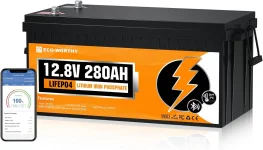
280ah 12.8v lithium x2 (7168WH total so far)
1726073864233.jpeg

Solar panels
Rooftop:
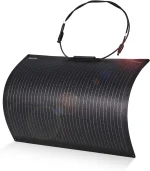
  • 100W x 9 (25v @ 4A each, 3S3P) mix of long and short to fit roof, shade tolerant
  • 55W x 3 (18v @ 3A each, 3S) to fill in the gaps on the roof around the vents, not shade tolerant
1726073978097.jpeg
1757973873671.webp

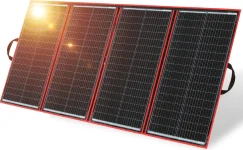
Ground deployable: 300W x 2 (18V 16A each, wired parallel)
dokio.jpg

Solar MPPT controller
Rooftop:
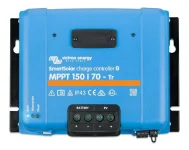
  • Victron SmartSolar 150|70 for 900W array
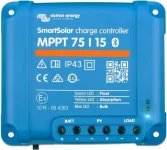
  • Victron SmartSolar 75|15 for 165W array
1751048839468.webp1757974032547.webp
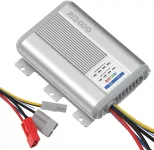
Ground: 26V 40A (also DC-DC charger)
1726074131223.jpeg


Power "converter" charger
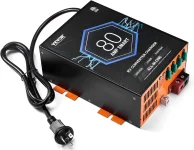
80A charger (Better price on eBay.)

1726698192059.jpeg

Update:

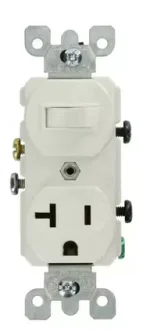
I had to change the socket for the "buzz-box" to a 20A type (with switch for the water heater). The converter draws 12.5A at maximum usage, so the 20A circuit breaker (combined converter and water heater [not in use]) is just fine. Luckily, all of the AC wiring in the coach should be 12ga (which is required for 20A circuits) and it's all short runs from the 50A junction to the breaker box/water-heater switch.
1726773768576.png

All items have been procured and I have successfully run for a weekend (just fridge and freezer) from the battery with no panel attached. So, adding solar charging to the mix should provide adequate boondocking time.

Ordered a 4KW inverter with Line Out connections and a remote display/on-off.
 

Attachments

  • 1757973845587.webp
    1757973845587.webp
    20.3 KB · Views: 0
Last edited:
Installed airbag shut-off valves yesterday.
1726154469873.jpeg
After checking rear ride-height, it turns out my front-end is about an inch or so low. Looks like yet another alignment is in my future as the torsion bar gets tightened.

At least my air-line leaks will no longer leave my coach on the ground after a few hours....

UPDATE October 2024

Front end raised. Now the auto-adjust on the rear bags can be left to function as normal. The vehicle looks much better when sitting still. It also feels a bit better while driving. Just wish I would have known it was sitting too low in the front when I had it aligned the first time. Could have saved myself another $500....🤣
 
Last edited:
Productive Sunday.

Removed roof cargo box.
Removed TV antenna and support bracket.
Removed Radio antenna whip.
Removed drivers-side roof rail.
Removed air-horns.
Adjusted spacing of drivers-side jackknife sofa to allow for proper operation (mounted it too close to the wall the first time even though I knew better; no idea how I screwed that up... šŸ˜–).

The roof is much cleaner now. All screw holes were filled with a stainless-steel rivet with expanding "fingers" to hold it in place and a urethane O-ring with a plastic sleeve, then covered with polyurethane "caulk" to completely seal it.

The cargo box didn't survive; it was already cracked/broken and had been unsuccessfully repaired by a PO. The roof rails and ladder are available if anyone wants them; the ladder is still mounted until I can come up with a good solution for sealing the mounting holes without leaving obvious marks/sealant lumps.

At some point in the next few months I will be replacing the rear AC with another roof vent fan and replacing the front AC with a Gree/Tosot heat-pump. Once that is done (update Nov 26; done!), up go the solar panels (Update May 22; done!).

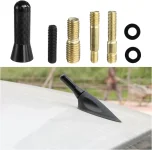
The radio antenna will probably be replaced with a short "rubber duck" or stubby antenna. Maybe move it closer to the front of the cap to make more room for solar panels.
kus1NtOX.jpg
 
Last edited:
  • Like
Reactions: Kendra
Productive Sunday.

Removed roof cargo box.
Removed TV antenna and support bracket.
Removed Radio antenna whip.
Removed drivers-side roof rail.
Removed air-horns.
Adjusted spacing of drivers-side jackknife sofa to allow for proper operation (mounted it too close to the wall the first time even though I knew better (no idea how I screwed that up... šŸ˜–).

The roof is much cleaner now. All screw holes were filled with a stainless-steel rivet with expanding "fingers" to hold it in place and a urethane O-ring with a plastic sleeve, then covered with polyurethane "caulk" to completely seal it.

The cargo box didn't survive; it was already cracked/broken and had been unsuccessfully repaired by a PO. The roof rails and ladder are available if anyone wants them; the ladder is still mounted until I can come up with a good solution for sealing the mounting holes without leaving obvious marks/sealant lumps.

At some point in the next few months I will be replacing the rear AC with another roof vent fan and replacing the front AC with a Gree/Tosot heat-pump. Once that is done, up go the solar panels!

The radio antenna will probably be replaced with a short "rubber duck" or stubby antenna. Maybe move it closer to the front of the cap to make more room for solar panels.
View attachment 12195

Maybe mount the antenna to the outside rear view mirror.
 
Productive Sunday.

Removed roof cargo box.
Removed TV antenna and support bracket.
Removed Radio antenna whip.
Removed drivers-side roof rail.
Removed air-horns.
Adjusted spacing of drivers-side jackknife sofa to allow for proper operation (mounted it too close to the wall the first time even though I knew better (no idea how I screwed that up... šŸ˜–).

The roof is much cleaner now. All screw holes were filled with a stainless-steel rivet with expanding "fingers" to hold it in place and a urethane O-ring with a plastic sleeve, then covered with polyurethane "caulk" to completely seal it.

The cargo box didn't survive; it was already cracked/broken and had been unsuccessfully repaired by a PO. The roof rails and ladder are available if anyone wants them; the ladder is still mounted until I can come up with a good solution for sealing the mounting holes without leaving obvious marks/sealant lumps.

At some point in the next few months I will be replacing the rear AC with another roof vent fan and replacing the front AC with a Gree/Tosot heat-pump. Once that is done, up go the solar panels!

The radio antenna will probably be replaced with a short "rubber duck" or stubby antenna. Maybe move it closer to the front of the cap to make more room for solar panels.
View attachment 12195
Nice progress!

IIRC, Steve Staats asked me if my parts coach had an OEM ladder once, and it did not. Maybe he's still looking for one? You can find him in the Facebook groups, and he's in The Dalles area.
 
Last edited:
  • Like
Reactions: dsmithy
Another direction change...

Looking for opinions.

Roof-mounted A/C heat-pump. RecPro or Gree/Tosot/Premier (made by Gree, imported by Premier and Tosot)? Follow the Gree link for an interesting comparison to older technologies.

I wanted an inverter-compressor and a heat-pump. Apparently, there are no heat-pumps with inverter technology in roof units. Furrion Chill Cube will do cooling only, but isn't yet available for the after-market; OEM only at this time.

The RecPro and Gree units are more efficient than earlier units and more quiet. Amazon currently has the Tosot at $910 ($1110 plus $200 discount). I could add a soft-start to make it more battery-friendly (important down the line).

I had intended to go with a mini-split to clear the roof, but I just don't want the hassle of figuring out a workable system.
 
I've been pondering a cassette style mini split so I don't have to give up a cabinet anywhere to mount an indoor unit. It would need a roof enclosure, but that seems easy enough. I haven't quite found the right one though.
 
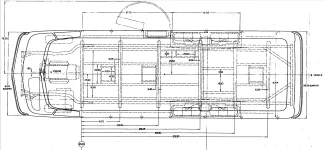
Anyone have a good dimensional drawing of the roof of a 26ft? I found this on GMCMI.
roof.jpg
If I did the math correctly, there should be 21.35" between the front cap seam and the front fan opening, 30.05" between the front fan opening and the front A/C opening, and 102.25" from the A/C opening to the rear fan or A/C opening. I'm trying to find the surface width of the roof from drip-rail to drip-rail (91.84"? 85.5"?).

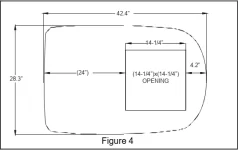
The Gree A/C unit has the dimensions below (flip it to align it properly to the roof drawing). This should result in a space of 78.25" between the rear of the housing and the leading edge of the rear fan opening.
1731111557036.png

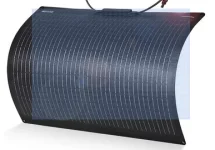
I hope to place flexible solar panels on the roof, following the curve of the roof. The panels have the following dimensions (both sizes have the same electrical ratings):
Short 42.5" x 26"
Long 82.2" x 13.7"

It looks like I can place one short and two long in a "horseshoe" shape in front of the A/C unit. Then, I just have to determine how much space I have to maneuver around the vent pipes between the rear of the A/C and the rear fan (3 short + 2 long?).

This all assumes I have at least 83" of width on the roof.

Update:

Apparently I have 81.4"
1731615526342.webp
 

Attachments

  • 1731615459980.webp
    1731615459980.webp
    5.3 KB · Views: 2
Last edited:
Weekend progress...
  • Final mounting of sofas completed. I can now drop both to make a king bed, and it's solid! And, easily removable since T-nuts were used everywhere (or threaded metal inserts when the holes aligned with frame materials).
  • Replaced key-latch for 50A and city water door. (Small issue, but needed to be done.)
Started tear-down of refrigerator cabinet. Just had to remove the face-frame; I will build a custom panel from 1/2" or 3/4" plywood to retain the new fridge and freezer. Installing wood blocks or a wood strip around the perimeter of the cabinet to give more secure mounting of the new face. Need to add a shelf above the freezer to support the fridge. Add a shelf above the fridge too for the new microwave/air-fryer/convection oven.
 
Last edited:
Just pulled the trigger on a new roof-mount heat-pump. 15K BTU cooling/12K BTU heating. Supposedly 30% more energy efficient than "standard" roof A/C units. It's from Gree (Atmos 4.4/Premier ECO-Cool/TOSOT GO-Cool). The bulk of the energy efficiency seems to come from the R32 refrigerant and from using two smaller fans instead of one large fan to circulate air. It's also about half as loud in operation; many indicating they can barely hear it outside and almost not at all inside.

It doesn't have an inverter compressor (variable speed), so it could still be improved with a soft-start when running from an inverter/battery bank, but the Onan 4K or 6K shouldn't have any problem (a 3K or 4K inverter with a hefty BMS on the batteries should be fine as well).

45A Locked Rotor (startup; very short duration, just like all non-inverter A/C units)
12.5A compressor running (heat or cooling)

It's getting good reviews under all of the brand names; check RV forums and YouTube reviews.

Once it gets installed, I can finally install my solar panels on the roof (had to see how much room I have).
 
Last edited:
Looking forward to hearing how that rooftop unit treats you. I'm purchasing a 23 with no genny (will need to add one), so the ac/heat pump choice will play into that decision. I'm not afraid of creative problem solving, so previously I was planning on a mini split, but between the require headroom for the interior unit and the lack of being able to actually *move air,* I just don't think the minisplit is a good solution at this time (I wish the tech would just get translated to an RV-designed unit).

For your fridge cab, if the layout has your fridge right next to the door, I highly recommend a drawer that pulls out in front of the door for tool or shoe storage (or anything else for "outside" use, so you don't have to climb into the rig to get it).

P.s. Your original post mentions a light to dark ombre paint scheme which sounds very cool and something I'm considering (metallic silver to charcoal on the way down), but hopefully you mask and keep Mr. T; that graphic is legendary in the community (as I'm sure you've learned). šŸ˜‰
 
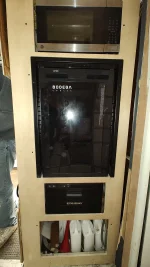
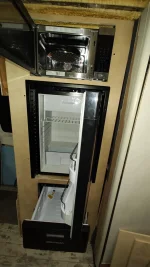
Productive weekend. Reinforced the refrigerator cabinet. Installed additional shelves. Built a new face panel. Installed a drawer freezer, refrigerator, and microwave/air-fryer/convection oven.

I will finish trimming out where it meets the bathroom, add a door at the bottom, and build a new storage compartment next to it (vacuum cleaner compartment). I ran out of time this weekend, but this gives an idea where the project is headed. And, that cabinet is now rock-solid (2x2 supports for the shelves, plus the same along the sides in front).
1000004680.jpg1732035234674.jpeg
 
Last edited:
Heat pump installed. It's quiet! The rear unit will be replaced by a fan later.

In operation, the fan starts first, followed by the compressor about 15 seconds later. It takes a few moments for any heat to be felt at the ducts, but it does get warm within a minute. The air never gets "hot", but it will warm the coach after a bit. I have 12K BTU "heads" on my mini-split home system. That air is also not "hot" but heats the house just fine. Once my generator issues are resolved (runs a bit rough and rich, with bluish exhaust; needs a tune-up) I will test for longer periods of time.
Untitled.jpg
 
Last edited:
Onan issues again...

Generic question first...

How much fuel must be in the tank for the generator to run? I know the pickup tube for the generator is shorter than for the engine so that the generator doesn't run the tank dry, leaving me stranded somewhere. I have noticed that when I have sputtering issues, filling the tank resolves them. I'm currently at half of a tank in both tanks according to the gauge (some tell me not to trust that gauge, but it's been reliable so far). At 3/4 and 1/2 the generator ran fine, but at 1/2 and 1/2 it sputters and dies quickly. I'll fill the tanks to verify that is the only issue.

The original issue...

The rough-running/rich-smelling/blue-exhaust issues were all related to getting too much fuel into the generator. The OEM pump and air-cleaner have been replaced with generic parts; the current pump puts out too much fuel, so a cheap regulator was installed by a PO. Turning the regulator down to almost "0" resulted in a smoother-running Onan and no more non-burned fuel smell or blue smoke. I'd prefer to install a correct pump and remove the regulator. If that isn't possible, I'd replace the regulator with a more fine-tunable regulator (currently adjusted between "0" and "1" on the dial).

New issue...

When the generator is slid-out, the starter won't turn. K indicates he hears the solenoid engage, but the motor doesn't spin. When the drawer is closed, everything works. It wasn't an issue when we started tuning the Onan; it occurred after everything was setup and running smooth. :eek: (I hate whack-a-mole) All I can come up with is that somehow we exacerbated a poor connection in the 12v source to the starter (enough current flowing to engage the solenoid but not enough to turn the starter motor). I should be able to test this by bypassing any harnesses and connecting 12v directly to the starter with the drawer extended. If that works, then I have to trace the harness to it's source and replace/repair it.

General maintenance...

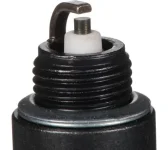
The plugs were cleaned and the gap checked. All OK. I'm probably going to replace the plugs anyway as they have a short electrode; K. suggests plugs with an extension to put the spark further into the fuel "cloud".
1733158416382.png

Suggestions?
 
Last edited:
Onan issues again...

Generic question first...

How much fuel must be in the tank for the generator to run? I know the pickup tube for the generator is shorter than for the engine so that the generator doesn't run the tank dry, leaving me stranded somewhere. I have noticed that when I have sputtering issues, filling the tank resolves them. I'm currently at half of a tank in both tanks according to the gauge (some tell me not to trust that gauge, but it's been reliable so far). At 3/4 and 1/2 the generator ran fine, but at 1/2 and 1/2 it sputters and dies quickly. I'll fill the tanks to verify that is the only issue.

The original issue...

The rough-running/rich-smelling/blue-exhaust issues were all related to getting too much fuel into the generator. The OEM pump and air-cleaner have been replaced with generic parts; the current pump puts out too much fuel, so a cheap regulator was installed by a PO. Turning the regulator down to almost "0" resulted in a smoother-running Onan and no more non-burned fuel smell or blue smoke. I'd prefer to install a correct pump and remove the regulator. If that isn't possible, I'd replace the regulator with a more fine-tunable regulator (currently adjusted between "0" and "1" on the dial).

New issue...

When the generator is slid-out, the starter won't turn. K indicates he hears the solenoid engage, but the motor doesn't spin. When the drawer is closed, everything works. It wasn't an issue when we started tuning the Onan; it occurred after everything was setup and running smooth. :eek: (I hate whack-a-mole) All I can come up with is that somehow we exacerbated a poor connection in the 12v source to the starter (enough current flowing to engage the solenoid but not enough to turn the starter motor). I should be able to test this by bypassing any harnesses and connecting 12v directly to the starter with the drawer extended. If that works, then I have to trace the harness to it's source and replace/repair it.

Suggestions?
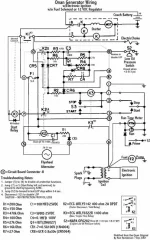
Check the starter mounting bracket, it could be broken. There is also 2 solenoids for the starter to operate. From the schematic posted below, K1 looks like the "boost" solenoids and is mounted near the control board. K1 then activates "K" which is mounted on the starter. You could be hearing K1, but something is preventing it from powering "K".

The Onan fuel pickup is mounted to prevent picking up fuel when the tank is below about 1/4 tank. Maybe there is a pickup sock or some hole corroded in the pickup tube that causes it to lose fuel below 1/2 tank.

Or I could be all wrong!

KH Onan wiring - alternator after fuse.webp
 
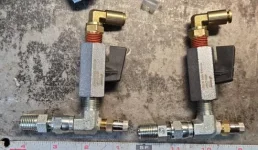
It sounds like your fuel pressures are questionable, so I'd definitely put a gauge on those for now until you can prove it's working reliably within the correct range. Harbor Freight has an inexpensive vacuum/fuel pressure gauge that works at low pressures in both directions. I believe it comes with a tee and some different fittings, perhaps you can tee in and keep an eye on things.

IIRC the fuel pickup is somewhere around 1/4 tank. I've heard some say they can go down to 1/8 tank. There could be an issue with the pickup tube. Or it could be non-original. A fuel pressure gauge would help figure out if you need to start looking in this direction.

It sounds like you're moving in the right direction with the starter. Hot-wiring it will basically serve as a bench test. If it works, you've got wiring to track down. My K3 was busted when I first got the coach. The wiring bundles and board cover were not arranged correctly, and pushing it into the hatch would put pressure on the broken relay and make it stop working. So I had a position-related intermittency just like you.

My Onan also suffered from gummed up linkages. The governor linkage was particularly rusted up and would stick in different positions. The choke linkage also didn't operate smoothly. Either of these can cause a poor running condition.

One thing I forgot to mention when I saw you is the speed-related voltage output. Since these aren't inverter-based generators, they have to be spinning at the right RPM to make the right voltage. When yours is sputtering, it's likely putting out too little, making an undervoltage condition to everything in your system. Some appliances can be sensitive to this--not sure if your new heat pump would be in this category. A worse condition would be if your engine raced though. Mine has been up to 170V or more with the aforementioned governor linkage issue.
 
Last edited:
  • Like
Reactions: Tybalt39
It sounds like your fuel pressures are questionable, so I'd definitely put a gauge on those for now until you can prove it's working reliably within the correct range. Harbor Freight has an inexpensive vacuum/fuel pressure gauge that works at low pressures in both directions. I believe it comes with a tee and some different fittings, perhaps you can tee in and keep an eye on things.

IIRC the fuel pickup is somewhere around 1/4 tank. I've heard some say they can go down to 1/8 tank. There could be an issue with the pickup tube. Or it could be non-original. A fuel pressure gauge would help figure out if you need to start looking in this direction.

It sounds like you're moving in the right direction with the starter. Hot-wiring it will basically serve as a bench test. If it works, you've got wiring to track down. My K3 was busted when I first got the coach. The wiring bundles and board cover were not arranged correctly, and pushing it into the hatch would put pressure on the broken relay and make it stop working. So I had a position-related intermittency just like you.

My Onan also suffered from gummed up linkages. The governor linkage was particularly rusted up and would stick in different positions. The choke linkage also didn't operate smoothly. Either of these can cause a poor running condition.

One thing I forgot to mention when I saw you is the speed-related voltage output. Since these aren't inverter-based generators, they have to be spinning at the right RPM to make the right voltage. When yours is sputtering, it's likely putting out too little, making an under-voltage condition to everything in your system. Some appliances can be sensitive to this--not sure if your new heat pump would be in this category. A worse condition would be if your engine raced though. Mine has been up to 170V or more with the aforementioned governor linkage issue.
After adjusting the fuel, it was outputting 121vac pretty stable (± a percentage of a volt); a little high, but not dangerous.
 
Well, now I'm really confused. The PO mod doesn't have a "K" solenoid. What was its original function? Kelvin pulled an original pump from his spare Onan and it has the solenoid on it. I can use it to troubleshoot, but I can't obtain it.
The K solenoid is mounted directly on the starter, like the 403/455 engine starter. K1 (Looks like the Boost solenoids) is driven by the control board and provides a higher current output to power the K starter solenoid and the choke heater.