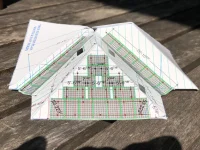
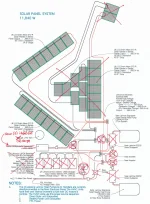
This is a scale mock up of the proposed installation of (32) LGChem 365 Neon R Solar panels. Each panel is rated at 365 watts, so the entire installation has a capacity of 11,680 watts. If the installation is cut in half, the capacity is 5,840 watts.
The GMC Motorhome installation is 1,470 watts.
View attachment 7062
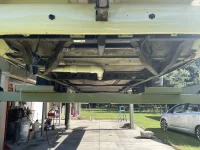
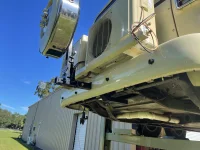
By incorporating my 1976 GMC Eleganca II Motorhome with its 15 SunPower Semi-flexible solar panels, BattleBorn batteries and accessories, the original design in severely downsized. I had estimated the original design at about $85,000.
View attachment 7063
The eliminated panels are facing south, but mounted on the existing 5V Gallalum roofing are pitched at 45°, much too steep for our lattitude.
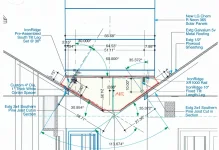
The (2) (8) panels arrays are facing SE (135°) and SW (225°) respecticaly. The are spanning the roof valley, so the slope is reduced to 34.5°. This slope is certainly more acceptable.
In addition, both of these arrays are flanked by the reflective surfaces of the metal roofing. Gallium 5V roofing is galvanized aluminum and is certified by LEED to reflect 2/3 of the solar radiation. Is LEED calculations, this roofing is used to reduce the solar air conditioning load on buildings, mostly residential. The aluminum panels have an expected life of 40 to 50 years, seldom leak and render the roof protect against fire and burning embers.
This design uses the existing 5V roofing to select solar radiation onto the LGChem solar panels. With the paired reflective surfaces on either side of the panels, in a perfect situation, we can expect an additional (2x(2/3)) = 4/3 (1.33) solar radiation on the panels. That is a total of 2.33 times the normal radiation. Therefore, the originally anticipated 5,840 watts may be increased to 13,600 watts without increasing costs.
However, there is a downside. Since these solar panels have only about 22% efficiency, 78% of solar radiation heats up the panels. The panels are designed for this, but not for 233% of the anticipated solar radiation.
I called up LGChem and asked how much the efficiency of the panels would be reduced by the added radiation but he said that it had not been tested. However, the efficiency would be severely affected.
What to do?
View attachment 7064
This is a section through the solar panels spanning the two valleys running SE and SW.
With the increased radiation on the panels, their temperature will rise considerable and may reach the point where the panels may become physically or electrically damaged. Probably half of heats may be radiated up back toward the sun, but that might not be enough, especially if there is no wind.
However, this configuration forms a kind of triangular air shaft/flue rising at a slope of 34.5° and a very strong solar powered draft will rise below the solar panels.
This a way to use natural forces to generate air movement using the cooler air closer to the ground, heating it to make it lighter, causing it to rise and move the uncollected energy, in this example heat, upward. It does not need any wind to make this happen. It just needs the sun. There is not electrical power needed.
Keeping the solar panels at cooler temperature increases their efficiency and therefore that of the entire installation.
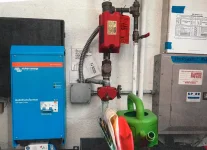
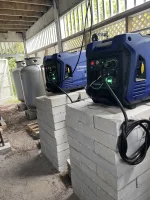
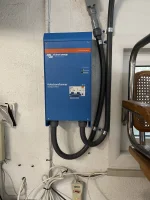
Since all of the battery storage in on the GMC Motorhome, along with the solar controllers, charger/inverter, etc., my motorhome is an intragel component of the solar design.
The battereis will always be with us, whether we are are home or on the road.
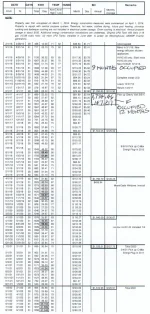
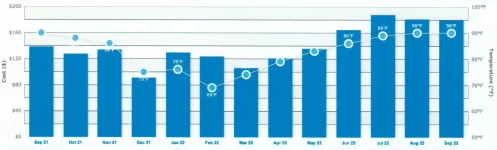
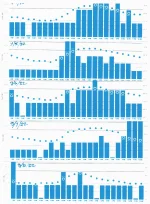
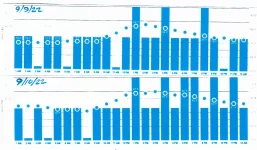
The now demonstrated very low amount of energy being used is now tempting me to go off grid. Wouldn't that be a gas!
Even though we are located in a subdivision in Palmetto, FL, a city of about 45,000, there is no law that prevents us from cutting the chord!