Converting to LiFePO4 batteries and Sailor Man's LiFePO4 Build

  • Please note, the forum recently had a problem with outbound emails for notifications, registrations, etc. A new email provider has been set up which should resolve all email issues. If you have any further trouble, please DM Christo or reach out via the Contact Us link in the website footer.
In order to put things into context, the Motorhome project is only part of a larger project to integrate the motorhome into residence/RV symbiotic pair. I am trying to justify the expenditure on the motorhome to find a use for it when we are not actively using it.
If we use it actively 4 to 6 weeks a year, we won’t be home, but if we are home, I want it to help power the house and provide additional living space for visitors and family.
I can move the Motorhome all around to stay in the sun, which I cannot do with panels fixed to the roof.
Besides, I have been quoted $85,000 to add 32 panels to the roof with (2) Tesla PowerWalls.
View attachment 6998

Since we live near Tampa Bay on a canal, I also envision the motorhome as a lifeboat to run away from a hurricane. We did that once, running from Irma. We need a better way.
Our house is in a mandatory evacuation zone, so I am planning to develop an ultimate boon docking rv that will never require any hook ups anywhere.
I have not yet revealed all of the components of the transformation.
Autotransformer Install 090122.webp
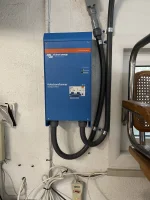
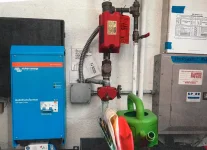
This is the Victron AutoTransformer that is being install in the house. It is capable of handling 100 amps.
It will convert 120v since phase power into 120/240 2 phase residential power.
To the right is alarm system for the Automatic Fire Suppression Alarm connected to the sprinkler system throughout the residence.
Next to it is the Always On emergency power panel.
 
IMG_1663.webp
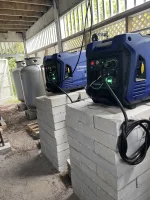
There is an installation of (2) Westinghouse i4500DF inverter generators in parallel. They s=use either lpg or gasoline. When on the ECO setting, the speed of the generator’s motor is adjusted to match the connected load.
Each will generate 3,330 Watts for a total of 6,660 Watts @ 120 volts using lpg. (55.5 ams).
Using gasoline, 3,700 Watts & 61.66 amps.
There are (3) 110 lb lpg tanks.
They are placed on 6’-8” concrete block pedestals because the FEMA maximum storm surge will rise up only 2 or 3 blocks. We are in a hurricane mandatory evacuation zone.
I intend to use the GMC Motorhome’s battery banks, solar panels, generators and if necessary, the 455 as alternate electrical power sources during a prolonged power outage.
 
We are now hearing a lot about “2 way charging” as part of the switch to the ev world.
This GMC Motorhome will be already capable of this.
For the 48v battery bank, I am installing a Victron MultiPlus II 48/3000/35-50 120v Inverter/Charger.
For the 12v battery bank, I am installing a Victron MultiPlus II 2 x 120 120v Inverter/Charger.
 
We are now hearing a lot about “2 way charging” as part of the switch to the ev world.
This GMC Motorhome will be already capable of this.
For the 48v battery bank, I am installing a Victron MultiPlus II 48/3000/35-50 120v Inverter/Charger.
For the 12v battery bank, I am installing a Victron MultiPlus II 2 x 120 120v Inverter/Charger.
Cost Clarification for GMC Motorhome
Some comments have been related to the cost of my conversion, but I need to point out that there are some things that you may not know about.
You may be aware that a motorhome, rv or boat may be considered as a second home by the IRS if it has a functional bedroom, bathroom and kitchen. That allowed me to take the interest on my boat loan I secured for Mistral off my income for taxation.
Also, in Florida, I searched the statues and confirmed that no state sales tax could be collected on a solar collection system for a residence or thereby an RV.
When I was planning to order Lithionics batteries, I informed them that they could not collect Florida State Sales Tax on any of the components, including batteries, solar panels, insulation, chargers, alternators, regulators, cables, battery management system, inverters, etc. Saving a 7% tax was not a small deal.
By the way, this includes labor, design, shipping and all other costs related to a solar installation.
Lithionics contacted their attorney and accountant and agreed.
So the installation of the (15) SunPower panels on the roof makes all of the investment, sales tax free.
In addition, there may be a possibility to use some of the solar grant options, particularly if the motorhome is a primary residence.
This should work in every state, however, how did this all come about. I have to tell you a little story.
In 1973, I was the Chairman of the Energy Committee of the New Jersey Society of Architects. I was also a founding member of the NJ Solar Energy Association. As such, I was appointed by then, NJ Governor Byrne (R) to serve on (3) committees to select and implement the first State Construction Code. I served on the Mechanical Code Committee, the Energy Conservation Code Committee and the Solar Energy Code Committee.
Subsequently in 1976, when Gov. Byrne was preparing for a campaign for a second term, I was contacted by two of his campaign workers. They asked for a meeting and at that meeting in my office, they asked if I knew of anything related to energy that the Governor could use in his campaign. The competing Democratic Party was pushing very hard on environmental issues.
Since I always believed that one could accomplish great things as long as one was willing to let someone else take the credit for an advancement, I started to think.
I first suggested to them, that a solar installation was very expensive. There were no commercially available solar panels of any nature. We had to deign and fabricate them ourselves. I then suggested that collecting State Sales Tax on a solar installation was a large barrier and no sales taxes should be applied to any component of a solar installation.
Since there were very few installations at that time, it didn’t hurt New Jersey to agree. They said that they would tell the Governor and felt he would agree. Then then asked if there was anything else that he could consider.
New Jersey has the most punitive property tax in the nation, so I suggested that the value of a solar system should not be used to calculate the property tax. They said OK.
It took a while, but it became law in 1980. I think it was the first state to do so, but now I believe that is the case in every state.
If you put even one solar panel on the roof of your motor, there is a case that every component of the system and any component electrically connected to the solar charged electrical system qualifies.
If I also use the GMC Motorhome to provide emergency power during a hurricane when the grid is down, this may also apply.
 
  • Like
Reactions: Kendra
Cost Clarification for GMC Motorhome
Some comments have been related to the cost of my conversion, but I need to point out that there are some things that you may not know about.
You may be aware that a motorhome, rv or boat may be considered as a second home by the IRS if it has a functional bedroom, bathroom and kitchen. That allowed me to take the interest on my boat loan I secured for Mistral off my income for taxation.
Also, in Florida, I searched the statues and confirmed that no state sales tax could be collected on a solar collection system for a residence or thereby an RV.
When I was planning to order Lithionics batteries, I informed them that they could not collect Florida State Sales Tax on any of the components, including batteries, solar panels, insulation, chargers, alternators, regulators, cables, battery management system, inverters, etc. Saving a 7% tax was not a small deal.
By the way, this includes labor, design, shipping and all other costs related to a solar installation.
Lithionics contacted their attorney and accountant and agreed.
So the installation of the (15) SunPower panels on the roof makes all of the investment, sales tax free.
In addition, there may be a possibility to use some of the solar grant options, particularly if the motorhome is a primary residence.
This should work in every state, however, how did this all come about. I have to tell you a little story.
In 1973, I was the Chairman of the Energy Committee of the New Jersey Society of Architects. I was also a founding member of the NJ Solar Energy Association. As such, I was appointed by then, NJ Governor Byrne (R) to serve on (3) committees to select and implement the first State Construction Code. I served on the Mechanical Code Committee, the Energy Conservation Code Committee and the Solar Energy Code Committee.
Subsequently in 1976, when Gov. Byrne was preparing for a campaign for a second term, I was contacted by two of his campaign workers. They asked for a meeting and at that meeting in my office, they asked if I knew of anything related to energy that the Governor could use in his campaign. The competing Democratic Party was pushing very hard on environmental issues.
Since I always believed that one could accomplish great things as long as one was willing to let someone else take the credit for an advancement, I started to think.
I first suggested to them, that a solar installation was very expensive. There were no commercially available solar panels of any nature. We had to deign and fabricate them ourselves. I then suggested that collecting State Sales Tax on a solar installation was a large barrier and no sales taxes should be applied to any component of a solar installation.
Since there were very few installations at that time, it didn’t hurt New Jersey to agree. They said that they would tell the Governor and felt he would agree. Then then asked if there was anything else that he could consider.
New Jersey has the most punitive property tax in the nation, so I suggested that the value of a solar system should not be used to calculate the property tax. They said OK.
It took a while, but it became law in 1980. I think it was the first state to do so, but now I believe that is the case in every state.
If you put even one solar panel on the roof of your motor, there is a case that every component of the system and any component electrically connected to the solar charged electrical system qualifies.
If I also use the GMC Motorhome to provide emergency power during a hurricane when the grid is down, this may also apply.
Solar Tax Credits & Grants

Since there is no State Income Tax in Florida, I have no information on whether you may have some State Income Tax incentives to install solar energy systems. Please check out what is available where you are located. If you wish to pursue this yourselves, please contact your accountant to verify whether you can take advantage of this.
This year you can qualify for a Federal Tax credit of 26% of the installation and 22% in 2023. This tax credit may be renewed in Congress beyond 2023. It has happened in the past.
Just adding solar cells to an rv and installing a system that will provide solar energy to your residence can allow you to take advantage of this tax credit. Each case may be different, so see if it fits for you.
Instead of installing the storage batteries in my residence, it will be in the Motorhome. If I actually install any solar panels on the house or property, I will still be storing excess energy in the Motorhome’s batteries.
When I priced out a solar installation, with (2) Tesla PowerWall batteries, the quote was about $75,000. There were (32) LG Neon 365w panels arrangement in (4) banks connected in parallel for a total pf 11,680 watts.
The (15) solar panels on the Motorhome is rated at 1,470 watts. However, this solar panel installation is much less expensive with the SunPower 110w semi-flexible costing about $200 each and I can install them myself.
The motorhome will have the same amount of battery storage and other components that are not part of the house roof mounted collection system. So the motorhome installation system may come close to the house solar installation cost, so I will use the same number for this analysis.
If we use the $75,000 as an example, the Solar Tax Credit will be $16,500, reducing the cost to $58,500.
There may be other tax credits, benefits or grants available to you from your State, County or even Electrical Power company. You might be able to even sell some excess power back to the utility.
We may also be able to integrate a portable and foldable solar panel array into the motorhome system, used with at home or when boon docking. I am exploring this option.
 
View attachment 7003
This is the Victron AutoTransformer that is being install in the house. It is capable of handling 100 amps.
It will convert 120v since phase power into 120/240 2 phase residential power.
To the right is alarm system for the Automatic Fire Suppression Alarm connected to the sprinkler system throughout the residence.
Next to it is the Always On emergency power panel.
The Victron AutoTransformer is installed and tested.
Although I anticipated that the substantial energy conservation improvements in the residence would significantly reduce electrical energy consumption, I was not prepared for the remarkable reduction.
After I turned off the grid power (200 amps from Florida Power & Light), the (2) Westinghouse i4500DF generators were started. the manual transfer switch was thrown and all the circuit breakers were turned back on. We had turned off all of the breakers to prevent a possible surge on the switch over.
All of the systems in the residence were functioning normally, including the refrigeration and heat pumps. I then measured the actually amperage under generator power.
I was actually astonished! Each of the (2) phases were showing an identical 18 amps of current draw!
I also did not expect to see identical current on both phases, even though the specifications stated that the AutoTransformer was capable of balancing the current flow in both phases, but it did.
In my practice, when designing electrical distribution, I spent much time trying to balance the loads on the two or three phases in an electrical panel. Even so, they were at least minimally or worse out of balance in actual use.
18 amps in a home with a 200 amp service. It was @ 1800 yesterday with 93° outside.
18 amps or 36 amps combined, if one wishes to look at it that way, is extremely low current draw at a time of near maximum cooling load.
Each Westinghouse i4500DF generator is limited to 30 amps 120vac, single phase power and 60 amps when two are paired.
Unfortunately, when linked in parallel, the ECO feature cannot be employed. In ECO, the speed of the generator can be varied, matching the electrical output to the actual connected load being used at that moment.
Measurements were made at a time of peak load, so from hourly circuit reading, it appears that maximum draw occurs for only 5 afternoon hours a day and the other 19 hours use far less current.
I will be providing additional data in a future post.
If this is true, I am contemplating running both generators from 1400 to 1900 and turning one off at 1900. I would alternate from one to the other every day and could therefore use the energy saving ECO operation for 19 out of the 24 hours.
That could also reduce the actual lpg consumption and thereby extend the length of time that generators could provide power during a lengthly outage of grid power.
During Irma, the power was out for 11 days.
 
Solar Tax Credits & Grants

Since there is no State Income Tax in Florida, I have no information on whether you may have some State Income Tax incentives to install solar energy systems. Please check out what is available where you are located. If you wish to pursue this yourselves, please contact your accountant to verify whether you can take advantage of this.
This year you can qualify for a Federal Tax credit of 26% of the installation and 22% in 2023. This tax credit may be renewed in Congress beyond 2023. It has happened in the past.
Just adding solar cells to an rv and installing a system that will provide solar energy to your residence can allow you to take advantage of this tax credit. Each case may be different, so see if it fits for you.
Instead of installing the storage batteries in my residence, it will be in the Motorhome. If I actually install any solar panels on the house or property, I will still be storing excess energy in the Motorhome’s batteries.
When I priced out a solar installation, with (2) Tesla PowerWall batteries, the quote was about $75,000. There were (32) LG Neon 365w panels arrangement in (4) banks connected in parallel for a total pf 11,680 watts.
The (15) solar panels on the Motorhome is rated at 1,470 watts. However, this solar panel installation is much less expensive with the SunPower 110w semi-flexible costing about $200 each and I can install them myself.
The motorhome will have the same amount of battery storage and other components that are not part of the house roof mounted collection system. So the motorhome installation system may come close to the house solar installation cost, so I will use the same number for this analysis.
If we use the $75,000 as an example, the Solar Tax Credit will be $16,500, reducing the cost to $58,500.
There may be other tax credits, benefits or grants available to you from your State, County or even Electrical Power company. You might be able to even sell some excess power back to the utility.
We may also be able to integrate a portable and foldable solar panel array into the motorhome system, used with at home or when boon docking. I am exploring this option.
Iorder
 
Whoops!!

In order to verify my comments on Solar tax Credits and other incentives, I asked my wife, Claude, to see if the GMC Motorhome still qualified. Her research has confirmed that the GMC Motorhome actually does, but don’t take our word for it. Check it out yourself.
 
The Victron AutoTransformer is installed and tested.
Although I anticipated that the substantial energy conservation improvements in the residence would significantly reduce electrical energy consumption, I was not prepared for the remarkable reduction.
After I turned off the grid power (200 amps from Florida Power & Light), the (2) Westinghouse i4500DF generators were started. the manual transfer switch was thrown and all the circuit breakers were turned back on. We had turned off all of the breakers to prevent a possible surge on the switch over.
All of the systems in the residence were functioning normally, including the refrigeration and heat pumps. I then measured the actually amperage under generator power.
I was actually astonished! Each of the (2) phases were showing an identical 18 amps of current draw!
I also did not expect to see identical current on both phases, even though the specifications stated that the AutoTransformer was capable of balancing the current flow in both phases, but it did.
In my practice, when designing electrical distribution, I spent much time trying to balance the loads on the two or three phases in an electrical panel. Even so, they were at least minimally or worse out of balance in actual use.
18 amps in a home with a 200 amp service. It was @ 1800 yesterday with 93° outside.
18 amps or 36 amps combined, if one wishes to look at it that way, is extremely low current draw at a time of near maximum cooling load.
Each Westinghouse i4500DF generator is limited to 30 amps 120vac, single phase power and 60 amps when two are paired.
Unfortunately, when linked in parallel, the ECO feature cannot be employed. In ECO, the speed of the generator can be varied, matching the electrical output to the actual connected load being used at that moment.
Measurements were made at a time of peak load, so from hourly circuit reading, it appears that maximum draw occurs for only 5 afternoon hours a day and the other 19 hours use far less current.
I will be providing additional data in a future post.
If this is true, I am contemplating running both generators from 1400 to 1900 and turning one off at 1900. I would alternate from one to the other every day and could therefore use the energy saving ECO operation for 19 out of the 24 hours.
That could also reduce the actual lpg consumption and thereby extend the length of time that generators could provide power during a lengthly outage of grid power.
During Irma, the power was out for 11 days.
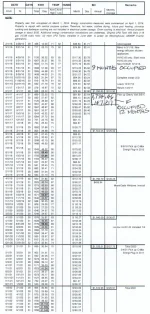
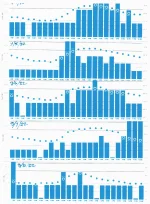
Since it is apparent that energy conservation is so essential and effective, I have decided to share with you the data I have been recording and analyzing since 2/1/16. The data from 2016 is somewhat compromised since we actually only lived in the house for 9 months that year. That is why the total annual cost is lower.
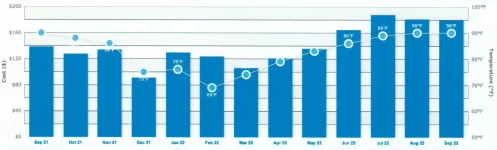
1505 Elect Energy Use 091122.webp1505 Elect Use Monthly 9:21-8:22.webp

In 2022, the dollar cost of the has increased due to the increased inflationary cost of oil, natural gas and lpg. However, the amount of energy used is still reducing even though 2022 has seen higher temperatures.
From the daily high temperatures listed, you can see that it is much, much lower that temperatures as high as 117°F in California. People complain about Florida heat because of the elevated humidity and much stronger sun.
Then I wanted to see how the energy used varied monthly along with the temperature, so I downloaded this. You can see that as the air temperature rose, so did the energy use. This is for the last 12 months.
 
I forgot to mention that FPL charges 30% less for electrical energy than the National average. You can use this as a yardstick to compare my findings with your own.
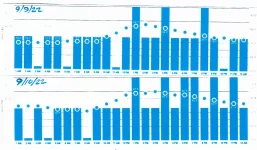
These bars indicate the actual hourly kWh usage eery hour broken into 0.5 kWh increments. When it shows usage of 0.5 kWh, the actual usage is somewhere between 0.26 kWh and 0.74 kWh. It is clearly notable that there are some hours where the bar is almost missing, indicating a kWh draw of less than 0.25 kwh.
There are also some spikes at times which do not seem to make sense. They may be due to us not properly controlling the times when we are charge out plug in vehicles which we do at random times. Therefore, I should institute demand control to limit charging times to the period when energy use is very low.
1505 Elect Use Day 9:4:22-9:8:22.webp1505 Elect Use Day 9:9:22-9:10:22.webp
The highest solar radiation occurs on June 21st, and the best achieved collection is between March 21st (beginning of Spring) and September 21st (beginning of Autumn).
However, the epicenter of energy use is about the beginning of August, due to the thermal flywheel caused by the total mass of Planet Earth.
This does impact the design of a solar energy system including how effective will be the GMC Motorhome’s solar energy collection and massive battery storage.
Furthermore, how does the local weather affect energy use on a daily basis, hour by hour?
On the west coast of Florida, at the time of year, the high temperature occurs anywhere from 1200 to 2000 EDT. The afternoon high temperatures vary between 85° and 92°. At night the temperature drops to 75° to 78°.
The Energy Conservation Code (first enacted in 1980 in NJ) limits temperature settings for air conditioning to 78° and 68° for heating. I know that less than 1% of the population actually follows the rules, but those who don’t are actually primarily responsible for one of the major causes of climate change which can easily be corrected by adherence.
The actual solar noon on Florida’s West Coast occurs around 1400 EDT. That is because we are located so far to the west that we should probably be in the Central Time Zone.
Every day, the thunderheads begin to form about 1400 and we expect the thunder and significant rain to start about 1700. With the rapidly forming clouds, solar radiation is severely reduced in the afternoon, just when we need more energy.
This reality, along with no solar radiation at night requires a more substantial battery storage capacity than what is required in other parts of the country.
 
In order to put things into context, the Motorhome project is only part of a larger project to integrate the motorhome into residence/RV symbiotic pair. I am trying to justify the expenditure on the motorhome to find a use for it when we are not actively using it.
If we use it actively 4 to 6 weeks a year, we won’t be home, but if we are home, I want it to help power the house and provide additional living space for visitors and family.
I can move the Motorhome all around to stay in the sun, which I cannot do with panels fixed to the roof.
Besides, I have been quoted $85,000 to add 32 panels to the roof with (2) Tesla PowerWalls.
View attachment 6998

Since we live near Tampa Bay on a canal, I also envision the motorhome as a lifeboat to run away from a hurricane. We did that once, running from Irma. We need a better way.
Our house is in a mandatory evacuation zone, so I am planning to develop an ultimate boon docking rv that will never require any hook ups anywhere.
I have not yet revealed all of the components of the transformation.
In order to put things into context, the Motorhome project is only part of a larger project to integrate the motorhome into residence/RV symbiotic pair. I am trying to justify the expenditure on the motorhome to find a use for it when we are not actively using it.
If we use it actively 4 to 6 weeks a year, we won’t be home, but if we are home, I want it to help power the house and provide additional living space for visitors and family.
I can move the Motorhome all around to stay in the sun, which I cannot do with panels fixed to the roof.
Besides, I have been quoted $85,000 to add 32 panels to the roof with (2) Tesla PowerWalls.
View attachment 6998

Since we live near Tampa Bay on a canal, I also envision the motorhome as a lifeboat to run away from a hurricane. We did that once, running from Irma. We need a better way.
Our house is in a mandatory evacuation zone, so I am planning to develop an ultimate boon docking rv that will never require any hook ups anywhere.
I have not yet revealed all of the components of the transformation.
Thisis
 
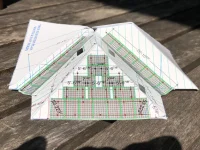
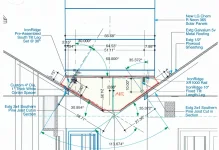
This is a scale mock up of the proposed installation of (32) LGChem 365 Neon R Solar panels. Each panel is rated at 365 watts, so the entire installation has a capacity of 11,680 watts. If the installation is cut in half, the capacity is 5,840 watts.


The GMC Motorhome installation is 1,470 watts.
IMG_0352.webp
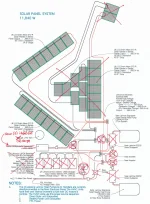
By incorporating my 1976 GMC Eleganca II Motorhome with its 15 SunPower Semi-flexible solar panels, BattleBorn batteries and accessories, the original design in severely downsized. I had estimated the original design at about $85,000.
1505 Solar Roof Elec PL Rev 091322.webp

The eliminated panels are facing south, but mounted on the existing 5V Gallalum roofing are pitched at 45°, much too steep for our lattitude.
The (2) (8) panels arrays are facing SE (135°) and SW (225°) respecticaly. The are spanning the roof valley, so the slope is reduced to 34.5°. This slope is certainly more acceptable.
In addition, both of these arrays are flanked by the reflective surfaces of the metal roofing. Gallium 5V roofing is galvanized aluminum and is certified by LEED to reflect 2/3 of the solar radiation. Is LEED calculations, this roofing is used to reduce the solar air conditioning load on buildings, mostly residential. The aluminum panels have an expected life of 40 to 50 years, seldom leak and render the roof protect against fire and burning embers.
This design uses the existing 5V roofing to select solar radiation onto the LGChem solar panels. With the paired reflective surfaces on either side of the panels, in a perfect situation, we can expect an additional (2x(2/3)) = 4/3 (1.33) solar radiation on the panels. That is a total of 2.33 times the normal radiation. Therefore, the originally anticipated 5,840 watts may be increased to 13,600 watts without increasing costs.
However, there is a downside. Since these solar panels have only about 22% efficiency, 78% of solar radiation heats up the panels. The panels are designed for this, but not for 233% of the anticipated solar radiation.
I called up LGChem and asked how much the efficiency of the panels would be reduced by the added radiation but he said that it had not been tested. However, the efficiency would be severely affected.
What to do?
1505 Sect Thru Valley 091322.webp
This is a section through the solar panels spanning the two valleys running SE and SW.
With the increased radiation on the panels, their temperature will rise considerable and may reach the point where the panels may become physically or electrically damaged. Probably half of heats may be radiated up back toward the sun, but that might not be enough, especially if there is no wind.
However, this configuration forms a kind of triangular air shaft/flue rising at a slope of 34.5° and a very strong solar powered draft will rise below the solar panels.
This a way to use natural forces to generate air movement using the cooler air closer to the ground, heating it to make it lighter, causing it to rise and move the uncollected energy, in this example heat, upward. It does not need any wind to make this happen. It just needs the sun. There is not electrical power needed.
Keeping the solar panels at cooler temperature increases their efficiency and therefore that of the entire installation.
Since all of the battery storage in on the GMC Motorhome, along with the solar controllers, charger/inverter, etc., my motorhome is an intragel component of the solar design.
The battereis will always be with us, whether we are are home or on the road.
The now demonstrated very low amount of energy being used is now tempting me to go off grid. Wouldn't that be a gas!
Even though we are located in a subdivision in Palmetto, FL, a city of about 45,000, there is no law that prevents us from cutting the chord!
 
This is a scale mock up of the proposed installation of (32) LGChem 365 Neon R Solar panels. Each panel is rated at 365 watts, so the entire installation has a capacity of 11,680 watts. If the installation is cut in half, the capacity is 5,840 watts.


The GMC Motorhome installation is 1,470 watts.
View attachment 7062
By incorporating my 1976 GMC Eleganca II Motorhome with its 15 SunPower Semi-flexible solar panels, BattleBorn batteries and accessories, the original design in severely downsized. I had estimated the original design at about $85,000.
View attachment 7063

The eliminated panels are facing south, but mounted on the existing 5V Gallalum roofing are pitched at 45°, much too steep for our lattitude.
The (2) (8) panels arrays are facing SE (135°) and SW (225°) respecticaly. The are spanning the roof valley, so the slope is reduced to 34.5°. This slope is certainly more acceptable.
In addition, both of these arrays are flanked by the reflective surfaces of the metal roofing. Gallium 5V roofing is galvanized aluminum and is certified by LEED to reflect 2/3 of the solar radiation. Is LEED calculations, this roofing is used to reduce the solar air conditioning load on buildings, mostly residential. The aluminum panels have an expected life of 40 to 50 years, seldom leak and render the roof protect against fire and burning embers.
This design uses the existing 5V roofing to select solar radiation onto the LGChem solar panels. With the paired reflective surfaces on either side of the panels, in a perfect situation, we can expect an additional (2x(2/3)) = 4/3 (1.33) solar radiation on the panels. That is a total of 2.33 times the normal radiation. Therefore, the originally anticipated 5,840 watts may be increased to 13,600 watts without increasing costs.
However, there is a downside. Since these solar panels have only about 22% efficiency, 78% of solar radiation heats up the panels. The panels are designed for this, but not for 233% of the anticipated solar radiation.
I called up LGChem and asked how much the efficiency of the panels would be reduced by the added radiation but he said that it had not been tested. However, the efficiency would be severely affected.
What to do?
View attachment 7064
This is a section through the solar panels spanning the two valleys running SE and SW.
With the increased radiation on the panels, their temperature will rise considerable and may reach the point where the panels may become physically or electrically damaged. Probably half of heats may be radiated up back toward the sun, but that might not be enough, especially if there is no wind.
However, this configuration forms a kind of triangular air shaft/flue rising at a slope of 34.5° and a very strong solar powered draft will rise below the solar panels.
This a way to use natural forces to generate air movement using the cooler air closer to the ground, heating it to make it lighter, causing it to rise and move the uncollected energy, in this example heat, upward. It does not need any wind to make this happen. It just needs the sun. There is not electrical power needed.
Keeping the solar panels at cooler temperature increases their efficiency and therefore that of the entire installation.
Since all of the battery storage in on the GMC Motorhome, along with the solar controllers, charger/inverter, etc., my motorhome is an intragel component of the solar design.
The battereis will always be with us, whether we are are home or on the road.
The now demonstrated very low amount of energy being used is now tempting me to go off grid. Wouldn't that be a gas!
Even though we are located in a subdivision in Palmetto, FL, a city of about 45,000, there is no law that prevents us from cutting the chord!
Letssee
 
This is a scale mock up of the proposed installation of (32) LGChem 365 Neon R Solar panels. Each panel is rated at 365 watts, so the entire installation has a capacity of 11,680 watts. If the installation is cut in half, the capacity is 5,840 watts.


The GMC Motorhome installation is 1,470 watts.
View attachment 7062
By incorporating my 1976 GMC Eleganca II Motorhome with its 15 SunPower Semi-flexible solar panels, BattleBorn batteries and accessories, the original design in severely downsized. I had estimated the original design at about $85,000.
View attachment 7063

The eliminated panels are facing south, but mounted on the existing 5V Gallalum roofing are pitched at 45°, much too steep for our lattitude.
The (2) (8) panels arrays are facing SE (135°) and SW (225°) respecticaly. The are spanning the roof valley, so the slope is reduced to 34.5°. This slope is certainly more acceptable.
In addition, both of these arrays are flanked by the reflective surfaces of the metal roofing. Gallium 5V roofing is galvanized aluminum and is certified by LEED to reflect 2/3 of the solar radiation. Is LEED calculations, this roofing is used to reduce the solar air conditioning load on buildings, mostly residential. The aluminum panels have an expected life of 40 to 50 years, seldom leak and render the roof protect against fire and burning embers.
This design uses the existing 5V roofing to select solar radiation onto the LGChem solar panels. With the paired reflective surfaces on either side of the panels, in a perfect situation, we can expect an additional (2x(2/3)) = 4/3 (1.33) solar radiation on the panels. That is a total of 2.33 times the normal radiation. Therefore, the originally anticipated 5,840 watts may be increased to 13,600 watts without increasing costs.
However, there is a downside. Since these solar panels have only about 22% efficiency, 78% of solar radiation heats up the panels. The panels are designed for this, but not for 233% of the anticipated solar radiation.
I called up LGChem and asked how much the efficiency of the panels would be reduced by the added radiation but he said that it had not been tested. However, the efficiency would be severely affected.
What to do?
View attachment 7064
This is a section through the solar panels spanning the two valleys running SE and SW.
With the increased radiation on the panels, their temperature will rise considerable and may reach the point where the panels may become physically or electrically damaged. Probably half of heats may be radiated up back toward the sun, but that might not be enough, especially if there is no wind.
However, this configuration forms a kind of triangular air shaft/flue rising at a slope of 34.5° and a very strong solar powered draft will rise below the solar panels.
This a way to use natural forces to generate air movement using the cooler air closer to the ground, heating it to make it lighter, causing it to rise and move the uncollected energy, in this example heat, upward. It does not need any wind to make this happen. It just needs the sun. There is not electrical power needed.
Keeping the solar panels at cooler temperature increases their efficiency and therefore that of the entire installation.
Since all of the battery storage in on the GMC Motorhome, along with the solar controllers, charger/inverter, etc., my motorhome is an intragel component of the solar design.
The battereis will always be with us, whether we are are home or on the road.
The now demonstrated very low amount of energy being used is now tempting me to go off grid. Wouldn't that be a gas!
Even though we are located in a subdivision in Palmetto, FL, a city of about 45,000, there is no law that prevents us from cutting the chord!
Let’s see if we can apply these techniques to my motorhome.
It already has a full length awning to the passenger side. It is old and might require replacement. It is not a ZipDee.
IMG_0192.webp
What if I add new ones on both the driver’s and passenger side and design powered telescoping braces in place of the folding locking ones? In addition, design a stainless steel cable between the braces over the roof providing a tension tie between both awnings. The length of the cables and the tension can be controlled by electrically powered locking winches. In addition additional cables from the end of the braces could be strung to ground screw anchors using similar equipment.
Think about Fitch, in the movie, tying down his “life raft motorhome” to weather a dangerous storm.
Some of these devices are now commercially available for the sailing community.
So if I employ this, I will have two awning guyed to the ground and tied overhead. I can now position each of the awnings in any position, sloping either up or down and can adjust to any angle to follow the sun.
Instead of the common canvas or Sunbrella fabric, I could use mirrored mylar, a mirrored mesh or a highly reflective fabric,.
This way, I could possibly almost triple the amount of solar radiation that powers the SunPower Semi-flexible 110w panels.
The collection of solar radiation could rise from 1,470 watts to nearly 4,410 watts. The ability to continuously reposition the awnings would allow them to follow the sun and increase the length of time to collect energy.
At some point, there will be fabric that collects solar energy itself without using solar panels. It has already be discussed about using such fabric to make sails. On a sailboat this fabric could be used to harness the power of the wind to move the boat while it collects solar radiation simultaneously for the boat’s electrical needs.
This may lead to the ability to design a motorhome, with electrical propulsion, that could charge its batteries while boon docking without shore power.
Is there anybody who wants to join me in this.
I also have a way to eliminate the nasty pump out, which I will discuss later.
Can you imaging the prospect of never having to plug in or pump out!
 
By the way, my Motorhome does not have a propane tank in the compartment that is open. There is another compartment just behind the front tire that has the propane tank in it.
Also, the dual exhausts are piped all the way to the rear bumper as per factory. In this motorhome the dual exhausts exit below the propane compartment just in front of the door and point out to the side. This significantly reduces the back pressure of the exhaust system.


Before I purchased this motorhome, I found another one in Tampa to look at, but I never did. I was put off when the owner told me that it had a composting toilet, which at the time seemed to be very nasty to me. I also new that I could not sell it to the misses.
He told me that they had lived on the motorhome for 4 years, boon docking most of the time and that he and his wife loved it. The toilet never smelled, was easy to clean and only need to be emptied every two or three weeks. He said it separated the urine from the feces.
The urine could be dumped anywhere. He used coconut fiber packs that thanks to the competing could be disposed of in any garbage can safely.
At the tile, I wasn’t buying it.
Now, I am a convert!
I have asked my wife to independently research the Nature’s Head Compositing Toilet and determine whether she could live with it. She has said that she is willing to go along, so I have purchased one and am ready to install it.
1505 Nature's Head 091322.webp
This now bring up other options.


There is no longer any need for a 40 gal black tank. Only a “grey” tank is now required and it will only drain water from the bathroom sink and the kitchen sink.
I also plan to install a separate tank to drain the shower and recirculate the water after running it through filters to remove the soap and soiling. This could then become the “endless shower”.
I don’t think that i will need the entire 40 gal capacity for these small tanks and the grey water can be dumped anywhere.
Since fresh water is no longer required to flush the toilet, the fresh water will last much longer.
I could use the approximately 20 gal unused capacity to either expand the fresh water or add an additional gasoline to extend range.

No pump out! No shore power! Using a water maker, perhaps, to extract fresh water from even polluted or sea water through reverse osmosis.

Free At Last except gasoline. Maybe there is a way to eliminate that too.
 
By the way, my Motorhome does not have a propane tank in the compartment that is open. There is another compartment just behind the front tire that has the propane tank in it.
Also, the dual exhausts are piped all the way to the rear bumper as per factory. In this motorhome the dual exhausts exit below the propane compartment just in front of the door and point out to the side. This significantly reduces the back pressure of the exhaust system.


Before I purchased this motorhome, I found another one in Tampa to look at, but I never did. I was put off when the owner told me that it had a composting toilet, which at the time seemed to be very nasty to me. I also new that I could not sell it to the misses.
He told me that they had lived on the motorhome for 4 years, boon docking most of the time and that he and his wife loved it. The toilet never smelled, was easy to clean and only need to be emptied every two or three weeks. He said it separated the urine from the feces.
The urine could be dumped anywhere. He used coconut fiber packs that thanks to the competing could be disposed of in any garbage can safely.
At the tile, I wasn’t buying it.
Now, I am a convert!
I have asked my wife to independently research the Nature’s Head Compositing Toilet and determine whether she could live with it. She has said that she is willing to go along, so I have purchased one and am ready to install it.
View attachment 7066
This now bring up other options.


There is no longer any need for a 40 gal black tank. Only a “grey” tank is now required and it will only drain water from the bathroom sink and the kitchen sink.
I also plan to install a separate tank to drain the shower and recirculate the water after running it through filters to remove the soap and soiling. This could then become the “endless shower”.
I don’t think that i will need the entire 40 gal capacity for these small tanks and the grey water can be dumped anywhere.
Since fresh water is no longer required to flush the toilet, the fresh water will last much longer.
I could use the approximately 20 gal unused capacity to either expand the fresh water or add an additional gasoline to extend range.

No pump out! No shore power! Using a water maker, perhaps, to extract fresh water from even polluted or sea water through reverse osmosis.

Free At Last except gasoline. Maybe there is a way to eliminate that too.
IMG_1678.webp
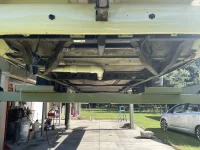
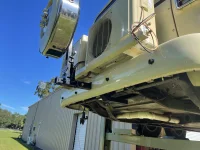
Yesterday: The coach is up on Cliff's lift.
There are no exhaust pipes coming back.
The new 13,000 lb through the bumper replace the under the bumper hitch which has much less capacity.
The 40 gal black water tank will be replaced by a smaller grey tank and perhaps a small recirculating shoer tank and/or another small gasoline tank.
 
View attachment 7073
Yesterday: The coach is up on Cliff's lift.
There are no exhaust pipes coming back.
The new 13,000 lb through the bumper replace the under the bumper hitch which has much less capacity.
The 40 gal black water tank will be replaced by a smaller grey tank and perhaps a small recirculating shoer tank and/or another small gasoline tank.
IMG_1675.webp
A camera focused on the hitch will be attached to the frame supporting the mini-split so that the hitch can be monitored at the driver's chair will underway to prevent a towing failure.
 
View attachment 6781
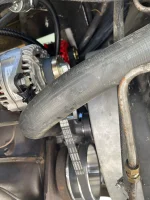
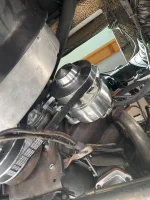
There are actually (2) belts.
One belt powers the new power steering pump.
The longer K-6 belt powers the (2) alternators and the new water pump.
For both belts, the system provides for tension adjustment.
IMG_1683.jpeg
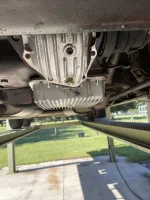
The Aluminum Final Drive Cover has a drain plug to simplify oil changing and increases capacity by one pint.

The final drive in the coach, as purchased, had been converted to optimal 3.21 ratio and it also had a switch pitch torque converter.

In this installation, the switch pitch was activated by a toggle switch on the dashboard, certainly not an optimal situation. The original GMC design had the switch pitch activated by the carburetor's throttle assembly. I have installed Bruce's black box computerized and learning control system, but it has not yet been tested.
As Dr. Frankinstein would ays, "Its alive". The new serpentine K-6 belts and alternators are installed and the engine is running with the new gear. The lower alternator generates 48V and the red one in the background generates 12v.
IMG_1682.jpeg
This is the new power steering pump with a close up of the (2) K-6 ribbed belts. I don't think that they will ever slip.
Cliff fashioned a new custom shroud for the radiator fan.
The new aluminum Ragusa Transmission Cooler Pan is installed with room for an extra quart of GMRG30 oil along with a new Ragusa Aluminum Final Drive Cooler Cover.
 

Attachments

  • IMG_1679.webp
    IMG_1679.webp
    823.3 KB · Views: 5
Last edited: