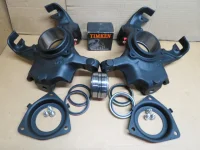
Thoma bearing kit?

Appreciate all the shared wisdom from all of you....so I may not have the option to rebuild this knuckle and hub. I got to the warner hub removal instructions of removing those three inner bolts, tapping the the threads and as i started to pull out the seal prior to hooking up the warner hub puller, the knuckle moved, i was able to pull it off without any resistance...I am assuming that is way to loose and a new knuckle is in order without even measuring. Oddly there was no scoring or otherwise obvious damage, the bore feels smooth.
The original knuckle was really too loose to begin with. Good for 20,000 mile service. Not good for long term bearing life. From what I understand guys like Ken thoma figured that out and when they rebuilt the knuckle they tightened the tolerance so the bearing races press into the knuckle to a tighter tolerance.

Lenzi does the same. Applied as well. They have learned the tighter knuckle to bearing race tolerance makes the bearings last much longer. 100k+. Dave puts zerks in his and reccomends re-greasing them occasionally. But he also says he knows of some front end rebuilds he has done that have never failed and the owner never did follow his grease reccomendations.

So if you can remove the bearing races without effort…. Your knuckle is probably shot for sure.
 
The original knuckle was really too loose to begin with. Good for 20,000 mile service. Not good for long term bearing life. From what I understand guys like Ken thoma figured that out and when they rebuilt the knuckle they tightened the tolerance so the bearing races press into the knuckle to a tighter tolerance.

Lenzi does the same. Applied as well. They have learned the tighter knuckle to bearing race tolerance makes the bearings last much longer. 100k+. Dave puts zerks in his and reccomends re-greasing them occasionally. But he also says he knows of some front end rebuilds he has done that have never failed and the owner never did follow his grease reccomendations.

So if you can remove the bearing races without effort…. Your knuckle is probably shot for sure.
Normally on a tapered roller bearing set it is wrong practice to have interference fit on both the inner race and the outer one
tandem tapered roller bearings should not be press-fitted on all surfaces. Proper installation requires a specific fit strategy to ensure performance and longevity:

  • Inner Rings (Cones): The inner ring must have an interference fit (press fit) on the shaft to prevent rotation, fretting, and galling. This ensures the bearing is securely retained and supported.
  • Outer Rings (Cups): The outer ring should typically have a sliding or clearance fit in the housing. This allows for minor axial movement or thermal expansion and prevents the housing from inducing excessive stress on the bearing assembly.
  • Axial Adjustment: Tandem arrangements are designed to handle high radial loads and distribute load capacity. They require precise axial preload or end-play adjustment via shims or nuts, rather than relying on interference fits in the housing for positioning.
Using a press fit on the outer ring can restrict necessary movement, induce harmful stresses, and reduce bearing life. Always follow the specific manufacturer’s fit recommendations for the application. Also, adding grease beyond about half full will increase the operating temperature of the bearing and likely lead to shorter bearing life. GM's recommendation to remove, inspect and replace any obvious worn bearings then repack with the best grease you can find at about 25000 mile intervals would be the best advice from general industry practice. I know of one coach locally that has over 200,000 miles and the front hubs have never been apart!
 
Last edited:
Normally on a tapered roller bearing set it is wrong practice to have interference fit on both the inner race and the outer one
tandem tapered roller bearings should not be press-fitted on all surfaces. Proper installation requires a specific fit strategy to ensure performance and longevity:

  • Inner Rings (Cones): The inner ring must have an interference fit (press fit) on the shaft to prevent rotation, fretting, and galling. This ensures the bearing is securely retained and supported.
  • Outer Rings (Cups): The outer ring should typically have a sliding or clearance fit in the housing. This allows for minor axial movement or thermal expansion and prevents the housing from inducing excessive stress on the bearing assembly.
  • Axial Adjustment: Tandem arrangements are designed to handle high radial loads and distribute load capacity. They require precise axial preload or end-play adjustment via shims or nuts, rather than relying on interference fits in the housing for positioning.
Using a press fit on the outer ring can restrict necessary movement, induce harmful stresses, and reduce bearing life. Always follow the specific manufacturer’s fit recommendations for the application. Also, adding grease beyond about half full will increase the operating temperature of the bearing and likely lead to shorter bearing life. GM's recommendation to remove, inspect and replace any obvious worn bearings then repack with the best grease you can find would be the best advice from general industry practice.

Not going to decipher that info. Only thing I know is what Lenzi does works. I know coach’s that have had his knuckles
For 16-20 years?? And no issues. I think one of our club members has had Ken thoma knuckles since the mid to early 90’s?
 
  • Like
Reactions: eserv
Not going to decipher that info. Only thing I know is what Lenzi does works. I know coach’s that have had his knuckles
For 16-20 years?? And no issues. I think one of our club members has had Ken thoma knuckles since the mid to early 90’s?
I would never badmouth Lenzi's work and knuckles but I don't believe slip fit bearings are causing failures in our coaches. I have lots of experience with bearings being a millwright my whole life and maintain that improper installation practices cause 90% of the premature bearing failures. It is likely the careful assembly that he does is more a factor than the tighter outer race fit.
 
I would never badmouth Lenzi's work and knuckles but I don't believe slip fit bearings are causing failures in our coaches. I have lots of experience with bearings being a millwright my whole life and maintain that improper installation practices cause 90% of the premature bearing failures. It is likely the careful assembly that he does is more a factor than the tighter outer race fit.
I installation practices do cause many issues.

Here is how I understand the problem.

Our double bearings with the spacer in the middle, with all the road cracks/ pot holes and road pounding load with the looser tolerance allows the harder race metal pounds the knuckle bore out of spec. Then you have an inner and outer bearing that is no longer 100% inline with each other and that causes the bearing to fail over time. Most worn knuckles are no longer perfect cirle bore. They are worn upwards on that outside race. By making the tolerance to that press fit, the race does not seem to knock the bore out of shape. But also on dave’s. He spray welds, so you have a harder bore as well.

I have been involved in a couple bearing failures(including my coach after about 12,000 miles
Had bearing noise, not catastrophic.. dave got out measuring devices and knuckle was just slightly out of round) where one has installed new bearings in what was probably a not perfect knuckle.
 
  • Like
Reactions: tmsnyder
I installation practices do cause many issues.

Here is how I understand the problem.

Our double bearings with the spacer in the middle, with all the road cracks/ pot holes and road pounding load with the looser tolerance allows the harder race metal pounds the knuckle bore out of spec. Then you have an inner and outer bearing that is no longer 100% inline with each other and that causes the bearing to fail over time. Most worn knuckles are no longer perfect cirle bore. They are worn upwards on that outside race. By making the tolerance to that press fit, the race does not seem to knock the bore out of shape. But also on dave’s. He spray welds, so you have a harder bore as well.

I have been involved in a couple bearing failures(including my coach after about 12,000 miles
Had bearing noise, not catastrophic.. dave got out measuring devices and knuckle was just slightly out of round) where one has installed new bearings in what was probably a not perfect knuckle.
Then we get into the pro's and con's of spray welding bearing fits! LOL
 
Then we get into the pro's and con's of spray welding bearing fits! LOL
I have installed temperature guages in my front hubs to monitor the bearing temp. That give me at least as much confidence as risking the potential damage by removing and reinstalling the bearings with new grease. I also occasionally jack up the front and check for bearing loosness.
 
  • Like
Reactions: tmsnyder
Normally on a tapered roller bearing set it is wrong practice to have interference fit on both the inner race and the outer one
tandem tapered roller bearings should not be press-fitted on all surfaces. Proper installation requires a specific fit strategy to ensure performance and longevity:

  • Inner Rings (Cones): The inner ring must have an interference fit (press fit) on the shaft to prevent rotation, fretting, and galling. This ensures the bearing is securely retained and supported.
  • Outer Rings (Cups): The outer ring should typically have a sliding or clearance fit in the housing. This allows for minor axial movement or thermal expansion and prevents the housing from inducing excessive stress on the bearing assembly.
  • Axial Adjustment: Tandem arrangements are designed to handle high radial loads and distribute load capacity. They require precise axial preload or end-play adjustment via shims or nuts, rather than relying on interference fits in the housing for positioning.
Using a press fit on the outer ring can restrict necessary movement, induce harmful stresses, and reduce bearing life. Always follow the specific manufacturer’s fit recommendations for the application. Also, adding grease beyond about half full will increase the operating temperature of the bearing and likely lead to shorter bearing life. GM's recommendation to remove, inspect and replace any obvious worn bearings then repack with the best grease you can find at about 25000 mile intervals would be the best advice from general industry practice. I know of one coach locally that has over 200,000 miles and the front hubs have never been apart!

This makes a lot of sense, thanks Ed
 
Last edited:
I installation practices do cause many issues.

Here is how I understand the problem.

Our double bearings with the spacer in the middle, with all the road cracks/ pot holes and road pounding load with the looser tolerance allows the harder race metal pounds the knuckle bore out of spec. Then you have an inner and outer bearing that is no longer 100% inline with each other and that causes the bearing to fail over time. Most worn knuckles are no longer perfect cirle bore. They are worn upwards on that outside race. By making the tolerance to that press fit, the race does not seem to knock the bore out of shape. But also on dave’s. He spray welds, so you have a harder bore as well.

I have been involved in a couple bearing failures(including my coach after about 12,000 miles
Had bearing noise, not catastrophic.. dave got out measuring devices and knuckle was just slightly out of round) where one has installed new bearings in what was probably a not perfect knuckle.

Contributing to the wear is the roughness of the bore. Under magnification, the surface would appear to be a series of peaks and valleys. The bearing is supported only up on the peaks. Much of the surface is not supported, and all the forces are wearing on just the top of the peaks.

Dave's are spray welded and _ground_ to the correct bore, not bored out with a single point cutter. So it's a smoother surface and no peaks to get pounded down.
 
Our fwd motorhomes, I think is fairly unique. I really dont know of another setup like it that also has the workload. A toronado is a fraction of the weight. And most the fwd vehicles I know of have a non-serviceable bearing that is a complete different design.

So I cant say if the logistics of all bearings apply. I have just seen what works and what seems to fail. The tighter bearings of dave lenzi, applied, Ken Thoma, ect. Have proven reliability.
 
  • Like
Reactions: tmsnyder
Our fwd motorhomes, I think is fairly unique. I really dont know of another setup like it that also has the workload. A toronado is a fraction of the weight. And most the fwd vehicles I know of have a non-serviceable bearing that is a complete different design.

So I cant say if the logistics of all bearings apply. I have just seen what works and what seems to fail. The tighter bearings of dave lenzi, applied, Ken Thoma, ect. Have proven reliability.
I like the fact that Lenzi’s bearings are greasable. Had I known about his bearings when I had the front end rebuilt in 2019, I would have used his kit.

workmanship2.webp
 
  • Like
Reactions: Kendra and tmsnyder
the thin aluminum circular item in the lower left is a setup meant to be able to grease the bearings without removing them, by forcing grease from the inside to the outside, through the bearings.

I have one and never used it as it seemed like a great way to get sand and crud into the bearings.

You do have the most important piece of the bearing puller puzzle, the actual thing that grabs the bearing. And you have a great puller there (the long skinny H shaped piece).
I tried to buy that greasing tool and applied no longer has them. Do you have the plans or want to sell it? Im Oakville .