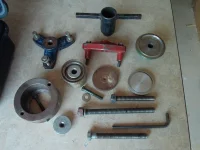
I have had stored away in the motorhome a used front bearing kit I bought off ebay years ago. Never had use for till now. Want to service the bearings. Im not sure that i have all the pieces needed to pull and replace the bearings. I found this link https://www.gmcmotorhome.com/tech/front_bearings/index.html that shows with pics how to using I am assuming a Thoma kit? I have included a pic of my bearing tool set in hopes that someone is familiar with this kit and can tell me if i have what i need, it looks like i am short the reinstall pieces or at least part of them?
Thoma bearing kit?
- Thread starter justpassinthru
- Start date
You are using an out of date browser. It may not display this or other websites correctly.
You should upgrade or use an alternative browser.
You should upgrade or use an alternative browser.
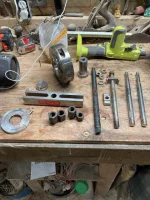
the thin aluminum circular item in the lower left is a setup meant to be able to grease the bearings without removing them, by forcing grease from the inside to the outside, through the bearings.
I have one and never used it as it seemed like a great way to get sand and crud into the bearings.
You do have the most important piece of the bearing puller puzzle, the actual thing that grabs the bearing. And you have a great puller there (the long skinny H shaped piece).
I have one and never used it as it seemed like a great way to get sand and crud into the bearings.
You do have the most important piece of the bearing puller puzzle, the actual thing that grabs the bearing. And you have a great puller there (the long skinny H shaped piece).
Thanks Todd...yup I forgot to move that aside. I did use it once about 3k miles ago, was meticulous on keeping the area clean. Ill report back when i pull these bearings if it appears any dirt etc was introduced to the bearing.


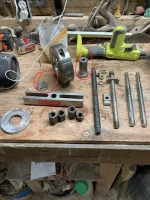
ok well that explains some of the differences thank you....so what threw me off and what i still dont know is what the two red circled pieces are for in this attached pic. When i look up the warner tool that can be purchased those items are missing.
Attachments

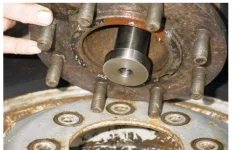
Here is a Ken Thoma kit:
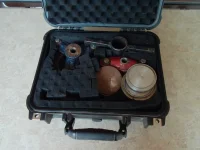
I have never used it...yet
Here is Ken Thoma demonstrating the device:
I have never used it...yet
Here is Ken Thoma demonstrating the device:

Thanks Tom, i downloaded that set of instructions. Doesn't show that small disk piece, but a pic of the warner hub tool shows it comes with it.

The problem with removing the bearings and races is that every time you do that it does some damage to the bore that the races sit in. Damaged enough and the races spin in the bore. The only way to make those knuckles bullet proof is to send them to Dave Lenzi. He will take them, clean them up, spray weld the bores, grind the bores to a .001 friction fit so the races will not spin. He then drills the knuckles for a grease zirk, and puts in a modified bearing spacer that will pass grease to the bearings. He then assembles the knuckles with greased bearings so you will never have to take it apart again. Pull the axle nut almost off, shove the axle in and grease the bearing until you see grease coming out. I do mine every 15K or so. Mine have over 100K on them and showing no bearing movement. Expensive? Yes, but putting your mind at ease over the long haul,..... worth every penny. JMHO
No argument on Dave's work he has earned alot of respect from GMC'ers. I have to weigh against my objective, over all cost, and the time frame. I am out in Oregon, i priced the just the shipping cost round trip for the two full assemblies and its close to $1200. I figure ( I hope) i have nine more years of local travel with the motorhome before i reassess any more travels after the tender age of 80. Based on my average miles traveled i wont bump up against the next 25k bearing service before then. I want to fully trust these replacement bearings, but don't need to overshoot. Make sense? Its a fine line and I will error on the safer side of which ever direction i go. Next step is to pull the bearings and see what kind of damage I got going. I am curious about the use of that split ring greaser and what condition this bearing is. Appreciate all the shared wisdom from all of you.
No argument on Dave's work he has earned alot of respect from GMC'ers. I have to weigh against my objective, over all cost, and the time frame. I am out in Oregon, i priced the just the shipping cost round trip for the two full assemblies and its close to $1200. I figure ( I hope) i have nine more years of local travel with the motorhome before i reassess any more travels after the tender age of 80. Based on my average miles traveled i wont bump up against the next 25k bearing service before then. I want to fully trust these replacement bearings, but don't need to overshoot. Make sense? Its a fine line and I will error on the safer side of which ever direction i go. Next step is to pull the bearings and see what kind of damage I got going. I am curious about the use of that split ring greaser and what condition this bearing is. Appreciate all the shared wisdom from all of you.
We recently had this discussion about retaining the axle bolts, and I noticed that GM hadn't adopted loktite in the era of our coaches. It existed but they hadn't started using it. Seems like the perfect application and they would certainly use loktite today in critical bolts that must never come out on their own.
Loktite also makes a bearing retainer compound available today that works up to 0.010". The original fit between the outer surface and the inner surface of the knuckle was a slip fit, close to 0.001" clearance. Once installed on the hub, the hub assembly was designed to slip into the knuckle. And to service (after removing the retainer) a few blows with a slide hammer was all that was needed to remove the hub assemble.
That slip fit is why, if the bearing fails, the outer race is known to rotate in the knuckle and ruin that hole.
In those instances, if someone weren't concerned about a 'forever fix' such as Dave's zerked knuckle and just wanted their somewhat worn knuckle to carry them down the road for several years, I wonder how well a bearing retaining compound would work at supporting the bearing in a somewhat worn open hole? I wouldn't be afraid to try it.
Removal later on would be a little more difficult, but nothing a small amount of heat wouldn't make possible.
Last edited:

The Loctite description and tech specs for their bearing mount adhesive appear to have been written for the GMC and has instructions for slip fit assemblies.We recently had this discussion about retaining the axle bolts, and I noticed that GM hadn't adopted loktite in the era of our coaches. It existed but they hadn't started using it. Seems like the perfect application and they would certainly use loktite today in critical bolts that must never come out on their own.
Loktite also makes a bearing retainer compound available today that works up to 0.010". The original fit between the outer surface and the inner surface of the knuckle was a slip fit, close to 0.001" clearance. Once installed on the hub, the hub assembly was designed to slip into the knuckle. And to service (after removing the retainer) a few blows with a slide hammer was all that was needed to remove the hub assemble.
That slip fit is why, if the bearing fails, the outer race is known to rotate in the knuckle and ruin that hole.
In those instances, if someone weren't concerned about a 'forever fix' such as Dave's zerked knuckle and just wanted their somewhat worn knuckle to carry them down the road for several years, I wonder how well a bearing retaining compound would work at supporting the bearing in a somewhat worn open hole? I wouldn't be afraid to try it.
Removal later on would be a little more difficult, but nothing a small amount of heat wouldn't make possible.

LOCTITE® 620
High-strength, high-temperature resistant bonding of cylindrical parts
 next.henkel-adhesives.com
WEll, this could be a game changer for some GMC'rs. Especially those where the damage from removing the bearings from the knuckles is relatively minor. I would not be afraid to try it. But would also borrow a zirk knuckle tool and fix the bearing spacer to accomodate the bearing greaser. As long as you got it apart, do this:The Loctite description and tech specs for their bearing mount adhesive appear to have been written for the GMC and has instructions for slip fit assemblies.
LOCTITE® 620
High-strength, high-temperature resistant bonding of cylindrical parts

I just posted in Resources, instructions on using the Thoma puller and Paul Bartz document on replacing the front bearing using the warner puller.

Front bearing replacement
Appreciate all the shared wisdom from all of you....so I may not have the option to rebuild this knuckle and hub. I got to the warner hub removal instructions of removing those three inner bolts, tapping the the threads and as i started to pull out the seal prior to hooking up the warner hub puller, the knuckle moved, i was able to pull it off without any resistance...I am assuming that is way to loose and a new knuckle is in order without even measuring. Oddly there was no scoring or otherwise obvious damage, the bore feels smooth.
Appreciate all the shared wisdom from all of you....so I may not have the option to rebuild this knuckle and hub. I got to the warner hub removal instructions of removing those three inner bolts, tapping the the threads and as i started to pull out the seal prior to hooking up the warner hub puller, the knuckle moved, i was able to pull it off without any resistance...I am assuming that is way to loose and a new knuckle is in order without even measuring. Oddly there was no scoring or otherwise obvious damage, the bore feels smooth.
Are you saying that after you removed the three bolts from the retainer, you were able to pull out the hub and rotor assembly from the knuckle by hand? And it appears the bore in the knuckle is smooth where the bearings would be supported?
Do you have a way to measure the bore? Inside micrometer or telescoping gauges and a micrometer?
ill try and get ahold of a bore meter. But yes, I was starting to mount the warner puller and noticed the knuckle slide up and down on the rotor hub. So i put the puller aside and grabbed the knuckle with two hands and it easily slide off the hub leaving the bearings intact mounted on the hub. In looking at the knuckle there is a small partial band of discoloration, i assume from heat of spinning. So my uneducated theory is, remember that split ring greaser i mentioned? I think years ago when i loosened the axle nut to gain access to the bearing to mount that split ring and i pumped grease in, it got into this hub-knuckle joint. There was grease covering that joint making it super slippery. So going down this slippery slope of wild guessing, this kept the surface from getting damaged by any spinning going on. ill follow up with the bore measurements when i get ahold of a bore caliper.