Hello from Austria!

  • Please note, the forum recently had a problem with outbound emails for notifications, registrations, etc. A new email provider has been set up which should resolve all email issues. If you have any further trouble, please DM Christo or reach out via the Contact Us link in the website footer.
So, what have I personally learned from this whole experience?

1. My drivetrain is indeed a 1978 UPP FWD system, which, as you know, is based on the Oldsmobile Toronado passenger car. Therefore, basically all the parts from the 1978 Toronado or Eldorado fit (with some minor modifications, such as to the power steering pump mounts).

With one caveat: The openings in the steering knuckles are larger than those in the Oldsmobile Toronado passenger car to accommodate the more robust lower ball joint of the Revcon suspension. The motorhome has a curb weight of 5.7 tons, while the Toronado passenger car weighs only around 2 tons.

2. The technical components of my Revcon drivetrain are about 95 percent identical to those of the GMC motorhome, since John Hall (founder of the Revcon brand) famously conducted the first UPP stress tests with GM's permission, which were then used for the Revcon motorhomes. The GMC motorhome didn't come onto the market until a few years later, at which point GM ultimately drew on John Hall's data collection.

However:

For example, the drive axles from the 1978 Oldsmobile Toronado fit my Revcon perfectly, while those of the 1978 GMC motorhome are longer because the frame is wider at the front.

The torsion bars on my Revcon are shorter than those of the GMC motorhome, but with some modification, they can still be used in my Revcon. Original, functional torsion bars for my Revcon are practically impossible to find.

For comparison:

Revcon motorhomes produced approximately 2,000 units, while GMC motorhomes produced around 12,000, two-thirds of which are still running today.

3. I remain very happy with my UPP drive and its use in the GMC motorhome, because from 1981 onward, only newly and more robustly designed Revcons were produced. While parts for these are still available in the U.S., identifying them would be even more difficult for me, as the Revcon community—compared to the GMC motorhome fanbase in the various forums—is significantly smaller and essentially only active on Facebook.

4. I already knew beforehand that my car had a 1978 UPP FWD engine, based on the engine number. However, the steering system, which had been botched over the decades with its undersized, haphazardly fitted tie rods, caused a huge amount of confusion. This led to damage (a crack) to one of my wishbones and the drilling out of the tie rod mounting points on both steering knuckles, as the parts I bought by part number simply didn't fit.

To make matters worse, last summer the new, correct tie rods were installed backwards on one side, with the shorter tie rod on the outside instead of the inside, because the mechanics had used the incorrect, old, and too-short tie rod as a guide. Naturally, this one also didn't fit.

So, I was at my wit's end and, admittedly, quite desperate. I was "saved" by an unsolicited photo from the Facebook Revcon group, to which I described my problem: This showed the correct installation on a 1979 (!) Revcon, with the long tie rod pointing outwards.

It's possible that the steering is now, for the first time in over 30 years, working correctly and in its original condition. The TÜV (German vehicle inspection agency) and anyone else never noticed, which is understandable, since all the parts looked fine and always passed the shake test. It was only the damage (crack) to the wishbone that finally revealed something was wrong with the steering angle. A closer inspection then uncovered further problems.

Luckily, I was able to acquire the only drag link available on eBay for a 1978 Toronado from Canada; the old one had been drilled into multiple times to somehow attach the wrong tie rods with countless bolts.

5. When it comes to sourcing the correct spare parts for my Revcon, I can only rely on myself. In this area, I now have the upper hand even over seasoned motorhome professionals in Germany. Of course, this is only possible with the help and support of the U.S. Revcon community on Facebook and the helpful members of the GMC Motorhome Forum.

Together we archieved a "victory" over the Revcon's steering problem.

My thanks goes to you, without a doubt, because without the help of incredibly dedicated people, it would have been over (once again).

For my part, however, dear friends, I have to agree with King Pyrrhus I of Epirus:

"One more such victory and I'm finally lost."

Because the whole thing was starting to take its toll. But: No pain, no gain. That's my motto.
 
  • Like
Reactions: Blue and VetteV8
So, what have I personally learned from this whole experience?

1. My drivetrain is indeed a 1978 UPP FWD system, which, as you know, is based on the Oldsmobile Toronado passenger car. Therefore, basically all the parts from the 1978 Toronado or Eldorado fit (with some minor modifications, such as to the power steering pump mounts).

With one caveat: The openings in the steering knuckles are larger than those in the Oldsmobile Toronado passenger car to accommodate the more robust lower ball joint of the Revcon suspension. The motorhome has a curb weight of 5.7 tons, while the Toronado passenger car weighs only around 2 tons.

2. The technical components of my Revcon drivetrain are about 95 percent identical to those of the GMC motorhome, since John Hall (founder of the Revcon brand) famously conducted the first UPP stress tests with GM's permission, which were then used for the Revcon motorhomes. The GMC motorhome didn't come onto the market until a few years later, at which point GM ultimately drew on John Hall's data collection.

However:

For example, the drive axles from the 1978 Oldsmobile Toronado fit my Revcon perfectly, while those of the 1978 GMC motorhome are longer because the frame is wider at the front.

The torsion bars on my Revcon are shorter than those of the GMC motorhome, but with some modification, they can still be used in my Revcon. Original, functional torsion bars for my Revcon are practically impossible to find.

For comparison:

Revcon motorhomes produced approximately 2,000 units, while GMC motorhomes produced around 12,000, two-thirds of which are still running today.

3. I remain very happy with my UPP drive and its use in the GMC motorhome, because from 1981 onward, only newly and more robustly designed Revcons were produced. While parts for these are still available in the U.S., identifying them would be even more difficult for me, as the Revcon community—compared to the GMC motorhome fanbase in the various forums—is significantly smaller and essentially only active on Facebook.

4. I already knew beforehand that my car had a 1978 UPP FWD engine, based on the engine number. However, the steering system, which had been botched over the decades with its undersized, haphazardly fitted tie rods, caused a huge amount of confusion. This led to damage (a crack) to one of my wishbones and the drilling out of the tie rod mounting points on both steering knuckles, as the parts I bought by part number simply didn't fit.

To make matters worse, last summer the new, correct tie rods were installed backwards on one side, with the shorter tie rod on the outside instead of the inside, because the mechanics had used the incorrect, old, and too-short tie rod as a guide. Naturally, this one also didn't fit.

So, I was at my wit's end and, admittedly, quite desperate. I was "saved" by an unsolicited photo from the Facebook Revcon group, to which I described my problem: This showed the correct installation on a 1979 (!) Revcon, with the long tie rod pointing outwards.

It's possible that the steering is now, for the first time in over 30 years, working correctly and in its original condition. The TÜV (German vehicle inspection agency) and anyone else never noticed, which is understandable, since all the parts looked fine and always passed the shake test. It was only the damage (crack) to the wishbone that finally revealed something was wrong with the steering angle. A closer inspection then uncovered further problems.

Luckily, I was able to acquire the only drag link available on eBay for a 1978 Toronado from Canada; the old one had been drilled into multiple times to somehow attach the wrong tie rods with countless bolts.

5. When it comes to sourcing the correct spare parts for my Revcon, I can only rely on myself. In this area, I now have the upper hand even over seasoned motorhome professionals in Germany. Of course, this is only possible with the help and support of the U.S. Revcon community on Facebook and the helpful members of the GMC Motorhome Forum.

Together we archieved a "victory" over the Revcon's steering problem.

My thanks goes to you, without a doubt, because without the help of incredibly dedicated people, it would have been over (once again).

For my part, however, dear friends, I have to agree with King Pyrrhus I of Epirus:

"One more such victory and I'm finally lost."

Because the whole thing was starting to take its toll. But: No pain, no gain. That's my motto.
Great. We learn something new every day, and with every problem.
It's rare for the German TÜV (vehicle inspection authority) to overlook something. But with rare vehicles, they don't know all the weak points.
 
  • Like
Reactions: The Revconeer
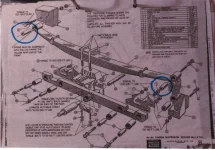
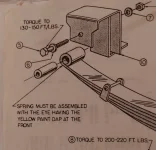
Update: My Revcon steering repair (knuckles, tie rods, wishbones etc.) and propane safety check are completed. Electronic wheel alignment is impossible because the Revcon is sagging 7 cm lower on the left side. I already noticed this during the adjustment as part of the torsion bars replacement when trying to reach the correct riding height. But it's coming from the rear; the rear springs are worn. Therefore, the rear springs are being replaced now, as the Revcon's rear end has always seemed to be too low above the ground.
 
Do you have leafsprings on the rear then?
Not the airbag suspension, like the GMC?
Then it would have been a simple adjustment I guess
Success with finding the correct type of spring, if an additional blade cannot be added.
Cor
 
  • Like
Reactions: The Revconeer
Screenshot_20250213_084413_Chrome.webp

Yes, leafsprings. They want to exchange all of them, the ordering of the springs is no problem.

It's also a kind of a known issue of my 1979 Revcon "Slantmobile", introduced 1978: They hadn't quite figured out the geometric balance of the vehicles so they tend to ride low on drivers side, because all the appliances and such are drivers side install.
 
If that is a known issue, wouldn't you not want an extra leaf on the drivers side?
When the body is leaning to one side, that might also influence the steering geometry somewhat.
Cor
 
  • Like
Reactions: The Revconeer
Yes, leafsprings. They want to exchange all of them, the ordering of the springs is no problem.
I don't have experience with this, but when I was accumulating parts to restore a 1936 Ford I heard about shops that can reliably re-arch leaf springs, and hotrodders who have done this at home. Considering the cost of replacements, re-contouring what you have may be worth a try. And you could aim for a bit more curve on one set.

https://www.jalopyjournal.com/forum/threads/re-arching-leaf-springs-does-it-last.1276645/
 
Thanks, but the leaf springs are easy to get in Germany for my Hendrickson Tandem on my Revcon. I was even able to order the wheel bearings from stock in Austria some years ago.

After the correct, painstaking restoration of the botched steering system, we are now finally treading familiar paths of spare parts.

The team in Babenausen is replacing all my spring packs; it's necessary after 47 years anyway.

But don' t ask for the costs...in the U.S. it would be around USD 2,000,--; in Europe much more €€€. 🫣
 
  • Like
Reactions: Kendra
I'm really excited to see how the Revcon will feel after the chassis restoration is complete this spring:

- New rear leaf springs and 2 new shock
absorbers (which were missing before)
- 4 rear brake drums balanced, wheel
balancing performed directly on the
vehicle, 2 rims repaired
- Steering: Correct tie rods, etc., with front
wheel alignment
- 2 new front shock absorbers
- Both front rims refurbished at a wheel
repair shop
- 4 new bushings in the front axle - will
the heavy vibration/shaking above
90km/h (55mph) finally be gone?
- 2 new engine mounts
- Torsion Bars replaced, as previously
mentioned
 
  • Like
Reactions: dsmithy and Kendra
Three things are still preventing the vehicle from passing its TÜV inspection.

The preliminary inspection on Saturday revealed: the brakes on the second axle are more than 25 percent uneven, the parking brake is uneven, and there's an oil leak/environmental hazard due to dripping from the engine. We're familiar with the brake issue. A little adjusting should do the trick.

Comes from sitting over months. Let's see where the oil is coming from and if the team in Babenhausen can solve the brake issue. Ordered a new starter too, the old one suddenly works only when engine has cooled down after 30 minutes.

Let everything break down right there on site. Anything's better than having to do it on tour. Starter is 98 EUR freight included.

AI:

The 1978 6.6L (403 cubic inch) Oldsmobile engine is prone to several common oil leaks due to its age and design.

Common areas for oil leaks on this engine include the rear main seal, the intake manifold gaskets, the oil pan gasket, and the valve cover gaskets.

Common Oil Leak Locations on the 1978 6.6L (403) Engine:

Rear Main Seal: This is a very common issue on older Oldsmobile V8s, often causing oil to leak from the back of the engine where the engine meets the transmission.

Intake Manifold Gaskets: Specifically, the front and rear china walls (the valley pans) are notorious for leaking oil, which can run down the front or back of the block.

Oil Pan Gasket: The oil pan gasket, particularly at the corners and near the rear main seal, can fail.

Valve Cover Gaskets: The cork or rubber gaskets can harden over time, allowing oil to leak down the sides of the engine.

Oil Filter Adapter Gasket: The adapter where the oil filter attaches can leak oil.
Distributor Gasket: Oil can leak from the base of the distributor.

Diagnosing and Fixing the Leak:

To pinpoint the source, it is recommended to clean the engine thoroughly and check for fresh oil after a short drive.

Rear Main Seal: Requires removing the transmission and potentially the crankshaft, making it a labor-intensive repair.

- Hopefully not! 😬

Intake Manifold Gaskets: Often require replacing the intake gasket set and using a high-quality sealant on the front and rear rails.

Valve Cover Gaskets: Relatively simple to replace.

Oil Pan Gasket: Often requires loosening or removing the engine mounts to lift the engine slightly for clearance.
 
Last edited:
Googled a bit: is this https://www.us-reisemobile-service.de/ ?
Quite some distance from Austria...

I had an oil leak some time ago on the engine of my oldtimer Mercedes 380SE ('81) and it did pass the inspection, but got an (official) nasty remark on the document. I did fix the leak, but to be 100% certain not to get the same remark again, I cleaned the area thoroughly and the sprayed it extensively with brake cleaner. Looked as new!

Yes I know that "environmental hazards" are serious in the German speaking countries; I remember the complaints from our Swiss dealer in the '80th about the single drop of oil on the then standard breathing pipe on a Deutz engine; this was a serious problem for them at that time, while Deutz factory just supplied the engines with that standard breather pipe, open to air, along the side of the engine. The Swiss were well ahead of the time...

Hope it is not the rear crankshaft seal, labor intensive! $$$$
Cor
 
  • Like
Reactions: The Revconeer
Correct, my partner is from Saxony/Germany, her parents live there and from their house it' s only about 3 hours to Babenhausen. ;)

From Austria much more, about 6.

Yes, my dear VetteV8, I passed the vehicle inspection (TÜV) with our 1997 GMC Safari last December in Austria, thanks to this cleaner. No more "oil loss" issues. :LOL:

Sounds familiar to me, they once tried to fail my 2003 Crown Vic inspection. There was only one drop of oil on the driveshaft seal. I changed the inspection station and never heard anything about it again – that was over 10 years ago. :rolleyes:

Not the crankshaft seal, may your esteemed word be heard by God. 🤯
 
Last edited:
  • Like
Reactions: Blue and VetteV8
Around $400, also in Florida. My UPP drivetrain from Crystal River, FL, cost $430. There must be a nest nearby.

Screenshot_20260225_194026_Chrome.webp

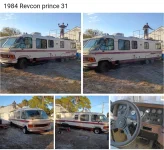
Nevertheless, this Revcon is obviously not for me, as it's a 1984 model and therefore a "new design" (from 1981 onwards), which isn't technically comparable to my "Slantmobile" (from 1978 onwards). It would therefore be unsuitable as a parts donor.

In the meantime, my 1978 Revcon drivetrain has arrived in Bremerhaven on the Maersk Tennessee from Miami and should be unloaded in Saxony this week. My mechanic there has been briefed and is borrowing a forklift from the neighboring garden center. The drivetrain, in its crate along with the three rims, will be stored in a dry place and then preserved by U.S. Revcon specialist Cyrax at the end of July. Cyrax is currently applying for a new passport; his has expired. His flight to Europe must be booked by May at the latest.

The transport costs, including customs and export VAT, are now around €1,000 higher than originally calculated. This is because the significantly increased weight (910 kg instead of the originally estimated 360 kg) has driven up the transport costs from Crystal River to Miami and from Bremerhaven to Saxony.

The consolidated container freight with export clearance from Miami to Bremerhaven (USD 400), the port fees/transshipment/unloading, and the customs clearance remained the same despite the increased weight. The entire process went smoothly and took a total of three months. I can highly recommend the freight forwarding company Pangaea Cargo.

Let's hope the replacement drivetrain never has to be used. ;)

It's still a very good feeling to have a suitable 6.6-liter Oldsmobile Toronado V8 with 100,000 km on the clock, plus a 425 transmission including the transfer case, chain, steering, drive axles, suspension, etc., on hand, just in case.

I might have this entire drivetrain rebuilt and reinforced in the medium term, including a transmission service. It's easy enough to do once it's out, and the team in Babenhausen has a specialist company they can refer me to.
 
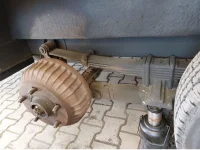
What's on the agenda this month? Replacing the rear leaf springs. You can clearly see the 7cm difference here. The Revcon is sagging on the driver's side.

Screenshot_20260226_192722_Chrome.webp
 
  • Like
Reactions: pvfjr
I don't have experience with this, but when I was accumulating parts to restore a 1936 Ford I heard about shops that can reliably re-arch leaf springs, and hotrodders who have done this at home. Considering the cost of replacements, re-contouring what you have may be worth a try. And you could aim for a bit more curve on one set.

https://www.jalopyjournal.com/forum/threads/re-arching-leaf-springs-does-it-last.1276645/

I talked to the repair shop today. That' s exactly what they are doing right now. New springs are not necessary.

I "only" need 4 new fitting bushings.

 
Yes, thanks! I will. "Pohl Springworks" maybe is a source for my bushings. Cyrax, the FB Revcon specialist, needs the measurement of my old bushings and he will give them to Pohl Springworks. A glimmer of hope.
 
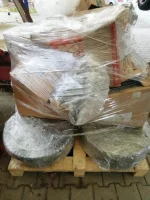
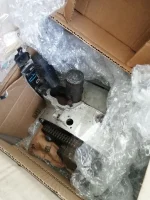
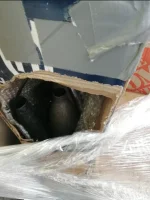
This is what was delivered to me yesterday from Florida to Germany instead of my UPP FWD Revcon drivetrain. Not my wooden crate, but two disassembled motorcycles (?) on a pallet. I'm speechless!

Screenshot_20260311_151701_Signal.webp

Screenshot_20260311_151713_Signal.webp

Screenshot_20260311_151723_Signal.webp
 
  • Wow
Reactions: RvRev2