Hello from Austria!
- Thread starter The Revconeer
- Start date
You are using an out of date browser. It may not display this or other websites correctly.
You should upgrade or use an alternative browser.
You should upgrade or use an alternative browser.


Lucky Cruisers Weekend
Lucky Cruisers Weekend. 9,279 likes · 5,537 talking about this. SRAZ AMERICKÝCH AUTOMOBILŮ www.LCW.cz
 www.facebook.com
Since the Revcon unfortunately wasn't finished in time for our summer vacation, we're switching to Plan B: Our Safari Van now has to be used again for the 5,000 km (3,106 miles) trip to Sweden.
We've already made provisions for this eventuality: the route is planned, a few romantic Swedish cabins have been booked, and our friend Dan is also providing us with his own new European camper free of charge.
If you're lucky enough to have a European network of very good friends, you can certainly compensate for any Revcon outages, although the final word on this matter hasn't been spoken yet...
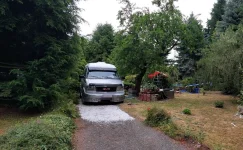
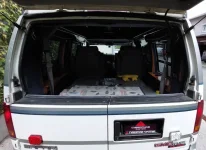

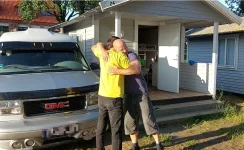
Hamburg - Trelleborg via Öresund Bridge.
Arrived without any problems. Always good to have a GMC as a backup plan in mind.
We've already made provisions for this eventuality: the route is planned, a few romantic Swedish cabins have been booked, and our friend Dan is also providing us with his own new European camper free of charge.
If you're lucky enough to have a European network of very good friends, you can certainly compensate for any Revcon outages, although the final word on this matter hasn't been spoken yet...
Hamburg - Trelleborg via Öresund Bridge.
Arrived without any problems. Always good to have a GMC as a backup plan in mind.
A member of the Austrian U.S. Car Forum saw this GMC Motorhome on a Polish truck in Lower Austria two days ago:
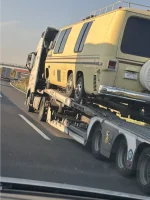
OK, the holiday season is over, Sweden was great, we did some filming.
And a little "family video" in the mansion of my old aunt in Vienna.
Back to topic.
I'm currently assuming my drivetrain is a stock Toronado. All components from the 1978 Oldsmobile Toronado should fit. This applies to the steering knuckles as well as the center drag link, which was drilled oddly to somehow accommodate the incorrect tie rods, so this also needs to be replaced.
I could need good steering knuckles, nobody has been able to tell me yet, if the ones from the GMC Motorhome would fit in my Revcon with a 1978 Olds Toronado drivetrain. The current knuckles are stock-Toro. I would be able to get two GMC Motorhome knuckles for USD 400, without shipping etc.
Maybe the ones in my Revcon could be repaired, the holes have been drilled out in the past in order to put the wrong, shorter tie rods in somehow. No answer from my repair shop yet concerning this topic.
I have to be careful when trying to use the parts from the GMC Motorhome in my Revcon. For example, the new drive shafts from the 1978 Toronado fit perfectly in my Revcon, but those from the GMC Motorhome are longer, because the GMC frame is wider at the front than the Revcon.
For us, the season is over, let' s hope to bring my Motorhome back on the streets on the 1st of April 2026.
And a little "family video" in the mansion of my old aunt in Vienna.
Back to topic.
I'm currently assuming my drivetrain is a stock Toronado. All components from the 1978 Oldsmobile Toronado should fit. This applies to the steering knuckles as well as the center drag link, which was drilled oddly to somehow accommodate the incorrect tie rods, so this also needs to be replaced.
I could need good steering knuckles, nobody has been able to tell me yet, if the ones from the GMC Motorhome would fit in my Revcon with a 1978 Olds Toronado drivetrain. The current knuckles are stock-Toro. I would be able to get two GMC Motorhome knuckles for USD 400, without shipping etc.
Maybe the ones in my Revcon could be repaired, the holes have been drilled out in the past in order to put the wrong, shorter tie rods in somehow. No answer from my repair shop yet concerning this topic.
I have to be careful when trying to use the parts from the GMC Motorhome in my Revcon. For example, the new drive shafts from the 1978 Toronado fit perfectly in my Revcon, but those from the GMC Motorhome are longer, because the GMC frame is wider at the front than the Revcon.
For us, the season is over, let' s hope to bring my Motorhome back on the streets on the 1st of April 2026.
Thanks for the videos. They were great. I was surprised when I saw the Studebaker Golden Hawk at the car show. Very fun!OK, the holiday season is over, Sweden was great, we did some filming.
And a little "family video" in the mansion of my old aunt in Vienna.
Back to topic.
I'm currently assuming my drivetrain is a stock Toronado. All components from the 1978 Oldsmobile Toronado should fit. This applies to the steering knuckles as well as the center drag link, which was drilled oddly to somehow accommodate the incorrect tie rods, so this also needs to be replaced.
I could need good steering knuckles, nobody has been able to tell me yet, if the ones from the GMC Motorhome would fit in my Revcon with a 1978 Olds Toronado drivetrain. The current knuckles are stock-Toro. I would be able to get two GMC Motorhome knuckles for USD 400, without shipping etc.
Maybe the ones in my Revcon could be repaired, the holes have been drilled out in the past in order to put the wrong, shorter tie rods in somehow. No answer from my repair shop yet concerning this topic.
I have to be careful when trying to use the parts from the GMC Motorhome in my Revcon. For example, the new drive shafts from the 1978 Toronado fit perfectly in my Revcon, but those from the GMC Motorhome are longer, because the GMC frame is wider at the front than the Revcon.
For us, the season is over, let' s hope to bring my Motorhome back on the streets on the 1st of April 2026.
Well, I took the risk.
The GMC steering knuckles, priced at USD 400, were ready to ship.
My Revcon Facebook contact/seller in Colorado checked the shipping:
FedEx wanted USD 775 and DHL 663 for air freight.
Jesus! Delivery within a week.
Via my Revcon pre-owner, it would probably cost around €200 or less, roughly estimated, with delivery at the end of December or the beginning of January 2026. On the back of an imported K30 pickup truck, like I did with the new windshield.
Well...
Finally, my darling wife finally relieved me of the "postage nightmare"; she smiled gently and said: "Send the parts over as soon as possible. Then you'll know right away if they fit, and the tension will be gone."
Quite right! Yes, constructive nudging always comes in very handy. With my tiresome ex girlfriends, the "TDI terror chicks," there would have been no chance of getting anywhere with this.
So I grabbed my smartphone and was about to give my Facebook contact Chad the OK for the freaky freight costs when he stopped me at a gallop. "I want to check with UPS and the U.S. Postal Service first..."
Good idea. A day later, the result:
With UPS, it was the same nonsense—outrageously expensive—but "Wait!"
What???
The guys at the American Postal Service
are charging USD 245 for shipping with delivery between 2 and 5 business days???
GIVE IT TO ME!
So, FB Revcon-Pal Chad, whom I basically
don't know at all, opened up this option for me. It's amazing how much selfless
help I keep getting at Revcon, otherwise I would have given up long ago.
Thank you so much!
Meanwhile, the parts have arrived safely in Babenhausen and the repair should be finished before Christmas - hopefully.
If all the parts fit...
The GMC steering knuckles, priced at USD 400, were ready to ship.
My Revcon Facebook contact/seller in Colorado checked the shipping:
FedEx wanted USD 775 and DHL 663 for air freight.
Jesus! Delivery within a week.
Via my Revcon pre-owner, it would probably cost around €200 or less, roughly estimated, with delivery at the end of December or the beginning of January 2026. On the back of an imported K30 pickup truck, like I did with the new windshield.
Well...
Finally, my darling wife finally relieved me of the "postage nightmare"; she smiled gently and said: "Send the parts over as soon as possible. Then you'll know right away if they fit, and the tension will be gone."
Quite right! Yes, constructive nudging always comes in very handy. With my tiresome ex girlfriends, the "TDI terror chicks," there would have been no chance of getting anywhere with this.
So I grabbed my smartphone and was about to give my Facebook contact Chad the OK for the freaky freight costs when he stopped me at a gallop. "I want to check with UPS and the U.S. Postal Service first..."
Good idea. A day later, the result:
With UPS, it was the same nonsense—outrageously expensive—but "Wait!"
What???
The guys at the American Postal Service
are charging USD 245 for shipping with delivery between 2 and 5 business days???
GIVE IT TO ME!
So, FB Revcon-Pal Chad, whom I basically
don't know at all, opened up this option for me. It's amazing how much selfless
help I keep getting at Revcon, otherwise I would have given up long ago.
Thank you so much!
Meanwhile, the parts have arrived safely in Babenhausen and the repair should be finished before Christmas - hopefully.
If all the parts fit...

The next crazy story:
Oh dear, there was a complete, working 1978 UPP Revcon drivetrain in Crystal River, Fl; with transmission and everything, and with just over 100,000 km on the clock, lying around for USD 400. "What to do?" said Zeus.
Simple answer!
I just bought for €381!
A pittance, even if it turns out to be a bad investment. Actions speak louder than words. Why all this?
Because I can.
The entire subframe with the 6.6 Oldsmobile Toronado V8 and 425 transmission – the converter alone is expensive without shipping – has to go on a pallet and into a wooden crate. Transport would again be via the previous owner's Revcon route (just like with the windshield)
on the bed of a pickup truck from Linden, New Jersey to Europe.
So was the original plan.
Storage in Saxony at my mechanic's place there.
The engine and transmission ran perfectly before removal – 62,000 miles.
Basically, I bought this:
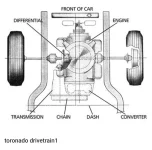
When I think about what just the steering knuckles cost, I'm definitely better off with a complete drivetrain as a parts donor, just in case. Of course, I might never need it. Let's hope so.
As a reminder:
To keep the drivetrain compact and avoid excessive weight on the front axle, the transmission was positioned next to the longitudinally mounted engine. The torque converter was mounted directly at the rear of the V8 engine, and power was transferred to the transmission via a chain that was rotated 180 degrees. The system was carefully engineered and proved to be very robust. The entire unit, the so-called "Unitized Power Package," was mounted on a subframe, and the use of torsion bars on the front axle freed up more space in the engine compartment.
Lee, the salesman from the UPP, another FB Revcon-Group contact, is a carpenter.
He built me a sturdy transport crate
according to my specifications within
one week. Another lucky coincidence.
Fancy a little Saturday lesson, ladies and gentlemen?
Then let's get started with a detailed explanation of the UPP, a true revolution in U.S. car manufacturing at the time.
"The new Unitized Power Package – it was the culmination of a long powertrain project at GM!
When the Oldsmobile Toronado was launched in 1966 as the first vehicle with UPP drive, it marked a turning point for the American automotive industry. General Motors took the plunge and introduced a front-wheel-drive coupe – the very first American front-wheel-drive car since the 1930s. The last time America had produced a front-wheel-drive car was in 1937, when the luxury compact car manufacturer Cord went bankrupt for the second time due to massive financial irregularities.
The UPP project underwent a lengthy development phase of nine years, beginning in 1958. GM appointed John Beltz to lead the project. Beltz was considered a rising star at Oldsmobile and, during the development of the UPP project, successfully brought another important project to market: the 1964 Oldsmobile 4-4-2."
It was important that Oldsmobile was equipped with the UPP first for two reasons:
The first reason lay in Oldsmobile's very nature as the GM brand that, with its top engineers, developed and implemented the most innovative ideas.
The second reason was practical. The UPP system had to prove itself in real-world driving conditions, far beyond the capabilities of engineers using test vehicles. Ordinary people needed to drive the UPP-equipped Toronados in real-world conditions to uncover any potential serious flaws. Only then could GM allow its Cadillac brand, the "global benchmark," to introduce the new powertrain.
Originally, the UPP project was intended to be quick and inexpensive. However, the project took longer than planned, and costs skyrocketed. The challenge of fitting a V8 engine, an automatic transmission, and all the other drivetrain components into the space typically reserved for the engine alone presented numerous problems. A longitudinal arrangement was chosen, and the engine was moved to the right in the engine compartment.
The space had to be sufficient to accommodate the transmission, which was split into two halves. The transmission was originally based on the Turbo-Hydramatic 400 (THM400). The front of the transmission was rotated 180 degrees so that it faced forward, while the torque converter remained in its usual position at the rear of the engine. The resulting transmission was designated the THM425.
A major engineering challenge was the power transmission between the torque converter and the transmission input shaft. This had been a problem with Cord's front-wheel-drive vehicles from the 1930s and led to their unreliability. GM's solution was to use a 5 cm wide chain with two 19 cm sprockets. The chain was a steel link chain and was developed by Morse Chain, a division of BorgWarner. The chain design proved to be quiet and reliable.
Steering and suspension were achieved via universal joints connected to the drive shafts. General Motors was so concerned about the reliability of the complex UPP system that it was tested for over 1.5 million miles (2.4 million kilometers). This distance was covered by more than a dozen test vehicles. Assuming an average speed of 55 mph, this resulted in 27,272 test hours.
The over-engineered powertrain was thus ready for use in the Oldsmobile Toronado and the Cadillac Eldorado, with the two expensive coupes helping to spread the costs incurred during the extended development period of the UPP.
The UPP system was so robust that it was famously adapted for use in heavy-duty motorhomes. From 1973 to 1978, GMC produced its motorhome, which used the same drivetrain components as the Toronado and Eldorado. The Class A motorhome, assembled by Pontiac West Assembly, was equipped with either a 7.5-liter Rocket V8 engine (455) or a 6.6-liter Oldsmobile V8 engine (403).
Final development came in the form of downsizing and weight reduction following the 1973 OPEC crisis. The UPP transmission was slimmed down in 1979 for use in the smaller E-body coupes (Riviera, Toronado, Eldorado). The engines were smaller (4.1 to 6.0 liters of displacement), and the Riviera was available with front-wheel drive for the first time. The lighter THM325 replaced the THM425 transmission in these models.
The UPP program ran until 1984. In 1985, in light of the anticipated astronomical fuel prices at the end of the 1980s, GM launched its completely downsized vehicles company-wide. With front-wheel drive, a significantly reduced design, and minimal brand differentiation, GM left its once proud UPP program behind.

 www.thetruthaboutcars.com
And there were actually some idiots in the local Austrian U.S. Car scene who had the following "opinion" about the Toronado/Eldorado: "Front-wheel drive in U.S. cars? HIHI!"
A 1973 Olds Toronado would be on my medium-term wish list, but please with driver and passenger airbags.
Oh dear, there was a complete, working 1978 UPP Revcon drivetrain in Crystal River, Fl; with transmission and everything, and with just over 100,000 km on the clock, lying around for USD 400. "What to do?" said Zeus.
Simple answer!
I just bought for €381!
A pittance, even if it turns out to be a bad investment. Actions speak louder than words. Why all this?
Because I can.
The entire subframe with the 6.6 Oldsmobile Toronado V8 and 425 transmission – the converter alone is expensive without shipping – has to go on a pallet and into a wooden crate. Transport would again be via the previous owner's Revcon route (just like with the windshield)
on the bed of a pickup truck from Linden, New Jersey to Europe.
So was the original plan.
Storage in Saxony at my mechanic's place there.
The engine and transmission ran perfectly before removal – 62,000 miles.
Basically, I bought this:
When I think about what just the steering knuckles cost, I'm definitely better off with a complete drivetrain as a parts donor, just in case. Of course, I might never need it. Let's hope so.
As a reminder:
To keep the drivetrain compact and avoid excessive weight on the front axle, the transmission was positioned next to the longitudinally mounted engine. The torque converter was mounted directly at the rear of the V8 engine, and power was transferred to the transmission via a chain that was rotated 180 degrees. The system was carefully engineered and proved to be very robust. The entire unit, the so-called "Unitized Power Package," was mounted on a subframe, and the use of torsion bars on the front axle freed up more space in the engine compartment.
Lee, the salesman from the UPP, another FB Revcon-Group contact, is a carpenter.
He built me a sturdy transport crate
according to my specifications within
one week. Another lucky coincidence.
Fancy a little Saturday lesson, ladies and gentlemen?
Then let's get started with a detailed explanation of the UPP, a true revolution in U.S. car manufacturing at the time.
"The new Unitized Power Package – it was the culmination of a long powertrain project at GM!
When the Oldsmobile Toronado was launched in 1966 as the first vehicle with UPP drive, it marked a turning point for the American automotive industry. General Motors took the plunge and introduced a front-wheel-drive coupe – the very first American front-wheel-drive car since the 1930s. The last time America had produced a front-wheel-drive car was in 1937, when the luxury compact car manufacturer Cord went bankrupt for the second time due to massive financial irregularities.
The UPP project underwent a lengthy development phase of nine years, beginning in 1958. GM appointed John Beltz to lead the project. Beltz was considered a rising star at Oldsmobile and, during the development of the UPP project, successfully brought another important project to market: the 1964 Oldsmobile 4-4-2."
It was important that Oldsmobile was equipped with the UPP first for two reasons:
The first reason lay in Oldsmobile's very nature as the GM brand that, with its top engineers, developed and implemented the most innovative ideas.
The second reason was practical. The UPP system had to prove itself in real-world driving conditions, far beyond the capabilities of engineers using test vehicles. Ordinary people needed to drive the UPP-equipped Toronados in real-world conditions to uncover any potential serious flaws. Only then could GM allow its Cadillac brand, the "global benchmark," to introduce the new powertrain.
Originally, the UPP project was intended to be quick and inexpensive. However, the project took longer than planned, and costs skyrocketed. The challenge of fitting a V8 engine, an automatic transmission, and all the other drivetrain components into the space typically reserved for the engine alone presented numerous problems. A longitudinal arrangement was chosen, and the engine was moved to the right in the engine compartment.
The space had to be sufficient to accommodate the transmission, which was split into two halves. The transmission was originally based on the Turbo-Hydramatic 400 (THM400). The front of the transmission was rotated 180 degrees so that it faced forward, while the torque converter remained in its usual position at the rear of the engine. The resulting transmission was designated the THM425.
A major engineering challenge was the power transmission between the torque converter and the transmission input shaft. This had been a problem with Cord's front-wheel-drive vehicles from the 1930s and led to their unreliability. GM's solution was to use a 5 cm wide chain with two 19 cm sprockets. The chain was a steel link chain and was developed by Morse Chain, a division of BorgWarner. The chain design proved to be quiet and reliable.
Steering and suspension were achieved via universal joints connected to the drive shafts. General Motors was so concerned about the reliability of the complex UPP system that it was tested for over 1.5 million miles (2.4 million kilometers). This distance was covered by more than a dozen test vehicles. Assuming an average speed of 55 mph, this resulted in 27,272 test hours.
The over-engineered powertrain was thus ready for use in the Oldsmobile Toronado and the Cadillac Eldorado, with the two expensive coupes helping to spread the costs incurred during the extended development period of the UPP.
The UPP system was so robust that it was famously adapted for use in heavy-duty motorhomes. From 1973 to 1978, GMC produced its motorhome, which used the same drivetrain components as the Toronado and Eldorado. The Class A motorhome, assembled by Pontiac West Assembly, was equipped with either a 7.5-liter Rocket V8 engine (455) or a 6.6-liter Oldsmobile V8 engine (403).
Final development came in the form of downsizing and weight reduction following the 1973 OPEC crisis. The UPP transmission was slimmed down in 1979 for use in the smaller E-body coupes (Riviera, Toronado, Eldorado). The engines were smaller (4.1 to 6.0 liters of displacement), and the Riviera was available with front-wheel drive for the first time. The lighter THM325 replaced the THM425 transmission in these models.
The UPP program ran until 1984. In 1985, in light of the anticipated astronomical fuel prices at the end of the 1980s, GM launched its completely downsized vehicles company-wide. With front-wheel drive, a significantly reduced design, and minimal brand differentiation, GM left its once proud UPP program behind.
Abandoned History: GM's Unitized Power Package, you Down With UPP?
As we wrapped up the latest installment in the Rare Rides series on the Cadillac Eldorado, we reached a turning point in the prestigious coupe’s identity: it became front-wheel drive. Underneath the ‘67 Eldorado’s smooth and angular body was the new Unitized Power Package, the UPP. And it was...
www.thetruthaboutcars.com
And there were actually some idiots in the local Austrian U.S. Car scene who had the following "opinion" about the Toronado/Eldorado: "Front-wheel drive in U.S. cars? HIHI!"
A 1973 Olds Toronado would be on my medium-term wish list, but please with driver and passenger airbags.
Then the bad news: The previous owner of my Revcon no longer imports K30s to Germany.
So I had to abandon that shipping option – the UPP on the back of a pickup truck, like with the windshield.
But he did give me the address of his transport company.
Consolidated container – that's the way to go!
I've signed a shipping contract for the Revcon drivetrain. From Crystal River, Florida to Saxony – door-to-door. With customs, etc., the transport costs are now around €1,000. So, factoring in the purchase price, I'll soon have a complete 1978 Revcon drivetrain (engine, axles, transmission, etc.) with 100,000 km on it stored in Saxony as a complete replacement for my Revcon, for a total of about €1,500.
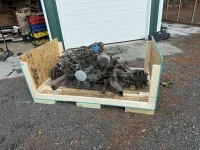
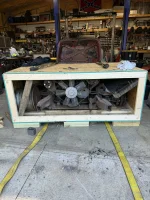
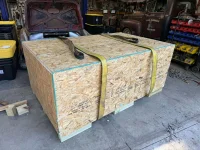
It will be picked up in Crystal River on Monday.
Very nice area, by the way. I have been there in 2013. Snorkeling with the Manatees.
So I had to abandon that shipping option – the UPP on the back of a pickup truck, like with the windshield.
But he did give me the address of his transport company.
Consolidated container – that's the way to go!
I've signed a shipping contract for the Revcon drivetrain. From Crystal River, Florida to Saxony – door-to-door. With customs, etc., the transport costs are now around €1,000. So, factoring in the purchase price, I'll soon have a complete 1978 Revcon drivetrain (engine, axles, transmission, etc.) with 100,000 km on it stored in Saxony as a complete replacement for my Revcon, for a total of about €1,500.
It will be picked up in Crystal River on Monday.
Very nice area, by the way. I have been there in 2013. Snorkeling with the Manatees.

Fantastic…. Seems like a bargain. I just helped our german exchange student send back 2 sweaters as gifts for her family. $108 for a 7 pound package.

Thanks a lot for your update!
You have the same problem GMC owners have... times three: no "local" knowledgeable parts suppliers, no "local" knowledge of mechanical quirks of an unusual vehicle, and blindingly expensive shipping from where appropriate parts may be found.
I admire your resourcefulness and persistence, and your financial resources. When someone with a passion and the resources to support it shows up- amazing things happen. Your Revcon tooling around Europe qualifies easily. The really cool thing is that you're sharing it with a community that can both help and with real appreciation, share in your successes. More power to you brother, keep it coming.
You have the same problem GMC owners have... times three: no "local" knowledgeable parts suppliers, no "local" knowledge of mechanical quirks of an unusual vehicle, and blindingly expensive shipping from where appropriate parts may be found.
I admire your resourcefulness and persistence, and your financial resources. When someone with a passion and the resources to support it shows up- amazing things happen. Your Revcon tooling around Europe qualifies easily. The really cool thing is that you're sharing it with a community that can both help and with real appreciation, share in your successes. More power to you brother, keep it coming.
I want to thank you sincerely for your encouraging words.
Yes, a house on wheels is simply fascinating. Of course, there are always some tough and expensive setbacks, like when that imported part doesn't fit after all. The people at the workshop in Babenhausen are very good, but even they can't manage without my help with research and sourcing spare parts.
Feedback like yours gives me strength, and although only two people regularly reply to me in the small Austrian U.S. Car Forum, I've had over 3 million hits there since 2020. So the Revcon story is somehow finding an audience in Europe too.
The German Astro-Safari forum was a huge technical help, but when it comes to finding the right Revcon parts, I'm pretty much on my own there too.
And you Americans are simply invaluable when it comes to helping out. I, a complete stranger, send my money across the Atlantic, and nobody in the US has taken advantage of it in any way; everyone is trying to help me affordably with fair prices for spare parts and inexpensive shipping.
What I truly regret is never having received formal technical training in automotive mechanics. Over the past five summers, I've learned a lot while working on Revcon projects from my Saxon mechanic, who, incidentally, will be retiring in the summer of 2026. It's all about learning by doing. My plan is to train myself on my own vehicles once I retire, which is still a long way off.
However, I'm a trained scientist and historian, so research and drawing conclusions is right up my alley. That, in turn, helps me with my Revcon project. And, of course, the incredibly valuable sense of community.
We're all a bit like car fanatics here, and we simply want to keep a piece of American history going.
My Revcon investments are covered by comprehensive insurance, including any increase in value. Sure, it's a lot of money, but nothing that would cost here in Austria/Germany to restore a coveted VW T1 Samba bus or a Porsche collection.
Simple tuning of a BMW or Audi can easily cost more, not to mention the depreciation when buying a new car.
I just love old U.S. RVs, my retired P-71 Crown Vic and our used GMC Safari Gulf Stream family van with over 187.000 miles on the odometer. They always make me smile. Have a nice Sunday!

Greetings from GermanyHi, my name is Matt!
I own a 1979 Revcon Camelot 30ft. with the 403 L80 Oldsmobile Toronado FWD UPP powertrain which is similar to the GMC Motorhome.
View attachment 5116
I bought the Revcon from an owner in Germany in June last year. He had the Motorhome for over 20 years and he was the second owner. It´s a monster!
View attachment 5119
Revcon and GMC Safari High Top.
Nobody drives such a beast on the small and winding roads here in Europe. We do! Local ordinary mortals stick to their high-priced small and tiny Volkswagen Camper Tin Boxes with their "clean" Diesel engines, so I´m a fine dust terrorist in their sight.
I hope to find here some helpful technical solutions concerning my vibration problem caused by the FWD.
View attachment 5117
View attachment 5118
Thank you very much for the admission into your forum society!
BR
Matt
A call from Babenhausen (German U.S. Motorhome Repair Shop) regarding my 1979 Revcon: All the steering components fit; only the alignment needs to be done. This means the steering knuckles I sourced via Facebook from the GMC Motorhome, the only once offered drag link for the 1978 Oldsmobile Toronado passenger car from Canada on Ebay, the tie rods (according to the typed-up, old parts list), and the wishbone from our GMC Motorhome forum member were all correct. It took a year of detective work and organization on my part. I still can't believe it. 


Journey of a thousand miles starts
with one step and you are almost there..
with one step and you are almost there..
GratulationA call from Babenhausen (German U.S. Motorhome Repair Shop) regarding my 1979 Revcon: All the steering components fit; only the alignment needs to be done. This means the steering knuckles I sourced via Facebook from the GMC Motorhome, the only once offered drag link for the 1978 Oldsmobile Toronado passenger car from Canada on Ebay, the tie rods (according to the typed-up, old parts list), and the wishbone from our GMC Motorhome forum member were all correct. It took a year of detective work and organization on my part. I still can't believe it.


 And the outfit always has to be harmonious...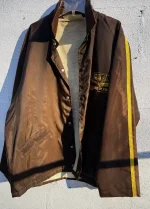
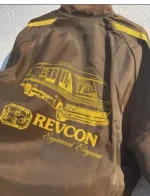

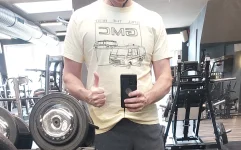
But I'm open to all brands, as long as a UPP is inside.

Last edited:
Best shirt