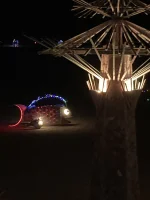
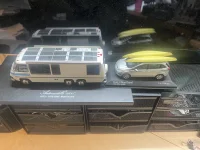
1,400 miles round trip. Seattle to Black Rock Desert and back during record-setting heat. No mechanical issues.
10 days' off-grid camping without shore power and without a generator (removed before trip). New lithium phosphate + solar setup worked great.
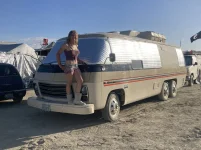
My only regret is because of the time and money involved I won't get to GMC regional or national meets this season. I definitely will next year.
- Getting in or out the gate at Burning Man usually involves 4 to 12 hours to travel 5 miles. To avoid vapor lock I aimed for midnight instead of noon. The site's driveway has 10 lanes but connects to a 2-lane county road with curves and no shoulders.
- Everything must be hauled in and hauled out. No money changes hands other than ice for sale a half mile away (ride a bicycle or walk) and a roving water/RV pumpout service which isn't scheduled or guaranteed. No convenience stores or other supplies on site.
- On the route from Seattle the nearest reliable gas station is 102 miles (Cedarville California).
- Gasoline other than built-in tanks is limited. If a camp (a dozen people in our case) brings more than 20 gallons total that triggers a bunch of fire lane and storage requirements and an upper limit of 110 gallons. I'd originally planned for solar next year but added it now to reduce generator hours. (I had the only RV in our camp).
- Nothing can be left behind. Not a single toothpick or shred of anything. Each camp is required to check and remove all debris before leaving and is barred from returning if they leave a mess. After 80,000 people leave, the Burning Man organization has a team that literally walks the entire 7 square miles (takes weeks) and removes any remaining debris. This sounds silly but makes sense - the site is a dry lake bed, fills with a couple inches of water in winter, shrimp hatch and thousands of migratory birds require this. If an event fails to follow rules the Bureau of Land Management won't issue a permit next year.
- Vehicles other than licensed art cars cannot move once parked until it's time to leave. Once on site, bicycle is best way to get around.
- Dust storms kick up without warning. If you're going more than a short distance from camp bring goggles, industrial-grade respirator, and water. This dust is alkaline (pH around 10), will quickly corrode unprotected metal and isn't great for lungs and eyes. I've seen new galvanized tent stakes come out of the ground a week later coated in rust.
Why would anyone do this to themselves and to a classic GMC? Because there is nothing quite like this place for a certain type of person.
My GMC doesn't currently have dash A/C, haven't had time to get UV film applied to the windshield, and for various reasons I never ran the roof A/C (hottest day was 104F).
Main task before this trip was modernize the electrical system. I'll detail modifications in other threads specific to each category.
- Single 300A Lithium-Phosphate battery under the bed which triggered a rebuild of that section of interior (replace rotted rear floor and build a more efficient bed frame).
- Victron components: inverter, solar controller, engine alternator charge controller, DC power bus, internet interface and display.
- Blue Sea remote battery switch and fuse.
- Unified power distribution panel for 110v & 12v house circuits
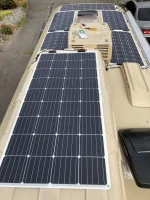
- Four curved rooftop solar panels with each pair wired series-to-parallel (36 volts).
- Automatic line filter for shore power (not needed for this trip).
- Automatic transfer switch for generator (will be removing and selling that due to next item).
- Removed Honda EV6010 generator before trip. Starter motor draw was too high, ran out of time to fix it. Turns out it wasn't needed at all - solar panels did the job and the additional storage space was useful. I'll sell this generator locally after fixing the starter (has correct base to bolt into any 26' GMC).
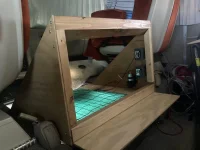
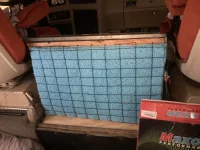
- Home-made swamp cooler with 16 inch DC fan, adjustable water intake pump, air filters. Installs over engine bay when parked, draws shaded air from underneath. Ran swamp cooler 6 hours per day, consumed 2 gallons water per day.
- Six 4-port 12v USB in-wall adapters.
- New dedicated 110v circuits for bathroom and 2 other areas, and updated all existing receptacles.
- New bedroom design involved moving the fresh-water fill forward to be alongside the city water fill. This freed up additional width for headboard/footboard area.
- Toto S550 bidet over a Thetford elongated porcelain toilet. Required modification with a diamond-blade grinder, I'll detail in a separate thread.
- European-grade headlights (Hella H4 E-Code) to avoid costly meetings with deer or cattle.
- Portable 26 gallon waste tank just in case. Not needed, still new, I'll sell it locally.
- Nest smoke alarms front and back. I prefer these because they send an alert if wifi is available.
- Reflective insulated covers for all window exteriors when parked.
- Furnace-type air filters for window openings when parked to reduce dust (wasn't necessary - the swamp cooler provided plenty of intake air).
- CRC 6026 anti-corrosion coating for inside of aluminum rims (outside has clear coat and did fine. This is to avoid alkali corrosion on inside of wheels).
I also have a bunch of additional items to install that are less essential, postponed for this fall/winter.
Two Renogy 175W + two Renogy 100W curved solar panels:
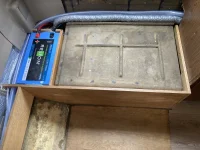
ReLion 300A adjacent to remote battery switch and just-in-case fuse. Photos taken before final connections and trim.
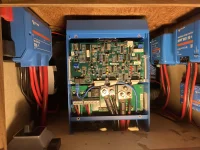
Victron Lynx, MultiPlus 12/3000 Inverter, Orion 12/12-30 DC-DC, SmartSolar 100/50, Cerbo GX.
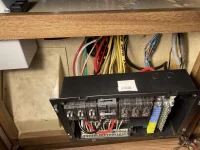
Arterra WF8930/50 power distribution panel.
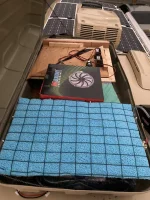
Swamp cooler stored in roof pod. Fits into engine lid, draws relatively cool air from underneath when parked, adds an adjustable amount of humidity. Bad idea in Florida, good idea in Nevada. Also ran 3 power roof vents 24/7 for entire trip.
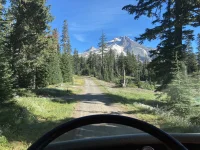
On the way, dry-camped at base of Mount Hood Oregon. Arrived at midnight, woke up to this:
Installed Hella E-Code headlights in Oregon (ran out of time before leaving Seattle). A few hours later found the new headlights were so dim they were unusable. This was caused by new LED bulbs having less power consumption than original headlamps, not enough resistance to jump past corrosion on old electrical sockets. Discovered the solution while Saha and I were patching temporary headlight power (cannibalized an extension cord for that) - the additional chunk of copper was enough to make contact with original wiring. With that solved the new headlights are excellent with a sharp low-beam cutoff and plenty of high beam.
Arrived a bit after midnight as planned (avoid daytime heat in slow traffic). Gate line was much shorter than expected. The more crowded route from California had a bad wreck, that particular road closed several hours and eliminated traffic merging into the route from Seattle. And then... I suppose I can say we are here because we're not all there ;-)
Saha and Beth next to a mid-size art car. Some art cars are quite a bit larger with ridiculous sound systems and a stage or rave/dance floor on top.
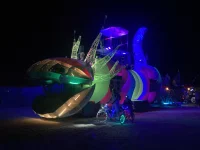
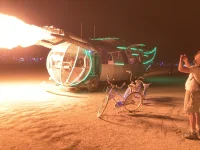
The dragon car is based on a mid 1970s GM P30 chassis, designed and fabricated by a friend of mine (Lucy) from Santa Cruz. Sides fold in so it's street legal - driven from the California coast to Black Rock Desert in Nevada. Lucy has designed and built four art cars - one has a flame-shooting pipe organ and was featured on the Discovery Channel.
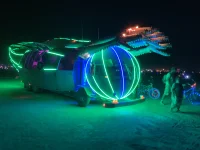
Don't cut off that car in traffic. Safety third!
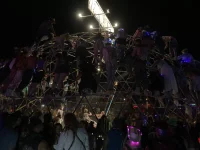
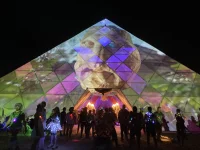
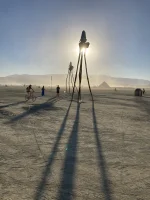
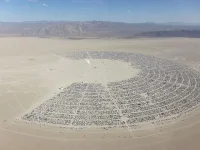
I didn't take the following two photos but this might provide a sense of scale. The desert is dotted with art installations that aren't visible in these aerial photos - some are stunning beautiful, some are bizarre, and most are so creative. The setting is part of the art.
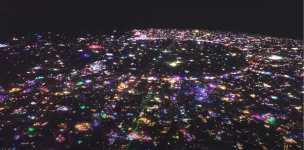
Same view at night:
Time to go. Left at midnight to avoid thick traffic in record-setting heat. After getting thru the gate (just 4 hours) took a different route - instead of the crowded but paved 2-lane country road, headed north into desolate gravel and dirt roads in the hills and dry camped. Got up next day, continued on 100 miles of gravel. Pavement starts at the state border near Cedarville California.
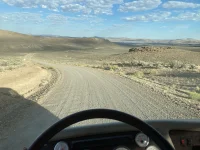
After a hot day driving across Eastern Oregon (no dash A/C yet) found a great primitive campsite on a one-lane gravel road a few miles from Warm Springs Oregon.
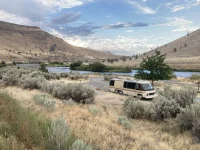
And then back to Seattle.
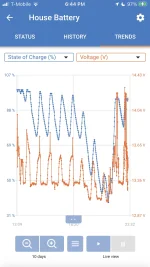
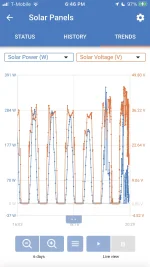
Here's 10-day graph of 300A battery and solar without any shore power or generator.
Daily battery depletion and charging was fairly consistent while parked.
The drop in performance was from dust accumulation and worsened after a couple major dust storms (got caught in one at night, could barely see the front tire of my bicycle).
I didn't start the GMC's engine until it was time to leave.
Solar performance resumed after 60mph driving blew dust off the roof.
-Kendra
10 days' off-grid camping without shore power and without a generator (removed before trip). New lithium phosphate + solar setup worked great.
My only regret is because of the time and money involved I won't get to GMC regional or national meets this season. I definitely will next year.
- Getting in or out the gate at Burning Man usually involves 4 to 12 hours to travel 5 miles. To avoid vapor lock I aimed for midnight instead of noon. The site's driveway has 10 lanes but connects to a 2-lane county road with curves and no shoulders.
- Everything must be hauled in and hauled out. No money changes hands other than ice for sale a half mile away (ride a bicycle or walk) and a roving water/RV pumpout service which isn't scheduled or guaranteed. No convenience stores or other supplies on site.
- On the route from Seattle the nearest reliable gas station is 102 miles (Cedarville California).
- Gasoline other than built-in tanks is limited. If a camp (a dozen people in our case) brings more than 20 gallons total that triggers a bunch of fire lane and storage requirements and an upper limit of 110 gallons. I'd originally planned for solar next year but added it now to reduce generator hours. (I had the only RV in our camp).
- Nothing can be left behind. Not a single toothpick or shred of anything. Each camp is required to check and remove all debris before leaving and is barred from returning if they leave a mess. After 80,000 people leave, the Burning Man organization has a team that literally walks the entire 7 square miles (takes weeks) and removes any remaining debris. This sounds silly but makes sense - the site is a dry lake bed, fills with a couple inches of water in winter, shrimp hatch and thousands of migratory birds require this. If an event fails to follow rules the Bureau of Land Management won't issue a permit next year.
- Vehicles other than licensed art cars cannot move once parked until it's time to leave. Once on site, bicycle is best way to get around.
- Dust storms kick up without warning. If you're going more than a short distance from camp bring goggles, industrial-grade respirator, and water. This dust is alkaline (pH around 10), will quickly corrode unprotected metal and isn't great for lungs and eyes. I've seen new galvanized tent stakes come out of the ground a week later coated in rust.
Why would anyone do this to themselves and to a classic GMC? Because there is nothing quite like this place for a certain type of person.
My GMC doesn't currently have dash A/C, haven't had time to get UV film applied to the windshield, and for various reasons I never ran the roof A/C (hottest day was 104F).
Main task before this trip was modernize the electrical system. I'll detail modifications in other threads specific to each category.
- Single 300A Lithium-Phosphate battery under the bed which triggered a rebuild of that section of interior (replace rotted rear floor and build a more efficient bed frame).
- Victron components: inverter, solar controller, engine alternator charge controller, DC power bus, internet interface and display.
- Blue Sea remote battery switch and fuse.
- Unified power distribution panel for 110v & 12v house circuits
- Four curved rooftop solar panels with each pair wired series-to-parallel (36 volts).
- Automatic line filter for shore power (not needed for this trip).
- Automatic transfer switch for generator (will be removing and selling that due to next item).
- Removed Honda EV6010 generator before trip. Starter motor draw was too high, ran out of time to fix it. Turns out it wasn't needed at all - solar panels did the job and the additional storage space was useful. I'll sell this generator locally after fixing the starter (has correct base to bolt into any 26' GMC).
- Home-made swamp cooler with 16 inch DC fan, adjustable water intake pump, air filters. Installs over engine bay when parked, draws shaded air from underneath. Ran swamp cooler 6 hours per day, consumed 2 gallons water per day.
- Six 4-port 12v USB in-wall adapters.
- New dedicated 110v circuits for bathroom and 2 other areas, and updated all existing receptacles.
- New bedroom design involved moving the fresh-water fill forward to be alongside the city water fill. This freed up additional width for headboard/footboard area.
- Toto S550 bidet over a Thetford elongated porcelain toilet. Required modification with a diamond-blade grinder, I'll detail in a separate thread.
- European-grade headlights (Hella H4 E-Code) to avoid costly meetings with deer or cattle.
- Portable 26 gallon waste tank just in case. Not needed, still new, I'll sell it locally.
- Nest smoke alarms front and back. I prefer these because they send an alert if wifi is available.
- Reflective insulated covers for all window exteriors when parked.
- Furnace-type air filters for window openings when parked to reduce dust (wasn't necessary - the swamp cooler provided plenty of intake air).
- CRC 6026 anti-corrosion coating for inside of aluminum rims (outside has clear coat and did fine. This is to avoid alkali corrosion on inside of wheels).
I also have a bunch of additional items to install that are less essential, postponed for this fall/winter.
Two Renogy 175W + two Renogy 100W curved solar panels:
ReLion 300A adjacent to remote battery switch and just-in-case fuse. Photos taken before final connections and trim.
Victron Lynx, MultiPlus 12/3000 Inverter, Orion 12/12-30 DC-DC, SmartSolar 100/50, Cerbo GX.
Arterra WF8930/50 power distribution panel.
Swamp cooler stored in roof pod. Fits into engine lid, draws relatively cool air from underneath when parked, adds an adjustable amount of humidity. Bad idea in Florida, good idea in Nevada. Also ran 3 power roof vents 24/7 for entire trip.
On the way, dry-camped at base of Mount Hood Oregon. Arrived at midnight, woke up to this:
Installed Hella E-Code headlights in Oregon (ran out of time before leaving Seattle). A few hours later found the new headlights were so dim they were unusable. This was caused by new LED bulbs having less power consumption than original headlamps, not enough resistance to jump past corrosion on old electrical sockets. Discovered the solution while Saha and I were patching temporary headlight power (cannibalized an extension cord for that) - the additional chunk of copper was enough to make contact with original wiring. With that solved the new headlights are excellent with a sharp low-beam cutoff and plenty of high beam.
Arrived a bit after midnight as planned (avoid daytime heat in slow traffic). Gate line was much shorter than expected. The more crowded route from California had a bad wreck, that particular road closed several hours and eliminated traffic merging into the route from Seattle. And then... I suppose I can say we are here because we're not all there ;-)
Saha and Beth next to a mid-size art car. Some art cars are quite a bit larger with ridiculous sound systems and a stage or rave/dance floor on top.
The dragon car is based on a mid 1970s GM P30 chassis, designed and fabricated by a friend of mine (Lucy) from Santa Cruz. Sides fold in so it's street legal - driven from the California coast to Black Rock Desert in Nevada. Lucy has designed and built four art cars - one has a flame-shooting pipe organ and was featured on the Discovery Channel.
Don't cut off that car in traffic. Safety third!
I didn't take the following two photos but this might provide a sense of scale. The desert is dotted with art installations that aren't visible in these aerial photos - some are stunning beautiful, some are bizarre, and most are so creative. The setting is part of the art.
Same view at night:
Time to go. Left at midnight to avoid thick traffic in record-setting heat. After getting thru the gate (just 4 hours) took a different route - instead of the crowded but paved 2-lane country road, headed north into desolate gravel and dirt roads in the hills and dry camped. Got up next day, continued on 100 miles of gravel. Pavement starts at the state border near Cedarville California.
After a hot day driving across Eastern Oregon (no dash A/C yet) found a great primitive campsite on a one-lane gravel road a few miles from Warm Springs Oregon.
And then back to Seattle.
Here's 10-day graph of 300A battery and solar without any shore power or generator.
Daily battery depletion and charging was fairly consistent while parked.
The drop in performance was from dust accumulation and worsened after a couple major dust storms (got caught in one at night, could barely see the front tire of my bicycle).
I didn't start the GMC's engine until it was time to leave.
Solar performance resumed after 60mph driving blew dust off the roof.
-Kendra