Fuel 2 Electric - Converting the GMC to an EV

Andreas

New member
Feb 8, 2026
7
1
3
Germany
I will have my '76 Eleganza II converted to electric. The way to go will be a renewed Tesla LDU with 455 horsepower instead of the old V8-engine and transmission, combined with 200 kWh LiFePo-Batteries, most in the frame and some in the motorcompartment. Should give a range of 4 hours driving at highway speed.
I am curious if here are other people who have done something similar with their moho and are willing to share experiences. So far i only know of one GMC moho, that has been converted already.
 
  • Like
Reactions: pilondav
I will have my '76 Eleganza II converted to electric. The way to go will be a renewed Tesla LDU with 455 horsepower instead of the old V8-engine and transmission, combined with 200 kWh LiFePo-Batteries, most in the frame and some in the motorcompartment. Should give a range of 4 hours driving at highway speed.
I am curious if here are other people who have done something similar with their moho and are willing to share experiences. So far i only know of one GMC moho, that has been converted already.
Interesting! How did you figure the battery and motor requirements?
 
Hi Christo, that wasn't too difficult: Most classic car conversions are done this way. Used Tesla motors are easy to get and the LDU from Model S and X is a little bit heavier and stronger built than the newer SDU, which is used in the smaller Models 3 and Y. The Tesla motor can be fitted right between the front axels where the final drive used to be. Only the drive shafts and the motor mounts have to be special crafted.
The size of the battery is planned to be around 200 kWh, because we think the moho will consume around 40-50 kWh per 100 km, which is at least twice as much as an electric car does at highway speed. First we thought about used Tesla or VW LiIon-batteries, but then decided for new LiFePo-batteries. They are much more flexible to install and to manage, and even cheeper. They weight a bit more, but thats no problem because the GMC can carry a lot of load when you have got rid of all the old fossil stuff: engine, trans, cooler, fueltanks, gastank, onan...
 
This thread talks about needing 60 HP sustained: https://www.gmcmotorhome.org/threads/electric-conversion.70876/

I believe the GMCMH has a frontal area of about 70 square feet, and you're at maybe 9k pounds if you remove all the existing ICE gear (Olds engine/trans is about 1k pounds by itself)

I'm thinking you'll actually need about 400kwh of batteries for 4 hours of range at just 60 mph, which will add about 6k pounds of weight. If that's right, there's a chassis/tire problem, setting aside the significant cost and charging time concerns. Hm.
 
N
What happens when climbing I-5 over the 4000' elevation gain to the Siskiyou Summit?
Not shure id i get the question right, Bill. Never heard of any ev having problems with climbing or height.
With 455 horsepower from the very robust Tesla motor that will be easy. Of cause the power consumption will get higher, but thats physics, same with fuel.
 
This thread talks about needing 60 HP sustained: https://www.gmcmotorhome.org/threads/electric-conversion.70876/

I believe the GMCMH has a frontal area of about 70 square feet, and you're at maybe 9k pounds if you remove all the existing ICE gear (Olds engine/trans is about 1k pounds by itself)

I'm thinking you'll actually need about 400kwh of batteries for 4 hours of range at just 60 mph, which will add about 6k pounds of weight. If that's right, there's a chassis/tire problem, setting aside the significant cost and charging time concerns. Hm.
How do you come to that idea, Christo? Half of it is realistic.
 
N

Not shure id i get the question right, Bill. Never heard of any ev having problems with climbing or height.
With 455 horsepower from the very robust Tesla motor that will be easy. Of cause the power consumption will get higher, but thats physics, same with fuel.
And of course, it's more involved than just power consumption. It's also the ability of the batteries to deliver the sustained amperage without overheating.
 
  • Like
Reactions: billvv
And of course, it's more involved than just power consumption. It's also the ability of the batteries to deliver the sustained amperage without overheating.
The batteries will of course be temperated - same as usual in other ev's. For example when charging at a supercharger they are cooled to make fast charging possible. I charge my Tesla from 10% to 80% in 15-20 min - just enough time to go pee and have a coffee. The three times bigger batterie in the moho will of course require some additional charging time. But, its a moho, i can cook my own coffee in it and take a nap or go with the dogs.
 
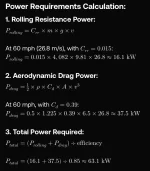
I found an updated coefficient of drag for the GMCMH of .39, which reduces the battery requirements significantly. Looks more like 250 kWh (minimum) based on the following calcs. How does this compare with your assumptions:

Key Parameters:
• Base vehicle weight: 9,000 lbs ≈ 4,082 kg
• Frontal area: 70 square feet ≈ 6.5 m²
• Target range: 240 miles
• Drag coefficient (C_d): 0.39
• Speed: 60 mph (26.8 m/s)
• Tesla LDU efficiency: approximately 85-90%

IMG_0845.webp

Battery Capacity for 240-Mile Range:
For 240 miles at 60 mph:
• Time = 240 miles ÷ 60 mph = 4 hours
• Energy needed = 63.1 kW × 4 h ≈ 252.4 kWh

LiFePO4 Battery Configuration (assuming use of 100% capacity which isn't practical in real world)
• Battery weight: 252,400 Wh ÷ 100 Wh/kg ≈ 2,524 kg (5,563 lbs)
• Cell configuration: Approximately 11-12 parallel strings of 280Ah cells
• System voltage: Typically 400-800V to match Tesla LDU requirements

Total Vehicle Weight:
• Base RV weight: 9,000 lbs
• Battery weight: 5,563 lbs
• Total: 14,563 lbs (6,606 kg)
 
I found an updated coefficient of drag for the GMCMH of .39, which reduces the battery requirements significantly. Looks more like 250 kWh (minimum) based on the following calcs. How does this compare with your assumptions:

Key Parameters:
• Base vehicle weight: 9,000 lbs ≈ 4,082 kg
• Frontal area: 70 square feet ≈ 6.5 m²
• Target range: 240 miles
• Drag coefficient (C_d): 0.39
• Speed: 60 mph (26.8 m/s)
• Tesla LDU efficiency: approximately 85-90%

View attachment 18565

Battery Capacity for 240-Mile Range:
For 240 miles at 60 mph:
• Time = 240 miles ÷ 60 mph = 4 hours
• Energy needed = 63.1 kW × 4 h ≈ 252.4 kWh

LiFePO4 Battery Configuration (assuming use of 100% capacity which isn't practical in real world)
• Battery weight: 252,400 Wh ÷ 100 Wh/kg ≈ 2,524 kg (5,563 lbs)
• Cell configuration: Approximately 11-12 parallel strings of 280Ah cells
• System voltage: Typically 400-800V to match Tesla LDU requirements

Total Vehicle Weight:
• Base RV weight: 9,000 lbs
• Battery weight: 5,563 lbs
• Total: 14,563 lbs (6,606 kg)

That C(drag) was measured in a wind tunnel but the model was 'clean' with no bumpers sticking out scooping air, rear view mirrors sticking out, roof pods and A/Cs .

A more realistic Cd would be 0.7
 
This thread talks about needing 60 HP sustained: https://www.gmcmotorhome.org/threads/electric-conversion.70876/

I believe the GMCMH has a frontal area of about 70 square feet, and you're at maybe 9k pounds if you remove all the existing ICE gear (Olds engine/trans is about 1k pounds by itself)

I'm thinking you'll actually need about 400kwh of batteries for 4 hours of range at just 60 mph, which will add about 6k pounds of weight. If that's right, there's a chassis/tire problem, setting aside the significant cost and charging time concerns. Hm.

Based on the fuel consumption of our coaches, I calculated the horsepower required just to cruise down a flat highway at 65 mph was more like 90 HP
 
The batteries will of course be temperated - same as usual in other ev's. For example when charging at a supercharger they are cooled to make fast charging possible. I charge my Tesla from 10% to 80% in 15-20 min - just enough time to go pee and have a coffee. The three times bigger batterie in the moho will of course require some additional charging time. But, its a moho, i can cook my own coffee in it and take a nap or go with the dogs.

Hi Andreas,

Sounds like a great project! I hope you move forward with it (no pun intended!)

Do the calcs, make the assumptions you need to make and build it, this is how progress happens. Maybe some part of it won't work, but this is how we learn.

The fastest cars at the 1/8 track near me are the Teslas, they have some serious power.

Please keep us up to date on your progress.

Todd
 
I will have my '76 Eleganza II converted to electric. The way to go will be a renewed Tesla LDU with 455 horsepower instead of the old V8-engine and transmission, combined with 200 kWh LiFePo-Batteries, most in the frame and some in the motorcompartment. Should give a range of 4 hours driving at highway speed.
I am curious if here are other people who have done something similar with their moho and are willing to share experiences. So far i only know of one GMC moho, that has been converted already.
There are people that very conscientiously strive to lighten their GMCs. One 23' was under 9000 pounds and a 26' was just under 10,000. With some effort and expenditure I'd think a GMC EV could have a curb weight pretty close to the OEM GVWR.

The goalposts are constantly moving and there's denser energy storage batteries around the corner. Mercedes is doing some very interesting things.


Axial flux in hub motors, active control everything, ridiculously fast charging time, etc, etc.

It'll be less than $200K and I'd buy one except for 2 things:
1). 0 to 60 mph seems sluggish at 2.0 seconds
2). I'd be dead right around 2.1 seconds.