Dometic
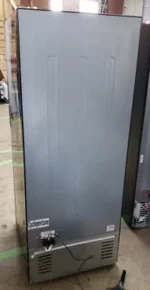
DMC4101 installation instructions don't specify a requirement for back or top ventilation. Top and sides are smooth, and the back is mostly smooth with a tiny set of louvers near the bottom. I might cover-up the GMC's exterior side vent as well. Here's the DMC4101 back side:
View attachment 18968
I'm not a fan of Dometic's sometimes ambiguous instructions. The link you shared has information in the troubleshooting section that's not worked out in the installation. It says the outside for the refrigerator should not be touching the walls of the cabinet enclosure, and as you say, it does not mention ventilation.
A refrigerator is a heat pump. The heat you're pulling from the inside of the refrigerator had to go somewhere and without any exterior vents it's all going to the inside. Maybe that's not a concern if the AC is cranked up to compensate, but it should be considered when designing the enclosure.
Here's AI's take on the situation.
To calculate the heat load inside your RV cabinet, you must look at how much of those
532.3 BTU/hr are trapped as waste heat.
Because the
Dometic DMC4101 is a front-venting refrigerator, it is highly efficient at pushing heat forward into the living space. However, it still radiates a small portion of electrical waste heat directly into the sealed rear cabinet enclosure.
1. Calculate Active Heat Load (10% Radiated)
Compressor refrigerators vent about 90% of their heat out the front grille. The remaining 10% radiates from the compressor housing and condenser loops into the back cabinet:
\(532.3\text{\ BTU/hr}\times 0.10=\mathbf{53.2}\text{\ BTU/hr}\)
2. Calculate Standby / Idle Heat Load
Once the refrigerator reaches its target temperature, the compressor runs roughly 35% to 50% of the time (a 50% duty cycle is typical in warm weather):
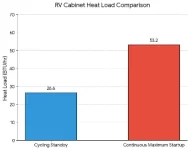
\(53.2\text{\ BTU/hr}\times 0.50=\mathbf{26.6}\text{\ BTU/hr\ (Average\ Cycle\ Heat\ Load)}\)
3. Calculate Maximum Startup Heat Load (100% Load)
If the refrigerator is working hard to cool down groceries on a hot day, or during an active defrost cycle, the compressor runs at 100% capacity continuously:
\(532.3\text{\ BTU/hr}\times 0.10=\mathbf{53.2}\text{\ BTU/hr\ (Continuous\ Peak\ Load)}\)

Final Answer
The continuous heat load inside your RV cabinet will fluctuate between
26.6 BTU/hr during normal cycling and a maximum peak of
53.2 BTU/hr under heavy usage.
Cabinet Ventilation Recommendation
To prevent this heat from degrading your refrigerator's efficiency, ensure you maintain the factory-required cut-out clearance of
59.9" H x 24" W x 24" D. If the cabinet is completely unventilated and tightly sealed at the top, trapping even 53 BTU/hr can cause the compressor to run longer and draw more battery power.
Me again: Note that the above calculations are for the waste heat inside the enclosure, the other 90% waste heat is warming up the coach interior.


 Just added solar to a friends Scamp camper for that reason.