Electrical Generation from Exhaust

sailor man

Well-known member
Jan 12, 2021
679
316
63
Palmetto, FL
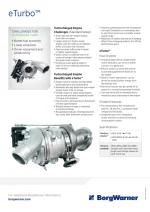
If you need more electrical power generation, perhaps you could consider this approach.

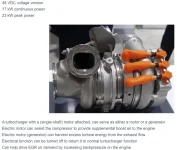
Since it can be either a turbocharger or a generator (think direct current alternator). We have massive big block engines with a massive amount of waste energy in our mufflers and tail pipes.

Maybe I should install this instead of an electric supercharger or maybe both.

If I install both, I could generate the electricity with an eTurbo to power and electric supercharger and get more electricity to charge the batteries simultaneously.

I could certainly accept 48vdc with my (2) Lithionics 51.2v, 150aH batteries and I can add a third one. I also am planning to install 48vdc to 12vdc converters to back up the 12vdc 1,000aH BattleBorn battery bank for 12vdc appliances and other users.

I could also install a 48vdc battery to 12vdc battery charger with appropriate ATS to select the charging source.

Direct current motors are also direct current generators.

This is a Borg Warner product.
1756730129182.webp
Maybe going uphill it's a turbocharger and downhill it's a generator. Isn't that how railroad diesel electrics work?

Which our massive engines, it make more sense to check out products that are characterized as gasoline or diesel trucks. Aren't every other motorhome built on the chassis and drivetrain of a truck or bus.

Maybe I have to merge this thread with the other thread I have on electric superchargers.
 
Last edited:
Sailor man,
What an interesting product. Nice research!
I think it's an especially interesting product considering your battery capacity and its ability to take some of the load off your engine driven alternator.
I have a couple of questions/concerns though:
How much room would it take up in our coaches considering the ductwork required. That would include whatever intercooler or similar product might be required. It seems to me that it would take a fair amount of intelligent management, balancing the generator/turbo cycling and automatic battery charge transfer, and if that was all managed with existing/provided electronics or if you'd have to invent it yourself for our application. If it would all fit, if it self managed, if a normal human could afford it, and if it would survive in our engine compartment environment I think it might be a really good idea/upgrade.
 
Sailor man,
What an interesting product. Nice research!
I think it's an especially interesting product considering your battery capacity and its ability to take some of the load off your engine driven alternator.
I have a couple of questions/concerns though:
How much room would it take up in our coaches considering the ductwork required. That would include whatever intercooler or similar product might be required. It seems to me that it would take a fair amount of intelligent management, balancing the generator/turbo cycling and automatic battery charge transfer, and if that was all managed with existing/provided electronics or if you'd have to invent it yourself for our application. If it would all fit, if it self managed, if a normal human could afford it, and if it would survive in our engine compartment environment I think it might be a really good idea/upgrade.
Just think of the massive amount of hot exhaust gas that the 455 and 403 provide and using this and reducing the HP load of the alternators.
A potential win win deal!
I'm early in the research, so much research and thinking lies ahead. I was just so excited that I couldn't keep this to myself.
 
Last edited:
Just think of the massive amount of hot exhaust gas that the 455 and 403 provide and using this and reducing the HP load of the alternators.
A potential win win deal!
I'm early in the research, so much research and thinking lies ahead. I was just so excited that I couldn't keep this to myself.

I was thinking it would be nice to have a 20mmHg vacuum switch turn on a relay to connect my house batteries to the alternator. At the moment I have them detached.

The result would be 'free' charging of the batteries while rolling downhill and also some free engine braking.
 
Sailorman with your big battery pack and a smart charger able to take that
power output it could definitely work. There's a ton of power there.

I had a friend as a UG MechEng student he was interested in an electric turbo boost. Turns out through simple calculations it was going to be 100s of amps at 12vdc to run anything near the power output of one driven by exhaust gasses.
 
Sailorman with your big battery pack and a smart charger able to take that
power output it could definitely work. There's a ton of power there.

I had a friend as a UG MechEng student he was interested in an electric turbo boost. Turns out through simple calculations it was going to be 100s of amps at 12vdc to run anything near the power output of one driven by exhaust gasses.
You need 48vdc for a BorgWarner HV 48v Gen2 Turbo.
The continuous power is 2.5kW. 2500/48 =52.0833 amps
Peak Power is 5kW. 5000/48 is 104.17 amps.

My 300aH system is 51.2vdc and it can be increased to 450aH. At 51.2vdc, it needs 48.83 amps.
 
Last edited:
I was thinking it would be nice to have a 20mmHg vacuum switch turn on a relay to connect my house batteries to the alternator. At the moment I have them detached.

The result would be 'free' charging of the batteries while rolling downhill and also some free engine braking.
Aint nothing free, some things are just paid by someone else

IMHO using a 'turbo' in the exhaust to power a generator is a lesson is thermodynamics. you are now using the engine to push a compressible fluid down a pipe to, maybe, turn an impeller which turns a generator.

<Devo mode on>
You ask yourself.
Is this my energy?
Where does this energy come from?
What did I do to deserve this energy?
Where does this energy go ?
</Devo>
 
Aint nothing free, some things are just paid by someone else

IMHO using a 'turbo' in the exhaust to power a generator is a lesson is thermodynamics. you are now using the engine to push a compressible fluid down a pipe to, maybe, turn an impeller which turns a generator.

<Devo mode on>
You ask yourself.
Is this my energy?
Where does this energy come from?
What did I do to deserve this energy?
Where does this energy go ?
</Devo>

Perhaps someone doesn't have a 300lb Onan on board their coach? (such as Sailorman who removed his) and he would like to charge his gigantic batteries using power from the coach engine?

Is the turbo more efficient converting energy in the exhaust stream gases into shaft horsepower than the Onan engine is at converting gasoline into shaft hp? I suspect yes.

More efficient than the Olds engine. Again, yes.

Is the turbine simpler, with fewer moving parts than the Onan engine? Yes

Is the maintenance of the turbine easier than the Onan? Yes

Is it lighter than the Onan? Yes, much lighter.

How about charging the battery bank from one or two coach engine mounted alternators? Again, the turbine powered generator wins on all the above questions.

So, I don't think it's necessarily a terrible idea to look into, if Sailorman is curious about it. The coach engine is already running and doing it's thing, so the cost of the exhaust gases driving the turbine are really just the extra fuel burned to drive the turbine. With increased power removed from the exhaust gases by the turbine, there will be increased fuel consumption. It won't be free power. The question is, how does it compare to the other options for charging a battery bank. It actually might be a good option for someone with a HUGE battery bank. It would be total overkill for someone with the stock coach battery though! :)
 
My point is I doubt it's very efficient. It is hard to predict what Choking the exhaust with a turbine would do to engine power due to back pressure etc. With a normal turbo the loss of the exhaust turbine is more than covered by the intake pressure increase. This scheme does not increase the intake pressure, so it is therefore all loss.

I would be willing to be a LOT of Sailor mans money that an engine mounted alternator would be an order of magnitude more efficient, and cheaper, than an exhaust driven turbine
 
  • Like
Reactions: Carl Stouffer
My point is I doubt it's very efficient. It is hard to predict what Choking the exhaust with a turbine would do to engine power due to back pressure etc. With a normal turbo the loss of the exhaust turbine is more than covered by the intake pressure increase. This scheme does not increase the intake pressure, so it is therefore all loss.

I would be willing to be a LOT of Sailor mans money that an engine mounted alternator would be an order of magnitude more efficient, and cheaper, than an exhaust driven turbine

It seems pretty obvious that there's not a choking issue b/c the most fuel efficient engines on the road are the ones with small displacements and turbochargers.

Just simply the way pumps, turbos, turbines work is that the restriction would be minimal, not zero, but minimal through the turbo acting as a turbine when no power was being removed by the motor acting as a generator. It would be freewheeling. Once power started being generated, (removed from the exhaust) yes it would cause more fuel to be burned. It's not free energy.

But there's no additional engine. It's the engine already there driving the coach. It's just being used to convert a small amount of additional gasoline into shaft horsepower into the DC motor/generator. That's where all the benefits come in that I listed above. So it is "free" in the sense that you don't have to carry around another complete engine with all its associated costs. You get the thing driving your electrical generator for free, it's already there. You just need to feed it a small amount of gas extra, which is the same (or less) gas that you would have fed your Onan.
 
It seems pretty obvious that there's not a choking issue b/c the most fuel efficient engines on the road are the ones with small displacements and turbochargers.

Just simply the way pumps, turbos, turbines work is that the restriction would be minimal, not zero, but minimal through the turbo acting as a turbine when no power was being removed by the motor acting as a generator. It would be freewheeling. Once power started being generated, (removed from the exhaust) yes it would cause more fuel to be burned. It's not free energy.

But there's no additional engine. It's the engine already there driving the coach. It's just being used to convert a small amount of additional gasoline into shaft horsepower into the DC motor/generator. That's where all the benefits come in that I listed above. So it is "free" in the sense that you don't have to carry around another complete engine with all its associated costs. You get the thing driving your electrical generator for free, it's already there. You just need to feed it a small amount of gas extra, which is the same (or less) gas that you would have fed your Onan.
Seems to me that there's a fair difference between having a turbo in front of the engine as opposed to behind it.

Someone please test it on something other than a GMC and one of our dwindling supply of engines.
 
It seems pretty obvious that there's not a choking issue b/c the most fuel efficient engines on the road are the ones with small displacements and turbochargers.
The turbocharger does indeed create significant losses, but makes up for them by charging the intake air. I've actually had to do the calculations on this thermodynamic cycle. It was surprising to see it come out more efficient in the end after calculating all the losses and drag in the system.

But for this electrical generation setup Keith is right, it's only losses. I couldn't say how much or whether it'd be super significant, but nothing is free of course. But sometimes things are worth the cost. Maybe this is? Maybe not--either way I'm intrigued, and would love to see someone else sink their money/time into so I can see what the results are.
 
  • Like
Reactions: Keith V
The turbocharger does indeed create significant losses, but makes up for them by charging the intake air. I've actually had to do the calculations on this thermodynamic cycle. It was surprising to see it come out more efficient in the end after calculating all the losses and drag in the system.

But for this electrical generation setup Keith is right, it's only losses. I couldn't say how much or whether it'd be super significant, but nothing is free of course. But sometimes things are worth the cost. Maybe this is? Maybe not--either way I'm intrigued, and would love to see someone else sink their money/time into so I can see what the results are.
I could not find anyone willing to divulge how many Hp and engine driven alternator or HVAC compressor uses. Jim Bounds once guessed that it uses about 35hp but who knows. Nobody will divulge how many btuH the dash engine driven compressor uses.
The engine belt driven pumps, power braking, power steering, alternators, ac compressors, etc all consume significant hp from the 455. No one will talk about how many HPs are left for propulsion.
The same thing is happening in recreational boats.
Bigger engines are needed.
My 37 foot sailboat had a basic engine of 18hp, 2 cylinder diesel and you could get an up grade to a 28hp 3 cylinder diesel. The sailboat had no air conditioning or refrigeration. No power winches. No power windlass.
Balmar did say that my 48vdc 60amp ((2,880watt) alternator will draw up to 6hp. I think that the 6hp is a small fraction of what the GMC 60 or 100amp dumb alternators need. A 12v 100amp (1200watt) alternator seems to be the largest most folks have in their coach. I also have a Balmar 12v 160amp (1,960watt) alternator.
That means that my alternators have a combined capacity of 4,800watts, so compare that to the common generators.
If I add the 1,470watts of the solar panels, I have a total electrical generation combined capacity of 6,270watts.

It sure makes sense to get rid of the 6000watt Onan and the Onan was stealing mpg from the coach using the 455's gasoline.

The Onan has only one speed but the 455 has an enormous range.

One should also consider the reduction of about 600 pounds of the Onan's mass that the engine no longer has to propel.

I have calculated that my design, that includes all the components except the additional 25 gal of fuel reduces the mass of the coach between 550 and 650 pounds, It also has significantly less air resistance and a lower center of gravity. I can't wait to fill all of the tanks to the brim and take the coach to the weigh station.

Alas, there is no black tank. Ah well......

Indel states that my Combi refrigerator/freezer uses 680watts in 24 hours (28.33 watts/hr) and it has more cubic inches that other refrigerator/freezers. It uses even less when the compressor motors are speed controlled as are mine.

Going uphill the exhaust gas will drive a supercharger and going downhill it will drive an electrical generator. It sort of sounds like regeneration to me.

Especially when the LiFePO4 batteries are being charged, which is a kind of flywheel. These batteries charge much faster and accept much more current and can provide 100% of the energy when lead/acid batteries can only give back 50%.

It is very important to consider the operation of the entire energy system and not just focus on a single component.

It is also very important to consider the multiple ways that the system operates and how it adjusts to varying conditions.
 
Last edited:
I could not find anyone willing to divulge how many Hp and engine driven alternator or HVAC compressor uses. Jim Bounds once guessed that it uses about 35hp but who knows. Nobody will divulge how many btuH the dash engine driven compressor uses.
The engine belt driven pumps, power braking, power steering, alternators, ac compressors, etc all consume significant hp from the 455. No one will talk about how many HPs are left for propulsion.
The same thing is happening in recreational boats.
Bigger engines are needed.
My 37 foot sailboat had a basic engine of 18hp, 2 cylinder diesel and you could get an up grade to a 28hp 3 cylinder diesel. The sailboat had no air conditioning or refrigeration. No power winches. No power windlass.
Balmar did say that my 48vdc 60amp ((2,880watt) alternator will draw up to 6hp. I think that the 6hp is a small fraction of what the GMC 60 or 100amp dumb alternators need. A 12v 100amp (1200watt) alternator seems to be the largest most folks have in their coach. I also have a Balmar 12v 160amp (1,960watt) alternator.
That means that my alternators have a combined capacity of 4,800watts, so compare that to the common generators.
If I add the 1,470watts of the solar panels, I have a total electrical generation combined capacity of 6,270watts.

It sure makes sense to get rid of the 6000watt Onan and the Onan was stealing mpg from the coach using the 455's gasoline.

The Onan has only one speed but the 455 has an enormous range.

One should also consider the reduction of about 600 pounds of the Onan's mass that the engine no longer has to propel.

I have calculated that my design, that includes all the components except the additional 25 gal of fuel reduces the mass of the coach between 550 and 650 pounds, It also has significantly less air resistance and a lower center of gravity. I can't wait to fill all of the tanks to the brim and take the coach to the weigh station.

Alas, there is no black tank. Ah well......

Indel states that my Combi refrigerator/freezer uses 680watts in 24 hours (28.33 watts/hr) and it has more cubic inches that other refrigerator/freezers. It uses even less when the compressor motors are speed controlled as are mine.

Going uphill the exhaust gas will drive a supercharger and going downhill it will drive an electrical generator. It sort of sounds like regeneration to me.

Especially when the LiFePO4 batteries are being charged, which is a kind of flywheel. These batteries charge much faster and accept much more current and can provide 100% of the energy when lead/acid batteries can only give back 50%.

It is very important to consider the operation of the entire energy system and not just focus on a single component.

It is also very important to consider the multiple ways that the system operates and how it adjusts to varying conditions.
I have a total electrical generation combined capacity of 6,270 watts but if I compare this to the eTurbo continuous 17,000 watts power capacity and 23,000 watts peak capacity @ 48vdc ........ just WOW!

My 51.2vdc battery bank has a capacity of 15,360 kwh which can be expanded to 23,040 kWh.

My 12vdc battery bank is 12,000 kWh.

and the starting battery is 1,200 kWh. The total storage capacity may be as much as 36,240 kWh.

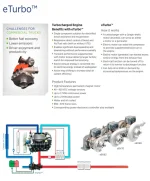
They have a corresponding power electronics controller available for the unit. I understand that you can actually make the decision yourself if you want it to function as a supercharger or a generator.

I am going to have to drill down further in the eTurbo Installation Manual.

17,000 watts / 48 volts = 354 amps. 23,000 watts / 48 volts = 479.17 amps
17,000 watts / 450 volts = 37.78 amps 23,000 watts / 450 volts = 51.11 amps

17 kW x 1.341 = 22.8 hp
23 kW x 1.341 = 30.8 hp
1757600009528.webp
It says that the 48v unit has a range between 3kW and 17kW.

At 3kW and 48v, the amperage is 62.47, similar to the 60 amps of the Balmar alternator.

3kW x 1.341 = 4.02 hp

The Balmar specifications state that my 48v, 60 amp alternator will draw up to 8 hp.

I wonder how many amps the Lithionics BMS will accept?
1757600966707.webp

Read this article:
 
Last edited: