Drinking the Koolaide... 😊

  • Please note, the forum recently had a problem with outbound emails for notifications, registrations, etc. A new email provider has been set up which should resolve all email issues. If you have any further trouble, please DM Christo or reach out via the Contact Us link in the website footer.
Kendra, thanks for that information. I looked all over for that info...where did you find it? Looks like going from 225/16's to 225/17's is roughly the same as going from 225/16's to 245/16's. FWIW, I run 245/16's with a 3.21FD and the one thing I notice is when getting the rears upon a set of ramps, the tires will rub against the bottom of the "T" skirts. I had a special set of "T"'s made that are 1" narrower at the bottom of the "T".

If someone starts the full height opening cockpit window order, I'd probably join that group.
 
  • Like
Reactions: old_skool_luvr
Kendra, thanks for that information. I looked all over for that info...where did you find it? Looks like going from 225/16's to 225/17's is roughly the same as going from 225/16's to 245/16's. FWIW, I run 245/16's with a 3.21FD and the one thing I notice is when getting the rears upon a set of ramps, the tires will rub against the bottom of the "T" skirts. I had a special set of "T"'s made that are 1" narrower at the bottom of the "T".

If someone starts the full height opening cockpit window order, I'd probably join that group.

(Tybalt39, sorry if we are kinda running over your original post. And best wishes for your potential purchase tomorrow.)

I use an online tire size calculator to compare diameters and widths.
 
Went to "test drive" it today. Wouldn't start. After jump-starting, it ran smoothly and at a "normal" noise level for a large engine. While idling, it died and wouldn't crank. Dead battery.

I'm thinking charging system issues, as I was told the coach (when last moved in September) had both batteries active (boost) and was able to be started and run multiple times. Since then, it won't start. I'm guessing that if both batteries were fully charged overnight the engine would start and keep running for a while, but would eventually shut-down as I believe the system electrics are running off of the batteries rather than the alternator. As I anticipate installing a second alternator to charge a lithium battery system eventually, does the vehicle require a high-output alternator? Am I good with current-technology alternators off the shelf?

I'm attempting to get a mobile battery person out to the coach early this week. I'll be looking for one that can test charging systems as well.
 
Last edited:
I know I've seen it before but evidently was not able to get the VIN.
It's a NEW VIN for the registry! Please fill out and submit the online form.

For the purpose of locating and keeping track of all Classic GMC Motorhomes.
Please fill out and submit the online form at www.gmcmhregistry.com/contact/form.html
(There are currently over 8,910 GMCs accounted for)

Find the VIN tag is on the firewall behind the passenger side hood.
Or on the inner glove box door tag.
Or on the title.

* Note about the Build Date of your GMC: From the decal on the inside of the glove box door - look for a number on the top line just left of center, similar to "032174". The example indicates the build date as March 21st, 1974. *

Thank you
Billy Massey
The GMC Motorhome Registry
www.gmcmhregistry.com
I entered what I know....
 
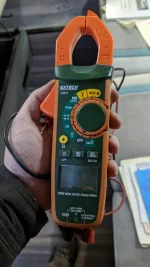
For things like this, I really really like my DC current clamp meter. You can get one from Extech from Amazon for around a hundred bucks. You can trace parasitic current draw, wire by wire. You can instantly check alternator output, or battery current draw vs charge. Get yourself one; it'll pay for itself by saving your time and sanity. Spend 10 minutes learning to use one of these, and you'll be your own expert. It's the best strategy if you plan to travel with one of these old motorhomes.

PXL_20230319_223136098.jpg
 
Get out your volt ohm meter. Any one will do. Start the engine any way possible. Attach the negative meter lead to the aluminum plate that the isolator is mounted on. With the meter set to any range higher than 15 volts DC, probe the center terminal of the isolator with the positive lead of the meter. You should see 14.5 to 15.2 volts DC there. Then probe the top terminal of the isolator with the positive lead. It should read 13.8 to 14.2 volts. Finally do the same probing on the bottom terminal of the isolator. It also should read 13.8 to 14.2 volts. If these three readings are good, the measure across the engine battery, and read the voltage. Then read the same across the house battery(s). Report back the numbers you have and we will tell what to do next.

Ken B.
 
Last edited:
Find the issues as to why your battery is dying per Ken's suggestions. FYI, leaving a lead-acid battery in a low state of charge for an extended period of time (even a few weeks) is a death sentence to the battery. Your chassis battery might just be toast.

When you change your house battery(s) to LiFePO4 (lithium), add a DC-DC charger to control the charging from the engine alternator. Unless you are planning a monster size LFP battery capacity, don't complicate things with a second alternator.
 
For things like this, I really really like my DC current clamp meter. You can get one from Extech from Amazon for around a hundred bucks. You can trace parasitic current draw, wire by wire. You can instantly check alternator output, or battery current draw vs charge. Get yourself one; it'll pay for itself by saving your time and sanity. Spend 10 minutes learning to use one of these, and you'll be your own expert. It's the best strategy if you plan to travel with one of these old motorhomes.

View attachment 7996
I have one of those I use when setting-up solar panel systems; I didn't have it on me at the time. This tells you how long its been since I had to diagnose vehicle issues (my daily driver has a lifetime warranty, so I just take it to the dealer when I have issues). I haven't had an "unreliable" vehicle since the 80's. Of course, that was a 1976 GM vehicle. But, after a few years, I got all of the bugs worked out of it and it became reliable; drove it from Iowa to Fairbanks Alaska and back when the Alkan was gravel and mud.🤣
 
Last edited:
  • Like
Reactions: tmsnyder and pvfjr
Went to "test drive" it today. Wouldn't start. After jump-starting, it ran smoothly and at a "normal" noise level for a large engine. While idling, it died and wouldn't crank. Dead battery.

I'm thinking charging system issues, as I was told the coach (when last moved in September) had both batteries active (boost) and was able to be started and run multiple times. Since then, it won't start. I'm guessing that if both batteries were fully charged overnight the engine would start and keep running for a while, but would eventually shut-down as I believe the system electrics are running off of the batteries rather than the alternator. As I anticipate installing a second alternator to charge a lithium battery system eventually, does the vehicle require a high-output alternator? Am I good with current-technology alternators off the shelf?

I'm attempting to get a mobile battery person out to the coach early this week. I'll be looking for one that can test charging systems as well.

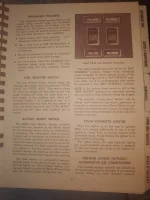
Check your BATTERY BOOST SWITCH. It should be in the BAT NORMAL position except when boost is required. When left in BAT BOOST position neither battery will be charged. The early GMC 's had a 2 position switch that could be left in either position. The later ones fixed the dead battery problem by installing a momentarily on switch for the boost function.0320230850.webp
 
  • Like
Reactions: old_skool_luvr
Check your BATTERY BOOST SWITCH. It should be in the BAT NORMAL position except when boost is required. When left in BAT BOOST position neither battery will be charged. The early GMC 's had a 2 position switch that could be left in either position. The later ones fixed the dead battery problem by installing a momentarily on switch for the boost function.View attachment 8015
I was told the switch was in the Normal position, but I didn't verify. It had previously been in "Boost" to drive the vehicle from its previous home to its current location, then left there for 6 months.

At this point, I'm simply going to acquire a Group 78 800CCA top-terminal battery, disconnect the second battery, and attempt to start it. Then perform the suggested measurements. There's no telling the condition/age of the existing batteries, so I would probably wind up replacing them soon anyway. There's no immediate need for a house battery, and I have lithium packs w/inverters if I have a need for power in the coach if no shore-power is available.
 
Last edited:
  • Like
Reactions: old_skool_luvr
Check your BATTERY BOOST SWITCH. It should be in the BAT NORMAL position except when boost is required. When left in BAT BOOST position neither battery will be charged. The early GMC 's had a 2 position switch that could be left in either position. The later ones fixed the dead battery problem by installing a momentarily on switch for the boost function.
Both batteries always charge. They are both always connected to the alternator (via the isolation diodes) and the boost circuit does not affect that.
The note is the manual is about discharge. The message is basically that if the boost switch is on then both batteries are connected together. This means that when you park and you leave your lights or radio on or something in your house side on you will end up with 2 flat batteries. If the boost is off only one battery will be flattened.

EDIT: I have a 78.
 
Both batteries always charge. They are both always connected to the alternator (via the isolation diodes) and the boost circuit does not affect that.
The note is the manual is about discharge. The message is basically that if the boost switch is on then both batteries are connected together. This means that when you park and you leave your lights or radio on or something in your house side on you will end up with 2 flat batteries. If the boost is off only one battery will be flattened.

EDIT: I have a 78.
That was my understanding of the "boost" switch as well; extra power when needed, but the risk of total discharge if not managed properly. When the dash is redone, that function will be eliminated along with the support circuits/wiring/components. Complete isolation of the two systems (lead-acid for the engine and lithium for the "house") is the goal.
 
  • Like
Reactions: old_skool_luvr
Tybalt,
It actually does not take a lot to crank a coach 455. They were supposed to be built as 8.5CR, but as nearly as I can tell most were shipped at ~8.0-8.2. Ergo the required cranking current is not all that high. With the short manifold, they also usually light real fast.
Find a battery list and see what a Grp78 is supposed to be and I bet you can look a little ways down that list and find some thing that will go in the hole.
Matt
 
Tybalt,
It actually does not take a lot to crank a coach 455. They were supposed to be built as 8.5CR, but as nearly as I can tell most were shipped at ~8.0-8.2. Ergo the required cranking current is not all that high. With the short manifold, they also usually light real fast.
Find a battery list and see what a Grp78 is supposed to be and I bet you can look a little ways down that list and find some thing that will go in the hole.
Matt
Found one at a local parts chain "Knecht's". Going out of business, so sold at a discount ($95, with additional core credit later). Going to perform tests tonight. Bought a second battery for temporary use as house battery.
 
Last edited:
Get out your volt ohm meter. Any one will do. Start the engine any way possible. Attach the negative meter lead to the aluminum plate that the isolator is mounted on. With the meter set to any range higher than 15 volts DC, probe the center terminal of the isolator with the positive lead of the meter. You should see 14.5 to 15.2 volts DC there. Then probe the top terminal of the isolator with the positive lead. It should read 13.8 to 14.2 volts. Finally do the same probing on the bottom terminal of the isolator. It also should read 13.8 to 14.2 volts. If these three readings are good, the measure across the engine battery, and read the voltage. Then read the same across the house battery(s). Report back the numbers you have and we will tell what to do next.

Ken B.
With new battery installed in the front location and ground removed from rear battery:
12.xxV at top terminal
9.xxV at center
10.xxV at bottom terminal.

With clamp meter on red wire at center terminal, no current is flowing with engine running.

Before disconnecting/replacing batteries, the front measured 7.3v and the rear was 10.xxV.

I'm wondering how I got voltage from the house terminal when the battery was disconnected from ground. Is there leakage? Does that indicate an isolator failure?
 
Last edited:
With new battery installed in the front location and ground removed from rear battery:
12.xv at top terminal
9.xv at center
10.xv at bottom terminal.

With clamp meter on red wire at center terminal, no current is flowing with engine running.

Before disconnecting/replacing batteries, the front measured 7.3v and the rear was 10.xV.

I'm wondering how I got voltage from the house terminal when the battery was disconnected from ground. Is there leakage? Does that indicate an isolator failure?
With new battery installed in the front location and ground removed from rear battery:
12.xv at top terminal
9.xv at center
10.xv at bottom terminal.

With clamp meter on red wire at center terminal, no current is flowing with engine running.

Before disconnecting/replacing batteries, the front measured 7.3v and the rear was 10.xV.

I'm wondering how I got voltage from the house terminal when the battery was disconnected from ground. Is there leakage? Does that indicate an isolator failure?
Did you take those reading with the engine running? It does not do much good to take a reading with one battery disconnected. Any way, you have some very strange numbers there. IF the engiine was running then you have an alternator problem. You may also have an isolator problem. The center terminal with the engine running should be in the high 14 volt range. Forget the clamp meter for now. It is just telling you whaat you already knew. It is not charging. Now we need to figure out why.
 
  • Like
Reactions: old_skool_luvr
Did you take those reading with the engine running? It does not do much good to take a reading with one battery disconnected. Any way, you have some very strange numbers there. IF the engiine was running then you have an alternator problem. You may also have an isolator problem. The center terminal with the engine running should be in the high 14 volt range. Forget the clamp meter for now. It is just telling you whaat you already knew. It is not charging. Now we need to figure out why.
Measurements were taken while the engine was running, per request. As it has been proven the vehicle will operate for a limited time with only battery power (longer with boost enabled), I may just wait until I get it into a shop (April 10th) for them to diagnose. I figure I'm looking at an alternator at the minimum.

Any guesstimates as to how long the engine will operate from two new group 78 batteries (no AH rating listed on the label)? I just need to get from where it's parked to the service shop; about 5 miles, but around 15 minutes in city traffic. I'm told the PO drove it a few blocks, then started it a few times before the old batteries died.

At least the engine started just fine and runs quiet (relatively) and smoothly.
 
Last edited:
Measurements were taken while the engine was running, per request. As it has been proven the vehicle will operate for a limited time with only battery power (longer with boost enabled), I may just wait until I get it into a shop (April 10th) for them to diagnose. I figure I'm looking at an alternator at the minimum.

Any guesstimates as to how long the engine will operate from two new group 78 batteries (no AH rating listed on the label). I just need to get from where it's parked to the service shop; about 5 miles, but around 15 minutes in city traffic. I'm told the PO drove it a few blocks, then started it a few times before the old batteries died.

At least the engine started just fine and runs quite (relatively) and smoothly.

If it were me, I'd pull the alternator and take it to a good local old fashioned starter/generator automotive electrical shop. Almost every town should have one and they all look the same inside.

They will be able to test the alternator and tell you if the problem is with the alternator.

You are going to want to have a tip-top alternator in the long term. Might as well make sure that is correct right off the bat. Do not buy a POS new or rebuilt alternator from your local parts shop. They are junk. Do not let your original alternator go as a 'core' trade in. Worst case, it can be repaired by any decent shop, for about 1/4 the cost of a new junk one.
 
  • Like
Reactions: old_skool_luvr
If it were me, I'd pull the alternator and take it to a good local old fashioned starter/generator automotive electrical shop. Almost every town should have one and they all look the same inside.

They will be able to test the alternator and tell you if the problem is with the alternator.
Unfortunately, no place to work on the vehicle. It will all be done in shops until it is mechanically sound and can be driven safely. I can do the interior re-fitting and the dashboard/cluster. I know a cabinet-builder to help with the "furnishings", an upholsterer for the seating, etc. Good contacts over the years. I just have no space to do mechanical work.