1975 GMC Glenbrook

Maybe something like this would work? Just cut the ends square and push connect.
 
Maybe something like this would work? Just cut the ends square and push connect.

I've used those probably hundreds of times fixing pneumatic lines at pinch points on machinery. It is a potential leak point, but they are usually pretty good.
 
Paul,
The coolant level sensor is just a probe that gets attached to an electronics package.
Matt
Yes, that much is clear. The trouble is, my radiator has no place for the probe as the manual shows it. I'm considering adding a float switch to the overflow tank as an alternative. I like the idea of a low-coolant indicator, particularly as my wife has indicated a desire to use the GMC on long weekends when I'm away for travel.
 
Maybe something like this would work? Just cut the ends square and push connect.
I'm sure those would. Fortunately I have all the fittings I need, and hopefully they're still in good shape. The broken piece of tubing was only about a foot long, running from the valve to the coupler. It's rather convenient, really. I just need to find some 1/4" tubing. I could've sworn I had some good stuff leftover from a previous pneumatics project, but moving makes finding things a challenge!
 
I've used those probably hundreds of times fixing pneumatic lines at pinch points on machinery. It is a potential leak point, but they are usually pretty good.

I'm looking forward to hooking the compressor back up the first time, and spraying all the connections with soapy water while they're easy to see and get to from both sides. I'm hoping I don't have to replace a bunch of these fittings. Fingers crossed!
 
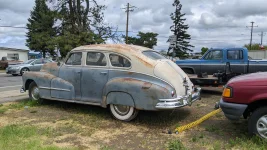
Today was mostly not spent on the GMC as I'd hoped, but I did get a little tinkering done. The main objective for the day was to pick up the wife's new classic: a 1948 Pontiac Streamliner 8 Silver Streak 4 door fastback. It's really, really solid, and only missing a few cosmetic parts. Still has the original carpet, door panels, headliner, etc in good shape.

PXL_20210501_195406996.webp

PXL_20210501_195349834.MP.webp

This evening I resoldered the main connector pins on the instrument cluster PCBs. I found that they were a cause for intermittency. I then bench-tested all the factory gauges, and they were now working. So I tracked down the sending unit wires for the coolant temp and oil pressure and found them abandoned. It looks like they tossed the old senders when they installed mechanical gauges. The wires ohm out just fine, and the gauges respond in kind when they're grounded. It'll all be going back to factory configuration now.

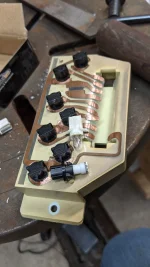
Cleaned up the telltale flex pcb and added new sockets with LEDs. Lower current will reduce the likelihood of burning what's left of these delicate traces in the event of further corrosion and resistance.

PXL_20210501_020231341.webp

Still looking for that air line...

I got the dome light working, and the "door" telltale and "low air" telltale are now working great as well. Hopefully I can see the "low air" telltale extinguish after getting the compressor hooked back up. I manually grounded the dark blue wire on the cruise transducer, and got the nice green telltale on the dash. Then I manually grounded the light green parking brake wire and its telltale also worked, but I couldn't get anything through the switch. I pulled it out and gave the switch some long overdue refurbishing with good results. Now if only the parking brake itself worked...

PXL_20210502_042411669.webp

There was also a mystery switch to the right of the headlight switch. A blue and a yellow wire in the back, that appeared to be part of the factory harness. I searched the schematic for a while and finally found out that's the washer fluid pump. Funny thing is, I don't have a washer tank, pump, or hoses anywhere. There was also no harness under the "hood". More searching revealed the blue and black wires for the washer pump had been erroneously rerouted to the engine bay and left dangling. Ground is good, power to switch is good, and continuity to the pump harness is good, but the switch is also bad. So all I need is the tank, pump and switch--hmm, basically starting from scratch, except I've recovered all the original wiring.
 
Last edited:
  • Like
Reactions: tmsnyder
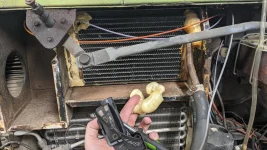
I finally set out to figure a way to get to the backside of the dual diaphragm vacuum actuator for the defrost. You have to either pull all the dash and ducting out, or you have to pull the heater core. I opted for the latter, as it was far easier in my current situation. I then discovered that I didn't have the original heater core, nor was it the correct size. The PO had installed one about an inch shorter, and had made up the difference with spray foam. This also held it in place, since he didn't rework the mounting points accordingly. It took some work to carve it out of there, but I was finally able to access the actuator and remove it from the vehicle.
PXL_20210429_030759995.webp


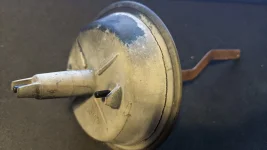
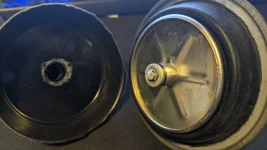
I broke it apart to see what was happening inside. There is a flattened o-ring that wasn't helping, but the diaphragms looked great! I think the main leak was an annular crack running around the perimeter of the plastic half of the body. I dabbled with the idea of replacing the o-ring and using some plastic epoxy to put it back together, but this really isn't something I want to take apart again. I begrudgingly forked out $80 for the new actuator from Old Air. It's supposed to finally come tonight, so I can take the first step of "reassembly" on this project!

PXL_20210507_155817410.webpPXL_20210507_155829890.webp
 
Last edited:
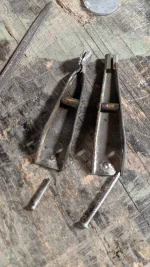
I also fixed up my hydraulic wiper motor controls at some point. I got a new lever from a Facebook member who had upgraded to electric. Since my motor worked fine, but had a choke cable hacked in that liked to activate at random times and lacked smoothness, detents, labeling, and that original quality, I decided going back to stock was a better plan. Unfortunately, the PO had completely buggered the old lever on the motor, but fortunately the Facebook member had tossed in the entire assembly. So I robbed the lever off the new motor, drilled out the rivets, and fashioned a new one out of a nail.

PXL_20210425_024529567.webp

PXL_20210429_023553624.webp
 
On to the air suspension system...
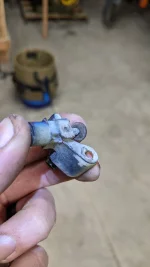
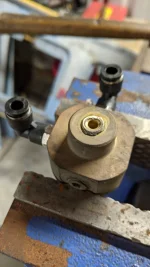
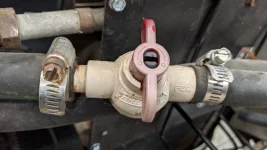
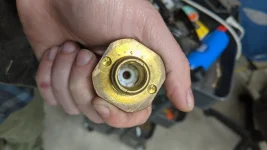
I removed the rotary valves from the coach and started replacing all their fittings. They all seemed to have a touch glue-like substance for thread sealer. The 90 degree fittings came out, but both of the straight fittings on the pressure source port broke off! I was not pleased. I'm still mulling over my options here. I may land on drilling out what's left of the fittings and JB-Welding some 1/4" Ni-Copp tubing into it, then just using 1/4" quick connect couplers to the nylon tubing. I fear trying to drill and extract what's left of the fittings will just leave me with damaged 1/8" NPT threads that leak.

PXL_20210507_032903431.MP.webp
 
Paul,

That is not an OE valve. That is a special that JB orders up and makes a panel to go with. Possible someone used an anaerobic set sealant there. Those valves are built to be serviced and so come apart very effectively. I suggest that you knock the valve down to simple parts, heat that back area to about 250~300 and put an ez-out in it.

Matt
 
Paul,

That is not an OE valve. That is a special that JB orders up and makes a panel to go with. Possible someone used an anaerobic set sealant there. Those valves are built to be serviced and so come apart very effectively. I suggest that you knock the valve down to simple parts, heat that back area to about 250~300 and put an ez-out in it.

Matt
I've found that this Proto brand of extractor (ez-out) works great on pipe stubs like that. YMMV

https://www.protoindustrial.com/en/...J9500B_Proto®-10-Piece-Screw-Extractor-Set-/#
 
It seems all the new elbow fittings I ordered stick out a bit farther and interfere with the dash cutout. Of course. So I'm not too close to getting it back together, so I may as well order the tools I need. It's going to take a pin spanner to disassemble the valve. I guess I've been looking for a reason to order one anyway. Just needed one last week for something else.

I did find that JR so-and-so developed this kit as an aftermarket upgrade, and it looks like Applied sells it. It's funny, I kept saying people bagging on the quality of the valves GMC used, but they seemed pretty nice to me! I guess that explains it. These are 2500 psi brass valves from Swagelok, and they're pretty nice. I just wish someone had chosen a smarter thread sealant.
 
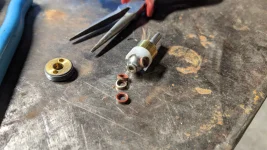
It turns out, taking this particular valve apart is a really, really, really bad idea. I should've gone straight for the JB Weld. Even if it failed, it'd be easier to undo.

PXL_20210508_022831120.webp
PXL_20210508_022855638.webp
 
Last edited:
Paul,
Don't count it out so soon. Those are the same valves that I used in early manual emissions benches. Mine were stainless, and a single bench had one for each instrument and another set to sample individual cylinder exhausts. If you don't know about old benches or lost count, that is 9 of those per bench and we had 8 benches in service most of the time. Of those 8 one was typically being repaired at any given time and I had tech that used to rebuild any of those valves that failed a bubble leak test. (That was both though the valve and external.)

Ours were all stainless and the pipe thread gawled all the time to we had to tale that valve down and chase the 1/8 fntp. That bottom teflon block can be pushed out. Then you can heat the body enough to fail that anaerobic sealant. When you get it apart. put it back together with Loctite 575 so you can take it apart when you need to.
Matt
 
I just can't push this lower Teflon packing out without marring it up. Were the valves you worked on 2500 psi rated? These packings were pressed in pretty darn tight. And there's these super fine lips on the packings that go between the ball and the side rings. Just a few mil thick. There's no way to put it together one half at a time. A guy would have to construct the whole packing assembly out of the valve body before pressing it in. One misstep and those side rings will deform the lips (too tiny to show up in the photos).
 
They were at least that.
There was a way to push that bottom piece out with a tool that we had. We got help from Swagelok. Good supplier and helpful. I know about the lips on the ring seals.
I also remember that when they got aldehide fouled they were a bear to clean. This would screw up the HC readings.
You could also contact JR Slaten (who I called JB) and see if he has any ideas. He will talk to you.
Matt
 
I might reach out to Swagelock on Monday. I did find a Whitey valve that this crosses over to on eBay for $68. That's not too bad, beats the heck out of $300.
 
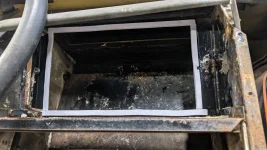
I really wanted to make some progress tonight and get the heater box all put back together, since I'm stymied with the air suspension until Monday. I just couldn't get the POs "custom" heater core to mount in a way I liked. The location of the inlet/outlet pipes prevented it from sitting flat in the box. They interfered with the heater core bypass diverter, so it wasn't a matter of just cutting sheet metal away (which they'd already done a ton of).

PXL_20210509_023501486.MP.webp

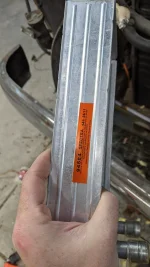
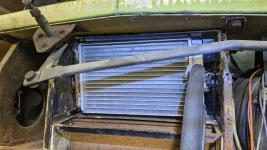
I went round and round trying to source a heater core from the part interchange list, or going back through the years and years of threads. Every rabbit hole returned a heater core with incorrect dimensions, obsolete part numbers, and unavailability. This is excluding the Applied heater for for $450, of course. I can fix a lot of other things with that money, so I kept searching. I eventually found a feature on the Spectra website that allowed you to browse through visual matches, then look up their dimensions. That landed me on a heater core for an old Econoline, and it was $27, and I was able to drive right over to a parts store and pick it up the day I decided I wanted it. No special order with a week lead time...imagine that!

PXL_20210509_023524180.MP.webp

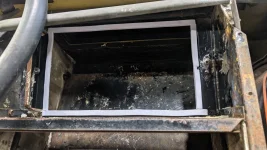
Anyway, the part number was 94584. It has 5/8" on the inlet AND outlet, so no more fudging between a 3/4" hose and the 5/8" universal coolant valve. The notch between the inlet and outlet tanks is off a bit, but I only had to move the driver's side heater core clamp down and to the pass side 3/4" or so. Now the heater core is mounted SOLID, and there's zero spray foam holding it all together. Eventually I'll have to make a plate to block off all the missing sheet metal from the PO. Aluminum tape is working fine for testing purposes.

PXL_20210509_033721944.webp

Speaking of testing, the brand new dual diaphragm actuator from Old Air is complete junk. The action is very rough. It'll barely spring-return on its own on the bench. By the time you hook it to the flap, it actuates to the vacuum side, then just gets jammed and only returns about 3/16" of it's stroke to the spring side when the vacuum is release. Thing took 8 days to come in, and a replacement will be another 8 days. I'm not happy about that. I guess I should've gone for the new o-ring and epoxy repair of the old one! Who'd of thought that would've worked better.

I've also determined that much of the defrost flow is lost between the dash plastic and the rest of the ducting. They're kinda married together, with rivets. I figured the ducting would be a separate assembly, but it isn't. With plastic warpage, and deteriorated foam tape (was probably 5/8" thick), there are some pretty big gaps blowing on the back of the instruments. I'll have to seal that up somehow.


The good news is, the rebuild of the HVAC controller seems to have been a success. I have vacuum reaching all the necessary places at the appropriate times. There is a bit of leakdown, but I think it's an acceptable level, and it is in the line connections rather than the actuators, so it's easy to fix later down the road if needed. I spent a lot of time with the vacuum pump making sure of that.
 

Attachments

  • PXL_20210509_023501486.MP.webp
    PXL_20210509_023501486.MP.webp
    746.7 KB · Views: 6
Last edited:
PXL_20210509_055746438.webp
Another PO mod. You'll never guess: it leaks. I'm just lucky it didn't blow up on the way home from Phoenix.


PXL_20210509_055353661.webp

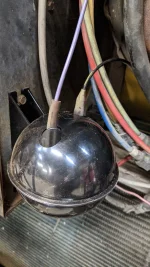
Added a new vacuum tank.


PXL_20210509_062226884.webp

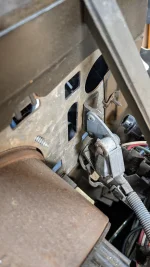
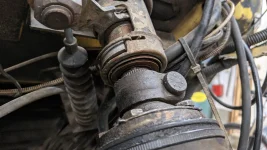
I also discovered some radial play in the lower column bearing. It looks pretty rusty and will probably worsen quickly, so I've got a new one on order.