Higher-Output Alternators

Tybalt39

Well-known member
Mar 10, 2023
528
291
63
Eugene, OR
I'm looking at replacing the "stock" (OK, after 50 years probably few of us are still running the original 63A alternator) with a higher output unit capable of operating a DC-DC Lithium battery charger without over-taxing the alternator. I recently realized I was mistaken in thinking the high-output alternators were only available in "1-wire" configuration.

So, which 12V units have you used or looked into to replace the existing 63/80/100A unit currently installed in your coach? I'm not looking for 24V or higher, 1-wire, or second alternators; just what can easily replace the existing 3-wire unit (with perhaps a modified support bracket if needed).

There are a few listed on Amazon and eBay; "200A" that are 180A when you read further, if those numbers can be believed. I assume if I get one of those I should either buy two or at least keep one of my original units handy, just in case...

There is the Jim Bounds video from a few months back showing the Delco 21SI (apparently already discontinued) and custom bracket. Anyone tried it?

Do you use one standard belt, a double-pulley, a "toothed" pulley/belt, something else?

Looking for options. Thank you!
 
Last edited:
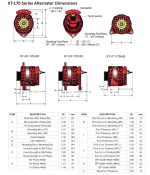
I recommend installing a Balmar XT/AT 170A alternator with either a Balmar Max Charge Regulator or a WakeSpeed external regulator. This unit only requires 5.2hp
.
On sale @ $984.00 with K6 pulley at PKS.
1757583764468.webp

Most other alternators will not provide horse power information because they require so much more HP and are just very dumb. They don't want you to know how inefficient they are.

You may have to install another pulley if you are still using a V belt.


IMG_1617.webp
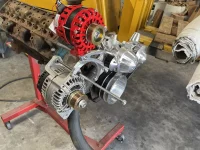
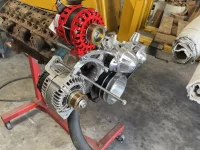
It is the red one although it is an earlier version producing 160amps.

This is a far more efficient arrangement.
 
Last edited:
Use a charger that limits the draw on the input. It should be programmable.

Our alternators were designed to rapidly (~100A) recharge the chassis start battery immediately after the engine is running. They were not intended for continuous long term generation of much more than a fraction of their max rating. The limit is how quickly they can dissipate the heat generated while operating.

You may want to set the charge rate low and observe the alternator temperature while it's charging your battery. If it doesn't get hot, increase the charge rate, repeat, .....
 
I recommend installing a Balmar XT/AT 170A alternator with either a Balmar Max Charge Regulator or a WakeSpeed external regulator. This unit only requires 5.2hp
.
On sale @ $984.00 with K6 pulley at PKS.
View attachment 16434

Most other alternators will not provide horse power information because they require so much more HP and are just very dumb. They don't want you to know how inefficient they are.

You may have to install another pulley if you are still using a V belt.


View attachment 16433
It is the red one although it is an earlier version producing 160amps.

This is a far more efficient arrangement.

Is that two alternators? - one for chassis and one for house batteries running in parallel on one belt or two?

Not thought of that before - interesting.
 
Jampants: I believe sailor man was referring to having a double v-belt pulley on the alternator, which is recommended by Balmar. I used to have a double v-belt on my stock alternator. I went back to a single belt.

When you use a dual belt pulley on the alternator, the second belt comes from removing the power steering belt and replacing with a longer power steering belt that includes the alternator. The problem is that the power steering pulley now only gets about a third of the belt touching the pulley, which can lead to squealing under steering load.

I had a problem with multiple alternator failures, and I think it was from using too much power to charge low house batteries (lead acid) and overheating my stock alternators which weren't designed for that. So I went back to a single belt and I stopped using my alternator to charge the house batteries. I have not had an alternator failure since.

There's no doubt that the Balmar alternator is top of the line. I wonder if it could run continuously to charge up lithium batteries, I wonder if the Balmar can sustain a 100% duty cycle. Also, I wonder if the Balmar has a temperature sensor to intervene when it starts overheating. Sailor man can probably speak on those things.

If I ever made a case & bracket change, I would only trust alternators from the marine world, not Amazon. I would like to read and trust the specs. And the marine alternators make a ton of power at low RPM, like you'd find on diesel marine engines. I have no faith that Amazon alternators could do this.
 
Last edited:
Is that two alternators? - one for chassis and one for house batteries running in parallel on one belt or two?

Not thought of that before - interesting.
IMG_1617.webp
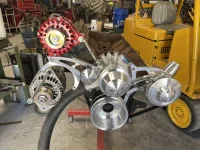
It is better to have a dual voltage system. 48vdc is now a proven system, particularly in recreational boats.
IMG_1616.webp

This as a modified March Racing (FL) system with a Balmar 12vdc, 160 amp alternator (red) + a Balmar 48vdc, 60 amp alternator.

Using 48vdc need far less copper. Check out my thread, "Converting to life ePO4 batteries and Sailor Man's LiFePO4 Build". It is a long read but there are many ideas that may intrigue you.
IMG_1761.webp
There are also some UK products in my design, particularly the (2) Sterling battery to battery chargers.
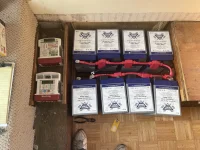
(10) 12vdc battery bank that gets 1.47kW power fr (15) solar panels.

One Sterling unit charges 51,2vdc Lithionics battery bank. The other charges (1) DieHard Gold 800CCA, 100aH starting battery.
IMG_2479.webp
Lithionics 51.2vdc, 300aH expandable to 450aH.

There is no generator.
 
View attachment 16442
It is better to have a dual voltage system. 48vdc is now a proven system, particularly in recreational boats.
View attachment 16443

This as a modified March Racing (FL) system with a Balmar 12vdc, 160 amp alternator (red) + a Balmar 48vdc, 60 amp alternator.

Using 48vdc need far less copper. Check out my thread, "Converting to life ePO4 batteries and Sailor Man's LiFePO4 Build". It is a long read but there are many ideas that may intrigue you.
View attachment 16444
There are also some UK products in my design, particularly the (2) Sterling battery to battery chargers.
(10) 12vdc battery bank that gets 1.47kW power fr (15) solar panels.

One Sterling unit charges 51,2vdc Lithionics battery bank. The other charges (1) DieHard Gold 800CCA, 100aH starting battery.
View attachment 16445
Lithionics 51.2vdc, 300aH expandable to 450aH.

There is no generator.

Cool.

I'm also running some Lithium on the house side but only at 12v. I've got a relay on a switch where I can send power from the alternator to the lithium but I haven't used it much yet. It just joins the two battery sets together but I only have a 80A alternator, which in reality puts out 45A.

I like the idea of 2 alternators though - is an interesting idea I'd not thought of.
 
Use a charger that limits the draw on the input. It should be programmable.

Our alternators were designed to rapidly (~100A) recharge the chassis start battery immediately after the engine is running. They were not intended for continuous long term generation of much more than a fraction of their max rating. The limit is how quickly they can dissipate the heat generated while operating.

You may want to set the charge rate low and observe the alternator temperature while it's charging your battery. If it doesn't get hot, increase the charge rate, repeat, .....
I'm figuring I need at least 160A as the DC-DC is 40A fixed. I believe the article linked by Bruce indicated the original alternator wants no more than a 50% duty-cycle and is not intended for "bulk" battery recharge use. Going by that percentage, a 40A constant draw (until the house batteries are out of "bulk" charging) would put me around 160-180A capacity. Rough numbers, but better too much capacity than too little.
 
I'm looking at replacing the "stock" (OK, after 50 years probably few of us are still running the original 63A alternator) with a higher output unit capable of operating a DC-DC Lithium battery charger without over-taxing the alternator. I recently realized I was mistaken in thinking the high-output alternators were only available in "1-wire" configuration.

So, which 12V units have you used or looked into to replace the existing 63/80/100A unit currently installed in your coach? I'm not looking for 24V or higher, 1-wire, or second alternators; just what can easily replace the existing 3-wire unit (with perhaps a modified support bracket if needed).

There are a few listed on Amazon and eBay; "200A" that are 180A when you read further, if those numbers can be believed. I assume if I get one of those I should either buy two or at least keep one of my original units handy, just in case...

There is the Jim Bounds video from a few months back showing the Delco 21SI (apparently already discontinued) and custom bracket. Anyone tried it?

Do you use one standard belt, a double-pulley, a "toothed" pulley/belt, something else?

Looking for options. Thank you!

I currently have a 100 amp alternator, with a double V-belt, on my coach feeding two BBGC-2 LiFePo4 batteries through a LiBIM225 combiner:

[ https://www.ebay.com/itm/325030966650?chn=ps&_trkparms=ispr=1&amdata=enc:1Lbsj_y26RnGzQ6CnPrKrpg40&norover=1&mkevt=1&mkrid=711-117182-37290-0&mkcid=2&mkscid=101&itemid=325030966650&targetid=2320274086935&device=c&mktype=pla&googleloc=9194380&poi=&campaignid=21404617128&mkgroupid=173029507108&rlsatarget=pla-2320274086935&abcId=9450159&merchantid=118936083&gad_source=1&gad_campaignid=21404617128&gclid=CjwKCAjwiY_GBhBEEiwAFaghviQ0uTCLMczNpnF3wgc17T_vvT1a9jkkUwMloB_YdIVdR57ekiiWvhoCHHgQAvD_BwE ].

The 100 amp alternator does not kick in until a certain RPM is hit, so it's kind of weird and different from the other 80 amp alternators I have. This setup generally seems to work well, although it doesn't seem to fully charge my batteries during a day's driving. That might have something to do with the three way fridge drawing power from the house batteries even during the time when the house batteries are not being intermittently charged through the combiner. My solar (only 195 watts) makes up the difference.
 
Last edited:
I wonder if the hot-rodders have a bracket setup that allows for 2 alternators, power steering, air conditioning, and the water pump. I suspect there were Transmodes or ambulances that came this way.
 
This setup generally seems to work well, although it doesn't seem to fully charge my batteries during a day's driving. That might have something to do with the three way fridge drawing power from the house batteries even during the time when the house batteries are not being intermittently charged through the combiner
Carl, Your 3-way fridge consumes 20 to 30 Amps when operating on 12 VDC. The BIM only charges for 15 minutes then disconnects for 20 minutes to allow the alternator to cool. So that's about a 40 % duty cycle charging while the fridge could be consuming current at near 100% duty cycle. Easy to see why you can't get a full charge.

You could rig up a relay that would power the fridge from the chassis battery while the engine (alternator) is running. This would prevent the house batteries from being discharged by the fridge during the BIM's 20 minute disconnect. However you will be pulling more power from the alternator.
 
  • Like
Reactions: Carl Stouffer
Carl, Your 3-way fridge consumes 20 to 30 Amps when operating on 12 VDC. The BIM only charges for 15 minutes then disconnects for 20 minutes to allow the alternator to cool. So that's about a 40 % duty cycle charging while the fridge could be consuming current at near 100% duty cycle. Easy to see why you can't get a full charge.

You could rig up a relay that would power the fridge from the chassis battery while the engine (alternator) is running. This would prevent the house batteries from being discharged by the fridge during the BIM's 20 minute disconnect. However you will be pulling more power from the alternator.
Thanks Bruce, that's something I might consider. On a sunny day, the fridge only draws about 13 - 15 amps more than the solar is charging, so even though the fridge is drawing 20 - 30 amps while on 12 volts, the solar is covering about half that demand, so it's not as bad as it might seem.

Most nights, even though we might be watching TV, powered by an inverter, and running lights, fans, etc, we are only drawing the batteries down to no less than about 95%. So the system works adequately as it is. There's always room for improvement though.
 
All this talk about high-output alternators, but NO mention of wiring capacity for that much current. The OEM wiring in the GMC is not designed to handle more than 80 amps, and even that is not continuous. But if you are expecting to run 160 Amps through the original alternator wiring, you are asking for trouble! ("Is that smoke I smell?!") If you are going to muck with power distribution in your GMC, check the wiring gauge of EVERY wire to EVERY new load. Also consider that the 50-year-old insulation on the OEM wires ain't what it used to be.
 
All this talk about high-output alternators, but NO mention of wiring capacity for that much current. The OEM wiring in the GMC is not designed to handle more than 80 amps, and even that is not continuous. But if you are expecting to run 160 Amps through the original alternator wiring, you are asking for trouble! ("Is that smoke I smell?!") If you are going to muck with power distribution in your GMC, check the wiring gauge of EVERY wire to EVERY new load. Also consider that the 50-year-old insulation on the OEM wires ain't what it used to be.
A load only draws as much current as it needs (this is why a higher-capacity starter battery doesn't mean you have to rewire everything in the electrical system; also why over-paneling works in a solar setup). The alternator doesn't "push" current; only voltage. Current is "drawn" as needed. The old water analogy; pressure (voltage) vs. capacity (current). The only increased load in MY system would be to the starter battery (directly connected to the DC-DC lithium charger). So, as long as the cables from the alternator to the battery are up to the job, nothing else should have to change.

The Boost switch/solenoid and associated wiring will be removed as the house systems are now lithium.

The larger question is how to drive a larger alternator; belt systems.
 
Last edited:
A load only draws as much current as it needs (this is why a higher-capacity starter battery doesn't mean you have to rewire everything in the electrical system; also why over-paneling works in a solar setup). The alternator doesn't "push" current; only voltage. Current is "drawn" as needed. The old water analogy; pressure (voltage) vs. capacity (current). The only increased load in MY system would be to the starter battery (directly connected to the DC-DC lithium charger). So, as long as the battery cables are up to the job, nothing else should have to change.

The Boost switch/solenoid and associated wiring will be removed as the house systems are now lithium.

The larger question is how to drive a larger alternator; belt systems.
If your load is so low that the 80 Amp wiring from alternator is sufficient, why would you want to install a 180 Amp alternator? Answer: if your engine battery is low and drawing 50-60 amps, AND you are charging the lithiim battery at 40 amps, AND the fridge is running on DC, your new alternator could supply it, but your alternator wire could not. Just sayin': be careful.
 
If your load is so low that the 80 Amp wiring from alternator is sufficient, why would you want to install a 180 Amp alternator? Answer: if your engine battery is low and drawing 50-60 amps, AND you are charging the lithium battery at 40 amps, AND the fridge is running on DC, your new alternator could supply it, but your alternator wire could not. Just sayin': be careful.
I believe you are thinking the house loads would be connected to the alternator. They wouldn't. The house loads connect to the house batteries which are NOT connected directly to the alternator. The DC-DC charger is the only connection from the house to the alternator. The "buzzbox" and any connection from the starter battery to the house fuse-block is gone.
 
  • Like
Reactions: mech0001
Perhaps Your coach is wired differently, but every GMC I know of that has a 12V fridge has it wired to +12V at the 12V stud on the firewall, which is connected directly the alternator.
 
Perhaps Your coach is wired differently, but every GMC I know of that has a 12V fridge has it wired to +12V at the 12V stud on the firewall, which is connected directly the alternator.
Correct; I have extensively rewired the coach to isolate the house from the original 12V system. If you are curious, here is my "build" thread.😁

Lithium batteries do not charge the same way lead-acid batteries do. Therefore, there can be no direct connection between the two systems. The only connection is the DC-DC charger that "massages" the output of the alternator/starter battery to give the lithium system what it needs (think of it like an isolation transformer with voltage/current regulation). A lithium battery can accept as much current as it can get. An alternator would overheat if its output wasn't "throttled" by the DC-DC charger. But, even at a maximum input of 40A that will overtax the "stock" alternator. Hence the purpose of this topic....
 
Last edited: