The electric GMC fully imagined -

I've contacted RƎE Automotive about a collaboration on my proposed GMC Motorhome EV RestoMod, employing their modular RƎEcorner alternative to the various motor in-wheel systems I'm researching in parallel, for example a relatively new leader out of Germany, DeepDrive Tech.
View attachment 12561
Here's a technical brief and walk-thru video with Peter Dow, VP of Engineering.
I drove professionally as a youngster, and to increase range, my thought is to borrow a page from the semi-truck handbook, that is to take advantage of the new suspension and drive to lift one set of bogie tires while cruising.

If RƎE Automotive isn't interested in collaboration, my course would then be to proceed with the in-wheel design or feasible to adopt their basic drivetrain architecture using the venerable “Industrial Lego” method made possible by RƎE Automotive's use of many industry standard components.
Personally, at this point I don't trust steer and brake by wire - no problem with electric power assists and whatever variable logic might prove beneficial, but definitely want "fail to manual" systems.
A no-lag drive by wire system would be fine - fail to idle or zero rpm is a major inconvenience but not as inherently life threatening as coming downhill with no connection to brakes and/or steering.
Pusher and tag axles are used on heavy trucks to stay within bridge load ratings with varying loads. For all practical purposes, RV GVW and axle loading is pretty constant - either the GMC needs four tires to support the rear end loads or it doesn't. If it doesn't, remove the weight and complexity of one set of bogies permanently. If it does, then the only reason to "lift" a bogie set would be to take weight off the rear-most tires to reduce the turning circle at very low speeds - would require something like True Track on the front bogie set at least and could be managed by creative valving of a four-bag system.
 
Personally, at this point I don't trust steer and brake by wire - no problem with electric power assists and whatever variable logic might prove beneficial, but definitely want "fail to manual" systems.
A no-lag drive by wire system would be fine - fail to idle or zero rpm is a major inconvenience but not as inherently life threatening as coming downhill with no connection to brakes and/or steering.
Pusher and tag axles are used on heavy trucks to stay within bridge load ratings with varying loads. For all practical purposes, RV GVW and axle loading is pretty constant - either the GMC needs four tires to support the rear end loads or it doesn't. If it doesn't, remove the weight and complexity of one set of bogies permanently. If it does, then the only reason to "lift" a bogie set would be to take weight off the rear-most tires to reduce the turning circle at very low speeds - would require something like True Track on the front bogie set at least and could be managed by creative valving of a four-bag system.
Drive-by-Wire, Brake-by-Wire, Steer-by-Wire systems have been integrated into military, commercial, racing, and premium vehicles since 1983 where they have proven to reliably provide the highest degree of command control input sensitivity and response under the harshest conditions, with the important capability of being fine-tuned to the individual drivers characteristics and environmental conditions. These systems have been under constant research, development, and are more fault-tolerant, with a higher safety and reliability record than the analog systems they replaced.

So despite persistent repetition of these worn, threadbare urban myths and legends about digital technology being less responsive or failing, advances in hardware, firmware, software means that by every objective standard the haptics, speed of response, sensing and precision of these systems exceeded the capacity of human perception more than two decades ago.

Even old timers like Sandy Munro understand and are confident in the technology I'm referring to, so if you "feel" uncomfortable, just say so. Only don't pretend your apprehension is based on facts or that your comments are meant to be helpful.
 
Having watched more than a few vids of runaway Teslas flying through town centers, the recent Honda Pilot runaway that a State Trooper managed get in front of and force to a stop, etc, I am a strong pass.
What is the maintenance to use ratio of these systems? Military and race systems can be tens to hundreds of hours "in the shop" for every hour "on the job", with nearly limitless budgets. Commercial aviation and ground transport fleets enjoy regular proscribed maintenance - being a deductible business expense helps.
How would annual or biannual servicing of steering, brakes and "engine" systems go over in the RV market?
 
For all practical purposes, RV GVW and axle loading is pretty constant - either the GMC needs four tires to support the rear end loads or it doesn't. If it doesn't, remove the weight and complexity of one set of bogies permanently. If it does, then the only reason to "lift" a bogie set would be to take weight off the rear-most tires to reduce the turning circle at very low speeds - would require something like True Track on the front bogie set at least and could be managed by creative valving of a four-bag system.
My GMC comes in at 12k fully loaded--4k on the front axle and 8k shared between the bogies. So a nice even 4k per axle. The bogies balance very nicely to share the load and eliminate bending moments in the frame rail. This would need addressed if permanently removing a bogie, and some fairly impressive tires would need sourced in order to eliminate one of the bogies. Brake/bearing upgrades would be in order too, though I'm sure you're thinking through this already since you're looking at hub motors (which would be really amazing, finally solving the GMC traction problem).

Lifting a bogie in low speed turns would be really neat though. We definitely get a lot of binding when positioning ourselves in parking lots or campsites. No real concern on tires/bearings/brakes in that case. You can easily see the wheels/bogies twist out of alignment under the strain of sharp turns. If parking after a tight turn, I like to roll front and back an extra time to alleviate the stress.
 
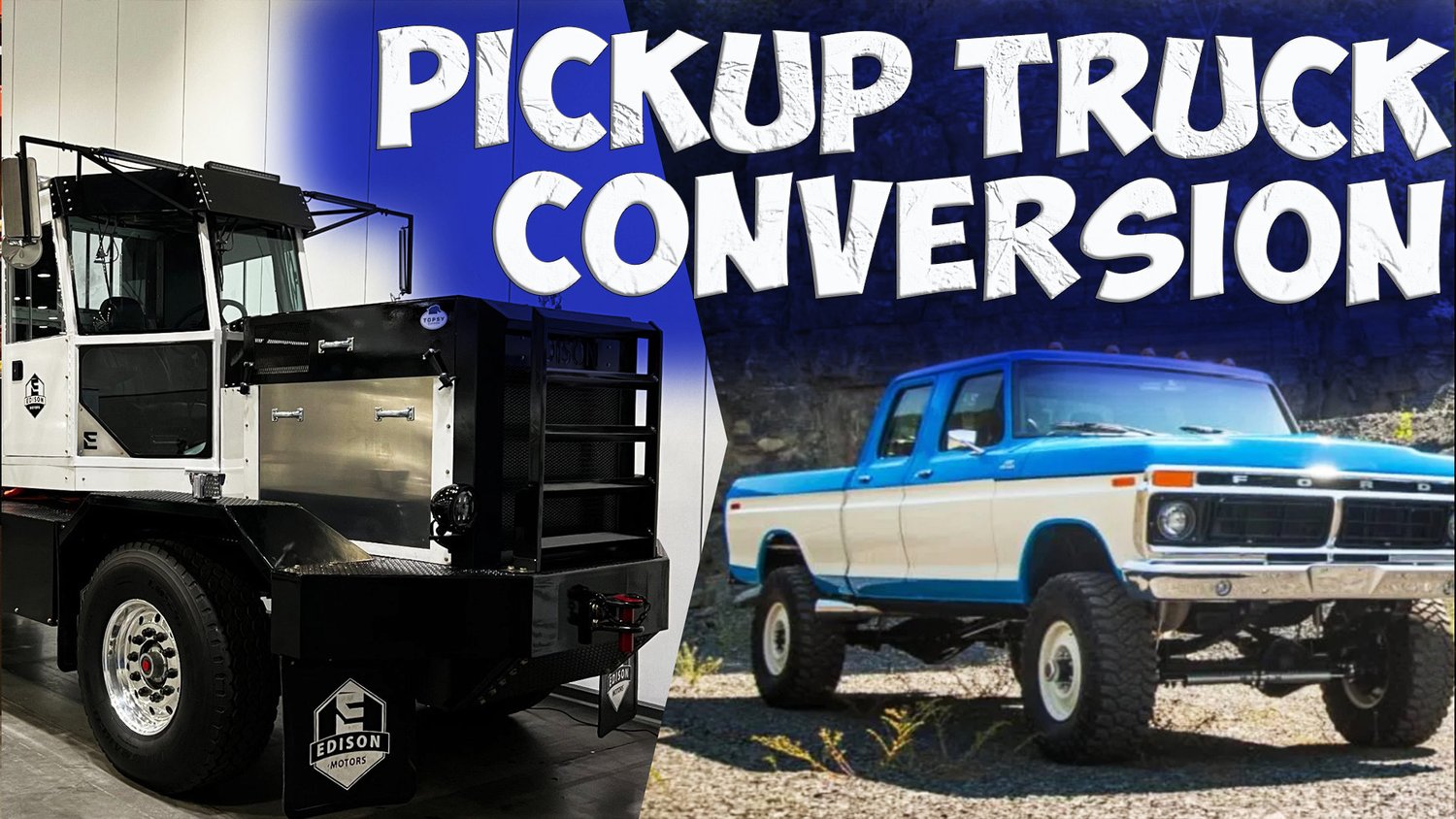
Edison Motors has been mentioned in this or a similar thread a couple of years ago. They make hybrid road tractors for the logging industry and also conversion kits.

Theirs is an interesting application... the truck goes up the mountain unloaded, then comes back down with a heavy load of logs. Regenerative braking coming down loaded makes their application work well and efficiently. The on-board diesel generator makes up for any shortfalls in battery charge capacity.

I see they are now in the process of making conversion kits for pickup trucks. They may have some parts that would be useful in a GMC motorhome conversion.

 
I've contacted RƎE Automotive about a collaboration on my proposed GMC Motorhome EV RestoMod...
An interesting concept. JimB mounted a GMC body on a GM workhorse chassis. It was quite a chore and took a while to complete. The R3E chassis solves a lot of the problems JimB encountered. With a modular design and drive/brake by wire a lot of physical constraints are dealt with.

What exactly do you mean by collaboration? Them donating a chassis or you purchasing a chassis built to match GMC motorhome specs? R3E does have numerous dealers throughout the US. I noticed there is one just down the street from me. they don't provide a lot of specs on their website. I'm curious about the load rating on each wheel.

JPB
 
An interesting concept. JimB mounted a GMC body on a GM workhorse chassis. It was quite a chore and took a while to complete. The R3E chassis solves a lot of the problems JimB encountered. With a modular design and drive/brake by wire a lot of physical constraints are dealt with.

What exactly do you mean by collaboration? Them donating a chassis or you purchasing a chassis built to match GMC motorhome specs? R3E does have numerous dealers throughout the US. I noticed there is one just down the street from me. they don't provide a lot of specs on their website. I'm curious about the load rating on each wheel.

JPB
The right way would be to design a new chassis from scratch setup for the batteries and motors and generator then just set the body on it.
Full air ride of course
How hard could that be?
 
If I had my way I'd build a diesel electric MH. use a very small cly diesel that has just enough HP to get it down the road, maybe a small hill but not enough for a 7% grade. it would run a generator that would run electric motor(s), batteries would be there for acceleration and hill climbing.

This would allow you to use normal AC/power steering etc, have a great battery for boon docking and 800 mile range ( or so )

All I need is 100k, and a year of free time
Back to the future! Diesel-Electric Baby, Yeah! Feels like 1925 all over again! https://www.borail.org/collection/cnj-no-1000/
 
  • Love
Reactions: tmsnyder
If I had my way I'd build a diesel electric MH. use a very small cly diesel that has just enough HP to get it down the road, maybe a small hill but not enough for a 7% grade. it would run a generator that would run electric motor(s), batteries would be there for acceleration and hill climbing.

This would allow you to use normal AC/power steering etc, have a great battery for boon docking and 800 mile range ( or so )

All I need is 100k, and a year of free time
Unless you are adamant about doing it with Diesel...you could do a conversion for $60K in about three months.

Happy to elaborate on how this is done. An outfit called "Electric Yacht" (right in your back yard) can help with the design. Let's talk...I've been involved with a number of hybrid designs for boats, I'd LOVE to tackle an RV conversion!
 
Unless you are adamant about doing it with Diesel...you could do a conversion for $60K in about three months.

Happy to elaborate on how this is done. An outfit called "Electric Yacht" (right in your back yard) can help with the design. Let's talk...I've been involved with a number of hybrid designs for boats, I'd LOVE to tackle an RV conversion!
sorry but $60k is about $59,900 too high at this time! My coach runs great and I'd never payback $60k at my usage rates!
 
  • Like
Reactions: LARRYT and dsmithy
Unless you are adamant about doing it with Diesel...you could do a conversion for $60K in about three months.

Happy to elaborate on how this is done. An outfit called "Electric Yacht" (right in your back yard) can help with the design. Let's talk...I've been involved with a number of hybrid designs for boats, I'd LOVE to tackle an RV conversion!
Okay, please elaborate! You have an audience.
 
  • Like
Reactions: dsmithy
I will have my '76 Eleganza II converted to electric. The way to go will be a renewed Tesla LDU with 455 horsepower instead of the old V8-engine and transmission, combined with 200 kWh LiFePo-Batteries, most in the frame and some in the motorcompartment. Should give a range of 4 hours driving at highway speed.
I am curious if here are other people who have done something similar with their moho and are willing to share experiences. So far i only know of one GMC moho, that has been converted already.
 
Andreas,
Welcome to the forum. You have a lot of friends you haven't met yet here.
Please consider starting a new thread and let us follow you on your journey. Lots of us have thought of this and wondered if existing hardware could tug a 12K pound around.
Start a new thread and we'll be hanging on every word.
 
Andreas,
Welcome to the forum. You have a lot of friends you haven't met yet here.
Please consider starting a new thread and let us follow you on your journey. Lots of us have thought of this and wondered if existing hardware could tug a 12K pound around.
Start a new thread and we'll be hanging on every word.
Thank you very much, dsmithy, for the warm welcome. Just opened another thread "Fuel 2 Electric..."
 
  • Like
Reactions: Kendra
I will have my '76 Eleganza II converted to electric. The way to go will be a renewed Tesla LDU with 455 horsepower instead of the old V8-engine and transmission, combined with 200 kWh LiFePo-Batteries, most in the frame and some in the motorcompartment. Should give a range of 4 hours driving at highway speed.
I am curious if here are other people who have done something similar with their moho and are willing to share experiences. So far i only know of one GMC moho, that has been converted already.

Some bad idea's never seem to die. This facinates me. I frequent many automotive formus and in all of them there are few re-occuring aspirational topics that resurface now and then and quickly go no-where. They all start this way with a declaritive, enthuiastic, pie in the sky post from a new memeber, then the encouragement from the faithful and then radio silence, with the OP never to be heard from again.

Let's get to the reality of the situation. There will never be a vialbe Vintage electric GMC motorhome.
Anyone with the knowledge, skills and abilities to pull this off would also understand it's idiotic and a fools errand.

Let me expain it to you by real world example. A Tesla cyber truck with every modern technical advantage, designed from the ground up to be an efficient EV has a real world effective range of 115 miles towing a basic camper flat. Head up to a mountainous area, it would be considerably less. As a DIY retro-fit project you would likely need double the battery capacity to get 1/2 the range. That's where the weight spiral sets in. With the A/C on in the summer you'd be lucky to get 60 miles before neededing a lengthy break at a high capacity charger. Hopefull there will be one large enough, just waiting for you at the exact spot you need it along your route. Spoiler alert... Not gonna happen.

Did you even do any back of the envelop calulations? The amount Lifpo battteies and copper wiring alone will cost well over 200$ per Kwh. Multiply that by 200 Kwh and you quickly get to $40,000 for about 60 to 80 miles of range as a DIY project. With conservitive public charging at $0.30 per KWh you looking at 60$ to go maybe 80 miles if you're lucky. Even at CA gas prices that still buys you 10 gallons of gasolene and will allow you to travel about 60 to 80 miles in a well tuned as-built GMC motorhome . None of this accounts for the cost of the controllers, electric motors, fabication, junction blocks, fuses, safery equiptment, systems integration, cooling, heating and many other costly issues that will also need to be accounted for.

The Tesla LDU has a peak torque of 332/ft lbs. That's far less then the Olds 455 and would be like swapping in a Olds 350. Major down grade. Using the LDU at or near it's torque capacity for long periods of time will casue it to fail quickly.

So you want to camp fully electric?

Option 1 - Get a used Cyber truck and a 2nd hand light weight travel trailer and stay close and hope it all works out, It might, it could, and you can be in you favorite near-by camping spot in 30 days or less for about 65k. If it doesnt work out, you'll likely be able to resell both and re-coupe most of your money. Trying to DIY a fully electric vintage GMC, never gonna happen and you'll waste 50 thousand dollars and years of your life trying with nothing to show for it.

Option 2. Get a Chevy Brightdrop (50k) and convert it to a camper. Still will only get 150 miles of range and budget 10K for the camper retrofit. Chevy already killed the platform so good luck getting parts and service a few years from now and few dealers will even touch a highly modified vehicle, so you're entirely on your own with this option. But... it's possbile... and might be worth 1/2 the sum of it parts IF executed well.
 
Last edited:
Some bad idea's never seem to die. This facinates me. I frequent many automotive formus and in all of them there are few re-occuring aspirational topics that resurface now and then and quickly go no-where. They all start this way with a declaritive, enthuiastic, pie in the sky post from a new memeber, then the encouragement from the faithful and then radio silence, with the OP never to be heard from again.

Let's get to the reality of the situation. There will never be a vialbe Vintage electric GMC motorhome.
Anyone with the knowledge, skills and abilities to pull this off would also understand it's idiotic and a fools errand.

Let me expain it to you by real world example. A Tesla cyber truck with every modern technical advantage, designed from the ground up to be an efficient EV has a real world effective range of 115 miles towing a basic camper flat. Head up to a mountainous area, it would be considerably less. As a DIY retro-fit project you would likely need double the battery capacity to get 1/2 the range. That's where the weight spiral sets in. With the A/C on in the summer you'd be lucky to get 60 miles before neededing a lengthy break at a high capacity charger. Hopefull there will be one large enough, just waiting for you at the exact spot you need it along your route. Spoiler alert... Not gonna happen.

Did you even do any back of the envelop calulations? The amount Lifpo battteies and copper wiring alone will cost well over 200$ per Kwh. Multiply that by 200 Kwh and you quickly get to $40,000 for about 60 to 80 miles of range as a DIY project. With conservitive public charging at $0.30 per KWh you looking at 60$ to go maybe 80 miles if you're lucky. Even at CA gas prices that still buys you 10 gallons of gasolene and will allow you to travel about 60 to 80 miles in a well tuned as-built GMC motorhome . None of this accounts for the cost of the controllers, electric motors, fabication, junction blocks, fuses, safery equiptment, systems integration, cooling, heating and many other costly issues that will also need to be accounted for.

The Tesla LDU has a peak torque of 332/ft lbs. That's far less then the Olds 455 and would be like swapping in a Olds 350. Major down grade. Using the LDU at or near it's torque capacity for long periods of time will casue it to fail quickly.

So you want to camp fully electric?

Option 1 - Get a used Cyber truck and a 2nd hand light weight travel trailer and stay close and hope it all works out, It might, it could, and you can be in you favorite near-by camping spot in 30 days or less for about 65k. If it doesnt work out, you'll likely be able to resell both and re-coupe most of your money. Trying to DIY a fully electric vintage GMC, never gonna happen and you'll waste 50 thousand dollars and years of your life trying with nothing to show for it.

Option 2. Get a Chevy Brightdrop (50k) and convert it to a camper. Still will only get 150 miles of range and budget 10K for the camper retrofit. Chevy already killed the platform so good luck getting parts and service a few years from now and few dealers will even touch a highly modified vehicle, so you're entirely on your own with this option. But... it's possbile... and might be worth 1/2 the sum of it parts IF executed well.

Best application for EVs is stop and go.

I'd love to see someone figure a way to get a more modern engine and transmission in the thing.
 
Edison Motots is developing a 4x4 pickup truck hybrid power kit. It would take some serious modifications to make it work in the GMC, but all the logistics of the design is worked out.
Designed for 12,000Kgs GVW (26,400lbs) with 120 continuous HP rating on the motors.

I don't expect being a hybrid you would get much better MPG, but you would get regenerative braking.

Based in British Columbia, Edison Motors manufactures large hybrid road tractors mostly for the logging industry. It's an excellent use case. Empty truck climbs up the mountain roads using electric (and diesel generator when required). Then comes back down the mountain loaded with logs. Using regenerative braking recharges the batteries for using on the next empty climb back up the mountain.
 
  • Like
Reactions: Richard RV
Victoria BC has a bunch (well one or two for sure) of city buses that are electric but AFAIK have some massive (presumably diesel) generator/power supply thing housed at the depot to charge them, not sure about range/hrs.