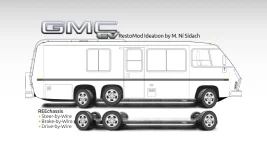
The electric GMC fully imagined -

Caution. We're skidding closer to political content here.
This major transition in the way we live and cope with climate change will be fraught. No way around it. As we navigate difficult choices lets be generous and enjoy the little backwater of a historic vehicle that may, if we're lucky, make the transition.
 
There are other battery types coming along, and two are no environmental issue at all. They still have to be recharged with utility electric power. When you can select to only car your car with wind/solar/hydro (US Hydro is not the same as Canadian), then it will be honestly environmental Matt_C
I disagree. Selecting where your car gets charged from does not change the environmental impact, it just shifts it to someone else.
UNLESS if by selecting wind/solar you can ONLY charge if there is currently enough power to do so from wind/solar and zero power from traditional power plants are used.
No sun, no wind? No charging for you
 
I disagree. Selecting where your car gets charged from does not change the environmental impact, it just shifts it to someone else.
UNLESS if by selecting wind/solar you can ONLY charge if there is currently enough power to do so from wind/solar and zero power from traditional power plants are used.
No sun, no wind? No charging for you

My hope is that as more solar and wind gets built and its intermittency, short lifetime and high cost per kw-hr, and high environmental impact become glaringly obvious, that the advantages of modern nuclear will become obvious and will drive a shift back to that source of stable, plentiful and inexpensive source of electricity.
 
  • Like
Reactions: Keith V and pvfjr
Caution. We're skidding closer to political content here.
This major transition in the way we live and cope with climate change will be fraught. No way around it. As we navigate difficult choices lets be generous and enjoy the little backwater of a historic vehicle that may, if we're lucky, make the transition.
I completely agree with you. Environmental issues (other than how to pass emissions) and moving to electric vehicles is as stuck in politics as a Dinosaur in the La Brea Tar pits.
 
Our GMC's (at least mine anyway) are usually driven highway at highway speeds for 200-300 miles/day.
I would love to see some data on this. I think the people who participate most in the forums, etc., probably clock a lot of miles, but I'm betting GMC owners who who tailgate and camp relatively "local" comprise a huge percentage of ownership. 100 miles of daily range is likely *plenty* for a large number of users.
 
I would love to see some data on this. I think the people who participate most in the forums, etc., probably clock a lot of miles, but I'm betting GMC owners who who tailgate and camp relatively "local" comprise a huge percentage of ownership. 100 miles of daily range is likely *plenty* for a large number of users.


We're planning a family trip, Buffalo, NY to Grand Tetons, almost 4000 miles in about 10 driving days.
 
  • Like
Reactions: Seankidd
Have there been updates on the EV GMC project?
I am figuring on converting mine and the 425 tranny gives about the correct gear ratios if an EV car motor is bolted onto it instead of the torque convertor. I understand the tranny needs to be spinning though to pressurize an internal oil pump. Hopefully the hotrod guys will figure this issue out. I hate automatics and their complexity.
As far as battery size goes, my current thinking is 40-50 kw-hrs plus a 400v range extender as in the BMW i3 or the current Mazda SUV EV.
As 200-300km is a fairly long leisurely drive, between level 3 charging and a range extender (if I get caught out), 40-50 kw-hrs should be fine.
Until then, I'm just nursing the 455 along until it's retirement.
 
Have there been updates on the EV GMC project?
I am figuring on converting mine and the 425 tranny gives about the correct gear ratios if an EV car motor is bolted onto it instead of the torque convertor. I understand the tranny needs to be spinning though to pressurize an internal oil pump. Hopefully the hotrod guys will figure this issue out. I hate automatics and their complexity.
As far as battery size goes, my current thinking is 40-50 kw-hrs plus a 400v range extender as in the BMW i3 or the current Mazda SUV EV.
As 200-300km is a fairly long leisurely drive, between level 3 charging and a range extender (if I get caught out), 40-50 kw-hrs should be fine.
Until then, I'm just nursing the 455 along until it's retirement.
So why keep the 425 then? Seems to me a complete transaxle from an EV would be the simplest.
 
  • Like
Reactions: GlenC
So why keep the 425 then? Seems to me a complete transaxle from an EV would be the simplest.
I don't want to mess with the differential and especially the halfshafts. That's a bit of of a problem I realize as most EV drivetrains have the whole motor/gearing package integrated. Apparently the Leaf is less integrated. Still thinking........
 
Have there been updates on the EV GMC project?
I am figuring on converting mine and the 425 tranny gives about the correct gear ratios if an EV car motor is bolted onto it instead of the torque convertor. I understand the tranny needs to be spinning though to pressurize an internal oil pump. Hopefully the hotrod guys will figure this issue out. I hate automatics and their complexity.
As far as battery size goes, my current thinking is 40-50 kw-hrs plus a 400v range extender as in the BMW i3 or the current Mazda SUV EV.
As 200-300km is a fairly long leisurely drive, between level 3 charging and a range extender (if I get caught out), 40-50 kw-hrs should be fine.
Until then, I'm just nursing the 455 along until it's retirement.


Keeping the TH425 would be extremely wasteful. All that heat the transmission produces and has to be pumped out into the air or else it will destroy the tranny?? A significant amount of your battery capacity would go out into the air as heat.
 
  • Like
Reactions: eserv and GlenC
Keeping the TH425 would be extremely wasteful. All that heat the transmission produces and has to be pumped out into the air or else it will destroy the tranny?? A significant amount of your battery capacity would go out into the air as heat.
If it is locked in first gear and no torque convertor is used, I'm thinking there wouldn't be any slippage which causes the heat but I am no expert on automatics and am hoping not to become an expert.
 
If it is locked in first gear and no torque convertor is used, I'm thinking there wouldn't be any slippage which causes the heat but I am no expert on automatics and am hoping not to become an expert.
That would certainly reduce waste. Would it be mechanically locked in first? Or hydraulically? The pump uses a lot of power too. If you could get rid of it or reduce pressure to only use it for lubrication rather than the high pressure hydraulic forces, there are some efficiency gains there.

Locked in 1st will leave many parts spinning way faster than they were designed for. Locking it in 3rd eliminates gear losses but requires way more torque on certain parts than they were designed for. I'm not certain if the implications of the former, but the latter is asking for trouble. Hard to have your cake and eat it too.
 
That would certainly reduce waste. Would it be mechanically locked in first? Or hydraulically? The pump uses a lot of power too. If you could get rid of it or reduce pressure to only use it for lubrication rather than the high pressure hydraulic forces, there are some efficiency gains there.

Locked in 1st will leave many parts spinning way faster than they were designed for. Locking it in 3rd eliminates gear losses but requires way more torque on certain parts than they were designed for. I'm not certain if the implications of the former, but the latter is asking for trouble. Hard to have your cake and eat it too.

I'd think it would be better to be locked in 3rd - with just the TC to absorb initial takeoff and the final drive to set the ratio, which might be very low.
 
I am still thinking the idea through but I am hoping that it is possible to gut most of the internals in the tranny and make it into a single speed gear reduction with no extraneous moving parts. 1st gear when combined with the differential gets pretty close to the correct overall ratio for an EV electric motor. Right now I am thinking that the tranny oil pump isn't needed as it would be lubed by splash like a manual transmission as there would not be any shifting required. I would need a friendly transmission guy to do the work/conversion though.

Again, I really, really don't want to mess with the halfshafts.
 
A couple points off the top of my head on a very interesting discussion:
Cyber semi has a CD of .34~.36 with trailer - higher without.
Hub motors would be easy to implement up front, fairly easy on the front boogies (probably requiring beefed up Shur Trac) and would take some study on the rear boogie (definitely not designed to push the GMC).
Ditching the mirrors, front grill, going to flush headlights, stripping the roof and cleaning up the windshield/cockpit window gaskets would help a lot - big bonus if retracting wipers developed. Add aero wheel covers and fairly tight wheel skirts.
Lowering the suspension at speed and raking it towards the front (counter to best handling practice) in combination with front air-dam, side skirts and cleaned up underside make a big difference - effectively reduces frontal area some and helps with skin friction. Turbulators on the rear sides and top could tune the negative pressure behind the coach. A rudimentary venturi under the rear could suck wheel-well and under-body air into this zone. Anybody have a kid studying aerodynamics at a school with a big wind tunnel (rolling road as a tie breaker)?
If doing a deeper frame, make it aluminum (with Jim B's bracket extensions incorporated incorporated, and hockey puck spacers).
Now that the extra space is made, have to say I'm not a fan of multi-cylindrical cell batteries.
Re-floor with ¾" Coosa board, then glue on a ¼" cork layer and another ½" Coosa layer - sound and temp insulation.
For weight savings, gut and strip the interior - insulate with aerogel, wire for 48V DC/240 AC, formed aluminum (a la DJ Eberhart) cabinetry and faced honeycomb-cored sheet "furniture".
 
I am still thinking the idea through but I am hoping that it is possible to gut most of the internals in the tranny and make it into a single speed gear reduction with no extraneous moving parts. 1st gear when combined with the differential gets pretty close to the correct overall ratio for an EV electric motor. Right now I am thinking that the tranny oil pump isn't needed as it would be lubed by splash like a manual transmission as there would not be any shifting required. I would need a friendly transmission guy to do the work/conversion though.

Again, I really, really don't want to mess with the halfshafts.
You could keep the final drive, adapt a planetary between it and the motor and eliminate all the bulk of the THM425. An appropriate motor will be much smaller than the 455/thm425 combination
 
I've contacted RƎE Automotive about a collaboration on my proposed GMC Motorhome EV RestoMod, employing their modular RƎEcorner alternative to the various motor in-wheel systems I'm researching in parallel, for example a relatively new leader out of Germany, DeepDrive Tech.
GMCEV-REEchassis_002.webp
Here's a technical brief and walk-thru video with Peter Dow, VP of Engineering.
I drove professionally as a youngster, and to increase range, my thought is to borrow a page from the semi-truck handbook, that is to take advantage of the new suspension and drive to lift one set of bogie tires while cruising.

If RƎE Automotive isn't interested in collaboration, my course would then be to proceed with the in-wheel design or feasible to adopt their basic drivetrain architecture using the venerable “Industrial Lego” method made possible by RƎE Automotive's use of many industry standard components.
 
Last edited: