I have an mpg question. These GMCs are supposed to get great mileage compared to standard box shaped RVs on truck chassis. 10-11 mpg seems to be a common figure. I've also experienced about 10mpg as well.
For my previous brick shaped motorhome with a frontal area of 8x9' and a coefficient of drag ~1.0, I calculated the max mpg possible at various speeds and assuming only aerodynamic drag, I found that the mpg I was experiencing was not that far off from what I calculated could be the best case scenario. I measured 7.5 - 8.0 (reality) mpg over many 1000s of miles, and my calculations (theory) said the best I could possibly see was 8.5-10.0 mpg. This was with an unpublished drag coefficient, mine was slightly wedge shaped so I used numbers from 1.0 to 0.7. The RV was carbureted and used an HEI distributor, similar to the GMC.
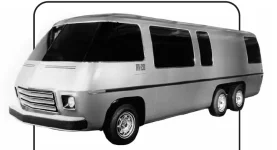
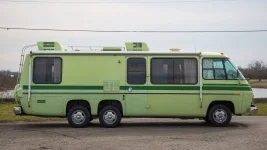
On the new to me GMC, it has a drag coefficient of 0.31 supposedly. It was designed in a wind tunnel, purportedly, to 'slip through the air'. LOL And, it's waaaay smaller than my previous class A. I put my old RV cover on it and it looks comic, there's so much extra material. But I digress. In my calculations, if I use 8' tall and 7' wide as the frontal area, and 0.31 for a drag coefficient, at 60mpg (which is what I typically drive) , the absolute max I could ever expect to see, in theory, should be 21.4 mpg.
Huh?! 21.4 mpg in theory vs 10-11mpg in reality? That's a significant difference between theoretical and observed mpg! It's only getting about 1/2 the mileage it should be getting.
So ........., what's happening here? Why is the GMC not delivering better fuel economy than it should in theory?
I don't think it's the engine delivering sub-par efficiency. If it were, we'd see much higher mpg reported from people that have swapped in other gas engines.
I think it has to be the coefficient of drag. It simply can't be 0.31. Did the wind tunnel tests include mirrors, and roof A/C units, and storage pods, refrigerator and plumbing vents? Or was it just a clean model with a smooth bottom and top? I'd be willing to bet it was a clean model.
To get anywhere reasonably close to the observed mpg of 10-11 at 60mpg, I have to raise the drag coefficient to almost double it's purported value, 0.5 to 0.6.
Where else could the MPG's have gone? We should be getting 20!
For my previous brick shaped motorhome with a frontal area of 8x9' and a coefficient of drag ~1.0, I calculated the max mpg possible at various speeds and assuming only aerodynamic drag, I found that the mpg I was experiencing was not that far off from what I calculated could be the best case scenario. I measured 7.5 - 8.0 (reality) mpg over many 1000s of miles, and my calculations (theory) said the best I could possibly see was 8.5-10.0 mpg. This was with an unpublished drag coefficient, mine was slightly wedge shaped so I used numbers from 1.0 to 0.7. The RV was carbureted and used an HEI distributor, similar to the GMC.
On the new to me GMC, it has a drag coefficient of 0.31 supposedly. It was designed in a wind tunnel, purportedly, to 'slip through the air'. LOL And, it's waaaay smaller than my previous class A. I put my old RV cover on it and it looks comic, there's so much extra material. But I digress. In my calculations, if I use 8' tall and 7' wide as the frontal area, and 0.31 for a drag coefficient, at 60mpg (which is what I typically drive) , the absolute max I could ever expect to see, in theory, should be 21.4 mpg.
Huh?! 21.4 mpg in theory vs 10-11mpg in reality? That's a significant difference between theoretical and observed mpg! It's only getting about 1/2 the mileage it should be getting.
So ........., what's happening here? Why is the GMC not delivering better fuel economy than it should in theory?
I don't think it's the engine delivering sub-par efficiency. If it were, we'd see much higher mpg reported from people that have swapped in other gas engines.
I think it has to be the coefficient of drag. It simply can't be 0.31. Did the wind tunnel tests include mirrors, and roof A/C units, and storage pods, refrigerator and plumbing vents? Or was it just a clean model with a smooth bottom and top? I'd be willing to bet it was a clean model.
To get anywhere reasonably close to the observed mpg of 10-11 at 60mpg, I have to raise the drag coefficient to almost double it's purported value, 0.5 to 0.6.
Where else could the MPG's have gone? We should be getting 20!