Wago connectors for power distribution

RF_Burns

Super Moderator
Staff member
Sep 7, 2008
5,148
1,348
113
Ontario Canada
So I have been working on Club member's coach sorting out some electrical issues. One was the spaghetti of power wires going to his add-on gauges panel. Most of the wires were power and back-lighting power wires for his add-on gauges, noting real high current. The wires were just tapped into existing wires over the years, you all know how that happens.

So I thought, why not Wago connectors? They come in 2,3,5 and 10 position connectors (i could only source 1,3 & 5 position locally off the shelf). The standard size accepts wire from 12 to 22 AWG. Each wire can be added or removed without disturbing the others. They are IEC rated for 32A and UL for 20A total per connector block. A pack of ten 5 conductor connectors works out to about $1. each retail.

So far they have worked out great. I can easily remove, change or add wires as I go along. Of course I am only using them internally to the coach as they are not water proof. On the 5 position connector there is a nice flat area on the opposite side of the levers where I can add a label (Batt 12V+, Ground, Ignition, Accessory, etc).

JWID
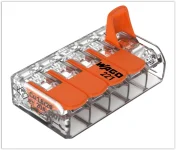
Wago 5 conductor connector-1.webp

This bad boy can handle up to 10 separate wires. I need to order a couple to try out.
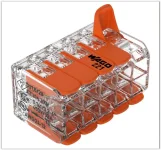
Wago 10 conductor connector-1.webp
 
So I have been working on Club member's coach sorting out some electrical issues. One was the spaghetti of power wires going to his add-on gauges panel. Most of the wires were power and back-lighting power wires for his add-on gauges, noting real high current. The wires were just tapped into existing wires over the years, you all know how that happens.

So I thought, why not Wago connectors? They come in 2,3,5 and 10 position connectors (i could only source 1,3 & 5 position locally off the shelf). The standard size accepts wire from 12 to 22 AWG. Each wire can be added or removed without disturbing the others. They are IEC rated for 32A and UL for 20A total per connector block. A pack of ten 5 conductor connectors works out to about $1. each retail.

So far they have worked out great. I can easily remove, change or add wires as I go along. Of course I am only using them internally to the coach as they are not water proof. On the 5 position connector there is a nice flat area on the opposite side of the levers where I can add a label (Batt 12V+, Ground, Ignition, Accessory, etc).

JWID

View attachment 18476

This bad boy can handle up to 10 separate wires. I need to order a couple to try out.
View attachment 18477
And, as usual, there are a bunch of knock-offs out there. Buy from a reputable source.
 
  • Like
Reactions: pvfjr
I know some residential electricians remain skeptical, but they seem well proven. In my mind, twisting conductor-to-conductor with a wire nut gives more contact area, and the wire nut gives more contact force. Plus, you're connecting the native conductors to each other, without some dissimilar series conductor in between. So wire nuts should be superior, in theory. But--wire nuts are very easy to do wrong. That's where Wagos gain a statistical advantage on reliability, I believe. On average, we may see fewer problems with Wagos over time simply due to the fact that people often don't get wire nuts done right.

For convenience, they certainly can't be beat. I do wonder though...
Wire nuts are theoretically better, but are still absolutely HATED in the automotive scene. They don't seal well obviously. Ring terminals on a junction block do better because of a nice, flat contact patch. Ring terminals aren't "sealed" per se, but crack one open that looks corroded and dirty, and you'll see shiny metal between the contact patches. They stand up to humidity, dirt, and vibration.

So the interior of a motorhome...
Well, it's not an engine bay. But it's not a well protected and controlled residential space either. I've seen plenty of humidity-driven connection failures on the interior of my motorhome. Maybe it depends on your winter storage region and conditions. There's more vibration than a residential space too. My guess is they'd last a long time. Probably as good as an unsealed spade connector which we already have a ton of, and certainly way more convenient. But not bulletproof--so I wouldn't use them on anything mission-critical. I'd be willing to give them a go though.
 
For power and grounding application for gauges. Other variation available from 1 in 2 out, 2 in 2 out, 2 in 4 out, 2 in 6 out

Lots of variations from Wago and others. The ones you link to don't state a total maximum current although they do mention UL.