The Ferrigno Family's 1976 Palm Beach

Paul,
It is obvious that you live in rust country.
Free Advice that has served me very well.
When you have any brake bleed screw out, wrap it in Teflon tape. This will make it so it can be opened the next time you need it because it keeps the brake fluid from getting into the threads. It also make vacuum bleeding (if do that - I do) work much better. And buy a bag of the rubber caps for the bleeders.
Note of these are original ideas with me. I just listened.
Matt
 
It is obvious that you live in rust country.
Interestingly enough, I actually don't. Things tend to last a very long time around here. I've got several 20+ year old cars with absolutely zero rust including a 93 Pathfinder with 325K, a 2004 Silverado with 307K, and a 2003 Baja with 220K. I see these rigs getting decommissioned regularly in the midwest in forums, but mine are rust-free inside, outside, underneath. Who knows what the full history of the coach is though. It's most recently from Idaho; the frame and suspension have just minor surface rust.

Those bogie brake lines get an awful lot of road spray though. They get wet and stay wet more than the other steel lines, I imagine. These same lines were seized on my Glenbrook last year. I don't mind replacing all of them for peace of mind. Nickel-copper goes in real easy.

I did start doing the teflon tape trick a couple years ago. I used to use grease or thread sealant as was recommended to me, but it would never take long to start sucking erroneous bubbles that obfuscate your progress. The tape is an improvement, but I still prefer pressure bleeding (though, perhaps not on the GMC). If I can rig up a convenient way to pressurize the master, I do. If I don't have the right stuff laying around, I go for the venturi vacuum bleeder.

I do need to acquire a bunch of rubber caps. I get sick of having to ream out the bleeders when I use them.
 
Paul,
Someone, I think it is Jim Humfy sells a kit to pressure bleed a GMC.
It works, but I vacuum bleed because so many of my vehicles have plastic reservoirs.
Matt_C
Mr Hupy actually lives in the city where I work; I've seen his setup mentioned before. I usually try not to acquire or make special-purpose tools though. I've got upwards of 25 vehicles to maintain, so I try to keep things universal.

With plastic reservoirs, I often improvise with my HF radiator pressure test kit. I've connected it to quite a few brake reservoirs over time. Sometimes the O-rings fit the bore, but I have to wire it in place as the retainer cap doesn't fit. That's easy enough. If that doesn't work, I'll just break out the vacuum bleeder.
 
Paul,
I did not have that level of success pressure bleeding a plastic reservoir. Because we were fast. most of the car's finish survived. It took the owner a long time to find a replacement. We did not try to pressure bleed the new master cylinder...
Matt_C
 
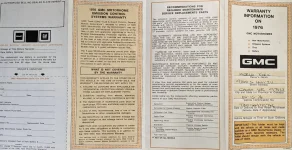
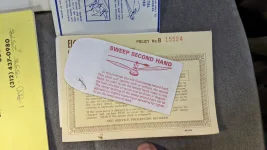
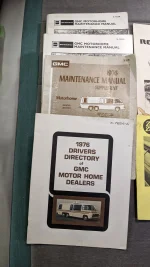
Well @bdub , I've got the original owner's name (Merle Kirk), and he was in my uncle's town (Canby OR), only 25 miles from me! I also own my uncle's 78 stepside, which may have spent decades in the same town as this motorhome. Who knew? Funny, since it was registered in Idaho recently. It was neat to discover the original warranty card from 6-15-1976.

PXL_20230315_044029381.jpg

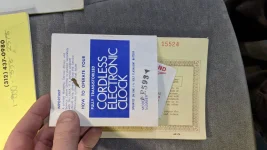
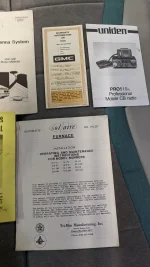
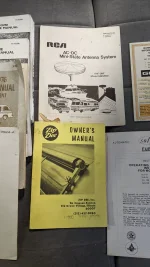
I found a lot of other documents and books too. The little envelope with the clock papers still has hands in it as well.

Edit:
From Merle Kirk the coach went to Jimmy Ray Ball for quite a few years. Then to Stephen (I forget) for a couple more years.
 

Attachments

  • PXL_20230315_043929708.webp
    PXL_20230315_043929708.webp
    882.3 KB · Views: 14
  • PXL_20230315_043919604.MP.webp
    PXL_20230315_043919604.MP.webp
    778.5 KB · Views: 14
  • PXL_20230315_043907275.MP.webp
    PXL_20230315_043907275.MP.webp
    829.4 KB · Views: 14
  • PXL_20230315_043741034.MP.webp
    PXL_20230315_043741034.MP.webp
    576.4 KB · Views: 13
  • PXL_20230315_043738353.webp
    PXL_20230315_043738353.webp
    552.1 KB · Views: 12
  • PXL_20230315_043731033.webp
    PXL_20230315_043731033.webp
    563.2 KB · Views: 13
  • PXL_20230315_043726887.webp
    PXL_20230315_043726887.webp
    594.7 KB · Views: 13
  • PXL_20230315_043722692.webp
    PXL_20230315_043722692.webp
    603.3 KB · Views: 13
Last edited:
  • Like
Reactions: bdub and Kendra
I've since found out some history about the original owner. He was the president of Willamette Egg Farms, which is the largest egg producer in Oregon, established in 1934. Sadly, he passed away about a year ago, but was survived by a large number of kids and grandkids. I've reached out to one on Facebook to let them know their childhood RV is still alive and kicking; I haven't heard back yet.

On another note, I think I've got an undersized wheel hub shank to contend with now. Here's the video of the slop:
https://photos.app.goo.gl/mbEwjotVJtnP6D4t8
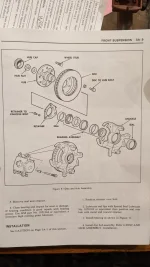
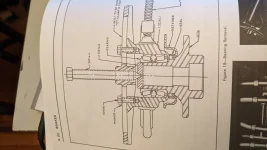
After removing the CV axle nut, I was able to remove the hub/disc assembly by hand. The shop manual shows a rather large slide hammer employed for this task, so I knew something was awry. The good news is, it took actual pressing to get the races out of the knuckle, so perhaps my knuckles are OK.
 
  • Like
Reactions: bdub
Well @bdub , I've got the original owner's name (Merle Kirk), and he was in my uncle's town (Canby OR), only 25 miles from me! I also own my uncle's 78 stepside, which may have spent decades in the same town as this motorhome. Who knew? Funny, since it was registered in Idaho recently. It was neat to discover the original warranty card from 6-15-1976.

I found a lot of other documents and books too. The little envelope with the clock papers still has hands in it as well.
Incredible! I added the original owner info to the record. Thanks for that.
It's a regular gold mine of materials!
 
  • Like
Reactions: pvfjr
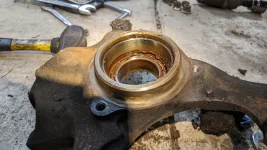
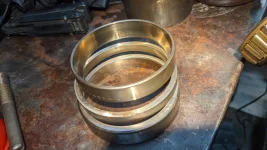
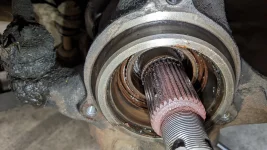
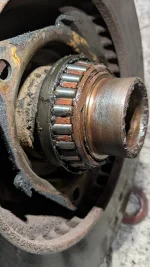
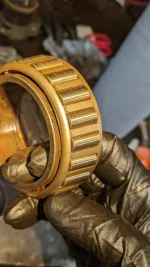
I started working on the front wheel bearings. I removed the CV axle nut and the caliper. I then gripped the disc/hub assembly and wiggled it off by hand! Uh oh. The manual shows usage of a large slide hammer to accomplish this task, so something was amiss. I got things apart and could see the inner bearing had a lot of clearance on the wheel hub's shank, rather than being a nice press-fit anymore. So, this hub will need spray welded and machined. Great.

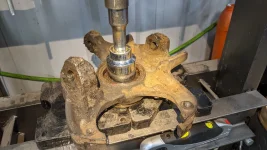
The good news is, I actually had to press the races out of the knuckle. It didn't take a lot of work, so they weren't super tight, but it was a 20 ton press after all. I'm going to say the knuckles are OK. We'll see how the new races fit going in.

This RV had bad bearing noise going down the road. The rearmost drivers bearing sounds pretty bad spun by hand, but hard to say how much of the racket was rusty brakes dragging. Judging by the looseness of the front wheels, I expected to see metal shavings and pitting, but I didn't. There's a light rust contamination color to the grease, I think, but I see no pitting on the races or rollers. There's a hint of scoring, but nothing I can feel with a fingernail. Odd.

Even weirder, is when I initially removed the cotter pin, the nut didn't feel very tight. So I tightened it, and all the slop in the wheel bearing basically vanished! So, did someone fail to see how these bearings work? Did they tighten the nut "finger tight" as if they were run-of-the-mill adjustable tapered roller bearings on a spindle? Yeesh, I shudder at the thought. A gambler might tighten them up proper and roll the dice, but the fact is, they've been driven on in an improper arrangement, and the innermost bearing race isn't holding tight to the wheel hub's snout/shank/whatever. So I'm going to do these up right. But, I don't wish to spend a couple grand shipping things to Dave Lenzi, so I've got some feelers out for an ag repair place that works on shafts.

Not sure if it works, but this attachment is a video:
View attachment PXL_20230316_045051078.mp4
 

Attachments

  • PXL_20230316_093134219.MP.webp
    PXL_20230316_093134219.MP.webp
    502.7 KB · Views: 16
  • PXL_20230316_032152379.webp
    PXL_20230316_032152379.webp
    604.3 KB · Views: 15
  • PXL_20230317_162736169.webp
    PXL_20230317_162736169.webp
    399.3 KB · Views: 15
  • PXL_20230316_033839842.webp
    PXL_20230316_033839842.webp
    632.7 KB · Views: 14
  • PXL_20230315_043136523.MP.webp
    PXL_20230315_043136523.MP.webp
    769.1 KB · Views: 14
  • PXL_20230315_043120460.webp
    PXL_20230315_043120460.webp
    612.9 KB · Views: 14
  • PXL_20230316_032813943.MP.webp
    PXL_20230316_032813943.MP.webp
    702.3 KB · Views: 14
  • PXL_20230316_033819030.webp
    PXL_20230316_033819030.webp
    580.8 KB · Views: 15
Last edited:
  • Wow
Reactions: tmsnyder and bdub
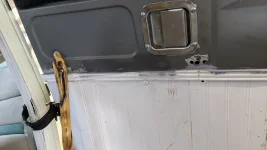
I've got a lot of parts in the mail, and wanted to accomplish something--however minor it may be. I have found it quite annoying to not have a grab handle on the door. The PO's upgrade didn't prove to be very robust. Proper repair will require patching the myriad of holes in the sheet metal, which is a lower priority task for another day.
PXL_20230319_215818283.MP.webp

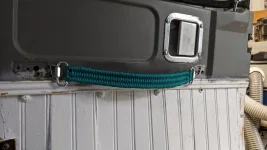
I had some dollar store paracord laying around that somewhat matched all the teal highlights this coach has, so I whipped up a handle and attached it to the door. Before you laugh, remember, this is "temporary"! Haha, right.
PXL_20230319_221727248.webp
 
  • Like
Reactions: bdub
I started working on the front wheel bearings. I removed the CV axle nut and the caliper. I then gripped the disc/hub assembly and wiggled it off by hand! Uh oh. The manual shows usage of a large slide hammer to accomplish this task, so something was amiss. I got things apart and could see the inner bearing had a lot of clearance on the wheel hub's shank, rather than being a nice press-fit anymore. So, this hub will need spray welded and machined. Great.

Something is wrong there. I don't think you can pull out the hub/bearing assembly from the knuckle and leave the outer race in the knuckle. Unless it was assembled incorrectly.
 
Something is wrong there. I don't think you can pull out the hub/bearing assembly from the knuckle and leave the outer race in the knuckle. Unless it was assembled incorrectly.
Indeed, that is the issue. If you can get the above video to play, it shows the extra clearance between the inner bearing and the hub. It should be a press fit, but it's very sloppy. The press fit between the inner bearing and the hub should keep the hub/disc assembly retained to the knuckle, and should require a large slide hammer to remove (the repair manual's process, anyway). I have some spray welding and machining in my future.
 
Indeed, that is the issue. If you can get the above video to play, it shows the extra clearance between the inner bearing and the hub. It should be a press fit, but it's very sloppy. The press fit between the inner bearing and the hub should keep the hub/disc assembly retained to the knuckle, and should require a large slide hammer to remove (the repair manual's process, anyway). I have some spray welding and machining in my future.

The slide hammer is really only to overcome the fact that it's a tight clearance fit and the parts have been in contact for some time. There may be some gooey oil or maybe even a bit of rust preventing the hub assembly from sliding out.

The outer races to the knuckle is not a press fit however. Not like the inner races to the hub, that's a press fit.
 
The slide hammer is really only to overcome the fact that it's a tight clearance fit and the parts have been in contact for some time. There may be some gooey oil or maybe even a bit of rust preventing the hub assembly from sliding out.

The outer races to the knuckle is not a press fit however. Not like the inner races to the hub, that's a press fit.
Well it was certainly a tighter fit than the inner bearing on the hub. That fell right apart. Everything else stayed in the knuckle, but pressed out easily.

I expect once I get the outer bearing pulled off, I'll find a decent step on the hub that shouldn't be there.
 
Last edited:
Well it was certainly a tighter fit than the inner bearing on the hub. That fell right apart. Everything else stayed in the knuckle, but pressed out easily.

I expect once I get the outer bearing pulled off, I'll find a decent step on the hub that shouldn't be there.
Most knuckles are out of round or loose.

Bad hubs are more rare. But seeing enough front bearing assemblies over the years there are people that poorly repair them.

The oem tolerances were too loose to help with service as I understand. Lenzi and applied and maybe others rebuild the knuckle to a tighter tolerance fit, and have had success seeing long life on front bearings after doing so.

It takes a big pipe on a arbor press and a couple guys to press a knuckle onto a hub.

55090ED5-6050-478C-B42E-624D469CF290.jpeg
 
  • Wow
  • Like
Reactions: tmsnyder and bdub
Most knuckles are out of round or loose.

Bad hubs are more rare. But seeing enough front bearing assemblies over the years there are people that poorly repair them.

The oem tolerances were too loose to help with service as I understand. Lenzi and applied and maybe others rebuild the knuckle to a tighter tolerance fit, and have had success seeing long life on front bearings after doing so.

It takes a big pipe on a arbor press and a couple guys to press a knuckle onto a hub.

View attachment 8026

Are they pressing the bearings into the knuckle? That is not supposed to be a press fit, not from the factory at least.
 
Are they pressing the bearings into the knuckle? That is not supposed to be a press fit, not from the factory at least.
Factory tolerance is too loose. The races pound out the knuckle and that is why they fail early.

I am noy the expert, i think there is documentation on it. I just know people with lenzi knuckles with the tolerance he uses that has 100k+ miles on them.
 
Factory tolerance is too loose. The races pound out the knuckle and that is why they fail early.

I am noy the expert, i think there is documentation on it. I just know people with lenzi knuckles with the tolerance he uses that has 100k+ miles on them.
I also saw a document that said Dave recommended people install the bearings into the knuckle first, then draw the hub into the assembly. He said it went smoother that way. It's opposite from the FSM process.

My knuckle fits well, but the hub doesn't at all, so I'll be attending to that first and foremost.

Edit: I think it was mentioned in the guide for the "Warner" puller tools.
 
Last edited:
It takes a big pipe on a arbor press and a couple guys to press a knuckle onto a hub.
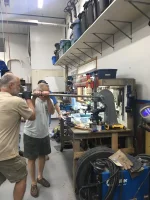
That looks like the hard way to do it. I've got a 20 ton hydraulic press, seen in the pics above. Granted, it's not as portable as the arbor press, but I'm always working alone so it's the way to go.