The electric GMC fully imagined -
- Thread starter hertfordnc
- Start date
You are using an out of date browser. It may not display this or other websites correctly.
You should upgrade or use an alternative browser.
You should upgrade or use an alternative browser.


What I am having a hard time understanding is why people want to put a modern drive train into a fifty year old design. I personally (as a builder of composite boats) think that one could start with a fresh design, keep the TZE parts you like (High Cab and Low Floor and maybe less window area) and do it all out of composite. Ray Frank made the original motorhome that became Travco in 1961 with a fiberglass body on a steel frame. There are better materials and methods available to us now. I personally would consider this but for two small impediments in my case. I couldn't afford to buy the materials I would like to use and my body can't work that long and hard these days.
Matt
I kind of along your way of thinking Matt.
All of us have concerns for the frame, especially up front where it can bolt apart.
Then there is the midrif bulge they all have.
I have it and was only marginally successful at correcting it.
The Parking brake, when it works, is marginal and if you have the air
rear suspension, the system leaks.
The Windshields are $700 per half and the body panels are not really replaceable.
The negatives are piling up against it.
Keeping in mind our front wheel weights are rougly 3k lbs and rear 7k lbs.
As for the refit, Tesla is going to bring out a line of electric semis which could be a possibility.
The Tesla car system is most likely too small and under powered motor wise.
The source for the power and motors would have to be in the truck arena.
To keep cost down, we'd have to consider strictly getting what is needed from the "Mens Mall" for parts.
This should be an easy deal, most newer cars, and trucks can only withstand one major hit then it is totaled.
As long as the drive train and batteries/controls are not destroyed, it would be a good days outing to harvest parts.
Then consider how you will transmit the power to the wheels. Will you keep the now antiquated Toronado/Eldorado front wheel drive train or modify to the drive train that you take from the doner vehicle???
Another off thought would be, who will service and do maintenance on these changed over GMC's??
We are looking at a whole different type of maintenance and service and they won't be all over the country.
A simple breakdown could cost thousands to truck to a shop that can work on it. and it would have to be a new GMC motorhome "electrified" shop. They will have some knowledge of the old motorhome but will need training, If it is possible to get it, for the new electrified version.
It would be most important to try to keep the vehicle up grades made using the same type of vehicle parts or there will be more problems with repairs.
Just thinking out loud.
First post. Hope you don't mind me resurrecting this thread. I found it via a google search. Fantastic conversation!
I do not yet own a GMC coach but I am a serious 'gearhead' and have been a fan of the GMC for a looong time. (I currently vacation in a Winnebago Brave -- don't hate me!) Anyway, I have collected all manner of drawings, etc. with the intent of determining whether my imagined EV-RV can square with reality. Regardless, EV conversion or not, I will own a GMC sooner rather than later. With that introduction, here is a specific question (after context)...
I've looked at the Tesla drive units, specifically the "large" drive unit. As these units have independent axles coming from a differential off each side, it would seem to be relatively straight forward to adapt the stock GMC drive axles and leave the front suspension otherwise unmodified. No need for the transaxle. Assuming, then, that fitment isn't an issue, here's where my question comes in. These units have a torque rating of 445 lb-ft. That's comparable to the 455 Olds but available from zero rpm, so acceleration would be just fine. It's the three horsepower ratings that need to be focused on. 536 max HP, but only for well less than a minute before overheating. There is a second rating of 215 HP for "up to twelve minutes". That would be more than enough for overtaking other vehicles. The key figure is the third, "continuous" rating of 61 HP. This one concerns me....
The details that have been shared about aerodynamic cd, etc. are really helpful. Although it would be nice if there was a definitive answer for HP required to keep the GMC at steady state highway speeds, I appreciate the well reasoned guesses that have been offered up... and, obviously, headwinds and grades are variable. At any rate, do you suppose 61 HP would be a sufficient bottom line for maintaining highway speeds.
I do not yet own a GMC coach but I am a serious 'gearhead' and have been a fan of the GMC for a looong time. (I currently vacation in a Winnebago Brave -- don't hate me!) Anyway, I have collected all manner of drawings, etc. with the intent of determining whether my imagined EV-RV can square with reality. Regardless, EV conversion or not, I will own a GMC sooner rather than later. With that introduction, here is a specific question (after context)...
I've looked at the Tesla drive units, specifically the "large" drive unit. As these units have independent axles coming from a differential off each side, it would seem to be relatively straight forward to adapt the stock GMC drive axles and leave the front suspension otherwise unmodified. No need for the transaxle. Assuming, then, that fitment isn't an issue, here's where my question comes in. These units have a torque rating of 445 lb-ft. That's comparable to the 455 Olds but available from zero rpm, so acceleration would be just fine. It's the three horsepower ratings that need to be focused on. 536 max HP, but only for well less than a minute before overheating. There is a second rating of 215 HP for "up to twelve minutes". That would be more than enough for overtaking other vehicles. The key figure is the third, "continuous" rating of 61 HP. This one concerns me....
The details that have been shared about aerodynamic cd, etc. are really helpful. Although it would be nice if there was a definitive answer for HP required to keep the GMC at steady state highway speeds, I appreciate the well reasoned guesses that have been offered up... and, obviously, headwinds and grades are variable. At any rate, do you suppose 61 HP would be a sufficient bottom line for maintaining highway speeds.

All of these mental gymnastics are interesting, but way back when, as a boy helping in the shipyards that dotted the east coast, I was listening to the lunch talk one day. These men were (from my POV) really old (like 40+). They talked one day about the cars that they had owned and included the adventures so related. Getting fuel was a big one. Apparently the prevalence of "service stations" was still not there yet. One that was making a long journey in his Essex got low on fuel. The only way to get more was to have a hardware store order some in 5 gallon cans and have it brought in by train in a day or so. It arrived and then he sold the cans back to the store. There was no internet, telephones were still not common and all this didn't change until the late 20's.
Admittedly, communication has improved, but it is still possible to run you electric car down without access to a charging station. And then there is the grid power issue that some genius politicians have just now recognized.
One of Mary's Canadian cousins has a Tesla and my brother has some little electric something, so they are real, but they do present their own problems.
One day after listening to the car talk on the building ways, I asked why if the cars of the day were so problematic and unreliable did they ever take over from horses. The reply was instant and straightforward. Something like -
"You never put up with a horse - Did you kid?" I seems that there was a over arching reason for early cars......
Electrics don't yet have this advantage to drive the change.
Matt
Admittedly, communication has improved, but it is still possible to run you electric car down without access to a charging station. And then there is the grid power issue that some genius politicians have just now recognized.
One of Mary's Canadian cousins has a Tesla and my brother has some little electric something, so they are real, but they do present their own problems.
One day after listening to the car talk on the building ways, I asked why if the cars of the day were so problematic and unreliable did they ever take over from horses. The reply was instant and straightforward. Something like -
"You never put up with a horse - Did you kid?" I seems that there was a over arching reason for early cars......
Electrics don't yet have this advantage to drive the change.
Matt

Matt, I've heard that before about horses! that and their exhaust is a lot messier than a cars exhaust.
GFMCCANN, Look into Edison motors, they are making diesel electric logging trucks. Just got Prototype 1 running, working on P2. They are using Eaton(?) E-Axels, large battery packs and a Cat generator. So it's an electric truck with a diesel generator. Pretty cool idea, not a new Idea, but cool
GFMCCANN, Look into Edison motors, they are making diesel electric logging trucks. Just got Prototype 1 running, working on P2. They are using Eaton(?) E-Axels, large battery packs and a Cat generator. So it's an electric truck with a diesel generator. Pretty cool idea, not a new Idea, but cool

I think the question would be "which highway?" I70 in Kansas? No problem. 285 here in CO? No chance.First post. Hope you don't mind me resurrecting this thread. I found it via a google search. Fantastic conversation!
I do not yet own a GMC coach but I am a serious 'gearhead' and have been a fan of the GMC for a looong time. (I currently vacation in a Winnebago Brave -- don't hate me!) Anyway, I have collected all manner of drawings, etc. with the intent of determining whether my imagined EV-RV can square with reality. Regardless, EV conversion or not, I will own a GMC sooner rather than later. With that introduction, here is a specific question (after context)...
I've looked at the Tesla drive units, specifically the "large" drive unit. As these units have independent axles coming from a differential off each side, it would seem to be relatively straight forward to adapt the stock GMC drive axles and leave the front suspension otherwise unmodified. No need for the transaxle. Assuming, then, that fitment isn't an issue, here's where my question comes in. These units have a torque rating of 445 lb-ft. That's comparable to the 455 Olds but available from zero rpm, so acceleration would be just fine. It's the three horsepower ratings that need to be focused on. 536 max HP, but only for well less than a minute before overheating. There is a second rating of 215 HP for "up to twelve minutes". That would be more than enough for overtaking other vehicles. The key figure is the third, "continuous" rating of 61 HP. This one concerns me....
The details that have been shared about aerodynamic cd, etc. are really helpful. Although it would be nice if there was a definitive answer for HP required to keep the GMC at steady state highway speeds, I appreciate the well reasoned guesses that have been offered up... and, obviously, headwinds and grades are variable. At any rate, do you suppose 61 HP would be a sufficient bottom line for maintaining highway speeds.

I will say that the difference in "go power" between my 1976 24 foot Airstream and my 26 foot 1977 GMC are night and day. The Airstream was like whipping a turtle. In comparison, the GMC is a sports car. If I'm not carefully watching my speedo, I often find I'm cruising at 80mph when traversing from Colorado to the Midwest. The fact that the vehicle is engineered so much better than a P30 chassis means it will take less to make it roll. I wouldn't want to face mountains with only 61HP available (or even 215 if it's only for 12 minutes), but in the flats... seems like it would be plenty (especially if the 215HP gets you up to speed).
I guess that means we're not "there" yet, but it doesn't mean we shouldn't be trying!
I can't wait till someone with the "extra" cash for the motors and batteries gets one of these up and running soon. It is SO doable. There are so many naysayers, and soon they will be standing next to the fools who said Orville and Wilbur were wasting their time too.
Gfmccann, I'm sure you've gathered this if you've been poking around, but there are 24 and 26 foot models of these GMC's. Obviously the 24 is a better choice for the electric, and though the 24 is harder to come buy, there are definitely gutted rolling chassis to be found for little to no money.
Regarding Matt's comments about current viability: the adoption of an electric infrastructure will be so much faster than the nation switching from horses to cars. Sure there are a lot of routes that are currently problematic, but there are already so many long range routes with plentiful charging stations along the way. There are also so many rural areas with charging stations already set up (weird places that you wouldn't imagine they'd exist). Can we go *everywhere we want* right now? Nope, but that certainly shouldn't stand in the way of preparing for what's right around the corner. Once interstate shipping starts to rely more heavily on electric, it'll be about 10 seconds before electric RV's are a totally viable option.
Are gas powered RV's a thing of the past? Not at all, and they won't be for a long time. But I will never understand all the grumpy old men insisting that it will *never* work (I'm not talking about Mr. Collie; I'm talking about all the other guys that chime in with such angry, practically "electric hate speech"). That's just ridiculous.
Keith... I've never understood the absence of electric/diesel hybrids. Seems like a no-brainer that is practically absent from the consumer sector.

"@Gfmccann, I'm sure you've gathered this if you've been poking around, but there are 24 and 26 foot models of these GMC's. Obviously the 24 is a better choice for the electric, and though the 24 is harder to come buy, there are definitely gutted rolling chassis to be found for little to no money."
I think you meant 23 foot and 26 foot.
I think you meant 23 foot and 26 foot.
Kidj,
To assume that anything here is "Hate Speech" is most unbecoming.
I have run both Diesel-Electric and Turbo-Electric power systems, so I think I might have some insight.
Are you aware that the army's MRAP are Diesel-Electric?
My wife's Canadian cousin and spouse have made the drive from Port Stanley to Miami a number of times. Obviously, it can be done. That is down the I-95 corridor and it is not Rt-10 across Montana.
About the infrastructure issues, I see this as being a lot tougher than getting cans of gasoline to remote places. There are two problems, one is getting the copper up to capability to convey the required power. That will not be trivial, if you care to look at California I don't have to pursue that. The other and more serious one will be creating the power generation capacity that will be required. In my career, I was part of building two primary power plants. Building them has a number of very serious issues.
First is what type to build. If it is renewable, there are not many places that this can happen and all (even hydro) have availability issues. Nuclear is the best choice environmentally, but that comes with years of permitting.
Another is where to build it, not just the unending NIMBY problems. There has to be enough real estate available because these things are large and most require a rail line at least to build and if coal to fuel it.
I suspect that you were not involved with the rush several years ago to have CNG vehicles. If you were, you would clearly remember the cluster operation that turned into in relative short time span.
In my life right now, an electric like my brother drives would be a good answer. For just a few thousand dollars I could have a low power charging station in our garage. I believe it could be done without upgrading the home's service.
What I see as the big obstacle at this time is the essential time to recharge all of the current secondary battery types available. There are possibly some breakthroughs coming there. I will be glad to see them.
I have been an engineer for a long time and I have seen a lot of neat stuff flash in the pan and a few that stayed burning. We will have to see how this comes out and I am no kind of a psychic that can tell you now.
Matt
To assume that anything here is "Hate Speech" is most unbecoming.
I have run both Diesel-Electric and Turbo-Electric power systems, so I think I might have some insight.
Are you aware that the army's MRAP are Diesel-Electric?
My wife's Canadian cousin and spouse have made the drive from Port Stanley to Miami a number of times. Obviously, it can be done. That is down the I-95 corridor and it is not Rt-10 across Montana.
About the infrastructure issues, I see this as being a lot tougher than getting cans of gasoline to remote places. There are two problems, one is getting the copper up to capability to convey the required power. That will not be trivial, if you care to look at California I don't have to pursue that. The other and more serious one will be creating the power generation capacity that will be required. In my career, I was part of building two primary power plants. Building them has a number of very serious issues.
First is what type to build. If it is renewable, there are not many places that this can happen and all (even hydro) have availability issues. Nuclear is the best choice environmentally, but that comes with years of permitting.
Another is where to build it, not just the unending NIMBY problems. There has to be enough real estate available because these things are large and most require a rail line at least to build and if coal to fuel it.
I suspect that you were not involved with the rush several years ago to have CNG vehicles. If you were, you would clearly remember the cluster operation that turned into in relative short time span.
In my life right now, an electric like my brother drives would be a good answer. For just a few thousand dollars I could have a low power charging station in our garage. I believe it could be done without upgrading the home's service.
What I see as the big obstacle at this time is the essential time to recharge all of the current secondary battery types available. There are possibly some breakthroughs coming there. I will be glad to see them.
I have been an engineer for a long time and I have seen a lot of neat stuff flash in the pan and a few that stayed burning. We will have to see how this comes out and I am no kind of a psychic that can tell you now.
Matt

Here in Australia we use about 50 billion litres of fuel per year. To replace that with electricity might require 150 billion kWh of electricity. Currently we produce about 220 billion kWh of electricity. I want to know where the extra electricity will come from and how it will get moved to where it needs to be. I don’t think we know the answer to this yet.
Oops. Still had my brain in Airstream land from my previous comment comparing Airstreams and GMC's!"@Gfmccann, I'm sure you've gathered this if you've been poking around, but there are 24 and 26 foot models of these GMC's. Obviously the 24 is a better choice for the electric, and though the 24 is harder to come buy, there are definitely gutted rolling chassis to be found for little to no money."
I think you meant 23 foot and 26 foot.
Kidj,
To assume that anything here is "Hate Speech" is most unbecoming.
And as I clearly stated, I wasn't referring to you, but other members and people elsewhere (on GMC Forums, GMC Facebook, etc.) who definitely speak and behave this way.
I have run both Diesel-Electric and Turbo-Electric power systems, so I think I might have some insight.
Are you aware that the army's MRAP are Diesel-Electric?
Yep, but that's why I said the consumer sector.
About the infrastructure issues, I see this as being a lot tougher than getting cans of gasoline to remote places. There are two problems, one is getting the copper up to capability to convey the required power. That will not be trivial, if you care to look at California I don't have to pursue that. The other and more serious one will be creating the power generation capacity that will be required. In my career, I was part of building two primary power plants. Building them has a number of very serious issues.
I agree that with the current tech and tools it would be difficult, but I foresee a much more robust means of transmission quickly coming to this landscape. I also think there will be salvation in an increase in local power generation vs. very few points of generation. I'm not talking tomorrow, but within the next 15 to 20 years.
Yep. I think most modern homes are capable of supporting a single or double car charging system (which obviously doesn't address transit, but hopefully could take care of under 150 mile commutes).In my life right now, an electric like my brother drives would be a good answer. For just a few thousand dollars I could have a low power charging station in our garage. I believe it could be done without upgrading the home's service.
Definitely. It's an exciting time for batteries and electricity. There are certainly going to be some crazy advancements in the next two decades!What I see as the big obstacle at this time is the essential time to recharge all of the current secondary battery types available. There are possibly some breakthroughs coming there. I will be glad to see them.
I have been an engineer for a long time and I have seen a lot of neat stuff flash in the pan and a few that stayed burning. We will have to see how this comes out and I am no kind of a psychic that can tell you now.
Matt

If it's any help my Bolt can DC fast charge at about 50Kwh, however that is only from 0% to ~50% SOC ..... battery management throttles the charge rate above 50%
My desire would be electric drive wheels. Just think if the GMC had all 6 wheels supplying power (no getting stuck on wet grass)
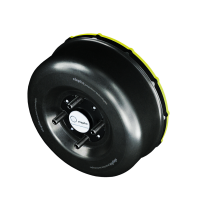
 in-wheel.com
My desire would be electric drive wheels. Just think if the GMC had all 6 wheels supplying power (no getting stuck on wet grass)
Direct-drive in-wheel motors - Elaphe
in-wheel.com
At any rate, do you suppose 61 HP would be a sufficient bottom line for maintaining highway speeds.
Back of the envelope calculation.......
You should be able to back that out of the average MPG these get, 9-11 mpg. Specific fuel consumption for a gasoline engine at best is 0.4 lb/(hp-hr), on our 455s it's probably a little higher.
At 60 mph, burning at 10 mpg, you use 6 gallons per hour. Gas weighs 6 lb/gallon, so burn rate is 36 lb/hr.
(36 lb/hr) / (0.4 lb/hp-hr) = 90 hp to push the GMC motorhome down the road at 60 mph. _approximately_
Since the 455 Olds probably isn't getting 0.4 lb/hp-hr, the hp produced at 36 lb/hr is most likely a little less than 90 hp.

Thank you to everyone for this robust conversation.Back of the envelope calculation.......
You should be able to back that out of the average MPG these get, 9-11 mpg. Specific fuel consumption for a gasoline engine at best is 0.4 lb/(hp-hr), on our 455s it's probably a little higher.
At 60 mph, burning at 10 mpg, you use 6 gallons per hour. Gas weighs 6 lb/gallon, so burn rate is 36 lb/hr.
(36 lb/hr) / (0.4 lb/hp-hr) = 90 hp to push the GMC motorhome down the road at 60 mph. _approximately_
Since the 455 Olds probably isn't getting 0.4 lb/hp-hr, the hp produced at 36 lb/hr is most likely a little less than 90 hp.
tmsnyder, your calculations are super helpful. Help me though: is your formula meant to calculate net wheel horsepower or the potential power in the fuel used? I'm assuming it's the latter, in which case I'd think we need to factor out the mechanical inefficiencies inherent in an internal combustion engine. Internal friction and pumping losses (manifested as wasted heat going out the exhaust pipe and into the cooling system) would be "consuming" a significant portion of that fuel usage you've calculated. I'm not an engineer so I have to resort to asking Dr. Google. For instance, one wiki discussing the mechanical efficiency of a "modern" gasoline engine suggests that the power available at the crank is (at best) 35% of the potential energy of the gasoline consumed. So (if that is factual), of that theoretical 90 HP you've calculated, 65% of the fuel burned is energy wasted as unused heat. Therefore, using your calculation as a starting point and applying this estimate of mechanical efficiency, my math says that the actual NET power required to sustain your GMC at a typical traveling speed is something over 31 HP. (My gut, though, thinks it's gonna be measurably higher.) Even so...
Electric motors are much more efficient at converting the potential energy stored in their batteries into mechanical energy (power at the "crank", so to speak). I'm reading in one article a calculated efficiency of about 76% for a Tesla Model 3 at 60 mph. But that's besides the point because, regardless of electrons"burned", the actual NET power of the Tesla large drive unit is the aforementioned 61 HP "continuous". So, based upon your extrapolation backwards from "10 mpg", the answer to my question would seem to be "Yes, 61 HP would be sufficient".
Now, flipping this conversation back over to aerodynamic calculations, I found this super helpful calculator:
All I need now is a 'real world' Cd number and (apparently) I'll have a definitive answer.
Thanks again everyone.
Last edited:
Help me though: is your formula meant to calculate net wheel horsepower or the potential power in the fuel used?
That 0.4 hp/lb/hr typical gas engine efficiency is at the crankshaft. It includes all the inefficiencies inherent in a typical gas engine.
If you look at the energy in the fuel, iirc a typical gas engine only turns about 15% of that into mechanical energy. Again, you could figure that number out knowing how much energy is in a gallon of gas and using that 0.4 hp/lb/hr number.
For your electric repower ambitions, I was just trying to give you an idea of approximately how many horsepower you'd need in order to push a GMC motorhome down the road at 60 mph. I believe based on the above back of the envelope calculation, that you would need 90 hp continuous at the output shaft of your electric motor.
<<Electric motors are much more efficient at converting the potential energy stored in their batteries into mechanical energy (power at the "crank", so to speak). >>
Yes electric motors are much much better at converting electrical power into mechanical power than a gas engine is at converting the energy in gas into mechanical power.
<<So, based upon your extrapolation backwards from "10 mpg", the answer to my question would seem to be "Yes, 61 HP would be sufficient".>>
No, I think you need more like 90HP at the electric motor shaft, continuous.
<<<Now, flipping this conversation back over to aerodynamic calculations, I found this super helpful calculator:
All I need now is a 'real world' Cd number and (apparently) I'll have a definitive answer. >>>
It's somewhere between 1.0 and 0.3
 My SWAG is 0.7
 How to measure it?? You'd have to collect a bunch of data and be able to measure either mpg or amps on an electric one _accurately_ Assuming you could find a long stretch of perfectly flat highway, there's the rolling resistance and the air resistance. If you had the ability to measure power output accurately, and a good steady headwind / tailwind, you could determine Cd for a real full size GMC motorhome
Drive back and forth at multiple constant speeds and look at the effect of effective air speed over the hull on power required
Last edited:
Search on "drag coefficient of a bus". There's a fair amount of info on this topic. Cd's range from 0.5 to 0.7. You can always test a range of values and see what the Cd should be to make it work. There are some useful charts in these two papers.Thank you to everyone for this robust conversation.
....
All I need now is a 'real world' Cd number and (apparently) I'll have a definitive answer.
Thanks again everyone.
JPB
Thank you. In fact, a scale model of the GMC coach was tested in a wind tunnel in the 70s, returning a stunningly good Cd of .31. HOWEVER, in the real world there is added turbulence from rails and pockets in the undercarriage, side mirrors, less streamlined bumpers, etc. So, in reality, the "real world" Cd number will be higher. It's likely not as high as typical boxy "bus", but the answer for an accurate number is still in the realm of speculation.Search on "drag coefficient of a bus". There's a fair amount of info on this topic. Cd's range from 0.5 to 0.7. You can always test a range of values and see what the Cd should be to make it work. There are some useful charts in these two papers.
JPB

The Princess Marguerite, a ship of the old CP fleet that transitioned to the Seattle-Victoria BC run was powered like this IIRCSo it's an electric truck with a diesel generator. Pretty cool idea, not a new Idea, but cool
You might want to consider looking into hub drive. Orbis wheel makes a hub motor that cranks out 50 hp. Fortunately you have 6 wheels so you could deploy 300 hp. With respect to going electric, I’d say it’s inevitable and something to look forward to. Just think about it! Every RV carries around 3 types of fuel: gasoline/diesel, propane, electric. Unifying into one singular source will be such an improvement.First post. Hope you don't mind me resurrecting this thread. I found it via a google search. Fantastic conversation!
I do not yet own a GMC coach but I am a serious 'gearhead' and have been a fan of the GMC for a looong time. (I currently vacation in a Winnebago Brave -- don't hate me!) Anyway, I have collected all manner of drawings, etc. with the intent of determining whether my imagined EV-RV can square with reality. Regardless, EV conversion or not, I will own a GMC sooner rather than later. With that introduction, here is a specific question (after context)...
I've looked at the Tesla drive units, specifically the "large" drive unit. As these units have independent axles coming from a differential off each side, it would seem to be relatively straight forward to adapt the stock GMC drive axles and leave the front suspension otherwise unmodified. No need for the transaxle. Assuming, then, that fitment isn't an issue, here's where my question comes in. These units have a torque rating of 445 lb-ft. That's comparable to the 455 Olds but available from zero rpm, so acceleration would be just fine. It's the three horsepower ratings that need to be focused on. 536 max HP, but only for well less than a minute before overheating. There is a second rating of 215 HP for "up to twelve minutes". That would be more than enough for overtaking other vehicles. The key figure is the third, "continuous" rating of 61 HP. This one concerns me....
The details that have been shared about aerodynamic cd, etc. are really helpful. Although it would be nice if there was a definitive answer for HP required to keep the GMC at steady state highway speeds, I appreciate the well reasoned guesses that have been offered up... and, obviously, headwinds and grades are variable. At any rate, do you suppose 61 HP would be a sufficient bottom line for maintaining highway speeds.
The GMC chassis is actually a skateboard chassis when you look at it, IMHO you already have a really good foundation to build upon.

Used in the
in-wheel.com
Lordstown Endurance truck ( https://en.wikipedia.org/wiki/Lordstown_Endurance ):
Direct-drive in-wheel motors - Elaphe
in-wheel.com