The electric GMC fully imagined -

No thanks! I wouldn't want one even if money were no object. I love the GMC and a lot of that love has to do with its small size and light weight. It's really not much longer or heavier than my daily driver Suburban.
Yep!!!

The scary part is elderly people drive these land yachts! Some states require CDLs or some form of one.

A cousin of mine who is nearly 80-years old drives a large class C motorhome at 75 mph with only one good eye. None of his siblings will ride with him. His wife has no choice; nor do his grandkids.
 
  • Wow
  • Like
Reactions: daver and tmsnyder
HOPE SPRINGS ETERNAL. Just maybe an electric GMC could go below 0.31.

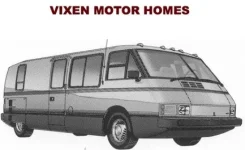
The drag coefficient of a Vixen Motorhome was only 0.21. Vixen is a 1980s a mini GMC motorhome. No grille. Snug bumpers. Smooth belly pan. Rear wheel fender skirt.

Only 500-some were made at a plant on Pontiac Ave in Pontiac MI.

Initial Vinens had a 4-cyl turbocharge BMW motor coupled to a Renault manual transmission. I can't think of worse combination. Lots of reliability issues. When they ran, mileage was in 20s. It was marketed as a Driver's Motorhome.

The Vixen was short enough to be garageable; they had a tilting roof for standing inside while camping. Both the low drag coefficient and low x-sectional area contributed to its great mileage, in addition to no emission controls back then.

Later models had a GMC motor and automatic trans.

Vixen Motor Home.jpg
 
HOPE SPRINGS ETERNAL. Just maybe an electric GMC could go below 0.31.

The drag coefficient of a Vixen Motorhome was only 0.21. Vixen is a 1980s a mini GMC motorhome. No grille. Snug bumpers. Smooth belly pan. Rear wheel fender skirt.

Only 500-some were made at a plant on Pontiac Ave in Pontiac MI.

Initial Vinens had a 4-cyl turbocharge BMW motor coupled to a Renault manual transmission. I can't think of worse combination. Lots of reliability issues. When they ran, mileage was in 20s. It was marketed as a Driver's Motorhome.

The Vixen was short enough to be garageable; they had a tilting roof for standing inside while camping. Both the low drag coefficient and low x-sectional area contributed to its great mileage, in addition to no emission controls back then.

Later models had a GMC motor and automatic trans.

View attachment 6071

This is a much much smaller motorhome than a GMC, they had to make the later model years with a pop up roof so you could stand up in it. And made in very small numbers.
 
If I had my way I'd build a diesel electric MH. use a very small cly diesel that has just enough HP to get it down the road, maybe a small hill but not enough for a 7% grade. it would run a generator that would run electric motor(s), batteries would be there for acceleration and hill climbing.

This would allow you to use normal AC/power steering etc, have a great battery for boon docking and 800 mile range ( or so )

All I need is 100k, and a year of free time
 
Diesel-Electrics locomotives were developed to bypass the need for monster transmissions... something old steam locomotives didn't need.

No silver bullet on moving a heavy vehicle such as medium to large trucks. Acceleration and hill climbing is nearly all mass dependent. Even with hill climbing, if the total height of the hill is such and such, then energy of required get of up that hill is fixed by the vehicle weight. The grade only affects the power (energy per time) needed to do it.
 
except with electric you can regen some power, store it and reuse it for those climbs.
you can also use a smaller more efficient engine as the batteries supply power for the hill climbing.

Still, it's not cost effective even at 5$ a gallon
 
except with electric you can regen some power, store it and reuse it for those climbs.
you can also use a smaller more efficient engine as the batteries supply power for the hill climbing.

Still, it's not cost effective even at 5$ a gallon
Yup, Formula E racecars don't even have rear brakes now, just regen.
 
Yup, Formula E racecars don't even have rear brakes now, just regen.
Kinda was looking around on the net on the future of RV’s. Sounds like I wouldn’t want to own a diesel pusher now. Anyhow am doing a TBI conversion on mine but am curious on potential hybrid or electric GMC. I found this guys writeup and have been wondering the same for our GMC. Why wouldn’t a series hybrid setup not work for our’s? Having a onboard generator already so was wondering if its plausible for us eventually like a earlier poster mentioned in a few years a men’s mall shopping for Tesla or Hummer electric drive motors or possibly cheaper electric drive motors may be available.

Article:

Just wondering,
TG
 
Last edited:
The Onan's maximum output power is 6Kw (or 4kw for a 23ft). Six Kw is equivalent to (6,000 / 746 =) 8 hp. The average power required to move a GMC down a level road at 60mph with no head wind is about 50hp.

I'm not sure where I read that, but someone calculated it and that's what comes to mind. So 50hp would require a (50 x 746=) 37,300 watts or 37Kw generator. But by the time you calculate in for some inefficiencies and losses, you would need approx. 50Kw generator on board just to keep up with highway traffic.

So here is a 50kw diesel generator:
https://masteraire.com/products/50-kw-prime-power-master-diesel-generator

Its fuel consumption at rated power output is 14.55 litres/hour or 3.85US gallons/hr. So at 60 miles per hour that's 60/3.85 = 15.5mpg. We haven't taken the electric power train losses into account yet.

So the Onan isn't going to power the GMC down the road much faster than jogging.
 
From that link...
"Vent scoops on roof of RV that tunnel wind power generator while driving at highway speeds to help charge batteries. This is the opposit of what regenerative braking does"

physics man... physics
 
Here is where I got the 50hp figure. Turns out that's the aerodynamic resistance HP for 56mph. Then you need to add ~20hp for the rolling resistance so that's now 70hp, but that's for a flat nosed, so 50hp is likely about right.

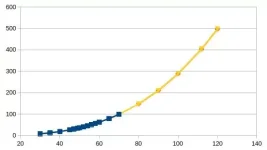
Aerodynamic drag is the largest issue from a cruising perspective. According to a chart I have in a GMC Dealer Data Book here's the Air Resistance Demand Horsepower figures between 30 and 70 MPH for a relatively square nosed vehicle of 60 sq/ft frontal area.
30 7.8
35 12.3
40 18.4
45 26.2
47 29.9
49 33.8
50 36.0
52 40.4
54 45.3
56 50.5
58 56.1
60 62.1
65 79.0
70 98.7
As you can see, horsepower just for wind drag is very significant. Driving 56 mph takes about half the output to overcome the wind that 70 mph does. Rolling Drag losses go up proportional to road speed/weight, and not exponentially as wind drag. Twice as fast or twice the weight = twice the drag for weight and rolling resistance for the most part. Takes about 20HP to overcome rolling resistance of a GMC at 60-65 MPH. At 30 MPH it would be more like 10HP.
Another thing to consider is there is approximately 145-160 net HP available in the first place from which you can deduct the drag;-)
 
Interesting empirical data.

The rule of thumb being that aerodynamic drag is proportional to velocity squared. So doubling velocity results in 4X drag. If I read the chart correctly then horsepower required increases ~8X when velocity is doubled. So if max available HP is 150 then max speed is around 80 mph. Extrapolating from the data it would require ~500 available HP to go 120 mph in a GMC motorhome.

drag.webp
 
JPB,
I'm wondering if that chart is for a flat fronted vehicle, no streamlining taken into account.

At the rate shown on your chart, an airliner would hit it's maximum power before it got to cruising speed.
 
JPB,
I'm wondering if that chart is for a flat fronted vehicle, no streamlining taken into account.

At the rate shown on your chart, an airliner would hit it's maximum power before it got to cruising speed.

I've not seen the dealer handbook that you referenced in your prior post. I presumed it was relevant to the GMC motorhome.

From your dealer handbook data table:
HP@60mph/HP@30mph ~= HP@70mph/HP@35mph ~= 8.

So according to those numbers from your table HP required increases by velocity cubed. This ratio of 8 was used to extrapolate your dealer table to the 120 mph requirement of ~500 hp. We do have an excellent reference point from the Motorhome Land Speed Record attempt conducted in August of 2016.


The land speed record topped out at 122.156 mph. The engine was dyno tested to 700HP at 6000RPM. The motorhome was seriously modified to reduce drag. So if anything the extrapolated portion of the chart probably predicts too low for a GMC motorhome.

JPB
 
JPB,
I'm wondering if that chart is for a flat fronted vehicle, no streamlining taken into account.

At the rate shown on your chart, an airliner would hit it's maximum power before it got to cruising speed.

It's your data for a "relatively square nosed vehicle of 60 sq/ft frontal area" . He just extrapolated your data.
 
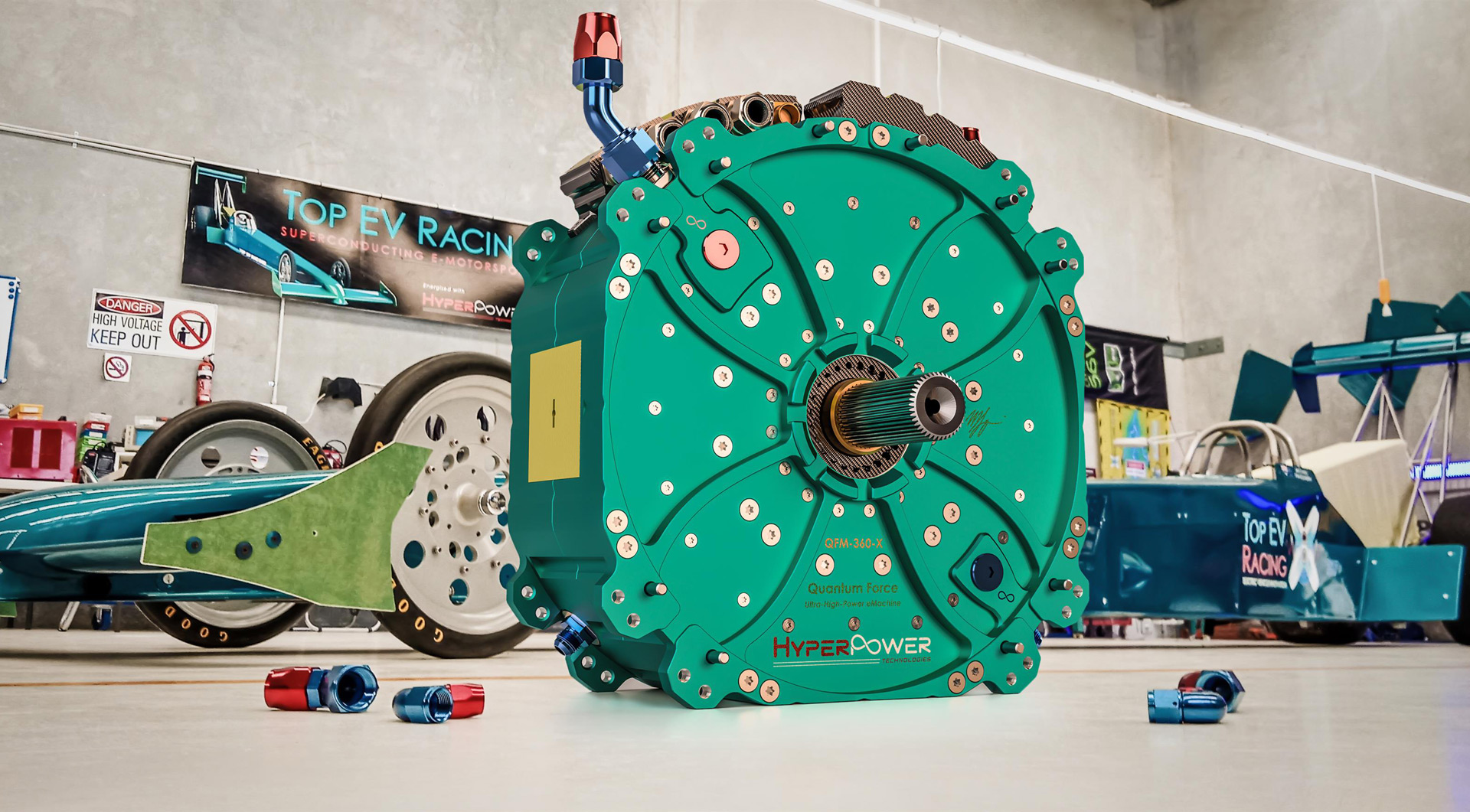
Getting back on topic. If one wanted to break the Land Speed Record with a GMC Motorhome then a QFM-360-X should have enough HP to do it. It shouldn't require too many batteries for that short distance.

 
Bowlus manufactures $300k travel trailers. Site shows a Tesla X towing one.

I didn't think that combination was possible until seeing the Tin Poodle blog:

"We traveled 7,000 miles cross country and back with our Bowlus and paid $0 in fuel costs...
Mileage traveled 7,000 miles traveled in total (6,000 miles towing Bowlus, 1,000 miles sans trailer)
Energy used 3280 kWh (2904 kWh towing, 376 kWh not towing)
Average energy consumption 484 watt/mile towing (highway speed range 55-67 mph)"
 
Last edited: