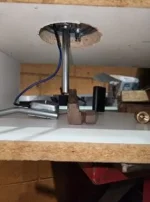
Replacement Fuel tank level sensor, interesting unit at a good price

  • Please note, the forum recently had a problem with outbound emails for notifications, registrations, etc. A new email provider has been set up which should resolve all email issues. If you have any further trouble, please DM Christo or reach out via the Contact Us link in the website footer.

RF_Burns

Super Moderator
Staff member
Sep 7, 2008
5,127
1,312
113
Ontario Canada
Just googling around and came across this fuel level sensor for $25USD. This one is 150mm (5.9") but the vendor says custom lengths can be made. 0-90 ohm output like we require. I separate hole would need to be made to mount it.

I'm in Mexico for the winter, so maybe someone else could do some further investigation with the vendor.

 
Just googling around and came across this fuel level sensor for $25USD. This one is 150mm (5.9") but the vendor says custom lengths can be made. 0-90 ohm output like we require. I separate hole would need to be made to mount it.

I'm in Mexico for the winter, so maybe someone else could do some further investigation with the vendor.

Looks like a nice unit. It will have one draw back in that it will cause the gauge to sway as gas sloshes in the tank while driving. That is why the bendix style gauge is used in most fuel tanks. With the arm you don't get much sway.
 
Over a decade back - I got tired of messing with the OE senders. I had let the tanks down enough times that I was really good at it. (This is not something to strive for...) I located a company that supplied 90 - zero sending units and picked a pair of the two that looked closest and got them. I took apart the originals and commenced to mount the new. Nothing was right about these. I had to mount the element on the opposite side from the OE and then shorten the arm to get the travel correct. This took me a whole day to do the two of them. This did not include letting the tanks down and hoisting them back up. At that time, Applied new units were about 50$us each. When I totaled up the effort it was clearly not an economic success and required tools and equipment that few owners would have. So, I never wrote up the story. They did and do still work, but I still have better ways to send two days.
This company also sells others versions many 90-0 and several with mounting that might be very adaptable. Some one should investigate this in depth.
Matt_C
 
Looks like a nice unit. It will have one draw back in that it will cause the gauge to sway as gas sloshes in the tank while driving. That is why the bendix style gauge is used in most fuel tanks. With the arm you don't get much sway.
If you go to their Ebay site, they make some that are arm type also. They seem to supply a range. Good winter project for those of us in the great white north.
Matt_C
 
In a post on facebook i responded to a post about using toronado fuel tank senders
as i am in Australia i could purchase 2 toronado senders from Rock auto for aroud $150 Aust ralian dollars delivered as opposed to arround 800 dollars for the correct ones from applied
so i thought it would be worth the effort to adapt
after a couple of days thinking these are the problems i encountered

The breather pipe in the new unit is only 5/16 thus restricting the breather for filling
You have to reset the pick up arm as it will be too long
The pick up arm after rebending will not be on the lowest part of the tank
You have to cut off the locating tabs on the top plate
You then have to adjust the float to land exactly at 0 ohms when on the bottom
And at 90 ohms when on the top

I ended up cutting the vertical pick up tube and brazing on a 3/8 elbow so the pick up sat on the bottom of the tank

I did not use the elbow in the photo but bent a bit of 3/8 copper pipe and
silver soldered it on to the verticle pipe then attached the pick up sock on the end
i then tig welded the sender resistor to the verticle pipe and bent and
adjusted the float arm to suit the tank depth and height

Picture shows the mock up tank so I can make the adjustment and get the pickup heights correct
unfortunatley i was in too much of a hurry and i diddnt get a photo of the finished adaption

1704096775753.webp
 
If these are what I think they are, they're not actually variable.

My Ducati uses something similar that I had to dissect (the Italians could never make these reliable, it's the bane of the Multistrada). The float has magnets, and the tube contains a long, thin PCB covered with magnetic reed switches and a resistor network. As a result, it's not variable, but instead has a certain number of discrete resistance values.

It could work fine, but I'd want to know how many "steps" I'm buying.
 
If these are what I think they are, they're not actually variable.

My Ducati uses something similar that I had to dissect (the Italians could never make these reliable, it's the bane of the Multistrada). The float has magnets, and the tube contains a long, thin PCB covered with magnetic reed switches and a resistor network. As a result, it's not variable, but instead has a certain number of discrete resistance values.

It could work fine, but I'd want to know how many "steps" I'm buying.
I was wondering how they worked and I suspected it was a magnet floating on the outside. The documents state that the bottom of the sensor should be 1" above the bottom of the tank. Being a magnet, I'm guessing that's to ensure the magnet does not get "pulled" at the bottom of a steel tank.
It makes sense that its just a resistor ladder with reed switches. The accuracy in our shallow tanks would be very poor.
Strike another idea off.
 
I was wondering how they worked and I suspected it was a magnet floating on the outside. The documents state that the bottom of the sensor should be 1" above the bottom of the tank. Being a magnet, I'm guessing that's to ensure the magnet does not get "pulled" at the bottom of a steel tank.
It makes sense that its just a resistor ladder with reed switches. The accuracy in our shallow tanks would be very poor.
Strike another idea off.
I'm still intrigued. I hadn't seen the 1" from bottom spec, so that does put the squeeze on us. I did see a variant that was 125mm. I don't know what our tank height is off the top of my head, but that's a step in the right direction.

If only they had a 58kohm version, I could get a replacement for my Ducati...
 
As to how these work: The ones I saw in industry were mostly a spiraled track. The magnet on the inside or outside in the float. This turns a potentiometer (variable resistor). The problem with these is that if the liquid sloshes the magnet can get lost and until a full cycle is completed so they become "aligned" again there may be no sensing. Our propane tank sensor works this way.
 
  • Like
Reactions: pvfjr
As to how these work: The ones I saw in industry were mostly a spiraled track. The magnet on the inside or outside in the float. This turns a potentiometer (variable resistor). The problem with these is that if the liquid sloshes the magnet can get lost and until a full cycle is completed so they become "aligned" again there may be no sensing. Our propane tank sensor works this way.
That makes sense that they're different from the Ducati style. The tube does look rounder and a bit smaller.

I'm guessing that means there's very little drag force in the resistor, thus very little contact force, reduced self-cleaning in the contacts, and so on. I'm left wondering how long they'd really last in the elements.
 
That makes sense that they're different from the Ducati style. The tube does look rounder and a bit smaller.

I'm guessing that means there's very little drag force in the resistor, thus very little contact force, reduced self-cleaning in the contacts, and so on. I'm left wondering how long they'd really last in the elements.
Very good point. Having torn several failed ones apart to see how they worked I can answer that. The ones in industry were sealed tight, and the contacts were Gold plated, so they didn't need a lot of force. to make a good connection. They had very strong magnets, which might be a issue in that they would pick up any rust particles in the tank over time.
 
I am still interested. The first thing we would need to do is determine the length needed. I assume you would cut a hole and drop it in. What would you screw the threaded screws to? I think you need a matching plate to put inside to thread the screws in to. How do I attach that plate to the inside of the tank that gasoline will not destroy? I have a couple of empty tanks in my hangar. I guess I need to find something that measures length in mm.
 
I am still interested. The first thing we would need to do is determine the length needed. I assume you would cut a hole and drop it in. What would you screw the threaded screws to? I think you need a matching plate to put inside to thread the screws in to. How do I attach that plate to the inside of the tank that gasoline will not destroy? I have a couple of empty tanks in my hangar. I guess I need to find something that measures length in mm.
Threaded screws are a "no-no" in gasoline tanks. A slight binding and "boom". Is there such a thing as a closed, or captured well nut?
 
Has anyone out there tried purchasing just any fuel sender with the standerd Bendix sensor on it and removing the old one and rebuilding the original fuel sender?
 
Has anyone out there tried purchasing just any fuel sender with the standerd Bendix sensor on it and removing the old one and rebuilding the original fuel sender?

Yes you can do whatever you want with these sending units, there's nothing magical about them.

I bought the least expensive full size auto sending unit from the era, it had a deeper tank. They still make them, brand new. Heated and bent the pickup tube and level float arm, cut off indexing tabs on the top and installed two of them in my gmc. Waaaaay less $

Details should be in my build thread.
 
  • Like
Reactions: RoadWarrior
Has anyone out there tried purchasing just any fuel sender with the standerd Bendix sensor on it and removing the old one and rebuilding the original fuel sender?
That is exactly what I did (times 2). But it wasn't just any sensor, the new parts were carefully selected and still required significant mechanical capability to complete. While the operation was a complete success about 10 years ago and they are still providing stable readings, the operation as I did it was so complex, involved and time consuming that I never wrote it up.
Matt_C
 
Last edited:
Over a decade back - I got tired of messing with the OE senders. I had let the tanks down enough times that I was really good at it. (This is not something to strive for...) I located a company that supplied 90 - zero sending units and picked a pair of the two that looked closest and got them. I took apart the originals and commenced to mount the new. Nothing was right about these. I had to mount the element on the opposite side from the OE and then shorten the arm to get the travel correct. This took me a whole day to do the two of them. This did not include letting the tanks down and hoisting them back up. At that time, Applied new units were about 50$us each. When I totaled up the effort it was clearly not an economic success and required tools and equipment that few owners would have. So, I never wrote up the story. They did and do still work, but I still have better ways to send two days.
This company also sells others versions many 90-0 and several with mounting that might be very adaptable. Some one should investigate this in depth.
Matt_C
has there ever been a write up on dropping the tanks? my fuel gauges are extremely unreliable but I have been dreading the effort to replace them.

also, both my tanks seem to be pretty much equally unreliable. what is the chance that I would be lucky and it is the gauge not the sender that is the issue? I know it is extremely unlikely, but a guy can hope right? have you ever heard of the gauge being the issue, not the sender(s)?

thanks!
 
has there ever been a write up on dropping the tanks? my fuel gauges are extremely unreliable but I have been dreading the effort to replace them.

also, both my tanks seem to be pretty much equally unreliable. what is the chance that I would be lucky and it is the gauge not the sender that is the issue? I know it is extremely unlikely, but a guy can hope right? have you ever heard of the gauge being the issue, not the sender(s)?

thanks!
I had the same problem you are experiencing. The problem was corrosion in the tank selector switch. I disassembled the switch, cleaned and re-lubricated it and problem solved. This is not a easy solution in that the switch, has a bit of the "boing" factor to deal with. I suggest taking images as you work with it. I have also solved a lot of other electrical issues by cleaning the connectors in the harness. The original Packard connectors tend to tarnish over time. My preference is to soak the connector in a tarnish remover, (I use "Tarn-X" from Ace Hardware). Rinse throughly and dry. Sometimes this can do magic.
 
  • Like
Reactions: cbirky
Cbirky,
Think about it. The dashboard instrument lives in a nice dry and clean environment and has not be assaulted by "motor fuel" additives. Those air-core AC instruments a pretty reliable. But the rest of the connections.......
Before you do anything with the fuel tanks, try removing the drain plugs. If those come out, your job just got a lot better. Then, go and read Lifting the tanks when working alone over in resources.
Matt_C
 
  • Like
Reactions: cbirky