Newbie - 1 million questions

  • Please note, the forum recently had a problem with outbound emails for notifications, registrations, etc. A new email provider has been set up which should resolve all email issues. If you have any further trouble, please DM Christo or reach out via the Contact Us link in the website footer.

ke263566

New member
Feb 11, 2022
8
0
1
Hi there,

New GMC owner here. I have been searching the forums here but had some general questions that I am a bit afraid to ask but some posts seemed too in depth for a newbie. I am mechanically savvy - I can do car suspensions/timing belts/brakes etc but my toyota 4runner seems like a piece of cake to this bohemoth. Feel free to respond to 1 or more questions IF you have time. ITs a lot to process and would love some feedback so thanks in advance.

1.) Jacking up the year - I just figured out what a bogie is. when I use a traditional jack - just right under the "big black" bogie? I do have a bottle jack as well but it seems I might need that little hook thing. Does that sound right and is it a requirement to use that hook with a bottle jack? And when I jack up one side, is it going to twist and crack the windshield? Can I jack up one side and then do the other without harm? I've read to do both backs and then the front on the crossmember.

2.) Greasing - someone told me there are about 15 spots to grease. I also saw a "straw" method. Is there a list I can find? I do have a grease gun and from what I have read is to use synthetic grease. Just want to shove a bunch of grease everywhere in case its old and cruddy in there.

3.) Front end work. I am about to jack up the front and do my brakes. I bought new calipers/rotors/pads/master clinger and brake lines. I figured just do the whole thing since I have no idea how old it is in there. Anything weird that I'm going to encounter compared to a normal car?

4.) When I have the front end apart, do most people just take care of the wear parts (ball joints/bushings/shocks/tie rods)? They don't look super worn but they're definitely are going to be a future maintenance item. Can I do these at a later time? I'm afraid when I'm doing my brakes, maybe something I take apart won't go together great again.

5.) When I ordered my brakes, the wheel bearings came up. It seems this is a rabbit hole in itself. I did order new seals to see how mine are but looks like pulling out the bearing requires 1 or 2 specialized tools. Do most people just go to a shop for that? Considering its probably a rare maintenance item, I probably won't use it much.

6.) Rear air bags. My rear air bags have been my 1st priority as of right now. I had just a huge leak with the rotary style power level knobs. My compressor turns on and does fill the tank. My pressure switch wasn't triggering so I have a new replacement on the way. I ordered the "power level II" switch panel which i have seen recommended which has the nice switches and it was pretty easy to install with the color coded install. BUT for whatever reason, my bags will still not inflate. I know my panel is getting the air pressure to the red line but when I follow the blue line to the bags for example - no pressure and no hissing. IS it possible its kinked somewhere or maybe some after market ball valve of some sort? Where do these lines run underneath? Are they just under near the frame or run somehow inside the cabin/under the floor. I can't seem to figure out that part although I do have some new height control valves on the way since mine are pretty cruddy.

I have more questions BUT this is my main worry for the time being - more safety related stuff. I appreciate any and all advice and sorry my jumbled up questions.
 
Hi there,

New GMC owner here. I have been searching the forums here but had some general questions that I am a bit afraid to ask but some posts seemed too in depth for a newbie. I am mechanically savvy - I can do car suspensions/timing belts/brakes etc but my toyota 4runner seems like a piece of cake to this bohemoth. Feel free to respond to 1 or more questions IF you have time. ITs a lot to process and would love some feedback so thanks in advance.

1.) Jacking up the year - I just figured out what a bogie is. when I use a traditional jack - just right under the "big black" bogie? I do have a bottle jack as well but it seems I might need that little hook thing. Does that sound right and is it a requirement to use that hook with a bottle jack? And when I jack up one side, is it going to twist and crack the windshield? Can I jack up one side and then do the other without harm? I've read to do both backs and then the front on the crossmember.

2.) Greasing - someone told me there are about 15 spots to grease. I also saw a "straw" method. Is there a list I can find? I do have a grease gun and from what I have read is to use synthetic grease. Just want to shove a bunch of grease everywhere in case its old and cruddy in there.

3.) Front end work. I am about to jack up the front and do my brakes. I bought new calipers/rotors/pads/master clinger and brake lines. I figured just do the whole thing since I have no idea how old it is in there. Anything weird that I'm going to encounter compared to a normal car?

4.) When I have the front end apart, do most people just take care of the wear parts (ball joints/bushings/shocks/tie rods)? They don't look super worn but they're definitely are going to be a future maintenance item. Can I do these at a later time? I'm afraid when I'm doing my brakes, maybe something I take apart won't go together great again.

5.) When I ordered my brakes, the wheel bearings came up. It seems this is a rabbit hole in itself. I did order new seals to see how mine are but looks like pulling out the bearing requires 1 or 2 specialized tools. Do most people just go to a shop for that? Considering its probably a rare maintenance item, I probably won't use it much.

6.) Rear air bags. My rear air bags have been my 1st priority as of right now. I had just a huge leak with the rotary style power level knobs. My compressor turns on and does fill the tank. My pressure switch wasn't triggering so I have a new replacement on the way. I ordered the "power level II" switch panel which i have seen recommended which has the nice switches and it was pretty easy to install with the color coded install. BUT for whatever reason, my bags will still not inflate. I know my panel is getting the air pressure to the red line but when I follow the blue line to the bags for example - no pressure and no hissing. IS it possible its kinked somewhere or maybe some after market ball valve of some sort? Where do these lines run underneath? Are they just under near the frame or run somehow inside the cabin/under the floor. I can't seem to figure out that part although I do have some new height control valves on the way since mine are pretty cruddy.

I have more questions BUT this is my main worry for the time being - more safety related stuff. I appreciate any and all advice and sorry my jumbled up questions.
First of all, congratulations and welcome to the forum! Happy to have you here. I'll take a stab at answering your questions:

1. Yes, a floor jack can go directly under the big honking bogie. You can use a bottle jack but a hook device is generally needed because there's not enough clearance otherwise. Note, the proper rear jacking procedure is to get a jack supporting the bogie (no lift), then remove the air from the bag on that side so that when you jack up the coach you don't end up with a bunch of force from the airbag pushing against the shock absorber's internal stop. Alternatively you can get a hunk of metal, such as a ~14" section of truck spring, and slip it between the bogie and the two suspension arms (if you search this forum there should be a few photos). This will keep the arms from dropping when you raise the coach and you won't have to lift the coach as high to get the wheels off the ground. There's no problem jacking one side of the rear and then the other. As far as the front, it's best to jack from the center of the heavy crossmember (not the radiator support!), but it's not necessarily a problem to jack up one side at the point where the front subframe attaches to the main frame aft of the front wheel. The caveat is to not jack it up any further than what's necessary to just get the wheel off the ground. If you need to go higher, jack from the center or you could break a windshield.

2. The list of greasing points (and jacking instructions, for that matter) are available in the X7525 Maintenance Manual available at bdub.net/manuals. Lots of folks recommend Valvoline Synpower, me included. I would also strongly recommend the LockNLube pistol grip grease gun with it's latching coupler. Some of the fittings are in awkward locations and it's difficult to use a lever-action gun and keep a regular coupler from popping off.

3. Many coaches have upgraded brake systems. The possible modifications include larger Cadillac front discs (or an entire one-ton front suspension conversion) and rear disc brakes, so first off you need to see if you have a stock system. Normally the front rotors do not need replacement; they're either fine as-is or they can be turned. If they need to be removed, the hubs need to come off and that requires special tools and procedures (consult the repair manual, also available from bdub.net), and you may find that the hubs need work. Also, you didn't mention the brake flex hoses, which is actually one of the more common failure points. I like braided stainless replacements. Bleeding the system can be quite an adventure; read up on the various issues and approaches either here or on GMCnet (Google "search GMCnet" for the best search engine for the old forum).

4. I guess I'd approach the job by inspecting the existing parts for wear/movement before replacing everything willy-nilly. Following the inspection, your time may be better spent assessing whether the steering system is clocked correctly. It's almost always wrong: https://www.gmcmotorhome.org/resour...ing-shaft-and-steering-gear-box-alignment.13/

5. Yes, it's a specialized job as mentioned above. Sometimes you can borrow the tool from someone in your regional club, in your case the Sunshine Statemen. Otherwise you may be better off going to Sirum or the GMC Co-op. I've done quite a bit of mechanical work on my coach, and I happen to have the tool (thanks to the PO), but I decided to get my front hubs/bearings/CVs done by a pro, just because the job will probably last for the rest of my time with the coach and I didn't want to take a chance on getting it wrong.

6. I'll let someone else comment as I don't have as much experience in this area and my coach's system (77 ElectroLevel I) is very different from yours. There's a pretty good troubleshooting guide in the repair manual. Note, if you don't already have shutoff valves and schraders at your airbags, I highly recommend installing them. They'll allow you to air up the bags and use the coach while you figure out the rest of the air system.

Whew, good luck! I'm sure there will be more replies here, but once you start to get into it it might be better to post focused messages in the appropriate sections of the forum.
 

ke263599,​

Christo gave you a lot of very good answers, but he does not have a Power Level coach. I do.

I suggest that you look at the airsprings themselves. Is there a little ball valve near them? Many people make this mod when they can't get the system tight enough to hold level for long.

If there is no valve there that you can open, loosen the fitting and see if air leaks out when the system is active.
You are new to TZE-Land, so you might not be aware that there are some airsprings used to replace the OE that can block off the airinlet when those airsprings are all the way down on the stops. This is very common for those that mount between two large plates.

Matt
 
  • Like
Reactions: Christo
First of all, congratulations and welcome to the forum! Happy to have you here. I'll take a stab at answering your questions:

1. Yes, a floor jack can go directly under the big honking bogie. You can use a bottle jack but a hook device is generally needed because there's not enough clearance otherwise. Note, the proper rear jacking procedure is to get a jack supporting the bogie (no lift), then remove the air from the bag on that side so that when you jack up the coach you don't end up with a bunch of force from the airbag pushing against the shock absorber's internal stop. Alternatively you can get a hunk of metal, such as a ~14" section of truck spring, and slip it between the bogie and the two suspension arms (if you search this forum there should be a few photos). This will keep the arms from dropping when you raise the coach and you won't have to lift the coach as high to get the wheels off the ground. There's no problem jacking one side of the rear and then the other. As far as the front, it's best to jack from the center of the heavy crossmember (not the radiator support!), but it's not necessarily a problem to jack up one side at the point where the front subframe attaches to the main frame aft of the front wheel. The caveat is to not jack it up any further than what's necessary to just get the wheel off the ground. If you need to go higher, jack from the center or you could break a windshield.

2. The list of greasing points (and jacking instructions, for that matter) are available in the X7525 Maintenance Manual available at bdub.net/manuals. Lots of folks recommend Valvoline Synpower, me included. I would also strongly recommend the LockNLube pistol grip grease gun with it's latching coupler. Some of the fittings are in awkward locations and it's difficult to use a lever-action gun and keep a regular coupler from popping off.

3. Many coaches have upgraded brake systems. The possible modifications include larger Cadillac front discs (or an entire one-ton front suspension conversion) and rear disc brakes, so first off you need to see if you have a stock system. Normally the front rotors do not need replacement; they're either fine as-is or they can be turned. If they need to be removed, the hubs need to come off and that requires special tools and procedures (consult the repair manual, also available from bdub.net), and you may find that the hubs need work. Also, you didn't mention the brake flex hoses, which is actually one of the more common failure points. I like braided stainless replacements. Bleeding the system can be quite an adventure; read up on the various issues and approaches either here or on GMCnet (Google "search GMCnet" for the best search engine for the old forum).

4. I guess I'd approach the job by inspecting the existing parts for wear/movement before replacing everything willy-nilly. Following the inspection, your time may be better spent assessing whether the steering system is clocked correctly. It's almost always wrong: https://www.gmcmotorhome.org/resour...ing-shaft-and-steering-gear-box-alignment.13/

5. Yes, it's a specialized job as mentioned above. Sometimes you can borrow the tool from someone in your regional club, in your case the Sunshine Statemen. Otherwise you may be better off going to Sirum or the GMC Co-op. I've done quite a bit of mechanical work on my coach, and I happen to have the tool (thanks to the PO), but I decided to get my front hubs/bearings/CVs done by a pro, just because the job will probably last for the rest of my time with the coach and I didn't want to take a chance on getting it wrong.

6. I'll let someone else comment as I don't have as much experience in this area and my coach's system (77 ElectroLevel I) is very different from yours. There's a pretty good troubleshooting guide in the repair manual. Note, if you don't already have shutoff valves and schraders at your airbags, I highly recommend installing them. They'll allow you to air up the bags and use the coach while you figure out the rest of the air system.

Whew, good luck! I'm sure there will be more replies here, but once you start to get into it it might be better to post focused messages in the appropriate sections of the forum.
Phew thanks. I did just buy some shut offs actually.

ke263599,​

Christo gave you a lot of very good answers, but he does not have a Power Level coach. I do.

I suggest that you look at the airsprings themselves. Is there a little ball valve near them? Many people make this mod when they can't get the system tight enough to hold level for long.

If there is no valve there that you can open, loosen the fitting and see if air leaks out when the system is active.
You are new to TZE-Land, so you might not be aware that there are some airsprings used to replace the OE that can block off the airinlet when those airsprings are all the way down on the stops. This is very common for those that mount between two large plates.

Matt
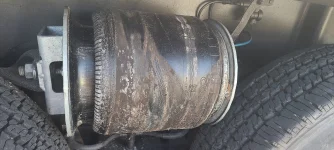
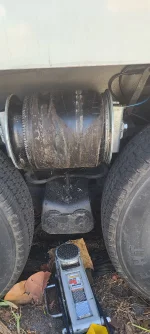
Thank you both for the responses and you were 100% right, the air inlet must have been block with it being all the way down. But I only tried one side because the bag looked like it was coming off. I turned it off real fast since I wanted your opinion. The left side looks like it's sliding off.

I'm not sure what's next. New bags? Adjust it? I lowered it all the way down for now.
 

Attachments

  • 20220219_164327.webp
    20220219_164327.webp
    977 KB · Views: 17
  • 20220219_164323.webp
    20220219_164323.webp
    955.6 KB · Views: 18
RVnewie (I like that better)
The airsprings you are not OE. They are a variety the community refers to a Sully Bags. They are (I am told) solidly afixed to the plates at both ends. Sliding off is not a possibility.

So, put air in them, get the coach near ride height and put blocking under the bogie castings.

Now go and pay attention to things that will get you on the road sooner.

Matt
 
Do NOT jack up the rear more than an inch or 2 above normal ride height without releasing all of air pressure to the bag. When I was new I did not and blew the shock seals out of 3 new shocks I had just installed. I

install the jack, go up an inch or so, and then just disconnect the air line at the bag. ( I am too lazy to go back inside and release it with the controls.) Then l contine to jack it the rest of the way to the desired height. Replacement shocks are in the neighborhood of $100 each.

Do NOT be afraid to ask questions. People here will help.

Ken B.
 
  • Like
Reactions: tmsnyder
I have found it interesting that the Bilstiern rear shocks can get blown out by over compressing them. The rears shocks do compress and the suspension extends.

Matt
Thanks. Got this thing up in the air which is awesome. I ordered a new compressor switch for Amazon since the old one was a little melty. It's a square D one so not sure if I need a specific one made for vehicles although seems like it should work


I wired two lines from motor to the motor terminals and a positive from positive terminal and negative to ground on the chassis. I still can't get it to shut off though. The old wiriing had a crusty relay.

The tank ends up filling until the emergency valve opens.

For now I have air in the bags but since I just dropped 500 bucks in the new panel, wanted to try to make it wortk.
Do NOT jack up the rear more than an inch or 2 above normal ride height without releasing all of air pressure to the bag. When I was new I did not and blew the shock seals out of 3 new shocks I had just installed. I

install the jack, go up an inch or so, and then just disconnect the air line at the bag. ( I am too lazy to go back inside and release it with the controls.) Then l contine to jack it the rest of the way to the desired height. Replacement shocks are in the neighborhood of $100 each.

Do NOT be afraid to ask questions. People here will help.

Ken B.
 
RAISING THE FRONT - even though GM may suggest using the bumper to lift the front end, DON'T DO IT.
The Windshield actually does perform a structural part in the body, yes I was surprised to hear this as well.
If you raise from the bumper you are stressing the body as well as the windshield and you can crack the windshield. That big peice of glass, when I purchased was about $700 each half.
AND the bumper can and will bend the support up under all that weight.
It was suggested to me to raise the front end with a jack under the motor support, direct center under the motor, a rather massive metal bracket that handles the weight.

My brakes are replacement OEM as close as possible. These huge vehicles will never stop on a dime but they are ok, but leave plenty of room to stop and it's better to keep up with traffic or be the slow traffic than to rush through traffic, someones sudden turn in front of you could be a big problem.
Loss of engine vacuum can bring your brake power down to almost nothing. Get a reserve vacuum pump (electric) to help maintain vacuum should your engine shut down for what ever reason. You will still have brakes.
EMERGENCY BRAKES are generally not working when we get them. Mine had been cut off.
The term EMERGENCY BRAKE probably should not be used as they really are poor even when in good condition and would take forever to stop the vehicle alone, especially on an incline/decline. Just my observance.
Use them as a parking assistance to hold her still and to take the pressure off the transmission lock when in park.
The Parking Brake handle in the cab takes a lot of force to engage, even when the Parking Brakes are adjusted correctly so try it out.
The OEM Parking brake cables relied on hooks to allow the cable suspend and to slide, and as the metal corroded, the cables would get stuck. The newer upgrade is to install pulley wheels which helps. I added adjusters on both sides of the brake cable system as the adjuster on the inside handle is frozen.
The parking brake system, if OEM, will mostly help you to stay still, and not a lot of help to stop you if the coach is moving.

The Rear Suspension uses a single "hotdog" type air bag. It was a good system but I believe Firestone, who was the last manufacturer to make them, stopped production. There are bags out there but those that have them have really raised the prices and are not available everywhere.
There are now alternate 4 bag suspension systems, which have nearly the same travel as the OEM, and the bags are readily available almost everywhere you go.

The air system is a leaky monster, though if you cannot keep air in the lines and raise the rear suspension, you may have a broken line.
OEM out of the factory, the air system would have held air for weeks with the rear suspended. As these girls got older leaks began to show up and it began to become very difficult to find and stop any air leaks.
There are many connections in that air system that goes to a air tank reservoir, to the leveling control valve (inside near the driver) to the levelers and to the air bags. Many connections to leak, over 50 feet of line to crack or break and of course the air bags that can rot.
The leveling control valve can be a multi task manual air valve or an electric solenoid device, depends on the age of your GMC motorhome.
When my airbags were changed out to the 4 bag system, my single OEM bags were bad with surface cracks on the back side where they could not be seen, I never knew it.

THE FUEL HOSES above the fuel tanks can and will go bad and are very difficult to get at. You have to change them out periodically, I will say 10 years or so but it is problematic to drop the tanks to get at them. If you do it yourself, (it can be done but it's a job) you need to also check out the inside of the tanks to make sure the tanks are clean and there is no problems with the pickups and level controls/seals. when you put it all back you need to be sure you do not pinch a hose as you attach the tanks back into the frames or you will have a lot of problems including power loss at the engine.
A tell tale sign that the hoses are in trouble would be gas leaking when you fill the tanks.

THE ALTERNATOR has a protective nichrome wire that is wired in the wire loom under the dash. If there is a problem with the alternator that nichrome wire can get red hot and start the wires on fire.
There is a diode accessory that is avialiable that plugs in and prevents that from happening. To see if you have it, look at the back of the alternator and see if there is a added device with red wires, about 6 inches long. It plugs in where the 12v wire plugs in, and the original 12v plug will plug into that device. If you don't have it, you need to get it.

Your HVAC system will most likely not work well. Most of the systems didn't.
First to check is if you have control of the dash duct doors that control air to the vents and to the windshield defroster.
In my case, the vacuum hoses to/from the dash controller were cut off. To get the vents to work I had to manually prop up the duct doors to keep them open. The HVAC fan can blow enough air through to heat and ventilate the coach. I use fans to defrost the windshield .
Air Con passes some cool, as long as you can force the air to flow, you will get some cool. Air flow is the key.
Check that you can get heat from the vents when the engine is hot, and that you can slide the control to cold and the heat stops. If you dont have heat or can't stop it by the control, you may need to replace that control cable from the dash controller to the arm on the HVAC unit. It is a simple thought but it comes up and that control cable has a plastic piece on it that breaks. When it breaks, the hot/cold will be uncontrollable.

Check the manifold, the part the carborator sits on, for cracks. Because of how they were made, hot gasses pass through a port which overheats the manifold and ultimately will crack it. The manifold is highly likely to have over heated and cracked, this can affect the carborator action and can cause the gas to vaporize, killing the engine when traveling. If your manifold is not cracked, those ports should be blocked.
There is a vid as well as info on the GMC sites about this and there is a fix that if you don't have , you need it.

In general, most parts of the GMC motorhome are shelf parts from other vehicles, more or less. There are a couple exceptions. The steering gear box is one of them.
The carborator, by the way, should be a numbered special carb that was made for the GMC motorhome. I believe the throat of the carb is larger than normal, don't trade off. sell off this carb if you have it, if it needs it, rebuild it.
IF you park the vehicle for a few days and you need to pump the gas pedal to get started while turning the engine with the starter, there is another concern.
The float bowl was used on other vehicles as well. The bottom of the float bowl had a port for some other purpose that we don't use. It was blocked in some manner and not used. over time, whatever was used to block that port begins to leak, it will drain the fuel bowl leaving it empty.
in my case, it would allow air back into the system, past the mechanical fuel pump until level with the fuel in the tanks. This caused my mechanical fuel pump to rust and ultimately was destroyed.
HIGHLY recommend checking the fuel bowl if you have hard starting because of fuel concerns.
I also recommend a fuel filter before the Mechanical fuel pump and before the Electric fuel pump if you put an electrical fuel pump in. The Electrical fuel pump can be used to prime the engine as well as add a bit of pressure to prevent the fuel from flashing to gas when it gets hot in the lines.

Your Distributor shaft is not the same as what was used on cars, the vacuum advance movement is shorter, keep that in mind.

I Strongly advise changing over the coach lighting to LED technology. The OEM lights in my coach were literally falling apart from plastic deterioration, makes this a good opportunity to change them out to LED.

Remember, your GMC is an old lady, a lot of the plastics have become fragile, they don't want to bend like they used to. Those two light units, above your side windows by your head, both of mine were so fragile when I took the screws out one crumbled. The other was sold to someone to be copied and re-manufactured. I replaced them with decorative wood plank and new lights/speakers.

Your outside panels and compartment doors are not Fiberglas, per se. They are the same material used to make Corvette panels. If you need to make repairs, you need to use fiberglass and epoxy resins. Plain fiber glass resin will come right off.

These are some concerns, you will find many more.
Ask anything you like, everyone is here to help and there are no bad questions.

Good luck in your new adventure.
 
  • Like
Reactions: Kendra
Wow, What a great listing.. Every bit of it true and most of which I have had to do over the years.

Ken B.
 
Thanks. Got this thing up in the air which is awesome. I ordered a new compressor switch for Amazon since the old one was a little melty. It's a square D one so not sure if I need a specific one made for vehicles although seems like it should work


I wired two lines from motor to the motor terminals and a positive from positive terminal and negative to ground on the chassis. I still can't get it to shut off though. The old wiriing had a crusty relay.

The tank ends up filling until the emergency valve opens.

For now I have air in the bags but since I just dropped 500 bucks in the new panel, wanted to try to make it wortk.
 
If you have the correct switch it is the same one used on 120 or 240 volt air compressors. It has two BIG switch contacts that are only necessary in 240 VAC installation where there are two hot leads. (Ours is 12 V DC with one hot and one ground lead) There are two versions of the switch. One has an additional pressure connection that is called a unloader and only cost a few dollars more. They also come in different pressure ratings for both off and on points. It has been a while since I changed mine but I used one for off at around 125 and on at around 105. They are usually somewhat adjustable.

To troubleshoot your problem, I would monitor the pressure, remove the switch cover and watch the armature. With the correct switch, if you hit 125 or so when running and the armature does not move, then you have an air pressure to the switch problem (or a bad switch) . If it does move at around 120 then you have an electrical wiring problem. You do not need to wire the ground side of the motor through the switch. Just run the motor ground direct to a good chassis ground and run the +12 volt motor lead only through the switch.
 
Last edited:
It sounds like a wiring problem if you are blowing the relief valve on the tank.
Try this............

Check that the positive goes to the open contact on the relay. The other contact that closes goes to the motor positive.
Also run that positive to the psi switch contact and the other side of the psi sw contact to the coil on the relay. The other side of the relay coil goes to ground.

It sounds like the positive is feeding all the time to the motor. If you have a meter you can verify this.
You want the relay to take the power surge and the psi switch to energize the coil on the relay.

If you suspect the relay as bad, you can run a test by running the positive to one side of the PSI sw, then run the other side of the psi sw to the compressor positive. It should shut down around 200, 210, whatever the rating is.
if it does that, then replace the relay.
 
Last edited:
If you have the correct switch it is the same one used on 120 or 240 volt air compressors. It has two BIG switch contacts that are only necessary in 240 VAC installation where there are two hot leads. (Ours is 12 V DC with one hot and one ground lead) There are two versions of the switch. One has an additional pressure connection that is called a unloader and only cost a few dollars more. They also come in different pressure ratings for both off and on points. It has been a while since I changed mine but I used one for off at around 125 and on at around 105. They are usually somewhat adjustable.

To troubleshoot your problem, I would monitor the pressure, remove the switch cover and watch the armature. With the correct switch, if you hit 125 or so when running and the armature does not move, then you have an air pressure to the switch problem (or a bad switch) . If it does move at around 120 then you have an electrical wiring problem. You do not need to wire the ground side of the motor through the switch. Just run the motor ground direct to a good chassis ground and run the +12 volt motor lead only through the switch.
Would you please post the brand and part number of the air switch you installed?