
Pretty good mileage, and there are some pretty good hills along that route also.We made it to the Apex airpark in Silverdale WA from Gilbert AZ, 1509.3 miles and used 174.69 gallons to average 8.63 MPG. Worst leg, 8.1 MPG. Best leg 9.5 MPG.
MPG question
- Thread starter tmsnyder
- Start date
You are using an out of date browser. It may not display this or other websites correctly.
You should upgrade or use an alternative browser.
You should upgrade or use an alternative browser.
3213 miles, 238.739 gallons of diesel. Mostly running 62-64 mph. Rio Rancho NM to Eugene OR, round trip, so not a flat land trip.
You can do the math.
Hi Hal,
I was noodling through the FB marketplace last week and ran across a 1994 medium duty GMC truck engine for sale. 6.0L, not a LS style engine, but a tall deck big block 366ci engine used for medium and heavy duty trucks. This one is complete with TBI system for $400. And that is pretty common, no one builds these for cars, no one wants them, they are not seen as a hot engine for hot rods so they are inexpensive
So naturally I went down that rabbit hole. Turns out these are meant to do heavy work, with forged cranks, 4 bolt mains, tall deck to accommodate a 4th ring groove and taller (forged?) piston. Gobs of torque. Better high nickel cast iron.
I know I've heard of some 454 and 8.1l big block swaps and these blocks are the same but the deck is 3/8(?) taller.
I figured you might know, has anyone swapped one into a gmc?
The oil filter boss seems to be right where the TH425 would be, but that would be the same on the 454 and the 8.1 others have used, correct? so maybe that's not an issue if a remote adapter is installed before the tranny.
Anyway, seems to me that if a 7.4l / 8.1l can be adapted with the bell housing plate adapter and modified oil pan, that a 366 would fit as well and would be a better candidate for all the reasons above.
What are your thoughts?


I think the 455 would get 10mpg in a fiero, it's a great torque engine, not a fuel efficient engine.
Also remember CD is a coefficient, you need to multiply by frontal area to get actual drag!
.31 on a GMC is not the same as .31 on a sports car
My original posting was related to that point exactly. 7mpg in a SOB shaped like a brick, 50% larger frontal area, 50% more rolling resistance should translate to much more than 9mpg in a GMC. Should be more like 14mpg.


My original posting was related to that point exactly. 7mpg in a SOB shaped like a brick, 50% larger frontal area, 50% more rolling resistance should translate to much more than 9mpg in a GMC. Should be more like 14mpg.

My coach arrived yesterday from being with Cliff Golby for 3 years and there is a lot of more work to be done here at my house. AS you can see, I have removed almost everything from the roof and tried to make it as slippery as possible. It has am air dam under the bumper cover.

The storage box and the (2) new 48 vdc YMGI 12,000 bruh mini split heat pumps and storage box are now at the rear and totally out of the air stream. All are accessible from the ground, so the ladder and rails are unnecessary.

When the solar installation is completed, the roof will look like this. The SunPower semi flexible solar panels will be laminated directly to the aluminum roof with virtually no wind resistance.

This is the GMC COOP 455 that I bought at the COOP's going out of business sale, so I think that has proven to have 35% greater power and increased efficiency.

his is the mock up of the 2 belt serpentine system that is now installed on the COOP 455 installed and running well in the coach. I have tried to remove as much of the parasitic energy losses as possible. The original inefficient alternator has been replaced by (2) highly efficient Balmar alternators controlled by WakeSpeed remote regulators. With the massive LiPO4 battery banks, these alternators will seldom be required to function.
In addition, there is no engine driven air conditioning compressor.
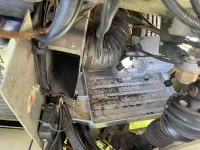
This is the 12 vdc air condition compressor providing the cooling for the dashboard ac. It can be set for 3 different levels of cooling. Cliff has fixed the air flow issue and the system now brows hard and cold. The engine does not need to be running for this ac to run.
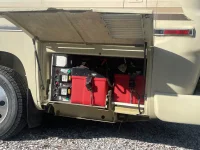
There is no generator to siphon off gasoline and depress the mpg. Also this setup, with the LiPO5 batteries saved over 500 lbs and a lighter coach uses less gasoline. Over weight coaches get worse mpg.
I also use only non ethanol gasoline which provides 3.5% added mpg over 10% ethanol. Why you might shudder at the increased cost of the fuel, consider that the ethanol in the gas degrades to water and causes bacterial growth in the gas tank. It must be treated with expensive stabilizer and causes multiple closing angles changes of fuel filters. In the end, the non ethanol gasoline is less expensive.
I also have a black box switch pitch torque converter.
Chuck Botts also tested a HHO system and he reported a 35% increase in mpg. https://docs.google.com/viewerng/vi...g/blog/wp-content/uploads/Chuck_Botts_HHO.pdf
It basically adds more oxygen to the combustion air fro the engine and reduces the polluting gases in the exhaust. If I install such a system and it works, I will be using solar power for propulsion.
Wth all of the energy conservation installations and some of these improvements, I am hoping to dramatically improve the mpg.
Last edited:
View attachment 14527
My coach arrived yesterday from being with Cliff Golby for 3 years and there is a lot of more work to be done here at my house. AS you can see, I have removed almost everything from the roof and tried to make it as slippery as possible. It has am air dam under the bumper cover.
View attachment 14528
The storage box and the (2) new 48 vdc YMGI 12,000 bruh mini split heat pumps and storage box are now at the rear and totally out of the air stream. All are accessible from the ground, so the ladder and rails are unnecessary.
View attachment 14529
When the solar installation is completed, the roof will look like this. The SunPower semi flexible solar panels will be laminated directly to the aluminum roof with virtually no wind resistance.
View attachment 14530
This is the GMC COOP 455 that I bought at the COOP's going out of business sale, so I think that has proven to have 35% greater power and increased efficiency.
View attachment 14531
his is the mock up of the 2 belt serpentine system that is now installed on the COOP 455 installed and running well in the coach. I have tried to remove as much of the parasitic energy losses as possible. The original inefficient alternator has been replaced by (2) highly efficient Balmar alternators controlled by WakeSpeed remote regulators. With the massive LiPO4 battery banks, these alternators will seldom be required to function.
In addition, there is no engine driven air conditioning compressor.
View attachment 14532
This is the 12 vdc air condition compressor providing the cooling for the dashboard ac. It can be set for 3 different levels of cooling. Cliff has fixed the air flow issue and the system now brows hard and cold. The engine does not need to be running for this ac to run.
View attachment 14533
There is no generator to siphon off gasoline and depress the mpg. Also this setup, with the LiPO5 batteries saved over 500 lbs and a lighter coach uses less gasoline. Over weight coaches get worse mpg.
I also use only non ethanol gasoline which provides 3.5% added mpg over 10% ethanol. Why you might shudder at the increased cost of the fuel, consider that the ethanol in the gas degrades to water and causes bacterial growth in the gas tank. It must be treated with expensive stabilizer and causes multiple closing angles changes of fuel filters. In the end, the non ethanol gasoline is less expensive.
I also have a black box switch pitch torque converter.
Chuck Botts also tested a HHO system and he reported a 35% increase in mpg. https://docs.google.com/viewerng/vi...g/blog/wp-content/uploads/Chuck_Botts_HHO.pdf
It basically adds more oxygen to the combustion air fro the engine and reduces the polluting gases in the exhaust. If I install such a system and it works, I will be using solar power for propulsion.
Wth all of the energy conservation installations and some of these improvements, I am hoping to dramatically improve the mpg.
I can't wait to see your results with the HHO system! Hopefully the increase in mpg is as dramatic as the link you posted. That would be a 'no-brainer'!
I'm afraid that it will be a long time before I install the HHO. When I bought the coach I asked Jack what mileage he got and I think that he said 7.5 to 8.5 mpg. However, I consider that information unreliable. The dashboard ac hardly blew, so he would run the Onan to power the front rooftop for cooling while driving. The sound was deafening.I can't wait to see your results with the HHO system! Hopefully the increase in mpg is as dramatic as the link you posted. That would be a 'no-brainer'!
I thought that I would establish that baseline before I found out that a COOP 455 was available. My first baseline will have been with the current COOP 455 w/ carb. The second will be the COOP 455 with carb and the third with fuel injection. The final will be with HHO.
Unfortunately, there is a delay. I am currently not allowed to drive because 3 weeks ago I suffered a sudden cardiac arrest event. I passed out for 10 minutes and my heart stopped 9 times and then I woke up without CPR or shock. 93% of people experience sudden cardiac death within minutes with no symptoms and the 7% that do survive have significant living consequences. I have virtually none. Anyway, I am campaigning to get my doctors to allow me to drive again.
There are many HHO products for sale. A lot of them are installed by trucking companies on their fleet. The install is rather simple and not expensive. Maybe we can find someone to try. I wanted to speak with Chuck Botts, but he has been gone for many years. I spoke with Jim Bounds. He said that he tried to install one but didn't have the time to sort it out.
I have found a number of studies that seem to back Chuck up as well as a lot of non believers.
Maybe we can find another guinea pig to try one before I do.

Looking at your roof, you've come so far... But those plumbing stacks seem to really stick out now. Have you thought about switching over to air admittance valves instead? If they can get away with AAVs in houses, I'd think you could use a couple here. It sure would be nice to get rid of those big vents sticking up.AS you can see, I have removed almost everything from the roof and tried to make it as slippery as possible. It has am air dam under the bumper cover.
The large refrigeration vent is sized for an lpg refrigerator. With the new Indel refrigerator/freezer, there is very little need for exhausting for the lpg waste heat except for lpg tankless hot water heater. However, the HW heater will be used so infrequently that a powered temperature activated vent through the vertical wall would be more than sufficient.Looking at your roof, you've come so far... But those plumbing stacks seem to really stick out now. Have you thought about switching over to air admittance valves instead? If they can get away with AAVs in houses, I'd think you could use a couple here. It sure would be nice to get rid of those big vents sticking up.
The toilet exhaust fan could be handled in the same way because the compost toilet needs little ventilation. I could also eliminate the skylight hatch. Then I could replace the (3) 50 watt solar panels with 110 watt replacements, increasing the 1,47 KW capacity to 1.65 KW capacity.
I'm afraid that it will be a long time before I install the HHO. When I bought the coach I asked Jack what mileage he got and I think that he said 7.5 to 8.5 mpg. However, I consider that information unreliable. The dashboard ac hardly blew, so he would run the Onan to power the front rooftop for cooling while driving. The sound was deafening.
I thought that I would establish that baseline before I found out that a COOP 455 was available. My first baseline will have been with the current COOP 455 w/ carb. The second will be the COOP 455 with carb and the third with fuel injection. The final will be with HHO.
Unfortunately, there is a delay. I am currently not allowed to drive because 3 weeks ago I suffered a sudden cardiac arrest event. I passed out for 10 minutes and my heart stopped 9 times and then I woke up without CPR or shock. 93% of people experience sudden cardiac death within minutes with no symptoms and the 7% that do survive have significant living consequences. I have virtually none. Anyway, I am campaigning to get my doctors to allow me to drive again.
There are many HHO products for sale. A lot of them are installed by trucking companies on their fleet. The install is rather simple and not expensive. Maybe we can find someone to try. I wanted to speak with Chuck Botts, but he has been gone for many years. I spoke with Jim Bounds. He said that he tried to install one but didn't have the time to sort it out.
I have found a number of studies that seem to back Chuck up as well as a lot of non believers.
Maybe we can find another guinea pig to try one before I do.
Wow Sailerman I hope you can get your health back on-line and continue your work on the motorhome. That seems like quite an experience to have to go through. Get well soon!
I understand that people use hydrogen making big power diesel engines, so the HHO system doesn't seem too off base to me.
It's not the hydrogen, it's the oxygen. Provide an increase over the 7% oxygen in ordinary combustion air increases the efficiency of combustion. Just suppose that you can increase the oxygen from 7% to 8%, 9% or even 10%. The fuel is almost 100% combustable, The 93% of nitrogen is ordinary air is not combustable.Wow Sailerman I hope you can get your health back on-line and continue your work on the motorhome. That seems like quite an experience to have to go through. Get well soon!
I understand that people use hydrogen making big power diesel engines, so the HHO system doesn't seem too off base to me.
That is why Chuck Bott investigated HHO and is why he got such a positive result.
There is another way to get better mpg and it doesn't involve any investment. It just means buying pure gasoline with zero ethanol.It's not the hydrogen, it's the oxygen. Provide an increase over the 7% oxygen in ordinary combustion air increases the efficiency of combustion. Just suppose that you can increase the oxygen from 7% to 8%, 9% or even 10%. The fuel is almost 100% combustable, The 93% of nitrogen is ordinary air is not combustable.
That is why Chuck Bott investigated HHO and is why he got such a positive result.
I thought that non ethenol gasoline was difficult to find but I was very wrong. It is available almost every where.

The problem is that pure gasoline is marketed at an increased price.

On this day, Ethanol free gasoline cost 4.149/ gal and regular gasoline cost 3.349gal. That is a 24% difference. However, that is not actually correct. The non ethanol rating is 89 and that matches Plus on the pump.
It is more accurate to compare the 10% ethanol to Plus. Plus is $3.699/gal.

Therefore we are comparing 4.149/gal with 3.699/gal. So the non ethanol gas is only 12% more than an equal octane alternative.
Ethanol itself has considerably less energy density that gasoline. If we compare gasoline to 20% ethanol, the difference expands to 7% in energy density.
According to the USDOE, pure gasoline has a GGE 0f 1.00 and E10 has a GGE of 0.67. Pretty dramatic difference.
This is not the end of the story.
Pure gasoline starts the break down in 3 to 6 months. E10 is only 2 to 3 months. This is an important issue because we use our coaches so infrequently.
Gasoline with stabilizers increase the shelf life to 1 to 3 years.
32 oz. of Sta-Bil Fuel Stabilizer cost $12.48 on Amazon. 1 oz. treats 2.5 gal of fuel. So with 50 gal of gasoline, a single required dose will be 20 oz. Stay-Bil is $0.39 per oz.
20oz x $0.39 = $7.80 per 50 gal tank or $7.80 /50 =$0.16/gal.
So, if we only used a single dose, the coast of Plus rises to $3.859 per gal.
Have we completed the investigation. No!
We have not included the cost of filters, replacement of hoses and on and on. Now many filters have you replaced in a year? How many times did you have to stop by the side of the road to change a filter? Did it happen more than once on a trip? Was it fun?
I have read a torrent of filter crisis moan and groans about clogged filters. The engine stalls, fiilter replacements and pure frustration seem to make the use of Ethanol Free Gasoline far more attractive.
Which E10 are you buying?
The nice thing is that you get all the benefits by just buying Ethanol Free Gasoline instead of E10.

So I've noticed we get considerably better mileage (or in our case Litres/100Kms) in Mexico than in Canada or USA. I documented this in our latest trip south in this thread:
You will notice that after about 3,000Kms from Canada to Mx border we averaged 9.3l/100Kms. Once we crossed the border and filled with Mx fuel a couple of times, we are getting 6.3l/100Kms once we got past some mountains and on a level plateau. At our destination it was at 7.9l/100Kms which included some decent mountain climbs.
I'm thinking Mx fuel must be ethanol free, but Google says it's about 10%.
@sailor man, atmosphere is ~21% oxygen and ~78% nitrogen.

My wife, I and the dawg left Christmas morning to drive to Manzanillo Mx. Close to 4,500Kms over 5 days in our family-truckster 2019 Dodge minivan. I reset the MPG (in our case Litres per 100 kms, I'll let you do the conversions) before we left.
This first photo is the dash display taken at Laredo Tx after about 3,000Kms on 10% Ethanol fuel. This is typical of what we see for hyway mileage in Canada (closer to 9l/100Kms because we are mostly driving 80Km/hr hyways). We filled up in Laredo before crossing into Mx to take advantage of the cheap gas. Note that from our home in S...
This first photo is the dash display taken at Laredo Tx after about 3,000Kms on 10% Ethanol fuel. This is typical of what we see for hyway mileage in Canada (closer to 9l/100Kms because we are mostly driving 80Km/hr hyways). We filled up in Laredo before crossing into Mx to take advantage of the cheap gas. Note that from our home in S...
- RF_Burns
- Replies: 15
- Subforum: General Off-Topic Discussion
You will notice that after about 3,000Kms from Canada to Mx border we averaged 9.3l/100Kms. Once we crossed the border and filled with Mx fuel a couple of times, we are getting 6.3l/100Kms once we got past some mountains and on a level plateau. At our destination it was at 7.9l/100Kms which included some decent mountain climbs.
I'm thinking Mx fuel must be ethanol free, but Google says it's about 10%.
@sailor man, atmosphere is ~21% oxygen and ~78% nitrogen.
if it's the oxygen why not just capture the O2 and vent off the hydrogen?It's not the hydrogen, it's the oxygen. Provide an increase over the 7% oxygen in ordinary combustion air increases the efficiency of combustion. Just suppose that you can increase the oxygen from 7% to 8%, 9% or even 10%. The fuel is almost 100% combustable, The 93% of nitrogen is ordinary air is not combustable.
That is why Chuck Bott investigated HHO and is why he got such a positive result.
It doesn't matter. Either it will combust or escape as part of the exhaust gases.if it's the oxygen why not just capture the O2 and vent off the hydrogen?
I am back on the road! I got permission from the doc yesterday. He thinks that there is little chance for me to pass out behind the wheel. I am going to get to see you guys in person. Wow!Wow Sailerman I hope you can get your health back on-line and continue your work on the motorhome. That seems like quite an experience to have to go through. Get well soon!
I understand that people use hydrogen making big power diesel engines, so the HHO system doesn't seem too off base to me.
I have got to shorten the GMC Motorhome's base to get the C-Max toad down for accuracy, but I think that is is very cool to RV this way.
I think that there will be very little air resistance, but I am thinking about a rear spoiler on the coach. I have seen a few applications.
I have 2 red 16ft Hobie kayaks using Thule Hullavator mounts that support and drop the kayaks on the side of the vehicle.
Maybe I really get the coach to the redwoods.
Very correct. In addition to cleaning the top, sides incl mirrrors, bumpers, --- two things I did: lite aluminum belly pan starting before engine (like skid plate) and vented all engine compartment air out sides; and #2: engine & trans mods -- 467cid 403 block w/#3 heads (my mods) = 12.3 compression (+ more) and trans mod = locking torque converter engaged via 1966-67 "switchpitch" variable stator (complex but never failed custom design -mine). The high-swirl & tighter squish combustion chambers (& other) allow pump gas. Thus the high comp gives greater efficiency (much more torque, etc) with 2.73 gears ----- fun racing at stop lites and laffing at Lincoln Nav's at the gas pump. Never calculated gas milage, but I use less gas than my 1968 Toronado.My thoughts:
First of all, I don't even get 20 MPG in my 2018 Wrangler with an 8 Spd automatic and efficient V6.
Secondly, when I remember reading the articles about the development, they always quote that 0.31cd.
"A mahogany block was modeled to the designed shape, and a fiberglass model was then made from this master. Holes were drilled about one inch apart over the fiberglass body, and flushmounted, hollow tubes were installed and connected to pressure-measurement devices. Time was purchased at the Guggenheim wind tunnel facility in California, and the test was performed. Was the shape clean? You bet! The CD was .310, better than that era’s Corvette, which was .312."
Nowhere have I read that the finished project went to a wind tunnel.
View attachment 2418
I believe ^^^that^^^ GMC could have a 0.31. Now go outside and look at yours. Huge bumpers, huge mirrors, AC units, cargo boxes, windshield wipers, drip rails, roof rails, ladders, spare tires, tank clean out pipes, etc... It is just not as clean as everybody thinks it is. Look at a Tesla. They go out of their way to even flush mount the door handles for less drag. Everything would have to be taken into account.
You also have rolling resistance. If I understand the math correctly, the rolling resistance is calculated by the weight x the coefficient of rolling friction. A typical vehicle's car tires on asphalt is coefficient of rolling friction of .02.
So the GMC at 11,000 lbs is (11000x.02) or 220 lbs of rolling resistance. On my Jeep, it would be 90 lbs.
So the rolling resistance doesn't matter too much.
Modern Chevy Suburban with a modern V8, displacement on demand, and 5500 lbs is rated at 15/22. I will promise you that it's overall cd is less than the GMC as most of us drive them with all of the stuff bolted to them.

One of the AIs claims 5 - 7 mpg improvement for an older vehicle with a locking torque converter. I expect that's for a car but still a significant improvement with full lockup.I've been able to achieve near 14 mpg economy on a pretty consistent basis solo and averaged about 12.65 pulling a towd on a 5000+ mile trip that included a RT66 run with lots of stop and go traffic. While there have been out liners of 15+, 14 has been more the norm. Diesel fuel does provide a 30% improvement over gasoline right off the top and an optimized 2.82 ratio puts the motor right in its sweet spot for efficiency. The extra gear (4l80e trans) with true locking converter capabilities as well as PCM control over all engine performance and optimized computer shifting makes it all work. Trying to get a gas engine to deliver much over 10 will be a real challenge I'd guess.
Hal
I don't think I did better than 8 mpg on my long trip.

