I'm currently rebuilding one that was in a similar state of disrepair, possibly even worse. It needed a new frame. They are available new from a shop in Ontario, Canada. I paid around $6,000 to $7,000 for new/refurbished frame pieces aft of the engine cradle. I'm relatively close in Buffalo, NY, and the shipping alone was around $1,000 (I couldn't go pick it up myself because of COVID border closing).
Depending on what your goals are and what it needs, a total rebuild with everything new, back to OEM specs (not considering upgrades), will be north of $30k, assuming you already have the tools, knowledge, space, and time. This figure does not include your time, nor a paint job, nor an interior rebuild. This is purely for making the coach mechanically sound and perfectly driveable.
I'm restoring mine out of a labor of love because it's been in my family since new and holds a lot of memories.
This one has potential but it is a HUGE undertaking. I underestimated the amount of work it would be but as I said, I have other motivating factors.
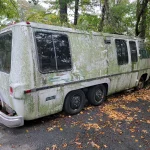
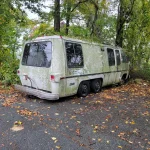
It being an early 23' as others have said is somewhat rare and worth considering a rebuild. Vintage RV's are popular right now and even with a spit shine and getting it running it may be worth a few thousand.
The interior being stripped is probably a good thing, saves you/whoever restores it a bunch of work tearing the old destroyed crap out!
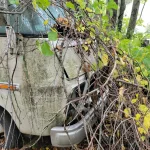
As for getting the coach up enough to inspect the frame -- check the air bags and air tank to see if either has a schrader valve. You can hook up an external air tank to inflate the system. Even if the bags are old and dry rotted, they may hold air well enough to get a look. The air suspension almost certainly has a leak, so use jack stands to avoid being crushed. Otherwise, you might try hotwiring the air compressor to run and pressurize the system. This would be pretty easy to do.
Not exactly sure what year this is but the air suspension system is either in the front (pre 76 I think?) or behind the closet inside the coach. I only have experience with the earlier systems. In this case, the air tank should be under the battery tray near the passenger front tire. You may have to remove the wheel well liner. The compressor will be on the driver's side mounted next to the radiator, it is visible from the driver side front hatch. You just need to attach power/ground to the compressor motor to run it. Be careful not to overpressurize the system if you're bypassing the pressure cutoff switch.
If you don't know how to do this kind of stuff you may not be the right person to restore this coach. But don't let that discourage you. If it's something you'd be interested in learning and you have the means, go for it. I started 10 years ago with practically zero automotive knowledge...

 20211025_170616.webp1.9 MB · Views: 33
 20211026_092023.webp2.6 MB · Views: 33
 20211026_092037.webp1.5 MB · Views: 31
 20211026_092045.webp1.5 MB · Views: 27
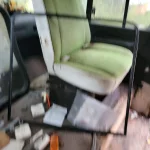 20211026_092103.webp221.7 KB · Views: 27
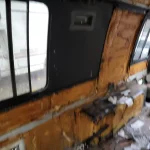 20211026_092120.webp242.2 KB · Views: 29
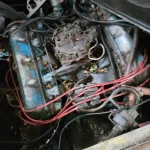 20211026_092144.webp541.6 KB · Views: 28
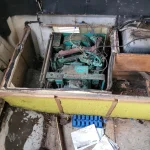 20211026_092205.webp797 KB · Views: 28
 20211026_092207.webp159 KB · Views: 29