Higher-Output Alternators

That just further proves my point. Why do you need a 180 Amp alternator?
The DC-DC connects to the starter battery. It can load the alternator down at 40A. The stock alternator running the engine systems can output at the most 45A-55A continuously without overheating (it's made for topping-off the starter battery, not continuously charging a high-current device like a lithium battery). So, in order to provide the starter battery, engine, and DC-DC charger enough current without overheating the alternator, a higher-capacity unit is needed. Again, current is drawn not pushed, so think of a high-output alternator as a reservoir; the higher the "output" capacity, the more current can be drawn continuously without damaging the alternator. A 180A alternator could provide (in theory) 90A continuously; enough to run the OEM systems with enough spare to operate the DC-DC charger for the lithium system.

My primary charging system is still the 1065W of solar panels on the roof (plus 600W ground deployed), but a little extra never hurts.... :)
 
Last edited:
If all that conrinuous load is too much for the OEM alternator, wouldn't it be too much for the OEM wiring, too?
Again, only the heavy battery cable will see that much current. It should be adequate, but if not can easily be replaced. All other loads remain unchanged, so their current requirements remain unchanged as well.
 
If your DC-DC is connected to your engine battery +, and the alternator is also, then the alternator is feeding both. What current do you have the dcdc set to?
40A
No adjustment. This is why the higher-output alternator (as has been stated repeatedly, in almost every post....).
 
OK, I give up. I was just trying to warn you and others that higher-output alternators may cook OEM alternator wiring. Perhaps others will heed.
Agreed, the 10 Gauge wire connecting the alternator to the isolator is designed to be an electrical "shock absorber" for the alternator. Drawing 100+ Amps through it will certainly overheat it... look at the terminals for that wire on most coaches and it will show signs of being overheated.

I would consider going to a #6 wire for a 180Amp alternator with your current draw.
 
  • Like
Reactions: billvv
Agreed, the 10 Gauge wire connecting the alternator to the isolator is designed to be an electrical "shock absorber" for the alternator. Drawing 100+ Amps through it will certainly overheat it... look at the terminals for that wire on most coaches and it will show signs of being overheated.

I would consider going to a #6 wire for a 180Amp alternator with your current draw.
I can agree on that. But, the isolator is being removed. Just a heavy-gauge wire from the alternator to the battery (OK, to the terminal post on the firewall near the isolator, then to the battery). The engine electrical system is being retro-fitted to just a standard "car" system; no support for a "house" is needed. The "house" is completely isolated from the engine and vehicle electrics. The DC-DC charger is an after-thought; "lets get just a bit more charge while running down the road". Plus, the DC-DC can be "reversed" to act as a lead-acid battery charger from the house lithium system if needed (the reason I selected this particular DC-DC charger); it can act as the "buzzbox" to charge the starter battery if needed.
 
Last edited:
I know it adds comlexity, but it sure looks like there is room on the left side of the engine, under the AC, for another alternator (48v?). Then again - I haven't had my head in the engine compartment in a long while.
Some bright soul who can think in 3 dimensions could come up with a bracket and then we could either use a larger AC belt, or add more complexity and go serpentine.
I believe Ken H. added a serpentine belt but it made the water pump spin backwards. (ages ago.)
 

Attachments

  • Screenshot 2025-10-04 at 2.58.27 PM.webp
    Screenshot 2025-10-04 at 2.58.27 PM.webp
    28 KB · Views: 3
Did we ever arrive at a consensus on this? I’m planning to dive in with a local RV Electronics guy. We talked through my original plan for 12V, and mostly due to the wiring size and age, arrived at doing a 48V System, stepping down for the 12V house, and using a Victron MultiPlus to step up to the 120V AC for what would primarily be for Air Conditioning.

I’m editing this post now, because we found the Victron unit for 48V was not a 4 post 50 amp input, I didnt’ want to downsize the input to 30Amp. Which may have been silly…. But I’ll own the silliness.

So we went with the 24V Victron Quattro, which has full 4 post 2 AC inputs, for 50 amp Generator and 50 amp shore power.

As my RV Electronics Expert, who I’d wholeheartedly recommend if your in Southern Oregon Coast, said. “Anything is better then 12V” for stepping up efficiently to 120V and keeping wire sizes reasonable from front to back. So, we went with what the Victron Quattro came in for the true 50Amp Passthru.

We used the Sterling unit same as below—but the 24 volt version, which is actually a little more efficient and so we got a little more charging speed to the battery bank out of it, and still low enough amperage that the factory power cable from front to the back batteries will not need to be replaced.


He’s proposing using this Sterling unit to draw from the Alternator, so the size of the existing lead would be ok using the 48V (changed to 24V) back to the Battery.

That he says would simplify yet keep the Start Boost Feature functional.

Making sense yet?

BUT—he didn’t want to do it unless I upgrade the Alternator, modern, efficient, and a fresh bigger wire to the Starter Battery. The Sterling Unit will replace a bunch of stuff on the engine bay, right by the battery, and convert the 12V Starter Battery to 48V and feed the house batteries like a DC to DC converter, with the added functionality of generator and house batteries being able to charge the starter battery too. The 48V house battery could also boost the 12V if needed for starting boots. The existing wire running back to the house battery at 48V the wire size would be more than adequate to charge the house battery.

There is a 50% charge rate setting on the Sterling unit, and I talked him into proceeding without changing the Alternator yet. The alternator was done in 2017, and presumably it’s the 100A version of the original.

Update: I bought a 260Amp alternator from Chad, phone number further down in the posts in this thread, who makes the bracket and alternator sets for the GMCRV… That solves a host of issues. He sells them with 2 belts, so I’ll try to use both of those…gets lots of grip on it.

This system would use the Victron MultiPlus II 48V unit, Victron Shunt, and a Victron Dc to DC 48V to 12V converter to power existing 12V house loads.

Changed to the Victron Quattro 24V 50amp unit…Shunt, and 24 to 12 V dc to dc converter for house lights. I went with all LED lighting—that really added up amperage draw with the ancient incandescent bulbs.
 
Last edited:
Did we ever arrive at a consensus on this? I’m planning to dive in with a local RV Electronics guy. We talked through my original plan for 12V, and mostly due to the wiring size and age, arrived at doing a 48V System, stepping down for the 12V house, and using a Victron MultiPlus to step up to the 120V AC for what would primarily be for Air Conditioning.

He’s proposing using this Sterling unit to draw from the Alternator, so the size of the existing lead would be ok using the 48V back to the Battery.

That he says would simplify yet keep the Start Boost Feature functional.

Making sense yet?

BUT—he doesn’t want to do it unless I upgrade the Alternator, modern, efficient, and a fresh bigger wire to the Starter Battery. Presumably he’d put that Sterling unit by the starter battery and use the factory cable feeding the batteries—but at 48V the wire size would be more then adequate.

I’d like to do this once, and not think of things i wish I’d done later.

This system would use the Victron MultiPlus II 48V unit, Victron Shunt, and a Victron Dc to DC 48V to 12V converter to power existing 12V house loads.

I'm interested in thought I haven’t thought of yet.
I’m interested if we ever really dialed in on an upgraded Alternator path—I liked the discussion of the efficiency of the Balmar.
I didn’t like the idea of more belts or less belt contact due to additional pulleys.

Where’d this discussion end up?
It didn't..... The original question got lost in the weeds and I finally gave up asking. I will probably look at the solution indicated by Jim bounds a few months back.
 
  • Like
Reactions: TwistyTony
He’s proposing using this Sterling unit to draw from the Alternator, so the size of the existing lead would be ok using the 48V back to the Battery.
That he says would simplify yet keep the Start Boost Feature functional.
I read up on the Sterling BB1248120 to understand what it does. It's an interesting unit that can do DC-DC changing in both directions between 12V and 48V battery systems. You need to isolate the 12V chassis battery and the 48V house batteries by removing the Bat-Boost solenoids and using the Boost feature of the BB1248120 when needed.

During bulk charging of the 48V LiFePO4 batteries, the BB unit will consume about 120 Amps on the 12 volt chassis side. So you will need to upgrade your alternator so something closer to 200 Amp rating. You can also reduce the charging current to 85% or 65%. But even at 65% that would be about 80A so still too high for the OEM alternator. There is a BB124865 (65 Amp) model which could operate with the standard OEM alternator, but at a lower charging level.
 
  • Like
Reactions: TwistyTony
I read up on the Sterling BB1248120 to understand what it does. It's an interesting unit that can do DC-DC changing in both directions between 12V and 48V battery systems. You need to isolate the 12V chassis battery and the 48V house batteries by removing the Bat-Boost solenoids and using the Boost feature of the BB1248120 when needed.

During bulk charging of the 48V LiFePO4 batteries, the BB unit will consume about 120 Amps on the 12 volt chassis side. So you will need to upgrade your alternator so something closer to 200 Amp rating. You can also reduce the charging current to 85% or 65%. But even at 65% that would be about 80A so still too high for the OEM alternator. There is a BB124865 (65 Amp) model which could operate with the standard OEM alternator, but at a lower charging level.
Dealer (Guld RV Services in Brookings, Oregon—did a camper for me and is meticulous) said there’s a 50% setting on the Sterling Unit, and we’ll set it at that until I get an Alternator upgrade—which I’m willing to do, just want to take time to figure it out, and wanted to get power back on in the Coach. So our plan will be to run the Sterling Unit @50% so we an use it, and upgrade alternator later.

We did some telephone call math, and at 48V the 50% setting would be low enough to Operate with the 2017 Alternator that’s in it. Im going to venture a guess Cinnibar put the upgraded alternator in it in 2017.

The goal was to take this step, modernizing, and do the Alternator upgrade later.

I’m going to take good pictures, and we’ll run some average tests once it’s installed.
 
It didn't..... The original question got lost in the weeds and I finally gave up asking. I will probably look at the solution indicated by Jim bounds a few months back.
That was the Delco 13 to 21 and brackets in the YouTube Video on his channel? I watched last night? Looked clean with the bracket set he made, or one of the Ranch Hands made and they were selling.
Or was there another posting I missed?
 
  • Like
Reactions: Tybalt39
That was the Delco 13 to 21 and brackets in the YouTube Video on his channel? I watched last night? Looked clean with the bracket set he made, or one of the Ranch Hands made and they were selling.
Or was there another posting I missed?
From Jim's Rehab Ranch Patreon post April 17

"Chad will offer this alternator both as a bracket kit for $175 or a complete kit WITH the 21si alternator for $500. Give Chad’s a call 423.737.4684 and for those attending the upcoming GMCMI convention can pick up your kit at the rally saving a pile of shipping on that big ole alternator."
 
That was the Delco 13 to 21 and brackets in the YouTube Video on his channel? I watched last night? Looked clean with the bracket set he made, or one of the Ranch Hands made and they were selling.
Or was there another posting I missed?
Yup, that's the potential solution. Perhaps an even larger alternator along the same lines?
 
Just a comment that those 48v Multiplus II units can be a little noisy when they are charging on grid hookup.

I have a 48v/240v/5000 system at home in the shed and I can hear it next door when its charging my off grid batteries at night. Its like a low hum, they can also run quite hot when charging so make sure it has some ventilation around it. Just saying to keep that in mind when thinking of placing it in the van somewhere.


Researched this one too. I like the low idle power…

So here we are with two viable options. I wonder if the belts slip or if these come with pulleys for a stickier belt solution.

Has anyone had experience with these two solutions?
 
Jampants: I believe sailor man was referring to having a double v-belt pulley on the alternator, which is recommended by Balmar. I used to have a double v-belt on my stock alternator. I went back to a single belt.

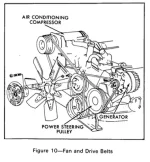
When you use a dual belt pulley on the alternator, the second belt comes from removing the power steering belt and replacing with a longer power steering belt that includes the alternator. The problem is that the power steering pulley now only gets about a third of the belt touching the pulley, which can lead to squealing under steering load.

I had a problem with multiple alternator failures, and I think it was from using too much power to charge low house batteries (lead acid) and overheating my stock alternators which weren't designed for that. So I went back to a single belt and I stopped using my alternator to charge the house batteries. I have not had an alternator failure since.

There's no doubt that the Balmar alternator is top of the line. I wonder if it could run continuously to charge up lithium batteries, I wonder if the Balmar can sustain a 100% duty cycle. Also, I wonder if the Balmar has a temperature sensor to intervene when it starts overheating. Sailor man can probably speak on those things.

If I ever made a case & bracket change, I would only trust alternators from the marine world, not Amazon. I would like to read and trust the specs. And the marine alternators make a ton of power at low RPM, like you'd find on diesel marine engines. I have no faith that Amazon alternators could do this.
Not a double V belt but a K6 flat ribbed belt. These do not slip.

There is just much more contact surface and the entire belt surface is employed.

The Altered March Racing serpentine belt system has adjustable tensioning devices, so if there is any slippage, just tension the belts more.

With Balmar alternators and the Wake Speed remote regulator, the charging does not start up at full speed charge but at 60% to 70%. There is no locked rotor type of stress.

In my system there is a pair of K6 flat belts and no heavy user belt driven air conditioning compressor. Each belt is powering different equipment. There is no dual belt arrangement for any piece of equipment.

The water pump and power steering pumps are brand new and more efficient.

The WakeSpeed regulator is programed to know exactly how many batteries are connected in parallel and the most efficient way to charge the batteries. You have to program the number of batteries, the manufacturer and the exact characteristics for charging the batteries in the system.

This is a very precise arrangement.

The 51.2vdc Lithionics batteries are the only Underwriter Laboratory certified batteries in the world. The entire 51.2vdc electrical system has been installed to conform with UL requirements. Therefore, the installation is a UL certified project.


Researched this one too. I like the low idle power…

So here we are with two viable options. I wonder if the belts slip or if these come with pulleys for a stickier belt solution.

Has anyone had experience with these two solutions?
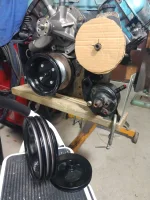
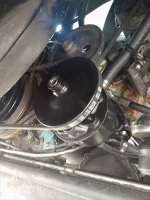
We added an extra pulley on the crank to drive an additional hydraulic pump. I think some Olds engines had a four groove pulley when they had an AIR pump for emissions but didn't go that way. You could drive an extra alternator with something like that maybe?additional pulley 3.webphydromax pump 1.webp