Electric Component what’s this pictures, what does it do?

TwistyTony

Member
Oct 6, 2024
87
24
18
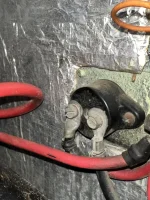
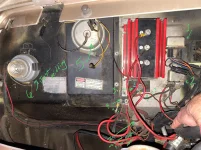
First one is in the engine bay. Guessing this orange wire is the same one appearing in the house battery bay.
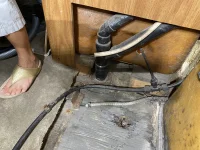
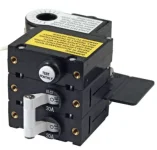
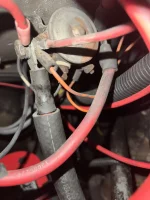
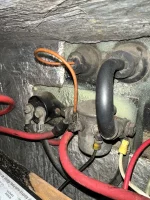
Second one is the two components in the Rear Battery Bay, third one is a close up of the specific thing I’m not sure what is.
I believe all of these are for the engine battery boost or charging from the alternator—but wanted to understand specifically before assuming.

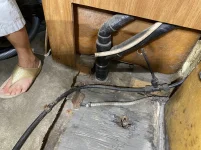
The last one—under or in front of the water tank is this connector T’s off the harness that goes to the water pump. It is not connected to anything.. What is it for? Where DID it go? It appears factory 50 years old, has a black connector On the end. The rest of that harness goes back to the water pump.

Thank you in advance.
 

Attachments

  • IMG_1361.webp
    IMG_1361.webp
    791.8 KB · Views: 43
  • IMG_1360.webp
    IMG_1360.webp
    1.1 MB · Views: 36
  • IMG_1359.webp
    IMG_1359.webp
    618.6 KB · Views: 43
  • IMG_8483.webp
    IMG_8483.webp
    1.4 MB · Views: 42
The first two are your boost solenoids, the third one is a 50 amp circuit breaker for the boost circuit, the fourth one I have no clue about. Not really enough information to determine exactly what it is. It could be something to do with the tank level monitor. Or, what Wally said, above, is a good possibility. I'm working on mine in that area right now and I'll take another look. Maybe I can shed some more light on it then.
 
  • Like
Reactions: TwistyTony
The first two are your boost solenoids, the third one is a 50 amp circuit breaker for the boost circuit, the fourth one I have no clue about. Not really enough information to determine exactly what it is. It could be something to do with the tank level monitor. Or, what Wally said, above, is a good possibility. I'm working on mine in that area right now and I'll take another look. Maybe I can shed some more light on it then.
Yea, I pulled the tank, and two of us where doing it, I was working on the pump end, he was working on the other end, and maybe it’s tank level sender…check it out and see if that’s what it is and where it goes for me. Thanks so much.
 
IIRC I have one coach with that same mystery wire (connector was gone) and I think the wire was green? I was never able to match it up to anything in the schematics. It doesn't seem to be part of "the basics" common to all coaches.
 
I don't think I'm going to be much help with this. My PO evidently made some changes back there. It looks like the wire coming out of that conduit, on mine, powers the fresh water pump. There is a green light gauge wire back there too that is grounded on mine and another one that is just not hooked up to anything.

Sorry
 
First one is in the engine bay. Guessing this orange wire is the same one appearing in the house battery bay.
Second one is the two components in the Rear Battery Bay, third one is a close up of the specific thing I’m not sure what is.
I believe all of these are for the engine battery boost or charging from the alternator—but wanted to understand specifically before assuming.

The last one—under or in front of the water tank is this connector T’s off the harness that goes to the water pump. It is not connected to anything.. What is it for? Where DID it go? It appears factory 50 years old, has a black connector On the end. The rest of that harness goes back to the water pump.

Thank you in advance.
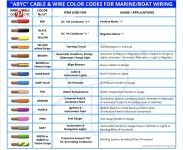
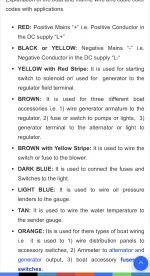
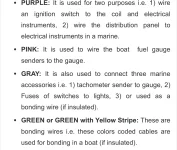
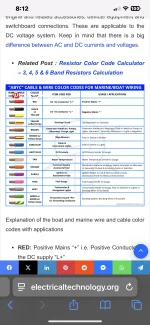
Since there is both DC and AC wiring in our coaches, sometimes it is difficult to determine what color coded electrical wiring can be confusing.
In the dc world, often marine wire color coding prevails and often GMC Motorhomer's are often boaters too. They may be familiar with dc boat wiring color coding.

IMG_3266.webp
Boats built outside the USA have a different electrical wire color coding system which made it a nightmare to change wiring or add new systems to such boats,

In the FiTech cabling, there is an orange wire between the fuel pump and the FiTech ECU. This seems to be consistent with the Table above.
In my case, I have paired (2) FiTech pumps with an on-off-on toggle switch. This is wired with orange wires.
1762867953099.webp

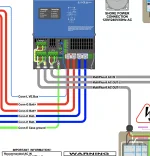
It is instructive to look at the wiring connections to a Victron Multi
Plus II inverter/charger.
In the AC wiring, there a (2) AC 4 wire cables (white, green, black & white). The green wire is normally a chassis grounding or bonding system. The same green colored wire also normally functions as a chassis and/or bonding system.

IMG_3267.webp
IMG_3268.webp
A good source for decoding wiring is:

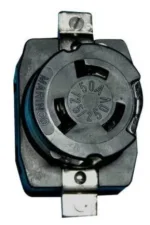
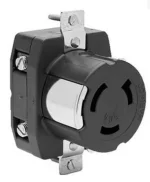
With regard to shore power, There are 2 types of connections.
1762869889615.webpThe Standard 3 wire 50 amp outlet.1762869916113.webpThe 4 wire ECLI 50 amp oulet.

I plan to install the ECLI system for my shore power. That will provide GCFI protection to the entire coach's wiring system.
1762870260257.webp
This is the ECLI Circuit Breaker that must be used with the 4 wire 50 amp shore power.

This system is mandatory for all new boats manufactured in the last 10 or 15 years and many older boats have been ungraded to this standard as has mine.
 

Attachments

  • IMG_3266.webp
    IMG_3266.webp
    215.8 KB · Views: 1
Last edited:
Since there is both DC and AC wiring in our coaches, sometimes it is difficult to determine what color coded electrical wiring can be confusing.
In the dc world, often marine wire color coding prevails and often GMC Motorhomer's are often boaters too. They may be familiar with dc boat wiring color coding.

View attachment 17109
Boats built outside the USA have a different electrical wire color coding system which made it a nightmare to change wiring or add new systems to such boats,

In the FiTech cabling, there is an orange wire between the fuel pump and the FiTech ECU. This seems to be consistent with the Table above.
In my case, I have paired (2) FiTech pumps with an on-off-on toggle switch. This is wired with orange wires.
View attachment 17110

It is instructive to look at the wiring connections to a Victron Multi
Plus II inverter/charger.
In the AC wiring, there a (2) AC 4 wire cables (white, green, black & white). The green wire is normally a chassis grounding or bonding system. The same green colored wire also normally functions as a chassis and/or bonding system.

View attachment 17111
View attachment 17112
A good source for decoding wiring is:

With regard to shore power, There are 2 types of connections.
View attachment 17113The Standard 3 wire 50 amp outlet.View attachment 17114The 4 wire ECLI 50 amp oulet.

I plan to install the ECLI system for my shore power. That will provide GCFI protection to the entire coach's wiring system.
View attachment 17115
This is the ECLI Circuit Breaker that must be used with the 4 wire 50 amp shore power.

This system is mandatory for all new boats manufactured in the last 10 or 15 years and many older boats have been ungraded to this standard as has mine.
The ECLI breakers actually are constantly comparing the currents in the 2 or 3 phases with each other. If they don’t match up, it exposes some low electrical current leakages or shorts, the kind that will not blow a standard fuse or circuit breaker. The ECLI breakers will trip and provide additional protection against electrocution. This is particularly important for marine installations. I think that it should be taken seriously in our GMC Coaches.
Marinas and RY Parks have many similarities.
 
The last one—under or in front of the water tank is this connector T’s off the harness that goes to the water pump. It is not connected to anything.. What is it for? Where DID it go? It appears factory 50 years old, has a black connector On the end. The rest of that harness goes back to
This is still up for grabs for the win—it wasn’t hooked to my water tank…. So apparently just relaxing down there—but you, know, we ALL wanna know what it was for—because that’s who we are if we’re in here…lol.

Anyone? The recirculating toilet “Possible Guess” might be the answer… but wouldn’t it be great to know?
 

Attachments

  • IMG_8483.webp
    IMG_8483.webp
    833.5 KB · Views: 12
After taking a second look, I saw that that conduit has a couple of other wires in it, possibly one to the fresh water pump (maybe 12 gauge) and two smaller (maybe 16 gauge) wires that may be going to the sender on the tank.
 
This is still up for grabs for the win—it wasn’t hooked to my water tank…. So apparently just relaxing down there—but you, know, we ALL wanna know what it was for—because that’s who we are if we’re in here…lol.

Anyone? The recirculating toilet “Possible Guess” might be the answer… but wouldn’t it be great to know?
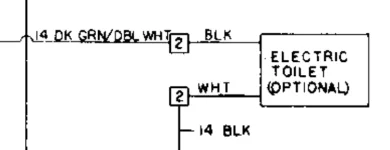
GMC 12v house wiring diagram shows a 14 gauge wire for an optional electric toilet.
This is the only load on 15A Fuse #6.
1763008775710.webp
78Z Parts Book shows a standard Aqua Magic toilet and an optional Electra Magic recirculating toilet.
Who comes up with these names?

GMCMI has a PDF of the Thetford Electra Magic.
 
GMC 12v house wiring diagram shows a 14 gauge wire for an optional electric toilet.
This is the only load on 15A Fuse #6.
View attachment 17123
78Z Parts Book shows a standard Aqua Magic toilet and an optional Electra Magic recirculating toilet.
Who comes up with these names?

GMCMI has a PDF of the Thetford Electra Magic.
Kendra for the win! “Magic” anyway you poop on it. What gets me is recirculating magic…. I don’t wanna re-anything with that magic…. thanks.
 
Yeah, those things are a little gross, especially in the Summer. It's one of the first things I replaced.
Some thought being given to how to keep the tank grey only so I can drain it for dishes and showers when boondocking…. There’s so many good toilet options now…. Or what a dual tank system looks like under there—but for now, I’ll be thrilled just to get electrical and plumbing back online so I can enjoy me “Goldie Howm”
 
Some thought being given to how to keep the tank grey only so I can drain it for dishes and showers when boondocking…. There’s so many good toilet options now…. Or what a dual tank system looks like under there—but for now, I’ll be thrilled just to get electrical and plumbing back online so I can enjoy me “Goldie Howm”
FYI, I don't know of a state where it is legal to dump gray water (from a tank) on the ground. In some cases, you can probably get away with it, but if caught, the fines are steep.

Interestingly enough, you CAN dump wash water from a tub etc on the ground, as long as it didn't go through any plumbing. When we are planning to do a lot of dry camping (more than 3 or 4 days) we take along a wash tub that fits in our sink, and dump the dishwater on the ground, saving a little capacity in the tank.
 
OK, More Show and Tell Fun!

What are these and any hints or insights into them? We will test of course, but before we start testing knowing what we know, knowing there’s a lot we don’t know, but don’t know exactly what the known unknown is, I thought I’d try to learn more about the known unknown:

IMG_8565.webp

1.
2.
3. thinking not factory. someone tied some circuits in the dash to the house batteries in the past. Any ideas? this will be a hunt.
4. Again, not all factory. Educated Guesses welcome.
5. Because Enquiring minds wanna know…if it’s something we don’t need—I’m all about removing and cleaning up old tech work around as I modernize the Electrical.
6. Just levity…but as cool as this is…it may need to go to make room for modern fusing and shut offs.
7. Previously identified, charging solenoid. That whole old system being replaced with this unit: Sterling B to B Charging system

2 OT Wire, big fuses, and shut off switches take up space in here—looking forward to a clean up. thought, input and pictures—SO welcome.

Thanks in advance.
 
  1. HVAC blower relay
  2. Horn relay
  3. Factory binding post for engine battery positive terminal
  4. PO added circuit breaker--follow the wires to discover what for.
  5. Vacuum actuator for HVAC door/flap. There are several more hidden here and there
  6. Too cool to eliminate, I'm sure you can work around it or slightly relocate it. They're still handy to have.
  7. I'd call it a boost solenoid. It's activated by the switch on the dash, and connects the engine and house batteries together.
 
Last edited:
I’m having so much fun right now. Making all this happen.
Chad’s 260 Amp Alternator with brackets and dual belt system went in without a hitch—nice fab work shout to Chad on that Alternator kit.
Chad 1 (423) 737-4684.

In calculating my C Rate on the Starter Battery, I decided to upgrade to a Group 31 Battery, and started researching AGM’s for that, 100Amp, 800 is CCA, that would allow the Sterling BB 12 24 120 to pull full 120amp chargeing to the 24V Group D LiTime Battery at a C Rate that was so low, the battery wouldn’t mind being in taht capacitor position for that much current.

I tripped across the LiTime Dual Purpose Auto Heating Group 31 battery for $442 on Black Friday Deal—at 165 Ah, and 1200CCW, 6,000 cycles! Even with the potential reduction fo full charge due to charging at something potentially less then the full 14.4volts, it’s still going to way outperform even the best AGM for the same price-ish. And without dual battery hoopty, jumpers, etc.

I’m making a nice new 1/8” steel battery tray for the Group 31. It’d also fit the Ragusa 3 battery or 2 battery tray.

Now it’s off to the Sterling BB 12 24 120 neatly fusing all cables not fused from the factory back to the LiTime 24V 230Amp Group D battery which tucked neatly in the factory battery bay.

Then into the Victron Quattro 24V—can’t wait to share pictures.
the 24V Quattro has multiple four post inputs, I’ll be able to pass through the full 50 amps without needing another fuse box.
teh 24V will power a single (room for adding another later if i need it) 24V DC OutEquipPro AC unit, with some backup heat, in the front fan space.

I’m fabricating some steel braces for that to hold the extra wieght.

The the other 24V DC output will go to a Victron 24 to 12V 300 watt converter for running the house 12V loads—same as it ever was.

I will loose the Battery Boost Function from the dashboard-but with the modern set up, the generator or plugged in or alternator always charging that huge Group 31 Dual Purpose LiTime starter battery—the need for that feature is just gone.

Anyway—here’s my epiphany—with the 165Ah in that dual purpose battery—

One Could effectively:
Eliminate the Lead Acid or even AGM House Batteries entirely back there in the bay by the generator.

Install one of these, and use the factory wire back to power the minor 12V loads back there…. Just a thought…but talk about cutting weight, simplifying, and still improving capacity by modernizing the battery tech and location…. That’s pretty exciting.

There’s likely bigger than Group 31 batteries that would easily fit in our battery spots. The idea of a single Dual purpose battery and still improving on the factory Power Density! Dropping hundreds of pounds—got me all excited.

I need to do a couple of these restorations just so I can try all my ideas as they come to me!

Have a great day. Thanks everyone for the help and understanding as i plan and do this. What a great community.

Merry Christmas.