EFI Throttlebody: Aces Killshot 2?

  • Please note, the forum recently had a problem with outbound emails for notifications, registrations, etc. A new email provider has been set up which should resolve all email issues. If you have any further trouble, please DM Christo or reach out via the Contact Us link in the website footer.

Tybalt39

Well-known member
Mar 10, 2023
514
279
63
Eugene, OR
Anyone with experience with this? I see one person (Larry Pontiac) planning to use this system, and there are good results according to various youTube videos. One is using it in a GMC motorhome with a 455. Another on a restomod '48 Buick with a 455.

External ECU, 100lb/hr injectors. It's square-bore, but most systems are anyway (other than the obvious Rochester or Holly). ESC is available if you change the distributor. "Self-learning" (after you choose options in the setup wizard) and you're up and running.

There are some good end-of-year prices right now.
 
Anyone with experience with this? I see one person (Larry Pontiac) planning to use this system, and there are good results according to various youTube videos. One is using it in a GMC motorhome with a 455. Another on a restomod '48 Buick with a 455.

External ECU, 100lb/hr injectors. It's square-bore, but most systems are anyway (other than the obvious Rochester or Holly). ESC is available if you change the distributor. "Self-learning" (after you choose options in the setup wizard) and you're up and running.

There are some good end-of-year prices right now.

Worth giving it a try, but I would connect to the ecu with Duetz connectors, and set up the same connector on a backup ecu just in case.

I believe it's a chinese made TB and ecu, it would not be great to be on side of road shipping your ecu back for repair. But that's the same story with any ecu.
 
"Self-learning" (after you choose options in the setup wizard) and you're up and running.
All EFI systems are "Self Learning". That is what the O2 sensor is for, closed loop feed back to tell the ECM whether the mixture is lean or rich so that it can dynamically adjust the fuel mixture. These changes are kept in separate "Trim" tables. The main fuel table is its starting point and sensor feedback along with the trim tables adjust the final for the desired result (AFR)

The Trim Tables are stored in memory however early ECM 's (the Howell system for instance) used volatile memory chips which would lose the Trim info if you disconnected the chassis battery. You may recall after taking your car in for service being told that your car engine may run poorly for the next number of miles while the engine computer "relearned" its settings. Later ECM's (including the EBL) store the Trim Tables in non-volatile (Flash) memory, so they retain the trim tables when the chassis battery is disconnected.

When an EBL user does a "VE Learn", the What's up Display software takes the Trim Tables and updates the main VE tables (fuel tables) and clears the trim tables. Flashing the new BIN into the EBL then makes this updated fuel table the starting point and the trim tables will be updated based on the new table.

I recall when FiTech came out and their buzzword was "Self Learning". That was a marketing thing, not a new technology.

Carb's on the other hand are "Open Loop" operation. They have no idea about the AFR they are delivering to the engine.
 
  • Like
Reactions: boybach
All EFI systems are "Self Learning". That is what the O2 sensor is for, closed loop feed back to tell the ECM whether the mixture is lean or rich so that it can dynamically adjust the fuel mixture. These changes are kept in separate "Trim" tables. The main fuel table is its starting point and sensor feedback along with the trim tables adjust the final for the desired result (AFR)

The Trim Tables are stored in memory however early ECM 's (the Howell system for instance) used volatile memory chips which would lose the Trim info if you disconnected the chassis battery. You may recall after taking your car in for service being told that your car engine may run poorly for the next number of miles while the engine computer "relearned" its settings. Later ECM's (including the EBL) store the Trim Tables in non-volatile (Flash) memory, so they retain the trim tables when the chassis battery is disconnected.

When an EBL user does a "VE Learn", the What's up Display software takes the Trim Tables and updates the main VE tables (fuel tables) and clears the trim tables. Flashing the new BIN into the EBL then makes this updated fuel table the starting point and the trim tables will be updated based on the new table.

I recall when FiTech came out and their buzzword was "Self Learning". That was a marketing thing, not a new technology.

Carb's on the other hand are "Open Loop" operation. They have no idea about the AFR they are delivering to the engine.

I did an LS swap using Holley Terminator Max X and although it had a setup "Wizard" and was supposedly self learning, the initial tune was incredibly rich. That's just the way Holley does it, probably to prevent people damaging their engines.

Getting the engine tuned, either by a tuning shop on a dyno, or by using a remote tuner, or tuning it yourself is required. My understanding is that there is no actual self tuning ecu. You have to get it close with a tune then the trim tables can be populated after the ecu goes into closed-loop. And you can copy over the trim tables to dial in the tune further over time.

A remote tune for the car I swapped was $300, and money well spent. That thing ran amazing. The tuner was Drayson Meade
 
Yup. Fully aware that there is no magic "AI" in the ECU. The simple initial setup on modern
efi systems is preferred. It may be enough for basic function until a professional tuner is needed.

Just seeking info/experience with this particular manufacturer. My carb is shot and needs a rebuild (fuel pools around the piston of the accelerator pump and spills onto the intake manifold). As I planned for EFI from the beginning, and integration with a Dakota Digital instrument cluster is needed (why have two of every sensor?), the end of year sales got me interested in this brand in particular.
 
  • Like
Reactions: tmsnyder
This looks like the easiest and most simple setup for this vehicle. If I ever need to swap for the carburetor, just bypass the surge tank and away we go.

As I plan to use a Dakota Digital instrument cluster+interface, the normal small programming/monitor screen would eventually be deleted (unless the Dakota Digital BIM will play nicely with their display).

And yes, I know I will need a spread bore adapter, and most likely a low-profile air plenum/filter set up.

This version gives me the option of electronic spark control in the future should I choose to go that route. I would start simple and keep the stock ignition for now.

ACES.webp
 
Last edited:
Has anyone used a drop-base 14" air-cleaner base to retain the original look of the air-cleaner after installing a manifold adapter plate, rather than going the plenum/snorkel route?
 
I am running the first gen FITECH with a 3/4"(?) plate. I am using the factory air cleaner. It's a tight fit but no issues to date.
I like the external filter idea but couldn't really figure a place to put that didn't interfere with something else more than I like. Didn't want a big hose running up into the grill area either.
I would also be concerned about interference from a drop-base with linkage.
 
  • Like
Reactions: tmsnyder
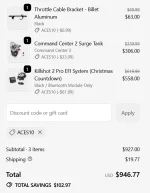
Installation completed! Aces EFI KillShot2 Pro with Command Center (high-pressure surge tank). Gen 2 ECM has more memory for larger tables, higher-volume fuel output, and can handle ESC.

It just worked first time, no issues.

I have the Q-jet as a backup (adapter hose installed to connect to fuel-return hose). Pull system fuses, cap high-pressure tank output, re-route fuel return to carb, and good to go in less than half an hour. For those concerned about roadside repair of a non-OEM EFI system. :)
 
Last edited:
  • Like
Reactions: tmsnyder
Installation completed! Aces EFI KillShot2 Pro with Command Center (high-pressure surge tank).

It just worked first time, no issues.

I have the Q-jet as a backup (adapter hose installed to connect to fuel-return hose). Pull system fuses, cap high-pressure tank output, re-route fuel return to carb, and good to go in less than half an hour. For those concerned about roadside repair of a non-OEM EFI system. :)
Where did you put the command center?
 
Where did you put the command center?
I mounted it horizontally (instructions said that is OK) to an aluminum flat bar using the pre-tapped mounting holes for that purpose, extended the ends of the bar beyond the top and bottom of the tank, then mounted the assembly against the step riser below the passenger seat. The AN6 fittings and pressure gauge are visible/accessible from the engine hatch/doghouse. The two filters are also mounted under the passenger seat near that opening for accessibility. Basically, everything is mounted within a few inches of the TB, with a hose running along the back wall of the hatch to the fuel filler pipe for return. I mounted the ECU high on the firewall on the passenger side on the outside, with the relays mounted next to it and the fuses just below on the inward slope. A very compact installation.

The pump is causing vibrational noise to transfer through the step, so I'm looking into rubber isolation mounts. But it is secure for now.

The power wires for both the ECU and the command center are running directly to the battery (hot and ground). Once I am certain everything is fine, I may route those wires to common power and ground locations instead. But I wanted to give the system the best chance of working before getting too custom.

The injectors are LOUD! I'm thinking about sound absorptive mat material under the hatch, then padding and carpet over the entire "flight deck".

Apparently, the cone style air filters we have to move to when using a small plenum over the TB are known to "roar" under acceleration. It is a throaty noise I may have to get used to. Paul indicates he is looking into an air-box instead to eliminate this noise.

Things they don't tell you when talking about EFI.... :LOL:
 
Last edited:
Wiring:

The +12v side of the relays for the ECU and Command Center (surge tank) are wired directly to the battery. The grounds for each are connected directly to the battery as well (even though the instructions say to use the chassis for ground). The negative of the relay coils is switched to ground by the ECU, which is controlled by the ignition switch position (I used the tab on the fuse-block directly next to the 4A LPS (lamps) fuse; hot when in run/start).

As I wanted to keep it simple for now, I'm not using ESC. So, the grey wire (Tach_in) from the accessory harness is connected to the negative terminal of the ignition coil for RPM reading. Plug-in the temp sensor and WBO2 sensor and the wiring is complete!

Other than the prep for the vehicle, the installation of the system is pretty basic/easy. But as the two guys installing is are 65+ and not very flexible, it took some time.... :ROFLMAO:

Once some time has passed and everything is simply "working", I will try using chassis ground and moving the battery connections to the large common post on the firewall. Then I can clean-up the wiring....
 
Last edited:
  • Haha
Reactions: RoadTrippin
Once some time has passed and everything is simply "working", I will try using chassis ground and moving the battery connections to the large common post on the firewall. Then I can clean-up the wiring....
Terminate all the grounds to the engine block. I used a threaded hole at the back of my 455 head on the passenger side. Its a 3/8" coarse thread.
 
Hi Luther,

Can you give us a status update?

How is the Aces EFI running?

Todd
It's functioning perfectly! The IAC is a bit high but there are easy instructions on how to adjust that. It starts fast, is responsive, and the engine pulls hard (IE: responsive to the gas pedal, no hesitation, good power, etc.). The coach has really "woken up".

When other priorities have been addressed, I will probably start to fine-tune the EFI. But for now all is very acceptable. I'm happy with it. At some point I will utilize ESC, but not yet.

It's nice to be able to stand near the seat and simply start the vehicle without having to sit, pump the accelerator a few times, then manually kick the gas pedal to drop the RPMs after warm-up.

IAC Adjustment:
Bring the engine up to a temperature of 165°F. Once the engine has reached temperature, shut it down. Using a piece of tape, block off just the IAC port.

Restart the engine and observe the idle speed:
  • Too low? Open the front set of blades on the throttle body until the idle gets close to the desired target.
  • Too high? Close the front blades slightly until the desired RPM is achieved.
Once the throttle blades are set, remove the tape and check the IAC count on the handheld. It should be between 10 and 25. Reinstall the air cleaner, shut the hood, and go for a drive.

The IAC is now properly set and will work behind the scenes to maintain the RPM you want.
 
Last edited:
Terminate all the grounds to the engine block. I used a threaded hole at the back of my 455 head on the passenger side. Its a 3/8" coarse thread.
Yup, I need to do that. Next time I collect the coach (probably this weekend) I'll move my grounds. Now that I have the system working with no issues, that is the first change to make. I just wanted to optimize my chances of a good outcome by eliminating any variables at first. One change at a time...

After moving the grounds, I'll next move the positive connection to the large stud on the firewall.
 
  • Like
Reactions: RF_Burns
Hi Luther,

I've been looking at lots of aftermarket standalone controllers lately and reading the manuals and wiring diagrams; Holley, Haltech, FuelTech, Megasquirt, ECUMaster, MaxxECU, MicroSquirt just in case the EBL system from DynamicEFI isn't resurrected.

In many of the manuals, they emphasize not using the battery as a ground. Especially for the sensors. So I'm laying out the wiring at the moment, and plan on using a single large ground to the engine block for power supply to the ECU and any sensor grounds emanating from the ECU are wired direct to the sensor itself.

The other detail I've noticed is that shields should never be grounded, not that you have to worry about that with the system you bought!

Question for you, what did you do for fuel pump and filter?
 
Hi Luther,

I've been looking at lots of aftermarket standalone controllers lately and reading the manuals and wiring diagrams; Holley, Haltech, FuelTech, Megasquirt, ECUMaster, MaxxECU, MicroSquirt just in case the EBL system from DynamicEFI isn't resurrected.

In many of the manuals, they emphasize not using the battery as a ground. Especially for the sensors. So I'm laying out the wiring at the moment, and plan on using a single large ground to the engine block for power supply to the ECU and any sensor grounds emanating from the ECU are wired direct to the sensor itself.

The other detail I've noticed is that shields should never be grounded, not that you have to worry about that with the system you bought!

Question for you, what did you do for fuel pump and filter?
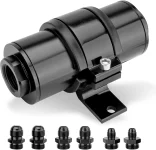
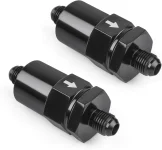
Since I'm using their surge tank with built-in "high" pressure pump, I didn't add any other pumps. I'm still using the mechanical pump to get fuel to the surge tank. It also makes going back to a carburetor that much more simple in the event of a failure on the road.

I'm using a 100µ and 20µ filter from Amazon; one before the surge tank and one after.
1776265964435.webp 1776265944384.webp

FYI, the instructions for the Aces system indicate going directly to the battery for both positive and negative connections. Apparently, many have problems with their systems because they don't do this. I still intend to move the ground and probably the positive as well.

As far as sensor grounds, I have no sensors that require a dedicated ground. My setup is very simple; power, O2, water temp, ignition-coil negative, fuel loop.
 
  • Like
Reactions: tmsnyder