
Duotherm thermostat.
- Thread starter B1gflip
- Start date
You are using an out of date browser. It may not display this or other websites correctly.
You should upgrade or use an alternative browser.
You should upgrade or use an alternative browser.

A standard on/off thermostat is all you need. I have a digital one that is way more accurate than the old sliding mercury bubble. Some now use a battery to run the display and logic board. Thrift store or second hand for a few bucks sometimes, new looks like $20-30 bucks online.


One thing to watch for, is making sure you don't get a 24VAC thermostat. Hard to power one of those in an RV.
The old two-wire switch styles don't need any power at all. I've been shopping for a vintage thermostat lately. I've settled on a Honeywell T87F1800, I've just gotta find the right deal on one. I like the looks, and they still had mercury. If you get one with a baseplate, it can have an "off" or "fan only" option. One thing I like about the old mercury switches is that they're tilt dependent (on top of lasting absolutely forever and being oxidation resistant for high humidity environments). So if a thermostat can't be set below 50F for example, you can just tilt the thing in its mount (depending on how you mount it) and get it down to a 35F set point if you want. Handy in an RV.
There are lots of programmable digital ones with nice features that will run a long time on a couple AA batteries too. Just stay away from the WiFi stuff. There aren't a ton of fancy thermostats that will run on 12V out of the box.
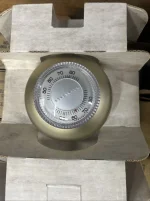
The old two-wire switch styles don't need any power at all. I've been shopping for a vintage thermostat lately. I've settled on a Honeywell T87F1800, I've just gotta find the right deal on one. I like the looks, and they still had mercury. If you get one with a baseplate, it can have an "off" or "fan only" option. One thing I like about the old mercury switches is that they're tilt dependent (on top of lasting absolutely forever and being oxidation resistant for high humidity environments). So if a thermostat can't be set below 50F for example, you can just tilt the thing in its mount (depending on how you mount it) and get it down to a 35F set point if you want. Handy in an RV.
There are lots of programmable digital ones with nice features that will run a long time on a couple AA batteries too. Just stay away from the WiFi stuff. There aren't a ton of fancy thermostats that will run on 12V out of the box.
Just be aware that the Honeywell T87s have an anticipator heater that draws at minimum 0.1 amps at 24V (0.2 amps at 12V). This may be defeatable, but if it's not, it's an extra load on your DC system that you don't need. It's only active when the heater is running, but with only a 100 AH battery, I'm counting every watt. (It also loads down the heater's control circuit, which is just an open collector transistor. I know when I tried to run the fan under the stove off the thermostat circuit, the furnace wouldn't start. The fan was noisy and ineffective anyway.)
The stat that was packed in with my Suburban furnace is of the bimetallic type without an anticipator. I think it was made by White-Rodgers. I understand the concern about corrosion on the bimetallic switch, but after 20 years, mine still looks and functions fine.
If you find a way to defeat the anticipator in the T87, let me know. I like the aesthetics better than the "modern" Suburban/White-Rodgers stat. Unfortunately, years of sunlight coming through the back glass wrecked my original Sol-Aire stat.
The stat that was packed in with my Suburban furnace is of the bimetallic type without an anticipator. I think it was made by White-Rodgers. I understand the concern about corrosion on the bimetallic switch, but after 20 years, mine still looks and functions fine.
If you find a way to defeat the anticipator in the T87, let me know. I like the aesthetics better than the "modern" Suburban/White-Rodgers stat. Unfortunately, years of sunlight coming through the back glass wrecked my original Sol-Aire stat.
Good point Dave, the anticipator is certainly worth a discussion. I shouldn't have glossed over that bit.
It's not as complex as you might assume though, and won't consume twice the current at 12V than it will at 24V. From Honeywell's representation in the manuals, it's merely a variable resistance--which I hope is true for simplicity and reliability. For a fixed power consumption, half the voltage would require twice the current. But for a given resistance, half the voltage would result in half the current.
But, I actually shouldn't need to worry about that. We're comparing a bare switch to a switch with some series resistance added. Adding series resistance will never make the switch consume more current. So setting the anticipator to max current (least resistance) would actually make it look more like a regular thermostat.
I think the control circuits on furnaces that expect anticipators are going to be quite different, and expect to source a decent amount of current. I'll need to look into the specifications on what my furnace expects. If there's a maximum amount of allowable resistance for my thermostat, I may have to install a jumper as shown in red.
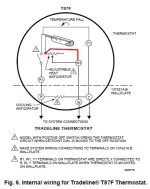
It's not as complex as you might assume though, and won't consume twice the current at 12V than it will at 24V. From Honeywell's representation in the manuals, it's merely a variable resistance--which I hope is true for simplicity and reliability. For a fixed power consumption, half the voltage would require twice the current. But for a given resistance, half the voltage would result in half the current.
But, I actually shouldn't need to worry about that. We're comparing a bare switch to a switch with some series resistance added. Adding series resistance will never make the switch consume more current. So setting the anticipator to max current (least resistance) would actually make it look more like a regular thermostat.
I think the control circuits on furnaces that expect anticipators are going to be quite different, and expect to source a decent amount of current. I'll need to look into the specifications on what my furnace expects. If there's a maximum amount of allowable resistance for my thermostat, I may have to install a jumper as shown in red.
Ah, got it. I assumed the resistance was in parallel, with the wiper limiting the current to something like a tiny nichrome wire. I see they're just using the heat thrown off by the makeshift rheostat as control. Looks like you could just jumper that anticipator out to make the thermostat act like an anticipator-less 'stat.
I think it's right to keep the load on the heater control circuit as low as possible. I'm sure the circuit is current-limited for safety. If there's too much voltage drop, it will never close in.
I think it's right to keep the load on the heater control circuit as low as possible. I'm sure the circuit is current-limited for safety. If there's too much voltage drop, it will never close in.

