Drinking the Koolaide... 😊

  • Please note, the forum recently had a problem with outbound emails for notifications, registrations, etc. A new email provider has been set up which should resolve all email issues. If you have any further trouble, please DM Christo or reach out via the Contact Us link in the website footer.
Yes, that’s how it works. The tanks with the hose to the filler neck that goes to the top of the reservoir have a soda straw to connect the cap to near the bottom of the reservoir, and it works the same way.

But the type with the connection at the bottom has to stay leak-free while submerged, so it’s more likely to leak in the long run. The top-feeder is above liquid level where the connection is. I switched from a leaky bottom-feeder to a top-feeder for that reason.

Rick ā€œand the top-feed tank was cheaperā€ Denney
 
  • Like
Reactions: Tybalt39
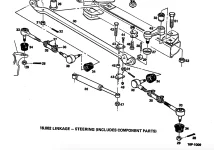
Who can talk to me about steering stabilizers? Were they original to the coach? If so, were they a simple shock absorber as is sold on various sites, or was it something more? I see shock absorbers sold, I see shocks with coil springs, and I see mechanical systems with springs that apparently are self-centering.

The vehicle is going in to have upper and lower ball joints replaced on the driver side next week. The coach just wanders going down the road. Below 45 miles an hour I can keep up and correct with the steering wheel. Above 45 mph it becomes White knuckle driving. Would a steering stabilizer refresh help with this?

I need to get this vehicle able to drive at highway speeds safely. If I can't, there's no point in going any further with it.
 
Last edited:
  • Like
Reactions: tmsnyder
The steering stabilizer is stock, but I’ll bet that’s not the problem.

In my experience, uncentered steering is most likely to be:

1. Steering gear box not centered.

2. Play in the steering linkages.

3. Bad alignment (more caster is better).

4. Ball joint (unlikely unless broken) and bushing wear.

5. Play in the middle steering shaft.

6. Play in the steering column.

7. Play in the rear bogies. (Common but more limited in effect than most expect.)

These are in order of effect, sort-of. All of them are extensively written about in the archives, and all of them can be addressed. The standard advice is to start with the steering gearbox and work out from there. But for now just have someone sit at the wheel and rock it back and forth while you crawl around looking for loose bits. If the linkages are loose, order linkage parts rebuilt by Dave Lenzi.

Rick ā€œyou’ll need an expert looking over your shoulder to align the gearboxā€ Denney
 
I don't know the answer to your question but add this to your possibilities list.... my steering was as you described,,, I replaced steering box, and numerous steering components and bushings to no avail. Recently drove it (white knuckles) 2400 miles to have steering and other items worked on at Cinnabar in Sandusky, MI. I pick up the coach on Monday from Cinnabar. Cinnabar says the problem was "the steering stabilizer was installed UPSIDE DOWN." They turned it over, reset the ride height and aligned it and says it now drives just fine. You will probably see a post from me if that does not happen to be correct as I drive it the 2400 miles back home!!!!!!! But, I really quizzed them when they said that was all it needed and they are quite confident it fixed the problem as well as GREATLY CORRECTING THE TURNING RADIUS because it was restricting the lock to lock number of turns of the steering wheel. Whooowuddathought????????
Rod
 
I’m sure the stabilizer was upside down, but I’m also pretty sure it was the correct ride height (which should have been about number 2 or 3 on my list) and alignment that did the bulk of correcting the problem.

Rick ā€œtoo high a rear relative to the front will upset stability for sureā€ Denney
 
There is no such thing as "upside down" as the unit is installed horizontally and the mounting holes are not directional.
I suppose the damper could be installed backwards, with the cylinder end mounted at the center link and the rod end mounted to the frame.


Screenshot 2023-08-13 at 8.05.07 AM.webp
 
Hmmmmm..... now I am wondering if I "heard wrong" and he might have said "sway bar" and I somehow switched that in my brain to stabilizer???????? Well, that will be resolved one way or another when I pick up the coach tomorrow and I will post on here the results so that I have not put out bum gouge.
 
I had a client who was a bit of a card. I was there on a friday afternoon when some guys where pouring a floor in his new building. He came roaring in and jumped out of his pickup and started at the concrete guys that they had poured the concrete upside down! The redimix driver and I were pissing ourselves laughing watching this.
 
The steering stabilizer is stock, but I’ll bet that’s not the problem.

In my experience, uncentered steering is most likely to be:

1. Steering gear box not centered.

2. Play in the steering linkages.

3. Bad alignment (more caster is better).

4. Ball joint (unlikely unless broken) and bushing wear.

5. Play in the middle steering shaft.

6. Play in the steering column.

7. Play in the rear bogies. (Common but more limited in effect than most expect.)

These are in order of effect, sort-of. All of them are extensively written about in the archives, and all of them can be addressed. The standard advice is to start with the steering gearbox and work out from there. But for now just have someone sit at the wheel and rock it back and forth while you crawl around looking for loose bits. If the linkages are loose, order linkage parts rebuilt by Dave Lenzi.

Rick ā€œyou’ll need an expert looking over your shoulder to align the gearboxā€ Denney
Steering box: Redhead. The first thing done was having it re-aligned by Kelvin D. At that time no play in the linkages or shafts was found. Intermediate shaft was disassembled, cleaned, lubed, re-assembled, "clocked" (?), and had boots installed. The steering had been terrible but this improved it (at least in-town).

Alignment: What it was in for next when ball-joints were noted. One shop indicated lower left joint and idler arm. Another found no issues at all but looked again after I described my symptoms. They came back with both left joints but no idler arm. They can get me in before October so.... Kelvin has offered to walk them through setting ride-height and general tips regarding the coach.

Rear Bogies appear to be solid with no play (says everyone who tests them).

In for a penny..... 🤣
 
Last edited:
Alignment: What it was in for next when ball-joints were noted. One shop indicated lower left joint and idler arm. Another found no issues at all but looked again after I described my symptoms. They came back with both joints but no idler arm. They can get me in before October so.... Kelvin has offered to walk them through setting ride-height and general tips regarding the coach.
When a shop is recommending changing the lower ball joints, make sure they have them first, they are getting quite rare and hard to find.
 
Hmmmmm..... now I am wondering if I "heard wrong" and he might have said "sway bar" and I somehow switched that in my brain to stabilizer???????? Well, that will be resolved one way or another when I pick up the coach tomorrow and I will post on here the results so that I have not put out bum gouge.
I’ve heard people call anti sway bars stabiliser bars. It’s not unusual.
 
You probably already know this, but the lower ball joints have to be really bad (1/8" of play?) to require changing. A lot of these were changed out and it wasn't necessary. Alignment guys these days are used to see that amount of play, so they automatically want to change them out.

I fought with my steering for about the last 10k miles. Went thru all the check boxes. The biggest improvement resulted from the coach weigh-in last Fall. Mike Sadlon from Sirum GMC was running it and found that my rear levels were way off. It was basically going down the road with most of the weight on two opposite corners of the coach. And too high in the rear.

I now have a wood block on a stick to measure and manually set the rear heights under the frame, I do it in the driveway before leaving, and then again when getting fuel. It made a huge difference in the handling.

Second and third biggest improvement, all new control arm bushings, and new borgeson steering shaft. The old bushings were shot, and the steering shaft had a 'catch' in it where you'd try to turn and it wouldn't until you gave it a little more force, then it would 'jump' It gave a 'tail wagging the dog' feel to driving the coach.

Also installed a Lenzi refreshed relay arm.

Now it drives great at any speed, I've had it up to 83 by accident and didn't even notice it. My better half even took a turn at driving and said it was fine for her (finally!).
 
  • Like
Reactions: Tybalt39
You probably already know this, but the lower ball joints have to be really bad (1/8" of play?) to require changing. A lot of these were changed out and it wasn't necessary. Alignment guys these days are used to see that amount of play, so they automatically want to change them out.

I fought with my steering for about the last 10k miles. Went thru all the check boxes. The biggest improvement resulted from the coach weigh-in last Fall. Mike Sadlon from Sirum GMC was running it and found that my rear levels were way off. It was basically going down the road with most of the weight on two opposite corners of the coach. And too high in the rear.

I now have a wood block on a stick to measure and manually set the rear heights under the frame, I do it in the driveway before leaving, and then again when getting fuel. It made a huge difference in the handling.

Second and third biggest improvement, all new control arm bushings, and new borgeson steering shaft. The old bushings were shot, and the steering shaft had a 'catch' in it where you'd try to turn and it wouldn't until you gave it a little more force, then it would 'jump' It gave a 'tail wagging the dog' feel to driving the coach.

Also installed a Lenzi refreshed relay arm.

Now it drives great at any speed, I've had it up to 83 by accident and didn't even notice it. My better half even took a turn at driving and said it was fine for her (finally!).
According to the first shop that is familiar with the coaches (they worked on this one before I owned it), the lower left ball-joint had 1/8" play, while the idler arm had 1/16" ("not TOO bad, but as long as we are in there..."). The other shop didn't indicate how much play they found in the upper left, but it shouldn't be much since they didn't initially find any issues and the other shop didn't mention it. But, since I'm no expert and I want it to be safe (and ball-joints DO wear out...), I'm letting them go for it. Unless there is a core charge, I intend to recover the parts to see if they have any rebuild value.

The question I have is, do I do anything about the steering stabilizer while I'm at it? How do I test it to know if it needs to be replaced, and if it does, with what (multiple options out there)?
 
According to the first shop that is familiar with the coaches (they worked on this one before I owned it), the lower left ball-joint had 1/8" play, while the idler arm had 1/16" ("not TOO bad, but as long as we are in there..."). The other shop didn't indicate how much play they found in the upper left, but it shouldn't be much since they didn't initially find any issues and the other shop didn't mention it. But, since I'm no expert and I want it to be safe (and ball-joints DO wear out...), I'm letting them go for it. Unless there is a core charge, I intend to recover the parts to see if they have any rebuild value.

The question I have is, do I do anything about the steering stabilizer while I'm at it? How do I test it to know if it needs to be replaced, and if it does, with what (multiple options out there)?

To test it, with it off the vehicle, grab both ends and push/pull it in and out. It should offer some significant resistance to your force applied.
 
Stabilizers are mostly a band aid, or in some cases to firm up movement, but do nothing to remove play or slop.
It's a simple oil filled shock, testing is easy. Remove it (or one end) and compress and extend it (with it oriented horizontally, as installed).
If it has equal and even resistance either way, it's fine.
If it has no resistance, binds, or unequal resistance, it's bad.

I like to put the front on ramps, get underneath and have someone saw the wheel back and forth while I'm watching for any relative movement from all the joints. I recently used this technique to identify a sloppy drag link. Replaced it with a less sloppy one and my steering is one hand on country roads or the interstate at 75.
All the rest of my steering components are in serviceable condition.

I also redid the front wheel bearings, my lower ball joints are both 1/16+ play.
 
  • Like
Reactions: tmsnyder
50A wiring....

Given that the "50A" wiring is comprised of two 110v 30-50A inputs 180 degrees out of phase, with one input running to each "side" of the breaker box....

When running from the Onan (with only one line of 110v at 50A), is only one side of the breaker box live? Or, does the 4-prong outlet wired to the Onan have internal jumpers between L1 and L2?

I ask instead of dissassembling the box because I'm not yet prepared to rebuild it; after 50 years, I assume anything I take apart will have to be rebuilt. Right now, I'm simply formulating a plan for the electrical system.
 
50A wiring....

Given that the "50A" wiring is comprised of two 110v 30-50A inputs 180 degrees out of phase, with one input running to each "side" of the breaker box....

When running from the Onan (with only one line of 110v at 50A), is only one side of the breaker box live? Or, does the 4-prong outlet wired to the Onan have internal jumpers between L1 and L2?

I ask instead of dissassembling the box because I'm not yet prepared to rebuild it; after 50 years, I assume anything I take apart will have to be rebuilt. Right now, I'm simply formulating a plan for the electrical system.
There is simply a jumper between L1 & L2 on the back of the Onan power socket. So you will read 120V from L1 and L2 to Neutral... but you would read Zero volts between L1 & L2.
 
  • Like
Reactions: Tybalt39