Another Fuel pressure, pumps and Injectors question

MikeB

Active member
Dec 24, 2018
288
29
28
Lower Alabama
I’ve dropped the tanks and about to put things back. However I’m not
feeling 100% comfortable with my set up. I have the early Howell/Holley TBI
set up (2009-10ish) and based on Bruce Hislops description I’m pretty sure
I have the 60 pph injectors. Supply is from airtex e3902 in-tank pumps.
One of which has 15 psi and the other is running 20 psi. I don’t know what
the Holley is regulating them at the injectors. When my PO installed them
he had a stock engine. He then had it rebuilt by Cad Company (don’t know if
that’s a good or bad thing) about 14k miles ago. It is bored .60, has Jim
Bounds Cam and Thorely headers. So it’s breathing a lot better. But I now
think it’s susceptible to dangerously leaning out. When driving and I
switched from tank to tank I could feel the power loss and at times the
weaker pump dropped the idle down with a little stumble.
So what is my next move? Stronger pumps? Go with a Rochester? Can the
injectors be changed out?
 
Use the in tank pumps as supply pumps, and either add a surge tank with the
correct pump that supplies the recommended pressure for the Howell system.
You did not mention whether you had the EBL, so I assume that you do not
have it. Bob R. is your go-to guy for accurate answers to your questions.
Randy VanWinkle is also a great source for accurate information.
Jim Hupy
Salem, Oregon
 
Get EBL, get a 30PSI fuel pressure sensor for the EBL.
its worth it
________________________________
From: gmcmh-efi on behalf of Jon Roche
Sent: Wednesday, July 7, 2021 10:45 AM
To: gmcmh-efi
Subject: Re: [GMCMH-EFI] Another Fuel pressure, pumps and Injectors question
Get a way to see the fuel
Pressure. Also a wide band o2.
So you can see what fuel pressure is and if it is truely leaning out.

Use the in tank pumps as supply pumps, and either add a surge tank with the correct pump that supplies the recommended pressure for the Howell system. You did not mention whether you had the EBL, so I assume that you do not have it. Bob R. is your go-to guy for accurate answers to your questions. Randy VanWinkle is also a great source for accurate information.
Jim Hupy
Salem, Oregon
I’ve dropped the tanks and about to put things back. However I’m not feeling 100% comfortable with my set up. I have the early Howell/Holley TBI set up (2009-10ish) and based on Bruce Hislops description I’m pretty sure I have the 60 pph injectors. Supply is from airtex e3902 in-tank pumps. One of which has 15 psi and the other is running 20 psi. I don’t know what the Holley is regulating them at the injectors. When my PO installed them he had a stock engine. He then had it rebuilt by Cad Company (don’t know if that’s a good or bad thing) about 14k miles ago. It is bored .60, has Jim Bounds Cam and Thorely headers. So it’s breathing a lot better. But I now think it’s susceptible to dangerously leaning out. When driving and I switched from tank to tank I could feel the power loss and at times the weaker pump dropped the idle down with a little stumble.
So what is my next move? Stronger pumps? Go with a Rochester? Can the injectors be changed out?
--


--


--

 
I looked up  the specs for the E3902 pump on the Airtex site and it is
rated at 13psi minimum. It sounds like you still have the tanks out, so
I'm not sure how you are measuring the fuel pressure each is delivering.
Did you put some fuel in the tanks, connect power to the pump and just
dead-headed into a pressure gauge?
Anyway, with a spec of 13psi minimum I would suspect they are passing
the performance test. The issue is with 60pph (I think it might be
63pph) you need to up the pressure higher than the GM nominal 13psi.
According to RobR's flow rate calculator, you need 21psi to get the
63pph injectors to flow 80pph which was the injector used in the 454 engine.
The Holley has an adjustable fuel pressure regulator, but mine would not
regulate reliably above about 17.5 psi. So I finally got a Rochester
TB. One of the injectors in it was intermittent so I got 2 new
replacements from Standard Products (TJ11). These turned out to be 90pph
injectors. Sounds like you have an oversized Cad 500, so 90pph might be
good for you as well.
Certainly your existing pumps can't develop the required pressure for
the Holley TB with 63pph injectors to make even 80pph. Likely the reason
it seemed you were leaning out.
The pumps should work with the Rochester TB since it will only require
13psi.
All those issues went away when I installed the Rochester.
Just my 2 cents
Bruce Hislop
 
I have a Dynamic EBL. It’s older so I think it’s a “classic” but I have
not figured out how to use/read it yet. As of now it is a bit over my head.
However at the moment my tanks are out and for the last few short trips the
gas was old so I’m not sure any of that info would be helpful at this
point. I do have a UEGO TYPE gauge that displays FAR but I didn’t pay much
attention to it. My setup drove pretty good only noticed a slight loss of
power and a idle struggling when the switch to main tank pump. My fuel
pressure gauge is a 20 gauge and would peg at aux tank pump and drop to
15psi at main tank pump. So I suspect the 15 psi is either not creating
enough pressure/volume to keep atomization optimal. I’m sure the
Howell/Holly regulator is still factory set to 12-13 ish psi. My fear is a
dangerous lean out.
Not sure if the PO ever adjusted the Holley regulator to get more PSI but I
doubt it. I think the drop in the one pump to 15 psi is due to the pump
being around 10 years old (approx 30k miles) and the specs on the pump are
minimal 12 psi. Since the pumps are older and fairly inexpensive I’m
considering replacing them while they’re all out. I know Airtex was Chinese
then and probably more now but what isn’t these days so who knows how long
the new ones will last.
I’m going to calculate first what my fueling should be first using a BSFC
of .50 and 258hp (average H.P. from my Dyno) and if my requirement is more
than 13 psi then I’ll have to switch to 80# injectors one way or another.
Bruce
Besides having a fuel pressure gauge I verified my pressure using a fuel
pressure test gauge before I dropped the tanks. My motors is a 468? now
that it’s bored out. I wish I had a CAD500 😁. I’m afraid your probably
right and I may have to go Rochester route.
Jim
I’m not interested in a surge tank and I like the having two pumps in case
of a failure. I bought the “Fat Bastard” in North West Montana and crossed
a dozen divides before coming home to the flat lands. Never had an issue
but I always aware of fuel levels and which tanks were in use up hill and
down. Maybe I’ll get one in the future. Thanks for the recommendation.
 
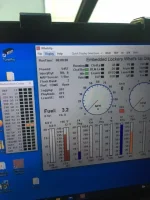
What is awesome about the ebl. Is logging.
It is not that difficult to hook a laptop to the ebl. Install the “whats up display”.
Menus are pretty simple to follow or a phone call can walk you through how to turn on logging and save the logging file.
Then you can see what and when it does things and there are people who can look at that log file and tell you exactly what is wrong.
Like loose connection the other day causing intermittent code 42.
 

Attachments

  • image0.webp
    image0.webp
    35.8 KB · Views: 0
It was just an option. It will work the same with or without a surge tank.
The pumps will stay cooler totally covered in fuel, as opposed to an
in-line pump bolted to a crossmember in the near vicinity of the exhaust
system. But, if you configure your tanks to include the in-tank options.
You only need 5-7 psi to boost the fuel to the high pressure in-line
injection pump. That was all I was trying to say.
EBL has a whole world of possibilities as far as controlling the
injectors as well as the ignition.
Jim Hupy
Salem, Oregon
 
The fuel pressure regulator is a bypass type so the pressure is the same
from the fuel pump outlet to the injectors. So your pressure has been
increased to something above 20psi. The lower pressure pump is likely worn
or the check valve is leaking in the other pump so it can't keep up. Since
they are 10 years old and you have the tanks down you might as well replace
both.
Since your fuel pressure is 20+psi you might have an external regulator on
the return line from the TB. Or maybe the PO put a stiffer spring in the
regulator.
current version just added USB instead of a serial port.
Once you get everything running, we can help you update the firmware in
the EBL and get the software running on your computer.
I would remove the mechanical fuel pressure gauge once you have everything
back together. Mechanical gauges fatigue and break internally in this
application and cause a fire. You can use a fuel pressure sensor and wire
it to the EBL to see fuel pressure.
Bruce Hislop
 
Bruce
It’s not a mechanical fuel pressure gauge. There is no other fuel
regulator on the system. Never even thought of good pump having bad check
valve.
I calculated fuel requirements based on HP and a BSFC OF .50 I came out
with a need of 75.88pph per injector. To achieve that with 61pph
injectors I need 19.8 of PSI. This would explain why the 20 pump is
noticeably better than the 15 which I agree is worn out. This leaves my
choices of
1. Change to Rochester and get new Airtex e3902 or
2. Change to airtex e3270 which will create more heat and maybe better off
in a surge tank.
I’ll need to think on this a little more.
Thanks to all for responses.
 
Bruce
Do you know if the 80# TBI injectors would bolt into the early Holly TBI in
place of the 60s? According to Howell the Holly uses the 80# injectors form
1995-96 GM Topkick 6.0.
I think I’m going to buy new e3902 pumps and either swap injectors or get a
Rochester set up.
 
I don't know if the GM injectors will fit in the Holley TB. Maybe someone
else here knows. I do know the connector to the injectors is different.
Bruce Hislop
 
Howell sold a kit a few years ago that would allow the use of GM injectors in the Holley throttle body. The Holley ones had been discontinued.
Emery Stora
77 Kingsley
Frederick, CO
 
That’s interesting. I’ve been emailing them and they never mentioned a kit.
As a matter of fact they insisted all I needed to do was tune via EBL. They
insisted the 80# injectors were unnecessary even after confirming their kit
now has them. When they told me stating the injectors are from a 1995-96
Topkick 6.0 GMC truck, I asked if the 61# could be switched out for 80# and
the statement was “You could swap injectors, as long as they will fit in
the housing.” followed by a snippy statement so I’m done with them.
I’ll go replace everything in my fuel system get it going and if I’m still
having issues I’ll trash the Howell Holley set up and find something else
like a Rochester.
 
I am currently installing a Howell system, and am using a FiTech sump. My
question is: will the 43 psi pump work against the TBI pressure regulator,
or should I seek out a pump near the 13 psi pressure? I am reading many of
you use "high pressure" pumps, either in-tank or otherwise, and am
wondering whether the pressure could cause another "failure point".
 
43 psi seems to be a bit much pressure for the Howell pressure regulator to
handle. They sometimes get kind of cranky at higher pressures in my
experience. But Randy Van Winkle is the go-to guy on this deal. My thoughts
on fuel supply from tank to high pressure pump is that 10 - 12 psi is
plenty if the lines are big enough for the volume required. Make sure that
you are using Gates "Barrier" reinforced hoses if you are using flexible
lines, and route them securely away from heat sources. Or, formed metal
lines work also.
Safety first on this stuff. High pressures make me shudder when there
is no purpose for it. If they leak, they spray fuel a long way. I
personally have seen 5 coaches burned to the lug nuts, 3 of them were
gasoline leak caused. Other two were electrical in nature.
Jim Hupy
Salem, Oregon
 
I’m in the same camp as Jim Hupy on this…. No reason for high pressure, when 13 or so will do.
I also highly recommend checking the pressure with the internal regulator (in the data sheet if you have the Holley).
30,000 miles on my Howell setup, and I’m pleased.
Dolph Santorine
Wheeling, WV
 
Thanks for the replies. I've been searching for days, and have come to the
conclusion that the higher pressures will work, but I am in agreement that
the pressure should be kept at nominal (13 psi) as long as the volume can
be accommodated. I have sourced a pump with the correct pressure/volume
output and will use the existing higher pressure pump as a spare. We all
know that you can't have too many spare parts!