This post will be a bit controversial but I've decided to share something that has worked out great for me.
A common recommendation is to disconnect the transmission kickdown switch activated by flooring the accelerator because of the stress this places on the transmission. Some folks disagree, noting that it reduces the acceleration available in an emergency maneuver and it's easy enough to avoid flooring the accelerator when on a hill (I'm in this camp). In general, for hill climbing the recommendation is to manually downshift, but this can be challenging as well when under way. Because of the age of our coaches, the shifter is balky more often than not, and it's all too easy to miss Super (2nd gear) and to downshift into Low (1st gear). Talk about something stressful to both the transmission and the driver!
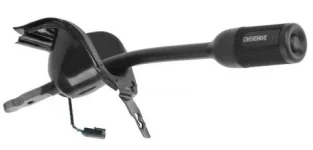
I decided that I wanted a way to manually activate the kickdown for moderate / short distance hill climb or acceleration situations. With this approach I could also let off the gas a bit to minimize stress on the transmission. The solution for me was to connect the kickdown switch to the unused cruise control activation button (a momentary switch) on the end of the turn signal stalk. I wired it in parallel to the accelerator-based kickdown and it works delightfully! I put a piece of heat shrink tubing over the black part of the turn signal stalk to avoid having a mislabeled button, and I attached a label describing the function to the inside of the glove box door just to be informative to potential future owners.
It is worth noting that that the kickdown uses different functionality in the transmission than manually downshifting. Functionally the downshift doesn't engage as strongly/positively. This can result in more slippage while engaging (which, by the way, reduces stress on the driveline if engaged under heavy load). It could also potentially permit slippage or additional heat under heavy load like a steep hill or when towing. In my case, though, under appropriate conditions, it provides a good boost while under way that is much less risky than trying to downshift via the column, and it's also preferable to lugging the engine.
Would love to hear your thoughts and comments.
A common recommendation is to disconnect the transmission kickdown switch activated by flooring the accelerator because of the stress this places on the transmission. Some folks disagree, noting that it reduces the acceleration available in an emergency maneuver and it's easy enough to avoid flooring the accelerator when on a hill (I'm in this camp). In general, for hill climbing the recommendation is to manually downshift, but this can be challenging as well when under way. Because of the age of our coaches, the shifter is balky more often than not, and it's all too easy to miss Super (2nd gear) and to downshift into Low (1st gear). Talk about something stressful to both the transmission and the driver!
I decided that I wanted a way to manually activate the kickdown for moderate / short distance hill climb or acceleration situations. With this approach I could also let off the gas a bit to minimize stress on the transmission. The solution for me was to connect the kickdown switch to the unused cruise control activation button (a momentary switch) on the end of the turn signal stalk. I wired it in parallel to the accelerator-based kickdown and it works delightfully! I put a piece of heat shrink tubing over the black part of the turn signal stalk to avoid having a mislabeled button, and I attached a label describing the function to the inside of the glove box door just to be informative to potential future owners.
It is worth noting that that the kickdown uses different functionality in the transmission than manually downshifting. Functionally the downshift doesn't engage as strongly/positively. This can result in more slippage while engaging (which, by the way, reduces stress on the driveline if engaged under heavy load). It could also potentially permit slippage or additional heat under heavy load like a steep hill or when towing. In my case, though, under appropriate conditions, it provides a good boost while under way that is much less risky than trying to downshift via the column, and it's also preferable to lugging the engine.
Would love to hear your thoughts and comments.