Problems with the engine

It was mentioned several times that the fuel lines should be replaced. Note that if you do not drop the tanks and replace the lines all the way to the pickups, you are NOT replacing the fuel lines. When I dropped my tanks, I replaced the rubber with steel lines, and bent them downwards at the edge of the tank so I can easily connect new rubber to them. This procedure is outlined in a GMCMI presentation by Emory Stora. See: https://www.gmcmi.com/wp-content/uploads/2013/02/In_tank_Fuel_Pump_Presentation.pdf
Emery was a treasure - a tremendous source of GMC "been there done that" knowledge.

Going down the rabbit hole of his postings on the original forum and the GMC photo site is never wasted time and highly recommended.
 
  • Like
Reactions: EricS
It was mentioned several times that the fuel lines should be replaced. Note that if you do not drop the tanks and replace the lines all the way to the pickups, you are NOT replacing the fuel lines. When I dropped my tanks, I replaced the rubber with steel lines, and bent them downwards at the edge of the tank so I can easily connect new rubber to them. This procedure is outlined in a GMCMI presentation by Emory Stora. See: https://www.gmcmi.com/wp-content/uploads/2013/02/In_tank_Fuel_Pump_Presentation.pdf
Thanks for Ermory's link. I downloaded it. Fantastic presentation! Thank you!
 
  • Like
Reactions: EricS
You could put a pressure gauge on the fuel line to see what it's doing, normal pressure for a carb should be about 5-6 psi I believe. Another thought could be a cracked intake manifold, mine acted like this when it cracked, when it cools the crack closes back up and it runs better.
 
  • Like
Reactions: Don Jaksa
I finally had some time to work on the GMC today. I replaced the Main to Auxiliary Fuel Tank Selector Valve. (That valve WAS faulty.) I added check valves to lines from each tank before the Valve. I also added an electric fuel pump before the Valve.

I'm assuming that if I had a dying mechanical fuel pump, I could simply flip the switch for the Auxiliary Fuel Tank. This would energize the new electric pump. My assumption is that the mechanical fuel pump would allow fuel to pass through it from the electric pump. Is this correct?
 
  • Like
Reactions: tmsnyder
I finally had some time to work on the GMC today. I replaced the Main to Auxiliary Fuel Tank Selector Valve. (That valve WAS faulty.) I added check valves to lines from each tank before the Valve. I also added an electric fuel pump before the Valve.

I'm assuming that if I had a dying mechanical fuel pump, I could simply flip the switch for the Auxiliary Fuel Tank. This would energize the new electric pump. My assumption is that the mechanical fuel pump would allow fuel to pass through it from the electric pump. Is this correct?
Correct!
 
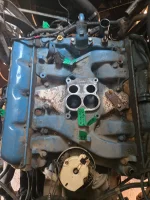
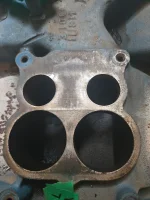
Problem not solved. I am now thinking that I may have a cracked intake manifold. The engine had been rebuilt by the previous owner just before I purchased it. The trip to Vidalia is when I started having troubles. I also noticed that the paint on the intake manifold where the exhaust crossover is became quite crispy. This means that there are no block off plates. I will pull the carb and take a look for the infamous crack.
 
  • Like
Reactions: pvfjr
Problem not solved. I am now thinking that I may have a cracked intake manifold. The engine had been rebuilt by the previous owner just before I purchased it. The trip to Vidalia is when I started having troubles. I also noticed that the paint on the intake manifold where the exhaust crossover is became quite crispy. This means that there are no block off plates. I will pull the carb and take a look for the infamous crack.
I still think you should try running off a boat tank….

My brother’s gmc had similar symptoms. Some trips ran fine. Tried a number of things and then he hooked up a boat tank. And it is running fine on the boat tank. He has been running on a boat tank for over a year now. Have not dropped tanks to see what was going on yet. But it for sure was/is a fuel delivery issue. Had lines or maybe bad socks/pickup in tank??
 
I still think you should try running off a boat tank….

My brother’s gmc had similar symptoms. Some trips ran fine. Tried a number of things and then he hooked up a boat tank. And it is running fine on the boat tank. He has been running on a boat tank for over a year now. Have not dropped tanks to see what was going on yet. But it for sure was/is a fuel delivery issue. Had lines or maybe bad socks/pickup in tank??
I guess your brother doesn't drive very far. 🤔
 
I guess your brother doesn't drive very far. 🤔
He has not done any long trips. Camps near a lake 3-4 weekends a summer.

About 70 miles one way. Between the boat tank and a 5 gallon can, he has made it to the lake, and back a 1/2 dozen times now on the boat tank.

First couple summers, tossed new fuel filters. Pump, .. coil. Ignition Modules. Ect.. everything short of dropping the tanks. . I installed the insulated carb line on it one summer when I visited. The PO claimed to have had new fuel lines done. We thought it was fixed a couple times as it had made a lake trip perfectly a couple times. Think the boat tank went in the fall of 2024. Been running solid since.

My guess is tank venting problems, Or fuel socks. Something you cant fix or see without dropping tanks.
 
  • Like
Reactions: Richard RV
He's in Albany, right? We should get him over to Mehama and on the lift some time. My buddy and I can drop tanks in no time.
Yes. albany.

I told him he should fly me out. But usually when I fly out it is for fun. Not to work on his gmc. I installed that carb line at the campground.

I will be out camping with him again over the 4th of july week.
 
If it is fuel socks you can disconnect the fuel line before the selector valve. or electric fuel pump. If no gas comes out of hose, connect a 3-foot piece of gas hose and blow back to unplug sock. I have had to do this a number of times on my own and a friend's coach.
I checked this. Gas flowed fine out of the fuel line before the selector valve. In fact, my clamp fell off and I ended up taking a bath in fuel. Un-fun.
 
Yesterday, I discovered that the front two bolts that bolt the carb to the manifold were not tight. The rear two bolts were very tight. I tightened the front two bolts slightly (I think they are supposed to be torqued to 15 foot pounds).
Today, with ambient temperatures in the low 80's, I went on a 35 mile drive. Once again, at highway speeds (65 and 55). Engine temperatures held steady near 200 degrees. Halfway through, I go through a small town. This required me to slow down to 20 mph for a number of blocks, and then eventually come to a stop. In the past, when I tried to accelerate to highway speeds from this dead stop, the engine would die. Today, it did not die. I noticed a little stumble and a lack of power, but no stalls, and I got up the hill and to highway speeds.
I am not considering the problem solved yet. It was a cooler morning, only in the lower 80's. I am thinking that this might confirm a vacuum problem. I'm thinking that I will need to get the block off plates and reseal the intake manifold sooner rather than later. Do you all concur?
 
Yesterday, I discovered that the front two bolts that bolt the carb to the manifold were not tight. The rear two bolts were very tight. I tightened the front two bolts slightly (I think they are supposed to be torqued to 15 foot pounds).
Today, with ambient temperatures in the low 80's, I went on a 35 mile drive. Once again, at highway speeds (65 and 55). Engine temperatures held steady near 200 degrees. Halfway through, I go through a small town. This required me to slow down to 20 mph for a number of blocks, and then eventually come to a stop. In the past, when I tried to accelerate to highway speeds from this dead stop, the engine would die. Today, it did not die. I noticed a little stumble and a lack of power, but no stalls, and I got up the hill and to highway speeds.
I am not considering the problem solved yet. It was a cooler morning, only in the lower 80's. I am thinking that this might confirm a vacuum problem. I'm thinking that I will need to get the block off plates and reseal the intake manifold sooner rather than later. Do you all concur?
It's certainly not a bad idea.

Whenever I have an engine that seems a bit goofy, I like to do a full compression test, leak-down test, and smoke test just to make 100% certain I don't have a problem with the hard parts (pistons, rings, valves, etc). I also like to check for timing chain slack (can be done by observing distributor rotor while rocking crank back and forth, or inspecting through fuel pump hole).

The smoke test can really help find the odd mysteries sometimes, and should be done both hot and cold. There are plenty of home-brew ways of making a smoke machine too. I have one with a cheap aquarium air pump, a glass jar, tiki torch wicks, steel wire and an old laptop power supply.

After I'm satisfied with all those things, I feel more confident looking into carb/fuel and ignition issues.