Problems with the engine

RvRev2

Active member
Mar 9, 2024
225
181
43
Kansas
In another post on "So What Did You Do To Your GMC Today?" I shared some engine problems I was having on the way down to the Spring Rally. Someone suggested that it would probably be better to make this topic its own post. So, I have attached the history on this topic from the other post in a PDF below.

In a nutshell, I traveled down to Vidalia for the Spring Rally. I took 3 days to get there. After driving more than 4 hours, when I would slow down or come to a stop, and then started to accelerate, the engine would shut down. This happened on the first two days getting down there. The third day was a short trip, just 2 or 3 hours long, and I had no issues. Each time I had this issue, it would not restart for between 10 minutes and 30 minutes.

This happened on the way back home as well. However, on the way back home, once I got past Dallas, it started to cool down outside, and was getting dark. I reasoned that I wouldn't have vapor lock running at night, so I drove all the way home non-stop except to refuel. No vapor lock troubles after dark.

I have since replaced my fan clutch, as well as the thermostat. I disconnected an electric fan I had purchased on the way down to the Rally. I had also replaced the Ignition Module in the distributor cap before I returned home. I have also replaced the carburetor fuel filter.

I have purchased an electric fuel pump to install near the fuel tank, but have not installed it yet.

I was thinking of installing a 3 port mechanical fuel pump to replace the 2 port pumps our rigs come with, and then run a return line back to the tank as I had heard that was helpful. Others thought it not a good idea because of potential fire hazards.

A new issue has since arisen. I drove the GMC to the gas station to put non-ethanol fuel in it. As I pulled out of my drive way, and onto the street, as I attempted to accelerate, it died. While rolling, I put it in Neutral and it fired right up. I made it to the gas station and back, and it stumbled a few times. It wasn't even warmed up yet. I didn't have much power as well.

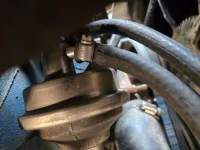
Today I was tracing out the fuel lines to see if there was another fuel filter I didn't know about. I didn't find an inline fuel filter, but I discovered I have a 3 port mechanical fuel pump with line running back to the tanks.

I'm thinking I have a fuel delivery issue. Would a worn out or close to failing mechanical fuel pump cause my issues? Could something with the fuel return line be causing my issues? I'm in over my head here.
20260515_144551.webp
 

Attachments

Did you put thermal compound (heat sink grease) on the back of the ignition module before installing?

The wires on the distributor pickup fatigue and break from the vacuum advance moving them back and forth continuously causing intermittent ignition.

My coach would stumble, die or not start intermittently. I finally found an OEM crimp connector that was fully crimped on the insulation but the conductor itself was loose in the connector. Once I found that and re-crimped the wire tight it has run great ever since!
 
Did you put thermal compound (heat sink grease) on the back of the ignition module before installing?
Yes I did.
The wires on the distributor pickup fatigue and break from the vacuum advance moving them back and forth continuously causing intermittent ignition.

My coach would stumble, die or not start intermittently. I finally found an OEM crimp connector that was fully crimped on the insulation but the conductor itself was loose in the connector. Once I found that and re-crimped the wire tight it has run great ever since!
I'll look into that. Thanks!
 
Get yourself a can of starter fluid.
When you encounter the no start condition, see if engine will start with a shot of starter fluid. This will help to isolate the problem to fuel or ignition related.
If it's fuel, you could install the electric pump temporarily to see if that solves the problem. My system is a FiTech injection setup and I have a feed pump installed underneath at about the middle of my coach. Pretty easy to do and nearby the fuel lines. Add a metal shield underneath for added protection.
If it's ignition, verify ignition isn't "sloppy". Some coils can fail when hot, though not something I've seen much with HEI coils. Also, replacing your ignition module isn't the guarantee it used to be. I bought a new NAPA module as a backup. Replaced it at last tuneup and it didn't work. OE part back in their. Electronic module parts aren't what they used to be. Or maybe I'm using the wrong sources.
 
  • Like
Reactions: pvfjr
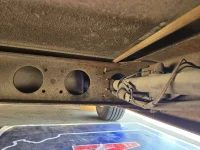
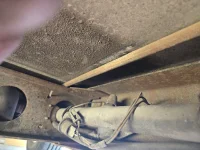
Purchased the Carter fuel pump. Looking at installing it before the fuel tank selector valve. Wiring is not a problem. I just don't have a lot of room under there. Here are photos of my current set up. Where/how would you install the pump? I know people like to install on the outside of the frame rail, but I have the emergency brake cable running there. There is no room on the inside of the frame rail, as you can see in the pictures below. If I were to install it near the selector valve on the crossbeam, I would need to manufacture something to make the pump sit proud of the "C" channel as the pump is too tall to fit inside the "C" channel (assuming you can't lay the pump on its side). Plus I got the last of the fuel hose from the parts store, and that is only 3 feet. 20260516_104656.webp20260516_104705.webp
 
Purchased the Carter fuel pump. Looking at installing it before the fuel tank selector valve. Wiring is not a problem. I just don't have a lot of room under there. Here are photos of my current set up. Where/how would you install the pump? I know people like to install on the outside of the frame rail, but I have the emergency brake cable running there. There is no room on the inside of the frame rail, as you can see in the pictures below. If I were to install it near the selector valve on the crossbeam, I would need to manufacture something to make the pump sit proud of the "C" channel as the pump is too tall to fit inside the "C" channel (assuming you can't lay the pump on its side). Plus I got the last of the fuel hose from the parts store, and that is only 3 feet. View attachment 18527View attachment 18528

I have mine mounted on the outside of the frame:


But I've seen them mounted to the cross-member. The only issue I can see with that is there is a lot of heat under there, but probably no more than the spot on the inside of the frame rail.
 
I have mine mounted on the outside of the frame:


But I've seen them mounted to the cross-member. The only issue I can see with that is there is a lot of heat under there, but probably no more than the spot on the inside of the frame rail.
I can see the point of having the pump, filters etc on the outside of the frame for serviceability.

But at the same time I think its an accident waiting to happen. Road trash thrown up by the front wheels, damaged in case of an accident etc. Need some protection around that stuff.
 
I took the GMC for a drive today. Got out of town just fine, as I'm only a few blocks from the outskirts. Drove 65 mph for 15 minutes, and everything was just fine. Went through a small town to turn back towards home, and at a stop sign, it stalled within 2 or 3 seconds of starting off from the dead stop. I was able to put it in Neutral and restart, and tried to accelerate, and it stalled again. Neutral and restart, and took it easy on the gas until I was rolling above 40 mph, and all was well again.

Came to another stop sign. Died as I started off again. This time it did not restart easily. It would crank, fire, and die before I could accelerate. Then it wouldn't even crank. I rolled to a stop and put it in Park, and then it restarted.

I drove back in to my town, and came to a 4 way stop. I topped and waited for 2 cars, and then on my turn I accelerated through the intersection very slowly. I made it to my driveway. At one point in backing in my driveway, it stalled again, and would not restart. It would crank, but not start/run.

I drove to the auto parts store and purchased some starter fluid. Drove back home and tried that. It started with the starter fluid, but would soon die. Then, all of a sudden, it started and ran just fine again.

The engine temps were good, running between 180 and 200. It may have reached 205 at one point. It was in the 90's for ambient temperature today.

I am not a mechanic, but am not afraid to get my hands dirty.

I don't know if this is fuel related, electrical related, or carburetor related, or something else.
 
Two things to do to determine if it is gas or electrical.

#1 When engine has stalled open hatch, remove air cleaner, and cycle throttle cable on side of carb. Look down the throat of the smaller bore and see if you have a steady stream of gas.

#2 Purchase an in-line spark tester to check for spark.

Or disconnect sparkplug wire from one of the cylinders and hold it away from a ground source and check for spark.

My thoughts are you have a bad fuel pump.
 
Last edited:
  • Like
Reactions: Carl Stouffer
Two things to do to determine if it is gas or electrical.

#1 When engine has stalled open hatch, remove air cleaner, and cycle throttle cable on side of carb. Look down the throat of the smaller bore and see if you have a steady stream of gas.

#2 Purchase an in-line spark tester to check for spark.

Or disconnect sparkplug wire from one of the cylinders and hold it away from a ground source and check for spark.

My thoughts are you have a bad fuel pump.
I have a mechanical fuel pump, and have not yet installed the auxiliary electric fuel pump. I was thinking that mechanical fuel pumps worked, or they didn't. Am I wrong in that? Replacing the mechanical fuel pump would be straight forward.
 
I took the GMC for a drive today. Got out of town just fine, as I'm only a few blocks from the outskirts. Drove 65 mph for 15 minutes, and everything was just fine. Went through a small town to turn back towards home, and at a stop sign, it stalled within 2 or 3 seconds of starting off from the dead stop. I was able to put it in Neutral and restart, and tried to accelerate, and it stalled again. Neutral and restart, and took it easy on the gas until I was rolling above 40 mph, and all was well again.

Came to another stop sign. Died as I started off again. This time it did not restart easily. It would crank, fire, and die before I could accelerate. Then it wouldn't even crank. I rolled to a stop and put it in Park, and then it restarted.

I drove back in to my town, and came to a 4 way stop. I topped and waited for 2 cars, and then on my turn I accelerated through the intersection very slowly. I made it to my driveway. At one point in backing in my driveway, it stalled again, and would not restart. It would crank, but not start/run.

I drove to the auto parts store and purchased some starter fluid. Drove back home and tried that. It started with the starter fluid, but would soon die. Then, all of a sudden, it started and ran just fine again.

The engine temps were good, running between 180 and 200. It may have reached 205 at one point. It was in the 90's for ambient temperature today.

I am not a mechanic, but am not afraid to get my hands dirty.

I don't know if this is fuel related, electrical related, or carburetor related, or something else.
Definitely sounds like a fuel delivery problem. I am assuming you did replace the fuel filter in the carburetor? You are pretty much right about a mechanical either working or not, but if it's original, replacing would be advised.
The thing that concerns me is the relation to engine temperature. Any fuel lines near exhaust lines, somehow, or physical damage causing a restriction? Some hose leak on the inlet side?
I would definitely try the electric to see if it changes the symptoms. Do you have to drive it to get it to fail?
 
Definitely sounds like a fuel delivery problem. I am assuming you did replace the fuel filter in the carburetor? You are pretty much right about a mechanical either working or not, but if it's original, replacing would be advised.
The thing that concerns me is the relation to engine temperature. Any fuel lines near exhaust lines, somehow, or physical damage causing a restriction? Some hose leak on the inlet side?
I would definitely try the electric to see if it changes the symptoms. Do you have to drive it to get it to fail?
I have replaced the filter at the carb.

I don't think it is the original mechanical pump. I have discovered that my mechanical pump has 3 ports, the third port being a return line to the tanks.

In regards to temperature, last summer I drove from Kansas to Oklahoma to travel Route 66. There were days of triple digit temps, but I never had a single problem like this.

I have replaced the fan clutch, and the thermostat. The engine was rebuilt about 3,000 miles ago by the previous owner. The engine does appear to be running cooling after the new parts.

Yes I do have to drive it to get it to fail. It appears to idle just fine. It also appears to go forever as long as you are driving at highway speeds. Slow way down, or stop, and the problem rears its ugly head. In fact, I feel like it is getting worse. It just appears to not like to accelerate after slow or stop.

I'll get creative with the auxiliary electric fuel pump to see if it solves the problem.
 
You mentioned you have a third line that returns to tanks, that can work, but it is not how it left the factory...so you need to verify where that is going and the integrity of hoses and connections.

Second thing to be aware of and check as you go: if the diaphragm in the mechanical fuel pump fails, it lets gas into the engine oil. This dilutes it and ruins the engine completely very quickly, so if you don't know how old the mech pump is, I recommend putting a new one on for this reason even if the current problem is not from the pump.

In your first post, the top hose looks cracked and some abrasion on the camera side...new hoses might be in order and may or may not solve the running issue. There are grades of hoses and Barrier is what is often mentioned as good on here, but maybe do some research. You don't need fuel injection rated, just ethanol rated.
 
  • Like
Reactions: RvRev2
I have replaced the filter at the carb.

I don't think it is the original mechanical pump. I have discovered that my mechanical pump has 3 ports, the third port being a return line to the tanks.

In regards to temperature, last summer I drove from Kansas to Oklahoma to travel Route 66. There were days of triple digit temps, but I never had a single problem like this.

I have replaced the fan clutch, and the thermostat. The engine was rebuilt about 3,000 miles ago by the previous owner. The engine does appear to be running cooling after the new parts.

Yes I do have to drive it to get it to fail. It appears to idle just fine. It also appears to go forever as long as you are driving at highway speeds. Slow way down, or stop, and the problem rears its ugly head. In fact, I feel like it is getting worse. It just appears to not like to accelerate after slow or stop.

I'll get creative with the auxiliary electric fuel pump to see if it solves the problem.
I have mentioned before that I dont care for the 3 port pump. I have now added another reason to my list.

In your situation you seem to be possibly questioning your fuel delivery system…. One would think it is a simple system, But it really has lots of moving parts. Venting, Fuel socks. The selector valve and I think 70 ft of possible fuel line issues(crushed, cracked, ect).

At this point what you should do is set up a boat tank system. Usually I would just easily hook to the input of the fuel pump. But with the 3rd port return, maybe that return is not allowing constant fuel
Delivery. So hook up a boat
Tank. See how it does, Then if still stalling, switch to a 2 port pump. Fuel pumps are not too hard to change.

A 5 gallon boat tank will run your coach for at lest 30 miles. And doing that will tell you if your chasing fuel delivery or if there is something with the engine.

Starting fluid is hard
On a motor. Try not to be using that.
 
I have mentioned before that I dont care for the 3 port pump. I have now added another reason to my list.

In your situation you seem to be possibly questioning your fuel delivery system…. One would think it is a simple system, But it really has lots of moving parts. Venting, Fuel socks. The selector valve and I think 70 ft of possible fuel line issues(crushed, cracked, ect).

At this point what you should do is set up a boat tank system. Usually I would just easily hook to the input of the fuel pump. But with the 3rd port return, maybe that return is not allowing constant fuel
Delivery. So hook up a boat
Tank. See how it does, Then if still stalling, switch to a 2 port pump. Fuel pumps are not too hard to change.

A 5 gallon boat tank will run your coach for at lest 30 miles. And doing that will tell you if your chasing fuel delivery or if there is something with the engine.

Starting fluid is hard
On a motor. Try not to be using that.
I should add. Long range success I am a believer in the aux pump. I have seen that work for people well for decades and was perfect for me as well. The carter is a great pump and seems to be most reliable. But it is not the most straightforward to mount. I prefer
The cube pump
For
That. If a cube pump is exercised occasionally they do seem to last. And you can hear them and determine if it is bad before you drive far. (I would turn it on to start engine, Then turn it off to drive and only use when vapor lock is an issue after
That).
 
  • Like
Reactions: RvRev2
A cracked or deteriorated fuel hose, somewhere in the system, could be sucking air.
Pumps and vapor lock are always prime suspects when engines stumble and die, but hoses, connections and the fuel selector valve should also be verified.

When I first got the Birchaven I had a number of things that were additive in causing the problems. One was the fuel selector valve was sucking from both tanks at the same time. I don't know if it was an intermittent problem or persistent, but higher fuel levels masked the problem. When the fuel level was lower and I was taking a left turn the problem would rear its head.

Another problem was the rubber fuel line on top of the tanks was partially flattened so it was oval, when under suction it would flatten more and be more restrictive. When fuel hose, any hose, is wound onto the spool at the factory it's done under tension and the hose takes a set. Pinch a piece of fuel hose between your fingers then rotate the hose 90° and pinch it again. You'll feel the difference in the amount of force it takes to pinch the hose. I don't think that this is a major factor, more a contributing one.

After I had the valve and hoses replaced I discovered that a couple of the hose clamps hadn't been tightened. 🤔 They were on the suction side of the selector valve and didn't leak fluid, but it's possible that air was able to enter the fuel stream and create a bubble. Again, maybe not likely, but another easy thing to check.


 
  • Like
Reactions: RvRev2
You mentioned you have a third line that returns to tanks, that can work, but it is not how it left the factory...so you need to verify where that is going and the integrity of hoses and connections.

Second thing to be aware of and check as you go: if the diaphragm in the mechanical fuel pump fails, it lets gas into the engine oil. This dilutes it and ruins the engine completely very quickly, so if you don't know how old the mech pump is, I recommend putting a new one on for this reason even if the current problem is not from the pump.

In your first post, the top hose looks cracked and some abrasion on the camera side...new hoses might be in order and may or may not solve the running issue. There are grades of hoses and Barrier is what is often mentioned as good on here, but maybe do some research. You don't need fuel injection rated, just ethanol rated.
Barrier or Barricade for the fuel hose?