Electric Choke Connection and Marine Water Heater to Radiator plumbing

RvRev2

Active member
Mar 9, 2024
228
183
43
Kansas
Howdy all,

Working on two things right now.
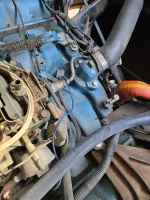
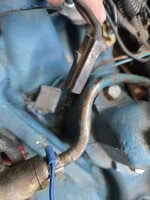
1. I took off the air cleaner/filter from the carburetor today, and as I did the blue wire going to the choke fell off its connector. Trouble is, I didn't see which electrical connector it fell off of, and there appears to be three possibilities. There is a two wire plastic connector with a blue wire and a black wire. There is also a single wire plastic connector with the wire being black. I have attached photos below. How can I tell which one is the correct one to re-attach the carb choke?

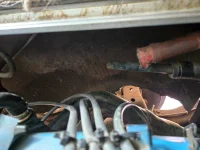
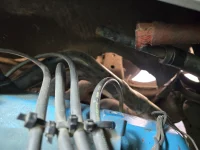
2. I've got the heater hose, so I was going to re-connect the marine water heater to the radiator. I traced the plumbing from the marine water heater all the way up to the passenger side, rear of the engine. I just can't see where I plumb the lines into the radiator. Once again, pictures attached. Can anyone send me photos of your setup? Give me some direction?

Thanks in advance!
 

Attachments

  • which electrical connection 2.webp
    which electrical connection 2.webp
    1.3 MB · Views: 10
  • Which electrical connection 1.webp
    Which electrical connection 1.webp
    1.4 MB · Views: 11
  • From Marine Water Heater to Passenger side engine.webp
    From Marine Water Heater to Passenger side engine.webp
    1 MB · Views: 10
  • Lines from Marine Water Heater.webp
    Lines from Marine Water Heater.webp
    1.4 MB · Views: 13
I was told the electronic choke should not have constant key-on power because that keeps the coil constantly heated and can burn out the coil. To me that doesn't make sense since the original choke would have been hot all the time too. 🤷‍♂️. But the carb does "actuate" into the choke open mode at which point you could theoretically stop sending the choke heat and it will stay open. Has anyone bothered with that?
 
I'll check my water heater connections tomorrow, @RvRev2. I noticed one of the tees today when I was working on something else, but I can't quite describe it. For sure it was on a passenger side water hose, fairly far back, but I don't recall what that hose does. I'll have to figure out where the other tee is also.
 
  • Like
Reactions: RvRev2
I was told the electronic choke should not have constant key-on power because that keeps the coil constantly heated and can burn out the coil. To me that doesn't make sense since the original choke would have been hot all the time too. 🤷‍♂️. But the carb does "actuate" into the choke open mode at which point you could theoretically stop sending the choke heat and it will stay open. Has anyone bothered with that?
A timer on the 12V line to the choke might help extend the coil's lifespan, but I don't think they are a high-failure-rate item. The coil might even have an internal limit switch...I don't know. It would be interesting to compare the coil current at start-up versus engine at operating temperature.

Also, the original choke on our engines used a stove design, taking heat from the exhaust cross-overs in the manifold instead of using the electric coil. Newer engines which had the OEM electric choke Qjet may have been designed with an external control for the choke coil.
 
Last edited:
I was told the electronic choke should not have constant key-on power because that keeps the coil constantly heated and can burn out the coil. To me that doesn't make sense since the original choke would have been hot all the time too. 🤷‍♂️. But the carb does "actuate" into the choke open mode at which point you could theoretically stop sending the choke heat and it will stay open. Has anyone bothered with that?

To close the choke, with the engine cold, one steps fully on the throttle and then lets off the throttle. The choke will close. The engine will start and run on primaries only as the secondaries are prevented from open.

The electric choke heater will cause the choke to open up as the heater works. It takes time to heat up. Blipping the throttle will allow the choke to open fully once the heater warms up, and there are a couple stages to that process, where the engine can be run at an elevated rpm while the engine warms up. Continuous 12V to the choke keeps the choke open.

If you cut power to the choke heater, the next time you stomp on the fuel the choke will close. You'll also lose the secondaries.

The common way to wire this is to connect the choke heater to the center post on the battery isolator. That only see's 12v when the engine is running and the alternator is making 12V. This way, it won't start heating up with the key on if you were waiting for your aux lift pump to fill the carb, or while cranking the engine to start it. It will only start heating once the engine is actually running.
 
Okay guys, I finally had time to work on the choke issue. I did as you said, and only one of the connectors showed 12v when the ignition key was turned to "ON." I hooked it up to that, and we'll see if that does the trick. The engine ran fine before I knocked the choke wire off. As we said in the Navy, "If it ain't broke, don't fix it." If this doesn't do the trick, I'll run a wire from the center post of the battery isolator to the choke.
Thank you all for your help!
 
To close the choke, with the engine cold, one steps fully on the throttle and then lets off the throttle. The choke will close. The engine will start and run on primaries only as the secondaries are prevented from open.

The electric choke heater will cause the choke to open up as the heater works. It takes time to heat up. Blipping the throttle will allow the choke to open fully once the heater warms up, and there are a couple stages to that process, where the engine can be run at an elevated rpm while the engine warms up. Continuous 12V to the choke keeps the choke open.

If you cut power to the choke heater, the next time you stomp on the fuel the choke will close. You'll also lose the secondaries.

The common way to wire this is to connect the choke heater to the center post on the battery isolator. That only see's 12v when the engine is running and the alternator is making 12V. This way, it won't start heating up with the key on if you were waiting for your aux lift pump to fill the carb, or while cranking the engine to start it. It will only start heating once the engine is actually runn
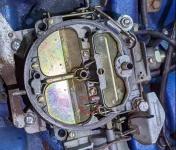
Drove around for 15 minutes on a 94 degree day. I had the engine hatch off so I could see the top of the carb as I drove. The primary choke opens fine. But I noticed while running at 190 to 200 degrees engine temp, that during acceleration, the secondaries do not open up. The air door just don't open at all.
 
Drove around for 15 minutes on a 94 degree day. I had the engine hatch off so I could see the top of the carb as I drove. The primary choke opens fine. But I noticed while running at 190 to 200 degrees engine temp, that during acceleration, the secondaries do not open up. The air door just don't open at all.
There's a little lockout tab hooked to the choke assembly that will keep the secondary plates from opening. The choke has to be super open all the way. Check on the operation of that. Perhaps the choke, choke pull off needs just a little adjustment, or the coil isn't moving as far is it should.

1778627254122.webp
 
  • Like
Reactions: RvRev2
Drove around for 15 minutes on a 94 degree day. I had the engine hatch off so I could see the top of the carb as I drove. The primary choke opens fine. But I noticed while running at 190 to 200 degrees engine temp, that during acceleration, the secondaries do not open up. The air door just don't open at all.

You need to verify that the choke is opening fully, it's adjustable by loosening the 3 screws on the choke housing and rotating the black circular lid on the housing, clockwise will make it open sooner.

When it's cold, you should try adjusting that lid so the choke is closed, but not overly closed if that makes sense. You want it to be opening right away as the engine warms up.
 
There's a little lockout tab hooked to the choke assembly that will keep the secondary plates from opening. The choke has to be super open all the way. Check on the operation of that. Perhaps the choke, choke pull off needs just a little adjustment, or the coil isn't moving as far is it should.

View attachment 18498
Howdy Paul,
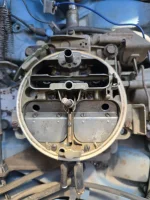
Here is a picture of the top of my carb.Carb 1.webp
 
Lots of good info from this web site.

From: quadrajetpower.com

Secondaries won’t open

Symptom: Secondaries don’t open, press pedal to floor and they don’t move.
Solutions:
•Secondary air valves on top of carb won’t open unless under load. Revving engine in park, they may not open.
•Quadrajets have a secondary lock out system, most to hold throttle blades in base, some early 65-70 have it on the air horn to prevent air valves from opening. This is activated by choke. Make sure choke is completely off, and the lock out is clear of the throttle blades. These lockouts can be removed if desired.
•Check throttle cable to make sure it is adjusted correctly. With engine off, some body presses pedal to floor and make sure throttle blades are open fully.
•Make sure base gasket isn’t interfering with throttle operation


The throttle peddle Bracket can be twisted enough so that even if floored there is not enough cable pull to open the secondaries.
Emery Stora came up with a solution to use the large split shot (fishing gear) on the back side of throttle peddle along the cable to shorten the cable throw.
Maybe you can grab ahold of the throttle peddle and try to force it up a bit.

Post #2 from Matt Cole
[IMG alt="Matt Colie"]https://www.gmcmotorhome.org/data/avatars/s/0/218.jpg?1639493036[/IMG]
 
The common way to wire this is to connect the choke heater to the center post on the battery isolator. That only see's 12v when the engine is running and the alternator is making 12V. This way, it won't start heating up with the key on if you were waiting for your aux lift pump to fill the carb, or while cranking the engine to start it. It will only start heating once the engine is actually running.
This is how I connected my electric choke but fused.