I always like to add, whether solicited or not, that this little guy fits in that space and zips those 12-pt bolts out no problem.
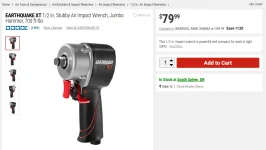
I always like to add, whether solicited or not, that this little guy fits in that space and zips those 12-pt bolts out no problem.
View attachment 18254
It becomes a tedious task trying to use ratchets or wrenches in that space for sure! I was quite pleased, when working on my second coach, to discover that little impact actually fit where I needed it to, and had plenty of oomph. Particularly since I like to Loctite the snot out of those things since I reuse the originals.Interesting.
I just pulled the axles from my parts coach using a 3/8 box end Barcalo wrench with a larger wrench on the open end for leverage. By the time I finished, the little wrench had an obvious bend LOL

Need to get me one of these. I used a socket wrench and crowbar to keep the axle from moving. Lots of back and forth adjustments…It becomes a tedious task trying to use ratchets or wrenches in that space for sure! I was quite pleased, when working on my second coach, to discover that little impact actually fit where I needed it to, and had plenty of oomph. Particularly since I like to Loctite the snot out of those things since I reuse the originals.

This is what I, and many in the community, use -Planning on doing the boot replacement on Monday. Picked up the boot and bands from Napa. The band tensioner arrives tomorrow, so all ready to go ...however, if it turns out to be a problem to separate the CV from the axle on the coach, I thought I'd have a backup plan ready to remove the axle and do the job on the bench.
If I DO have remove it completely and the axle bolts can't be reused, I'd like to buy some new ones today just in case I need them.
I saw on the link page they are grade 8 but didn't find the info on the size or torque - anyone know the specs and how many I need for these bolts at the final drive? (coach out at storage area at the moment)
Thanks
Larry

Thanks! how many do I need and do you know the torque setting for these bolts?This is what I, and many in the community, use -
McMaster-Carr
McMaster-Carr is the complete source for your plant with over 595,000 products. 98% of products ordered ship from stock and deliver same or next day.www.mcmaster.com
You really, really don’t want these loosening up, so be sure to use washers. I also added a dab of Loktite blue to each.

The manual says 75 ft-lbs for the bolts to the output shafts. That's a torque to yield number meaning that the bolt stretches and doesn't go back to its original length when it's unbolted. It's a permanent deformation. If the bolts are reused and torqued to the same value they'll deform more, it's cumulative. That's why the manual says to not reuse the bolts.Thanks! how many do I need and do you know the torque setting for these bolts?
I've done it. More importantly Bob Drewes posted it and he was one of the uber gurus.Have you done this? I removed my axles the last time because I needed to change the inner boots, but if this works I’ll use this process the next time the outers need to be replaced (which is much more frequently than the inners).
This raises some questions for me, Todd. A dry 3/8-24 Grade 8 bolt is torqued to ~45 ft-lbs ('standard' torque charts vary quite a bit), which is ~85% of its proof load and provides a clamping load of 7875 pounds. Proof load is a working‑strength limit - the highest load that can be applied repeatedly without causing permanent deformation.I reused the inner bolts torqued to Grade 8 number from a standard published table for that size bolt (they are higher grade in reality) with blue LockTite
I hear this repeated a lot, going many years back, and it is generally accepted as common knowledge.That's a torque to yield number
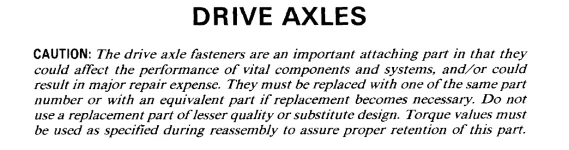
Where? I could be missing it somewhere (it is a length volume), or maybe I'm looking at a different version. I'm not seeing it in the X7525 manual. They do have this blurb that says, if it needs replacement the replacement should be equivalent:That's why the manual says to not reuse the bolts.
That does raise a good question. What is the lubricity of Loctite and how much are we inadvertantly raising the clamping force by using it?The same bolt lubricated (Loctite is a thread lubricant while the bolt is being installed) standard torque spec is ~35 ft-lbs or less. So if Loctite is used that ~45 ft-lbs is going to generate a lot more clamping force.
In the 75-76 ManualI hear this repeated a lot, going many years back, and it is generally accepted as common knowledge.
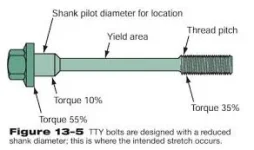
Personally, I would challenge it, and I've yet to see a legitimate source for this. TTY bolts have a necked down region, and the steps from the neck to the full shank are gently tapered so as to avoid stress concentrations. That is not how these bolts are designed. Threads are never an appropriate yield zone--it's a minefield of stress risers. TTY bolt torque specs are more than a value too--it's a value plus some angular displacement (i.e. 50 ft-lbs plus 90 degrees). That angular displacement is where the deformation occurs. They approach yield level with the initial torque value, then execute the yielding process with a known, physical amount of stretch that can be calculated from the thread pitch and the angular displacement. That is the process that shouldn't be repeated. Torquing a bolt to specified value below it's yield threshold can be done repeatedly.
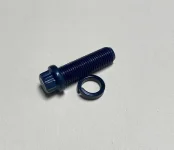
These are what Applied GMC sells:
View attachment 18260
Here's a conventional TTY bolt design we're all used to seeing on modern cylinder head bolts:
View attachment 18261
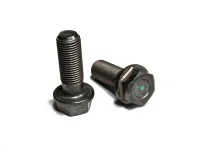
Flywheel/flexplate bolts are some of the shortest TTY bolts in the industry, but they still have a visible yield zone on them. Here are some Nissan flexplate bolts:
View attachment 18262
Where? I'm not seeing it in the X7525 manual. They do have this blurb that says, if it needs replacement the replacement should be equivalent:
View attachment 18263
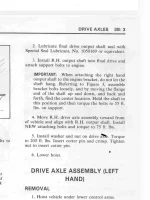
Thanks, I'd missed that bit.
Unfortunately the uj3415 arrived and is only long enough for a single wrap