CV joint ripped boot

boybach

Well-known member
Dec 9, 2020
1,031
192
63
The CV joint boot on the passenger side has torn and is leaking grease ...seems that the joint itself is still ok and well greased, but I will need to replace the boot. Is this a major job? One of my friends mentioned that I might be able to use a aftermarket boot that can be installed in two pieces? Anyone have experience with that type of repair?

thanks for any advice

Larry
 
Whether it's a major job is purely subjective. It's a lot of work, but not all that difficult. The shaft can be removed without taking the suspension apart. You will need to remove the oil filter and possibly the starter and turn the wheel hard in one direction (I don't remember which direction). Use NEW bolts for the flanged end when you re-install it.

If you aren't comfortable with replacing the boot yourself, take it to whoever you use for mechanical repairs and have them do that part for you. Good luck. This won't be the last time you do this.
 
the hard part is getting the axle nut off. you need a GOOD impact wrench for that.
Then the inner CV mounting bolts are 12 point, you need a good socket for them
 
Any input on using a split boot kit without removing the shaft?
 
Last edited:
The split boot option should be avoided. As as professional mechanic, I used one exactly one time. It was a frustrating experience to say the least. You have glue on edges right next to a wad of grease that is packed around the joint. Recipe for disaster. Plus, the boot must be uniformly flexible in all places (as it is turned back and forth) in order to ensure a decent longevity. Split boots end up with two ridges that don't flex the same.
 
  • Like
Reactions: boybach
There's another way...

Bob Drewes' post from years back

"Replace the CV boot with out removing the axle
Jack up the front of the coach, block it, remove wheel (optional), remove the tie rod from the knuckle(optional, but it will give you more room & flexibility), cut the old boot off, with a snap ring pliers, EXPAND snap ring in the outer CV joint and slide axle towards the inner plunge joint, clean as needed, install new boot on axle, slide axle into outer CV joint, snap ring will expand as axle is pushed into CV joint, MAKE SURE SNAP RING IS SEATED, install grease and position CV boot, burp the air out of the boot and clamp it, try to keep the surface for the outer clamp surface as dry as possible. This is about an 1-1/2 hour job per side, good luck. Bob Drewes in SESD"
 
The split boot option should be avoided. As as professional mechanic, I used one exactly one time. It was a frustrating experience to say the least. You have glue on edges right next to a wad of grease that is packed around the joint. Recipe for disaster. Plus, the boot must be uniformly flexible in all places (as it is turned back and forth) in order to ensure a decent longevity. Split boots end up with two ridges that don't flex the same.
I can appreciate the problems with the seam/glue/grease issue, it does seem problematic for sure.

Looking at the it, it does seem difficult to keep everything grease free - if it was going to work, everything would have to be squeaky clean. I thought If I had a go at it, I could slide the boot back along the axle and away from the CV joint/grease then glue it together. After the glue had set up, maybe coating the seam area with a smear of 5200 or "the right stuff" would help add strength to the joint?

Larry
 
There's another way...

Bob Drewes' post from years back

"Replace the CV boot with out removing the axle
Jack up the front of the coach, block it, remove wheel (optional), remove the tie rod from the knuckle(optional, but it will give you more room & flexibility), cut the old boot off, with a snap ring pliers, EXPAND snap ring in the outer CV joint and slide axle towards the inner plunge joint, clean as needed, install new boot on axle, slide axle into outer CV joint, snap ring will expand as axle is pushed into CV joint, MAKE SURE SNAP RING IS SEATED, install grease and position CV boot, burp the air out of the boot and clamp it, try to keep the surface for the outer clamp surface as dry as possible. This is about an 1-1/2 hour job per side, good luck. Bob Drewes in SESD"
Sounds reasonable although knowing nothing about axle assembly terminology am a bit baffled as to what is the "inner plunge joint" and how the axle actually functions/moves back and forth :unsure:

Larry
 
Sounds reasonable although knowing nothing about axle assembly terminology am a bit baffled as to what is the "inner plunge joint" and how the axle actually functions/moves back and forth :unsure:

Larry
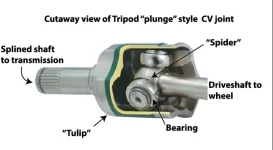
The inner CV outer housing (tulip) is more or less a hollow cylinder with 3 recessed channels (bearing races) on the interior, the inboard end of the axle shaft rides on 3 bearing wheels (spider), and the axle shaft is able to move in and out along the recessed channels allowing the CV axle assembly to adapt to changes from steering angles (left right) and suspension (up down). So the axle can "plunge" deeper into the housing.

1775685178640.webp

Once the outer CV snap ring is unclipped from the axle the axle shaft can be pushed inboard into the bell housing. With the wheel turned, the outer CV disconnected from the axle, and the axle pushed into the bell housing there's just enough room to pull the axle's outer splined end out of the CV. Then it's just inspecting the outer CV, cleaning up the shaft and sliding a new boot on and reassembling.
 
  • Like
Reactions: boybach
The inner CV outer housing (tulip) is more or less a hollow cylinder with 3 recessed channels (bearing races) on the interior, the inboard end of the axle shaft rides on 3 bearing wheels (spider), and the axle shaft is able to move in and out along the recessed channels allowing the CV axle assembly to adapt to changes from steering angles (left right) and suspension (up down). So the axle can "plunge" deeper into the housing.

View attachment 18250

Once the outer CV snap ring is unclipped from the axle the axle shaft can be pushed inboard into the bell housing. With the wheel turned, the outer CV disconnected from the axle, and the axle pushed into the bell housing there's just enough room to pull the axle's outer splined end out of the CV. Then it's just inspecting the outer CV, cleaning up the shaft and sliding a new boot on and reassembling.
Thanks a lot Richard (y)

Larry
 
I did the split boot repair probably seven years ago and maybe ten thousand miles. I remember it being frustrating seven years later, but if you get the rtv and the little screws in the right place, and the grease not in those places but the inside...it has done better than I expected.
 
I did the split boot repair probably seven years ago and maybe ten thousand miles. I remember it being frustrating seven years later, but if you get the rtv and the little screws in the right place, and the grease not in those places but the inside...it has done better than I expected.
AFAIK that split kit (with the small bolts) is discontinued?

Larry
 
There's another way...

Bob Drewes' post from years back

"Replace the CV boot with out removing the axle
Jack up the front of the coach, block it, remove wheel (optional), remove the tie rod from the knuckle(optional, but it will give you more room & flexibility), cut the old boot off, with a snap ring pliers, EXPAND snap ring in the outer CV joint and slide axle towards the inner plunge joint, clean as needed, install new boot on axle, slide axle into outer CV joint, snap ring will expand as axle is pushed into CV joint, MAKE SURE SNAP RING IS SEATED, install grease and position CV boot, burp the air out of the boot and clamp it, try to keep the surface for the outer clamp surface as dry as possible. This is about an 1-1/2 hour job per side, good luck. Bob Drewes in SESD"

This is the way
 
  • Like
Reactions: boybach
This is the way
Have you done this? I removed my axles the last time because I needed to change the inner boots, but if this works I’ll use this process the next time the outers need to be replaced (which is much more frequently than the inners).
 
Any input on using a split boot kit without removing the shaft?
I did that once as I was on the road and needed a way to keep the grease in and wasn't in a position to pull the shaft. The split boot worked fine to get me home. It should NOT be used as the primary method for boot replacement though. It's only held together with a couple of tiny screws and chances are grit and grime will make its way through the split and into the CV joint.
 
  • Like
Reactions: tmsnyder
Have you done this? I removed my axles the last time because I needed to change the inner boots, but if this works I’ll use this process the next time the outers need to be replaced (which is much more frequently than the inners).

No but should have. I pulled the entire axle out and did it on my bench / in my vice.

Also, I reused the inner bolts torqued to Grade 8 number from a standard published table for that size bolt (they are higher grade in reality) with blue LockTite
 
  • Like
Reactions: traveler1980